Ask a SaaS company who owns customer experience and the answer is usually "support", occasionally "everyone", and almost never a name. Both answers are symptoms of the same thing: customer experience is the one outcome every team affects and no team controls.
It is also the outcome most often measured in the wrong place. Companies survey after support tickets and after renewals, the two moments where a human was present, while the hundreds of moments in between happen inside the product, unattended, and get counted only when someone leaves.
This guide defines customer experience precisely, separates it from the three terms it gets confused with, walks the moments that actually decide it in a software business, covers measurement without survey overload, and ends with the seven changes that move it fastest for a team that does not have a CX department.
Key Takeaways
- CX is a perception, not a system. It lives in the customer's head, which is why no single team can own it and every team can damage it.
- In SaaS, the product is most of the experience. Customers spend hours in the interface and minutes with your people.
- UX is a component of CX, the largest one in software, but not the whole thing. Great screens plus a painful implementation is still bad CX.
- Effort predicts churn better than satisfaction. People leave products that are hard long before they leave products they dislike.
- Fix repeating moments, not individual incidents. The first session happens to every customer; a specific escalation happens to one.
- Measure behaviour alongside sentiment. Surveys tell you what people say; time to value and adoption depth tell you what they did.
What Is Customer Experience?
Customer experience (CX): definition
Customer experience is the total impression a customer forms of a company across every interaction they have with it: the marketing that set the expectation, the sales process, the product itself, onboarding, billing, support, and eventually renewal or cancellation. The operative word is impression: customer experience exists in the customer's head, not in any system you own. Two customers on an identical plan can have opposite experiences depending on what they expected, how quickly they got value, and what happened the first time something went wrong.
That definition has an uncomfortable implication. Because CX is an impression formed over time, it is shaped disproportionately by a few high-emotion moments rather than by the average of everything. A customer who spent six easy months with you and one bad week during a migration will describe the relationship by the bad week. Investment in customer experience is therefore not spread evenly: it goes into finding the moments that carry disproportionate weight and making those reliable.
The second implication is specific to software. In a restaurant or a bank branch, most impressions are formed in the presence of an employee. In SaaS, the ratio inverts: a customer might spend two hours a week in your product and twenty minutes a year talking to your company. Whatever the product does while nobody is watching is the customer experience for practical purposes.
CX vs UX vs Customer Service vs Customer Success
These four get used interchangeably in meetings, and the confusion is expensive because it decides who is asked to fix a problem.
Customer experience contains the other three plus everything nobody was assigned. That last box is where most unexplained churn originates.
| Scope | Posture | Typical owner | |
|---|---|---|---|
| Customer experience | The entire relationship | Perception, the result of everything else | Nobody, unless deliberately assigned |
| User experience | The interface and the flows in it | Designed in advance | Product and design |
| Customer success | Whether the customer reaches their outcome | Proactive | CS team |
| Customer service | Individual problems, once raised | Reactive | Support |
The 9 Moments That Decide SaaS Customer Experience
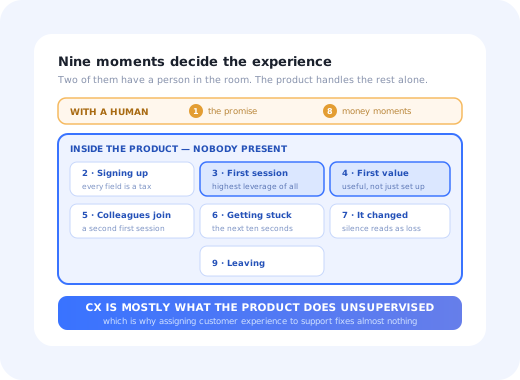
Rather than trying to improve "the experience", it is far more tractable to name the moments that recur for every customer and audit each one. These nine cover most software businesses. Note how many of them happen with nobody from your company present.
-
1. The promise
Marketing and the pricing page set an expectation. Almost every "bad experience" later in the relationship is really a gap between this moment and reality, which is why clarity here, including on the pricing page, is a CX investment rather than a marketing one.
-
2. Signing up
The first thing your product actually asks of someone. Every unnecessary field here is a small tax paid before any value has been delivered; see signup flow best practices.
-
3. The first session
The highest-leverage moment in the entire relationship, because it is where the expectation set in moment one either survives or dies. It is also the moment most companies leave to an empty dashboard.
-
4. First real value
The point where the product does something genuinely useful rather than merely being set up. Shortening the gap to this moment moves nearly every downstream number; the mechanics are in time to value.
-
5. Bringing in colleagues
The moment a single user becomes an account. It is also a second first-session, for people who never read the marketing and arrive with no context at all.
-
6. The first time they are stuck
What happens in the ten seconds after confusion decides more than the eventual resolution does. Help that lives beside the problem beats a help centre in another tab; see contextual help.
-
7. The product changes
A redesign or a moved feature is experienced as loss unless it is explained. Silent change is one of the fastest ways to convert a satisfied user into a frustrated one, as covered in rolling out a product redesign.
-
8. Money moments
Invoices, plan limits, upgrades, seat changes. Nothing damages goodwill faster than a surprise, and nothing is more often designed by whoever had capacity that sprint.
-
9. Leaving
The cancellation flow is the last impression and the one most likely to be shared publicly. A dignified exit (clear, quick, with data export) buys back more than a retention dark pattern ever will, and an exit survey turns it into information.
Count the moments with a human in them. In most SaaS businesses it is one or two out of nine. That ratio is the whole argument for treating in-product experience as the centre of CX rather than as a design detail.
How to Measure Customer Experience
The measurement trap is running one survey everywhere until people stop answering. Use a small set of complementary instruments, each in the place it is actually informative, and pair all of them with behaviour.
| Measure | Question it answers | Where to use it |
|---|---|---|
| Net Promoter Score | How is the relationship trending overall? | Periodically, at account level, never after a support ticket |
| CSAT | Did this specific interaction land well? | Immediately after one defined moment |
| Customer Effort Score | How hard was that to do? | After tasks, the strongest early churn signal of the three |
| Time to first value | How long before the product was actually useful? | Continuously, from behavioural data |
| Adoption depth | Are they using what they paid for? | Continuously, see feature adoption |
| Support contacts per account | How often does the product fail to explain itself? | Continuously, segmented by screen or workflow |
Two rules keep this honest. First, effort beats satisfaction as a predictor: people abandon products that are hard long before they abandon products they merely dislike. Second, ask less often than you want to: response rates collapse under repetition, and the customers who stop answering first are usually the ones drifting away. The failure mode is documented in survey fatigue.
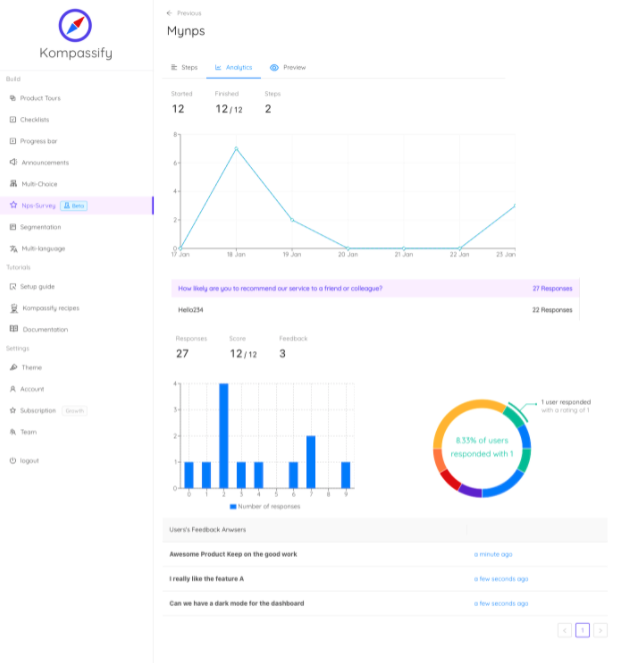
Sentiment is one input. On its own it tells you the temperature without telling you which moment caused it.
How to Improve Customer Experience: 7 Changes
Ordered by return for a team without a dedicated CX function. Each one improves a moment that repeats for every customer, which is what makes them worth more than fixing individual incidents.
1. Make the first session end in an outcome
Not a tour of the navigation, an actual result the person came for. A guided path with three or four concrete steps, ideally producing something they can look at. This single change moves activation, support volume and sentiment simultaneously, which is rare. The mechanics are in how to increase user activation.
2. Close the gap between the promise and the product
Walk your own marketing site, then your own signup, in one sitting. Every place where the product is harder or narrower than the promise is a CX debt you will pay in support tickets and churn interviews. Fix the promise or fix the product; leaving the gap open is the expensive option.
3. Put help where confusion happens
A help centre is a destination; confusion is a location. A tooltip on the field nobody understands, a short guide on the screen where people abandon, an answer next to the thing it explains: these resolve problems before they become tickets. Structural guidance is in in-app support.
4. Explain every change that alters how someone works
Not every release, but every change to a workflow people rely on. An unannounced move of a familiar button generates a specific kind of resentment that no amount of overall product quality offsets. The channel choice matters as much as the message; see announcing a new feature.
5. Design the second first-session
The colleague invited in month three arrives with none of the context the original buyer had, and usually lands in an account already full of data. Role-based onboarding for invited users is one of the most consistently neglected moments in B2B software; personalized onboarding covers how to branch it without building three products.
6. Reduce effort before adding delight
Teams reach for celebration animations while a core workflow still takes nine clicks. Find the friction first: the repeated task, the confusing field, the step that fails silently. Our user friction guide has the four types and how to find them.
7. Give the whole journey one owner
Not to do all the work, but to hold the map and notice that moment eight has no owner at all. Every company already has someone informally doing this. Making it explicit is usually the difference between a CX programme and a survey.
The In-Product Half Nobody Staffs
Most of the moments above happen inside the product, and most companies have no mechanism for changing them quickly. The design is fixed in the codebase, the help is in another system, and the explanation of what changed goes out by email, if at all. So the parts of the experience that repeat for every customer are the parts that take a release to improve, and they queue behind features.
Kompassify exists for that layer. Onboarding checklists and product tours that make the first session end in an outcome, contextual tooltips and hotspots that put help where confusion happens, in-app announcements that explain changes to the people affected, and NPS or CSAT surveys asked at the moment that matters rather than at the moment that is convenient, all built without engineering time, and all measured individually so you can tell which moment actually improved.
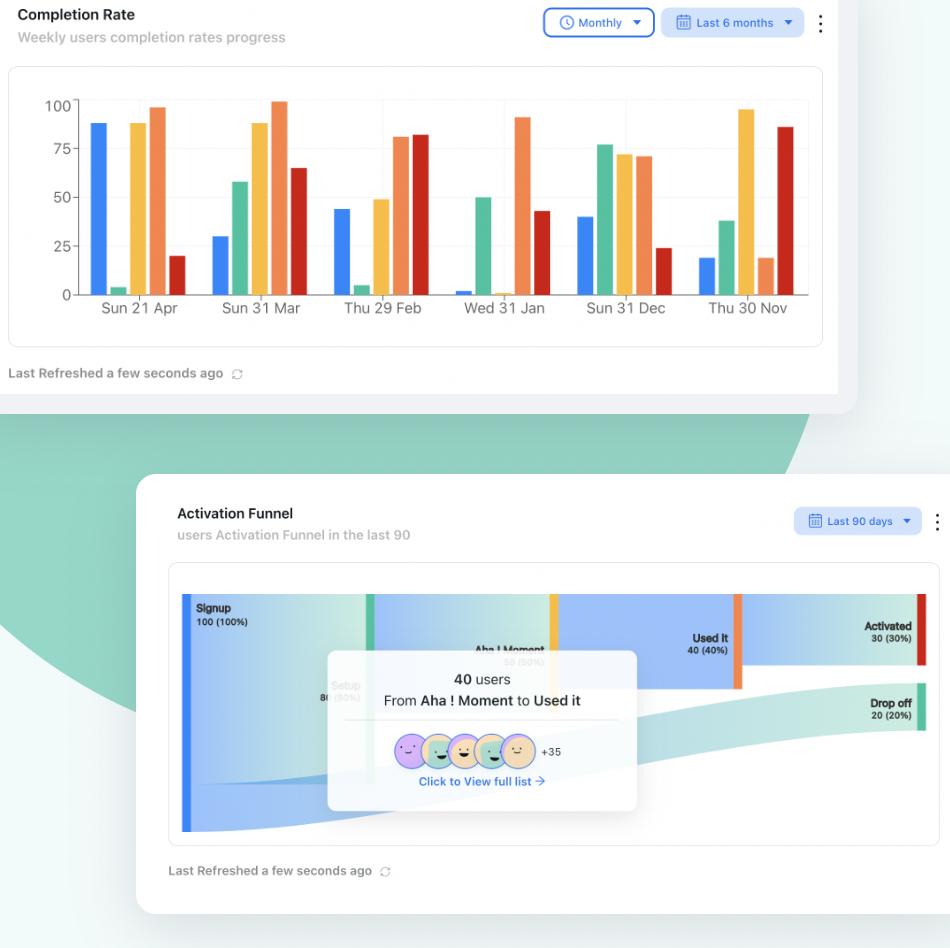
Moment three, designed on purpose. The first session is the only moment every single customer experiences identically, which makes it the cheapest one to improve.
Customer Experience: Do vs. Don't
Do
- Name the recurring moments and give each one an owner
- Measure effort, not just satisfaction
- Pair every survey with behavioural evidence
- Treat the first session as a product surface, not a nicety
- Explain changes to the people whose workflow they alter
- Make leaving dignified: it is the most shared moment
Don't
- Assign customer experience to support and call it done
- Survey after every interaction until nobody answers
- Assume an engaged buyer means a happy user base
- Add delight to a workflow that still takes nine clicks
- Change familiar things silently
- Judge CX from the accounts that have a CSM
Improve the moments that happen to every customer
Kompassify lets product, onboarding and customer-success teams build guided first sessions, contextual help, in-app announcements and surveys, no engineering ticket, with adoption data on each one. Free up to 100 monthly active users, plans from $129/month, GDPR-compliant and EU-hosted.
Start for free →The One-Sentence Version
Customer experience is the impression left by every moment of the relationship, and in SaaS, since nearly all of those moments happen inside the product with nobody present, improving CX mostly means improving what the product does when it is on its own.
Frequently Asked Questions
What is customer experience?
Customer experience, often shortened to CX, is the total impression a customer forms of a company across every interaction they have with it: marketing, sales, the product itself, billing, support and eventually renewal or cancellation. The important word is impression: customer experience lives in the customer's head rather than in any system you own. That is why it cannot be assigned to a single team. Two customers using an identical product can have completely different experiences depending on what they expected, how quickly they got value, and what happened the first time something went wrong.
What is the difference between CX and UX?
User experience is how it feels to use the interface: whether the screen is clear, whether the flow makes sense, whether the button was where you expected. Customer experience is how it feels to be a customer of the company, of which the interface is only one part. A product can have excellent UX and poor CX: beautiful screens paired with a three-week implementation, a confusing invoice and a support queue that never closes the loop. UX is a component of CX, and in SaaS it is the largest single component, because the product is where customers spend nearly all of their time with you.
What is the difference between customer experience, customer service and customer success?
Customer service is reactive and episodic: someone has a problem and you resolve it. Customer success is proactive and outcome-driven: you make sure the customer reaches the result they bought the product for, whether or not they ask. Customer experience is the perception that results from all of it, including the parts neither team touches: pricing pages, onboarding emails, the invoice, the cancellation flow. Service and success are functions you can staff; experience is an outcome those functions contribute to alongside product, marketing and finance.
How do you measure customer experience in SaaS?
Use a small set of complementary measures rather than one score. A relationship measure such as Net Promoter Score tracks overall sentiment over time. A transactional measure such as CSAT tells you whether a specific interaction landed. An effort measure such as Customer Effort Score predicts churn better than satisfaction does, because difficulty drives people away faster than dissatisfaction. Pair those with behavioural evidence: time to first value, adoption depth, support contacts per account, because behaviour tells you what people do, while surveys only tell you what they say.
Who owns customer experience in a SaaS company?
No single team owns it, which is precisely the problem. Marketing sets the expectation, sales confirms it, product either delivers on it or does not, support handles the gap, and finance quietly damages it with the invoice. Companies that improve CX usually do two things: they make one person accountable for the map of the whole journey, and they give each team a specific moment they own outright. Assigning customer experience to support alone is the most common failure, because support only sees the moments that already went wrong.
How can you improve customer experience without a large team?
Fix the moments that repeat. In SaaS, the same handful of moments happens to every customer: the first session, the first time they invite a colleague, the first time something breaks, the first time they see an unfamiliar screen. Improving one of those improves the experience for everyone at once, whereas improving a one-off interaction helps a single account. The cheapest high-return moves are usually a guided first session that reaches a real outcome, contextual help placed where confusion happens rather than in a separate help centre, and telling users what changed when the product changes.