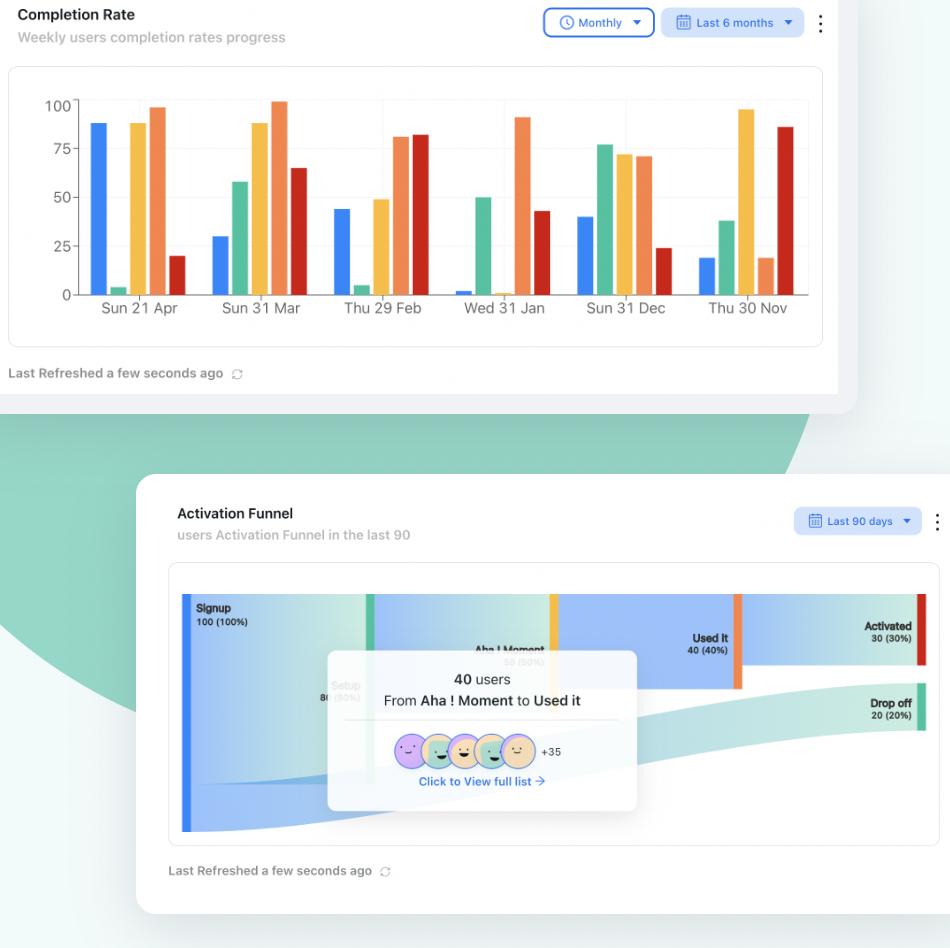
Every new sign-up arrives with an invisible timer over their head. It starts the moment they create an account, and it ticks down toward the moment they quietly decide your product isn't worth the effort. Your product's job is to deliver a first real win, the moment the user feels the value they were promised, before that timer runs out. The gap between those two moments has a name: time to value.
Most products lose this race without noticing. Roughly 70% of new SaaS users stop using a product within three months, and the steepest part of that cliff is the first few sessions, which means most churned users never actually experienced the product at all. They churned from the setup, not from the product. That is why time to value has become one of the most-watched metrics in SaaS onboarding: it measures precisely the stretch of the journey where you lose the most users, and it is one of the few metrics a product team can move within weeks.
This guide covers the whole subject: what time to value (TTV) means, the types of TTV worth telling apart, why it quietly drives trial conversion, churn, and payback, how to measure it without fooling yourself, and nine concrete ways to reduce it, most of which are user onboarding work, not engineering work.
Key Takeaways
- Time to value (TTV) is the time from signup to the user's first real win, the moment they experience your product's core value, not the moment setup finishes.
- TTV is the clock on the aha moment. The aha moment is the experience, activation is the state, TTV is how long it takes: one milestone, three angles.
- Long TTV is invisible churn. Users who leave before reaching value never complain, never file a ticket, and never come back; they just stop showing up.
- Measure the median, not the mean, from account creation to a specific instrumented value event, and segment by persona, because different users have different value moments.
- A good TTV is shorter than your users' patience: first session for self-serve products, days (not weeks) for products with real setup, and always far shorter than the trial.
- Most TTV fixes are guidance, not features: a shorter path to the first win, a persona-aware welcome flow, a tour to the quick win, a checklist that keeps momentum.
What Is Time to Value? (TTV Meaning & Definition)
Time to value (TTV) is the time it takes a new user to go from signing up to experiencing your product's core value for the first time. Not the time to finish onboarding. Not the time to complete setup. The time to the first moment the user could honestly say "okay, this is what I came for." For an email tool, that's a first campaign sent. For an analytics product, a first insight on a real dashboard. For a support platform, a first ticket resolved faster than before.
Time to value, defined. TTV is the elapsed time between account creation and the user's first value moment, the specific in-product event where the promised benefit actually lands. It is measured per user and reported as a median across a cohort. The distinction matters: setup completed is your milestone; value experienced is theirs. Users don't churn because setup is unfinished; they churn because value hasn't arrived yet, and setup is merely the thing standing in front of it.
TTV runs from sign-up to the first value moment, not to the end of setup. Everything between login and first value is the danger zone: the user is doing work and receiving nothing yet.
Time to value, the aha moment, and user activation are three views of the same milestone. The aha moment is the experience, the instant value clicks. Activation is the state, a user who has done the things retained users do. TTV is the clock, how long the journey to that milestone takes. Teams need all three: the aha moment tells you what to aim users at, activation tells you how many arrive, and TTV tells you how fast. Slow arrival is almost as lethal as no arrival, because patience runs out before value arrives.
The Types of Time to Value (And Which One to Optimize First)
"Value" isn't one event; a user's first small win, their first real workflow, and the moment your product exceeds expectations are different milestones on different timescales. The useful TTV vocabulary:
| Type | The clock stops when… | Typical timescale | What it drives |
|---|---|---|---|
| Time to first value (TTFV) | The user gets any real win, however small: the quick win | Minutes to the first session | Second sessions; whether the trial continues at all |
| Time to basic value | The user gets the core everyday benefit they signed up for | Days | Trial-to-paid conversion, activation |
| Time to exceeded value | The product delivers more than the user expected | Weeks | Expansion, advocacy, long-term retention |
| Immediate vs. delayed TTV | A property of your product: can value land in-session, or does it inherently need data, integrations, or teammates first? | Which onboarding strategy you need (guide vs. bridge the wait) |
Optimize them in order. TTFV first: a user who gets a small win in session one grants you the patience for the bigger setup, which is why good onboarding manufactures a quick win early (a sample report, a template pre-filled, a first tour completed) instead of front-loading configuration. Basic value second: this is the milestone that converts trials. Exceeded value third: it compounds retention but can't be rushed. Products with inherently delayed value (you genuinely need a week of data before dashboards mean anything) don't get to skip the race; they bridge it, with sample data, progress feedback, and a visible countdown to the real payoff.
Why Time to Value Matters: The Metric Behind Your Other Metrics
TTV earns its reputation because it sits upstream of nearly every number a SaaS team reports on:
-
Trial conversion is a race against the clock
A trial converts when value is experienced inside it. If your median TTV is twelve days on a fourteen-day trial, most users decide before value ever arrives; they aren't rejecting your product, they're rejecting the wait.
-
Long TTV is invisible churn
Users who quit before reaching value don't file tickets or answer surveys; they just stop logging in. By the time they show up in your churn numbers, they've been gone for weeks. TTV is the leading indicator; churn is the lagging autopsy.
-
Slow value delays payback
Every day between signup and value is a day of customer acquisition cost sitting unrecovered. Shrinking TTV moves revenue earlier for every single cohort; the same marketing spend simply pays back faster.
-
Fast value starts the retention flywheel
Users who reach value quickly come back, build habits, and discover more features; users who reach it slowly arrive with depleted goodwill even when they do arrive. The retention curve is largely shaped in the TTV window.
Trial conversion is mostly a question of who is still present when value arrives. Shrinking TTV means delivering the proof while the audience is still in the room.
How to Measure Time to Value (Formula Included)
TTV measurement is simple to describe and easy to fumble. The honest version has four parts:
1. Define the value moment: from evidence, not opinion
Pick the specific in-product event where the promised benefit actually lands, and derive it from behavior: what did users who stuck around do in their first days that churned users didn't? That analysis is exactly the hunt for the aha moment. Beware the convenient choice: "completed onboarding" is easy to track and wrong to use, because it measures your funnel, not their win.
2. Instrument both ends of the clock
You need two timestamps per user: account creation and the value event. If the value event isn't tracked yet, that's the first fix: you cannot improve a clock you haven't built. Event tracking in a product analytics tool covers this without custom infrastructure.
3. Report the median, per signup cohort
Averages lie here. A handful of users who take three months would drag a mean into meaninglessness while your typical user reaches value in a day. Use the median (and look at the 75th percentile to see the struggling half), computed per weekly or monthly signup cohort so changes in onboarding show up as changes in the number.
4. Segment: different users buy different value
A solo founder and an enterprise admin sign up for different reasons, so they have different value moments and different clocks. Segment TTV by persona, acquisition channel, and plan. A blended TTV can look healthy while one key segment, often the one sales cares most about, quietly takes weeks.
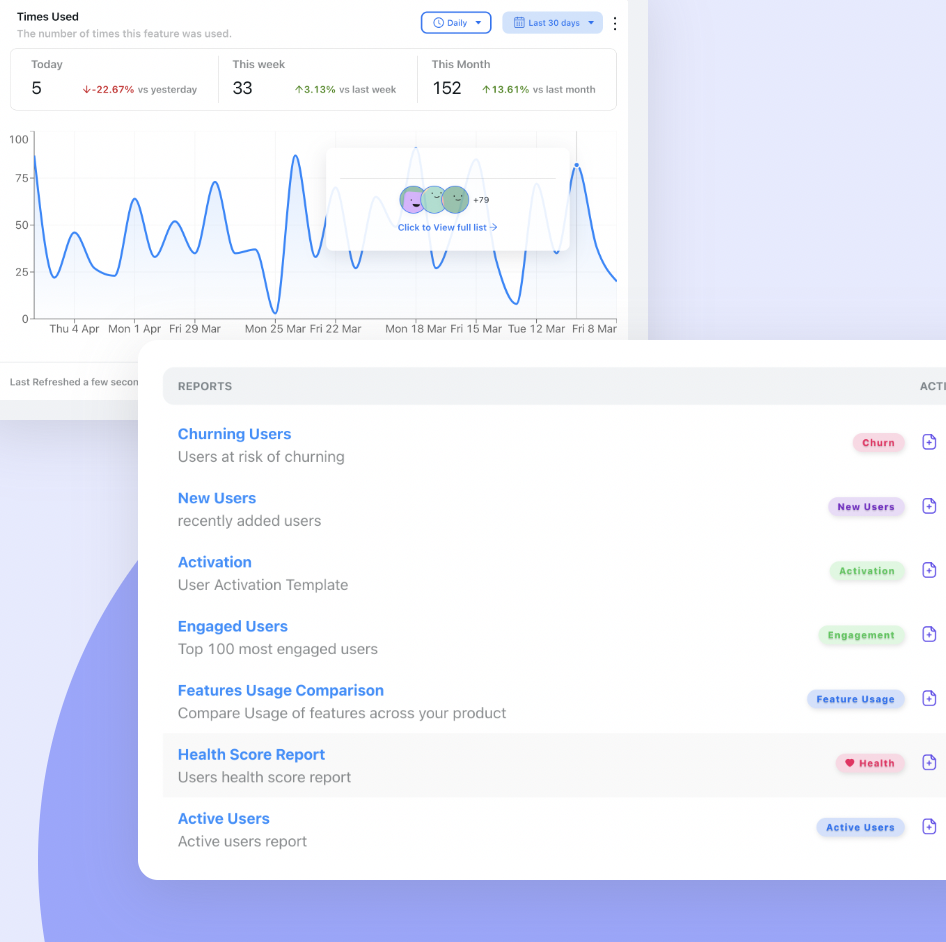
Computed per user, reported as the cohort median. Track it weekly: the trend line matters more than the absolute number.
What is a "good" TTV? Shorter than your users' patience, and shrinking. There is no universal benchmark (a note-taking app can deliver value in three minutes, a data warehouse genuinely cannot) so comparing your TTV to another product's is mostly noise. The two comparisons that matter: TTV vs. your trial length (value must land well inside the trial, not at its edge), and TTV vs. last quarter (the direction of the trend is the report card for your onboarding work).
How to Reduce Time to Value: 9 Ways That Work
Here's the encouraging part: most long TTVs are not caused by missing features. They're caused by new users not knowing the fastest path to value, and path problems can be fixed with guidance, this week, without an engineering sprint.
1. Map the shortest possible path to first value
Write down every action between signup and the value moment, then delete ruthlessly. Every field, permission, and decision that can wait until after the first win should wait. The question for each step is not "is this useful?" but "is this worth delaying value for?", and the answer is almost always no.
2. Ask one question, then personalize the route
Different personas have different value moments, so a single onboarding path is guaranteed to be a detour for someone. A one-question multi-choice welcome flow, "what are you here to do?", lets you route each user down their own shortest path instead of the average one.
3. Walk users to the quick win with a product tour
Not a tour of the interface, a tour to the first win. A focused product tour of three to five steps that ends with the user having actually done the valuable thing (sent the message, built the report, published the page) converts TTV from "however long exploration takes" into a guided few minutes.
4. Keep momentum with a checklist and progress bar
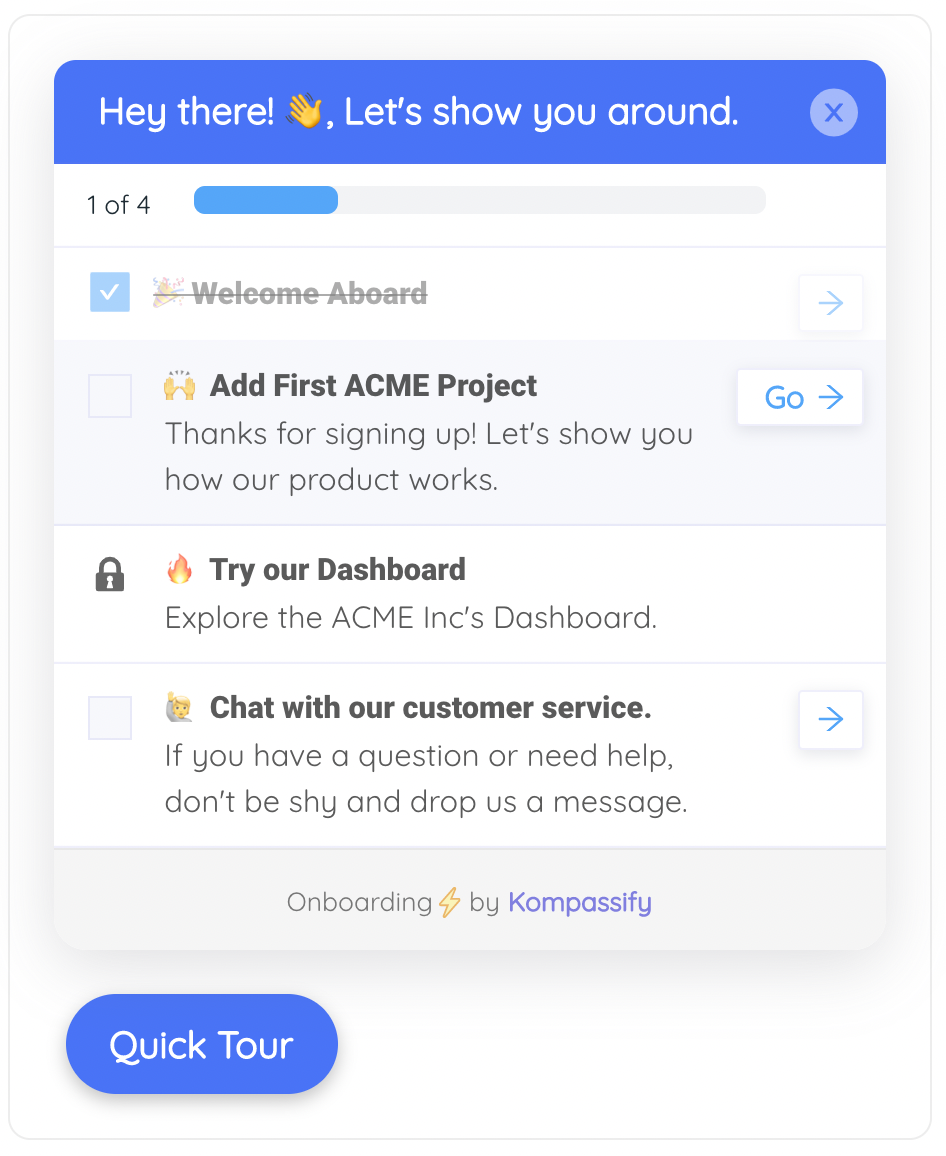
When reaching value takes more than one session, users need to see the finish line. An onboarding checklist with a progress bar turns the remaining distance into a visible, shrinking quantity: the checklist supplies the next step toward value, the bar supplies the pull to take it.
5. Unblock the stall points with contextual tooltips
Your analytics will show one or two steps where the clock burns most of its minutes: a confusing form, an unclear integration screen. A well-placed onboarding tooltip at exactly that element answers the question at the moment it's asked, instead of hoping the user finds the docs before they find the exit.
6. Start with templates and sample data, not a blank page
An empty workspace makes the user manufacture their own first value from scratch. Templates, sample projects, and demo data let them experience the value first and personalize afterwards: the product proves itself before it asks for work.
7. Bridge unavoidable waits visibly
If your product truly needs days of data or a teammate's approval before real value lands, don't leave a silent gap. Show what's accruing ("collecting data, first insights tomorrow"), deliver a partial preview, and announce the payoff the moment it's ready with an in-app announcement. A visible countdown keeps patience alive; silence kills it.
8. Celebrate the value moment when it happens
Value that isn't noticed doesn't count. When the user crosses the milestone, say so: a small celebration, a "here's what you just did" recap, and the natural next step. Marking the moment turns a technical event into a felt win, and a felt win is what the user remembers when the renewal email arrives.
9. Measure, find the biggest stall, fix it, repeat
TTV work is a loop, not a launch. Each cohort's median TTV and step drop-off point at the current worst bottleneck; fix that one, watch the next cohort, and take the new worst. Teams that run this loop quarterly find their TTV falls release after release without any single heroic change.
Every guidance pattern above (the welcome flow, the persona routing, the tour to the first win, the checklist with its progress bar, the contextual tooltips, the celebration) can be built in Kompassify without writing code: build in the visual editor, target by segment, ship with one script snippet, and watch the effect on completion and activation in the built-in analytics. It's GDPR compliant, EU-hosted, and free for under 100 monthly active users.
Time to Value Best Practices: Do vs. Don't
The teams that consistently shrink TTV share a handful of habits, and avoid a matching set of traps:
✅ Do
- Define the value moment from retained-user behavior
- Measure median TTV per cohort, segmented by persona
- Deliver a quick win in the first session, even a small one
- Route different personas down different shortest paths
- Guide to the first win; let exploration come after
- Use templates and sample data to show value before asking for work
- Make unavoidable waits visible and finite
- Re-measure after every onboarding change
❌ Don't
- Equate "completed onboarding" with "received value"
- Report mean TTV: outliers will flatter or panic you
- Front-load every setting before showing any value
- Force one onboarding path on every persona
- Tour the interface instead of touring to the win
- Greet new users with a blank workspace
- Leave silent gaps where value is "coming eventually"
- Celebrate shipping the flow instead of moving the number
One comparison makes the stakes concrete. Here is the same 14-day trial, as experienced by a guided user and an unguided one:
TTV and the Metrics It Moves
Because TTV sits at the start of the journey, improving it ripples through the whole funnel, which is also how you should justify the work:
- Activation rate rises first: more users reaching value means more users completing the actions that define activation. If TTV falls and activation doesn't move, your value moment is defined wrong.
- Trial-to-paid conversion follows: value experienced early in the trial leaves time for the habit, and the business case, to form before the decision point.
- Retention and churn respond next: cohorts that reached value quickly flatten out higher on the retention curve, because the habit started from a win instead of a grind.
- CAC payback improves silently: the same acquisition cost, recovered sooner, in every cohort, forever.
This is why TTV makes such a good north-ish star for onboarding teams: it's a single, fast-moving number whose improvements are mechanically connected to the slow-moving numbers the business actually cares about.
Ready to Shrink Your Time to Value?
Kompassify lets you build the guided path to first value (welcome flows, product tours, onboarding checklists with progress bars, tooltips, and announcements) with no code and no engineering sprint. Ship it with one script snippet and watch activation respond in built-in analytics. GDPR compliant, EU-hosted, and free for under 100 monthly active users.
Start for Free →Frequently Asked Questions
What is time to value (TTV)?
Time to value (TTV) is the time it takes a new user to go from signing up to experiencing your product's core value for the first time, their first real win, often called the aha moment. It is measured from account creation to a concrete value event (a first report generated, a first message sent, a first project shipped), not to the end of setup. The shorter the TTV, the more of your sign-ups survive long enough to become activated, paying, retained customers.
How do you measure time to value?
Four steps. First, define the value moment: the specific in-product event where users genuinely receive value, derived from what your retained users did early. Second, instrument both timestamps: account creation and the value event. Third, compute TTV per user as the difference, and report the median (not the mean: a few users who take months would drag the average into meaninglessness). Fourth, segment by acquisition channel, persona, and plan, and track the median per weekly signup cohort so improvements and regressions show up quickly.
What is a good time to value?
Shorter than your users' patience, which is usually the first session for a self-serve product, and days (not weeks) for a B2B product with real setup. There is no universal benchmark, because value moments differ wildly between products: a note-taking app can deliver value in minutes, while a data warehouse genuinely needs integration work. The practical rule: your TTV should be dramatically shorter than your trial length, and it should shrink release over release. If most trial users reach the value moment only near the end of the trial, or never, TTV is your biggest growth problem.
What is the difference between time to value and time to first value?
Time to first value (TTFV) is the strictest version of TTV: the time to the very first moment of any real value, however small, the quick win. Broader TTV variants sit behind it: time to basic value (the user gets the core everyday benefit they signed up for) and time to exceeded value (the product delivers more than the user expected, which is where expansion and advocacy start). Healthy onboarding chains them: a fast first value in session one, basic value within days, exceeded value over the first weeks.
How is time to value related to the aha moment and activation?
They describe the same milestone from three angles. The aha moment is the experience, the instant the user feels the product's value. Activation is the state, a user who has completed the actions that correlate with sticking around. Time to value is the clock, how long it takes to get there. You reduce churn by making more users reach activation, and you make more users reach activation by shrinking the time to the aha moment: TTV is the speedometer for the whole effort.
Why does time to value matter so much in SaaS?
Because users decide whether your product is worth their time long before your product has shown them. Roughly 70% of new SaaS users stop using a product within three months, and the steepest drop-off happens in the first sessions, before slow products ever deliver value. A short TTV moves every downstream number at once: more trial users convert because they experienced value inside the trial, churn falls because activated users stay, and customer acquisition cost pays back faster because revenue starts sooner.
How do you reduce time to value without engineering time?
Most TTV killers are guidance problems, not product problems, and guidance can ship without code. With a no-code platform like Kompassify you can add a welcome flow that routes each persona to their fastest path to value, a product tour that walks new users straight to the first win, an onboarding checklist with a progress bar that keeps them moving, and contextual tooltips that unblock the steps where users stall. It launches with a single script snippet, is GDPR compliant and EU-hosted, free for under 100 monthly active users, with paid plans from $129/month.