You are getting sign-ups. Traffic is growing. The dashboard shows new accounts every day. But when you look at what happens after sign-up, the picture changes fast. Most users create an account, poke around for a few minutes, and never come back.
The average SaaS activation rate sits at roughly 37.5%, according to 2025 benchmark data. That means almost two-thirds of your new users never experience the core value your product was built to deliver. They leave before the product gets a chance to prove itself.
Meanwhile, research from Hostinger shows that nearly 70% of new SaaS users stop using software within three months. And only 49% of SaaS users are even "active," meaning they logged in within the past 30 days (Cloudnuro, 2025).
The problem is rarely the product. It is the gap between signing up and reaching the moment where the product clicks. That gap is where activation lives, and closing it is the single highest-leverage thing a SaaS team can do for growth.
Key Takeaways
- Activation is when value lands. It is the moment a user goes from "I signed up" to "I see why this matters." Everything before it is friction. Everything after it is retention.
- A 25% increase in activation rate can drive a 34% increase in MRR. Of all the pirate metrics (AARRR), activation has the largest downstream impact on revenue.
- The average SaaS activation rate is 37.5%. Most products lose the majority of new users before they ever experience value. The benchmark varies wildly by industry, from 5% in FinTech to 55% in AI tools.
- Time to value is the metric that matters most. The faster you get a user to their first meaningful outcome, the more likely they are to stay. Aim for activation within 1–7 days of sign-up.
- Onboarding is the activation lever. Product tours, checklists, and contextual guidance are how you close the gap between sign-up and value. Not emails. Not documentation. In-app, in context, at the right moment.
- Activation is not a one-time event. Every new feature you ship creates a new activation challenge. Users need to discover it, try it, and experience its value, or it becomes a ghost feature.
What Is User Activation?
User activation is the moment a new user experiences the core value of your product for the first time. It is the point in the user journey where someone goes from "I just signed up" to "I see what this product can do for me."
In the AARRR pirate metrics framework (Acquisition → Activation → Retention → Referral → Revenue), activation sits right after acquisition. It is the bridge between getting users through the door and keeping them there.
The activation event is different for every product. For a project management tool, it might be creating a first project and inviting a teammate. For a CRM, it might be importing contacts and logging a first deal. For an analytics platform, it might be connecting a data source and viewing the first report.
What matters is that the activation event represents a genuine value moment, not just a completed step. A user who fills out their profile has completed onboarding. A user who sends their first campaign and sees open rates has been activated. The difference is whether the user has done busywork or experienced an outcome.
Activation ≠ sign-up. Creating an account is acquisition. Activation is what happens after, the moment the product proves its value. If you are treating "account created" as your activation event, you are measuring the wrong thing.
The Aha Moment
You will often hear activation described as the "Aha moment." That is the instant where the user mentally connects the product to their problem. The data shows up in a chart they understand. The workflow saves them 30 minutes. The integration pulls in data they would have spent an hour collecting manually.
Research shows that only a small fraction of a product's features drive the vast majority of daily usage. That means for most products, the Aha moment comes from a tiny fraction of what you have built. Your job is to identify those high-value features and make the path to them as short and frictionless as possible.
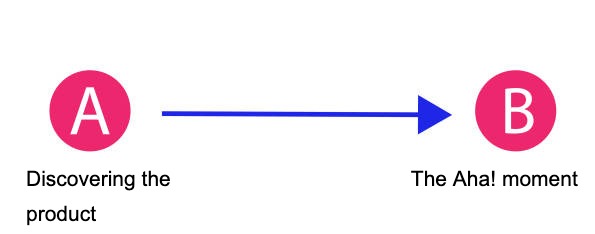
The Aha moment, when a user stops being a sign-up and starts experiencing real value from your product.
Why User Activation Matters
Activation is the metric with the largest impact on SaaS revenue. Not acquisition. Not even retention, because retention is impossible without activation first.
Here is why it matters so much.
- It drives revenue directly. A 25% improvement in activation rate can translate to a 34% increase in MRR over 12 months (Industry Reports). No other single metric moves revenue that much.
- It makes acquisition profitable. Acquiring a new customer costs 5 to 25 times more than retaining an existing one (Harvard Business Review). If you spend that much to get a user through the door and they never activate, the money is gone.
- It determines retention. Research by Bain & Company shows that increasing customer retention by just 5% can boost profits by 25% to 95%. Users who activate early are far more likely to stay and expand. Users who never activate churn, often silently, before you even know they existed.
- It validates product-market fit. A high activation rate tells you that your product is solving a real problem for the right audience. A low activation rate, even with high sign-up volume, is a signal that either the product, the audience, or the onboarding needs to change.
- It reduces support load. Users who reach their Aha moment quickly understand how the product works. According to Custify, 97% of companies consider good onboarding essential for product growth, and poor onboarding is the third most common cause of churn, right behind wrong product fit and lack of engagement.
The cost of low activation is invisible. Most SaaS teams obsess over acquisition, ad spend, SEO, sign-up form conversion. But if two-thirds of those hard-won sign-ups never activate, you are not solving a growth problem. You are filling a bucket with a hole in it. According to Cloudnuro, 51% of SaaS licenses purchased by enterprises go unused, the highest waste rate ever recorded. And research shows that only a small fraction of features in a typical product drive the majority of daily usage. The rest are effectively invisible.
How to Measure User Activation
You cannot improve activation if you do not measure it. And measuring it starts with defining your activation event, the specific action (or set of actions) that signals a user has experienced real value.
Step 1: Define your activation event
Look at your most successful long-term users, the ones who stayed, upgraded, and expanded. What did they do in their first few sessions that your churned users did not? That pattern is your activation event.
Good activation events are specific, measurable, and tied to a real outcome. "Completed onboarding" is too vague. "Created first project and invited at least one teammate within 7 days" is actionable.
Step 2: Track these metrics
| Metric | What It Measures | Why It Matters |
|---|---|---|
| Activation Rate | Percentage of new users who complete the activation event within a defined period | Your headline number. The average SaaS activation rate is ~37.5%. If yours is below that, you have a clear opportunity |
| Time to Activation (TTV) | How long it takes a new user to reach the activation event after sign-up | The shorter the time to value, the higher your retention. Target 1–7 days for product-led SaaS |
| Activation Funnel Drop-off | Where users abandon the journey between sign-up and activation | Pinpoints the exact step where friction kills momentum. Fix the biggest drop-off first |
| DAU/MAU Ratio | Daily active users divided by monthly active users | Measures stickiness. A high ratio means activated users are coming back regularly, which confirms your activation event is meaningful |
| Feature Adoption Rate | Percentage of activated users who use a specific feature | Tells you whether users are discovering and engaging with the features that deliver the most value |
| Trial-to-Paid Conversion | Percentage of free trial users who convert to a paid plan | The ultimate downstream indicator. Activated users convert at dramatically higher rates than non-activated users |
Step 3: Build an activation funnel
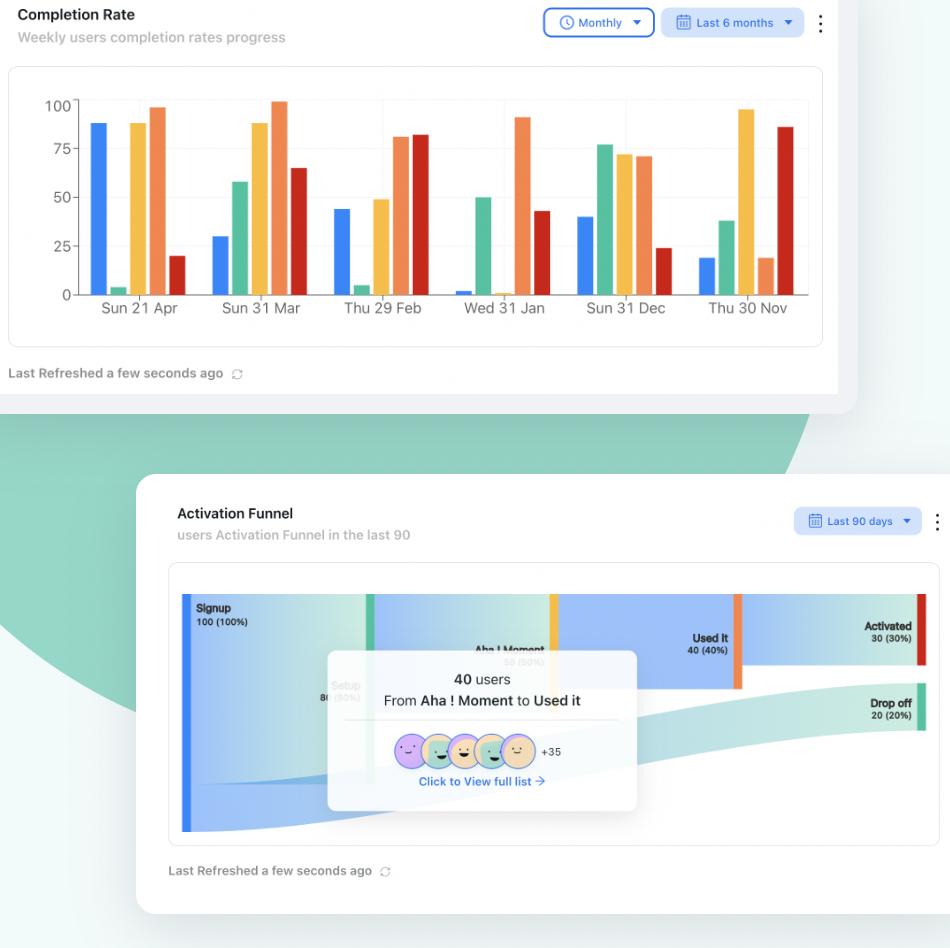
Think of activation as a funnel with clear stages: Sign-up → Setup (complete profile, connect integrations) → First action (create first project, send first message) → Activation (experience the value moment).
The activation funnel: every stage between sign-up and the value moment leaks users; map it to find and fix the leak that matters most.
Each stage leaks users. If sign-up to setup has a 60% drop-off, your onboarding flow is asking for too much too soon. If setup to first action has a 40% drop-off, users are getting stuck on "what to do next." Mapping the funnel lets you find and fix the leak that matters most.
Formula: Activation Rate = (Users who completed the activation event / Total new sign-ups) × 100. For example, if 200 users signed up this month and 60 completed the activation event, your activation rate is 30%.
User Activation Rate Benchmarks (2025–2026)
Benchmarks are useful as a sanity check, not as a target. Your activation rate depends on your product, your audience, and how you define your activation event. That said, here is where the industry stands based on data from the 2025 Product Metrics Benchmark Report.
| Segment | Average Activation Rate | Notes |
|---|---|---|
| Overall SaaS Average | 37.5% (median ~30%) | Based on 2025 benchmark data across SaaS and AI tools |
| Product-Led Companies | 34.6% | PLG users often have lower motivation to activate compared to users who went through a sales process |
| Sales-Led Companies | 41.6% | Annual contracts and upfront payment create stronger activation incentives |
| AI & Machine Learning | 54.8% | Highest in the industry: fast time to value is baked into the product |
| CRM | 42.6% | Activation typically requires importing contacts and completing a first workflow |
| FinTech & Insurance | 5.0% | Lowest in the industry: regulatory friction and complex KYC flows slow activation dramatically |
The range is enormous, from 5% to 55%. The gap between industries reflects differences in product complexity, regulatory requirements, and how quickly the product can deliver a first meaningful outcome.
Rather than chasing an industry number, define your own activation event, measure your current rate, and focus on improving it month over month.
Average activation rates by segment: an enormous 5%–55% spread, driven by product complexity and how fast each product delivers a first outcome.
How to Increase User Activation
Every point of improvement in your activation rate compounds into more retention, more revenue, and more efficient growth. Here are the strategies that move the needle.
1. Shorten the path to the first value moment
Every extra step between sign-up and value is a chance for the user to leave. According to SundaySky's research, 44% of subscription cancellations happen within the first 90 days, most of them because users never reached the value moment. Remove unnecessary profile fields. Defer non-essential setup. Get the user to a meaningful outcome in the fewest clicks possible.
If your activation event is "send first campaign," do not make users set up their profile, verify their domain, import contacts, and design a template before they can send anything. Let them send a test campaign in 60 seconds and handle the rest later.
2. Use onboarding checklists to structure the journey
New users do not know what to do next. An onboarding checklist gives them a clear, finite set of steps that lead to activation. Research from OnRamp shows that highly engaged customers who go through positive onboarding make purchases 90% more frequently, spend 60% more per transaction, and deliver 3x the annual value. A checklist creates structure and a sense of progress, users who see steps filling up are more motivated to complete them.
Keep your checklist short. Three to five tasks, each one tied to a step that brings the user closer to the activation event. If your checklist has twelve items, you are asking too much.
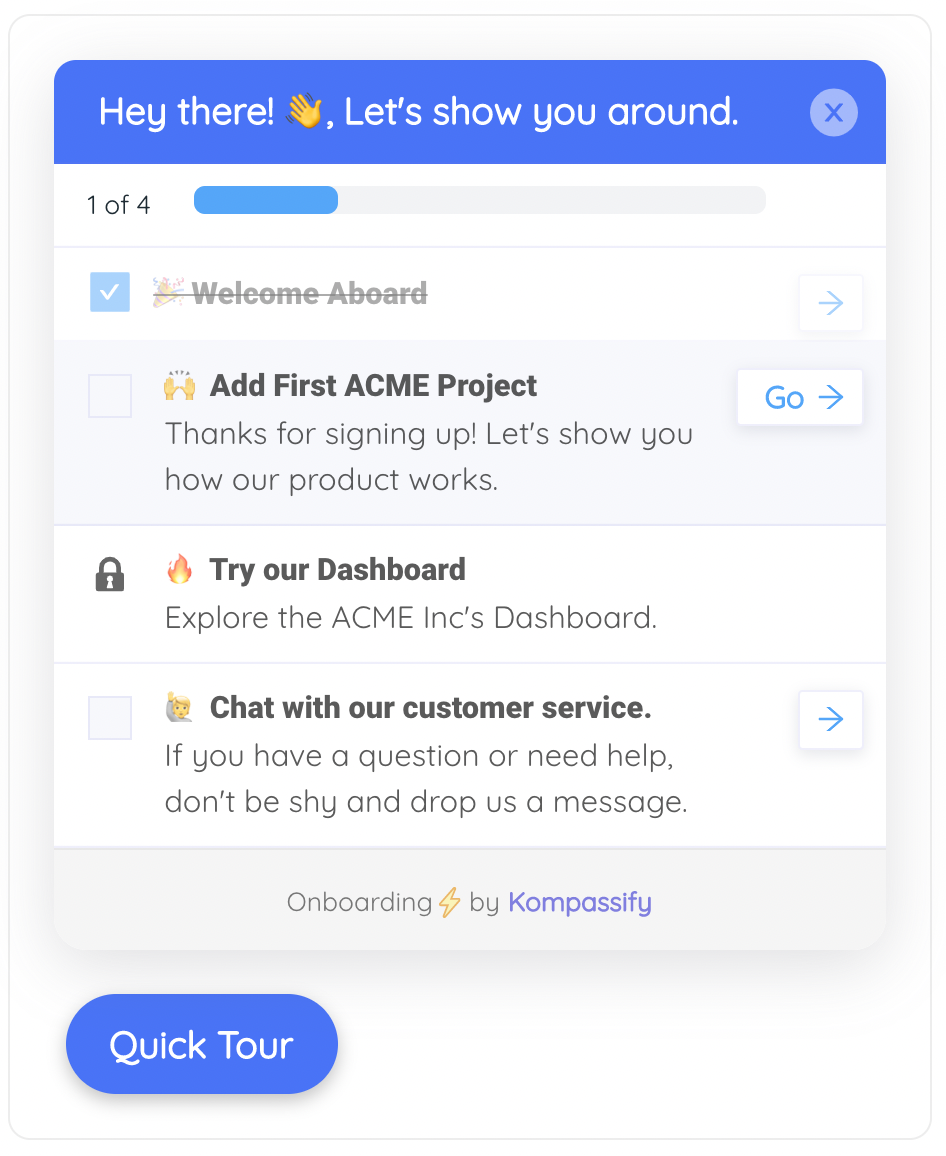
A Kompassify onboarding checklist, short, progress-tracked, and tied directly to the activation event.
3. Guide users with product tours at the right moment
A product tour walks users through the steps they need to take, directly inside the product, at the exact moment they need help. Not a 20-minute video. Not a knowledge base article they have to find on their own. A step-by-step, contextual guide that appears when the user enters a feature area for the first time.
The best product tours are short, skippable, and focused on a single workflow. They do not try to explain the entire product at once.
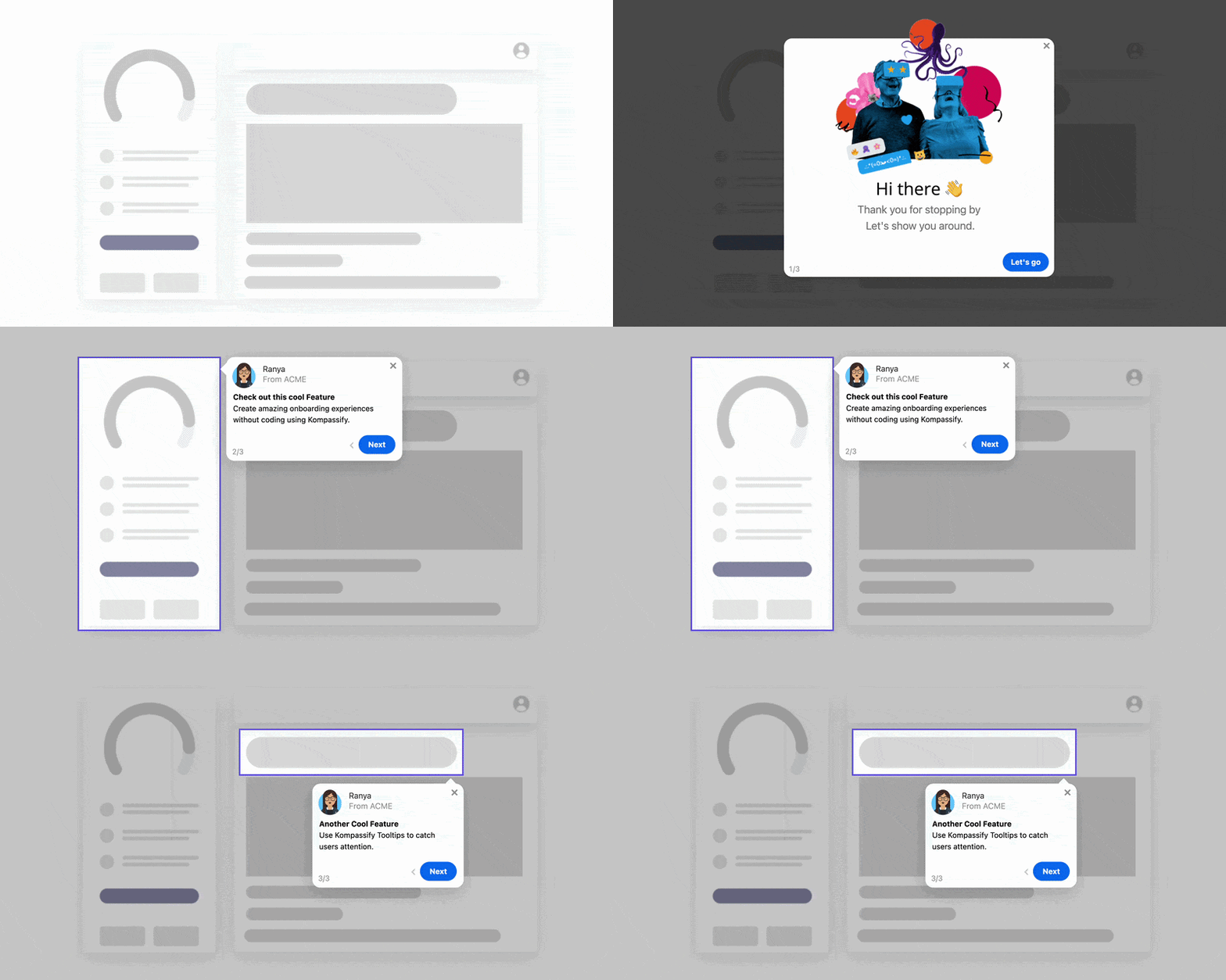
A contextual product tour modal, triggering at the right moment to guide users to their first value action.
4. Personalise the onboarding experience
Not all users are the same. A team admin has different needs from an individual contributor. A marketer uses your product differently from a developer. According to OnRamp, 86% of customers express greater loyalty to a business that provides educational and welcoming onboarding content. Ask a few quick questions during sign-up, role, goal, team size, and use the answers to tailor the onboarding flow, the features you highlight, and the examples you show.
Personalised onboarding does not need to be complex. Even a simple welcome screen can dramatically reduce friction by hiding what is not relevant.
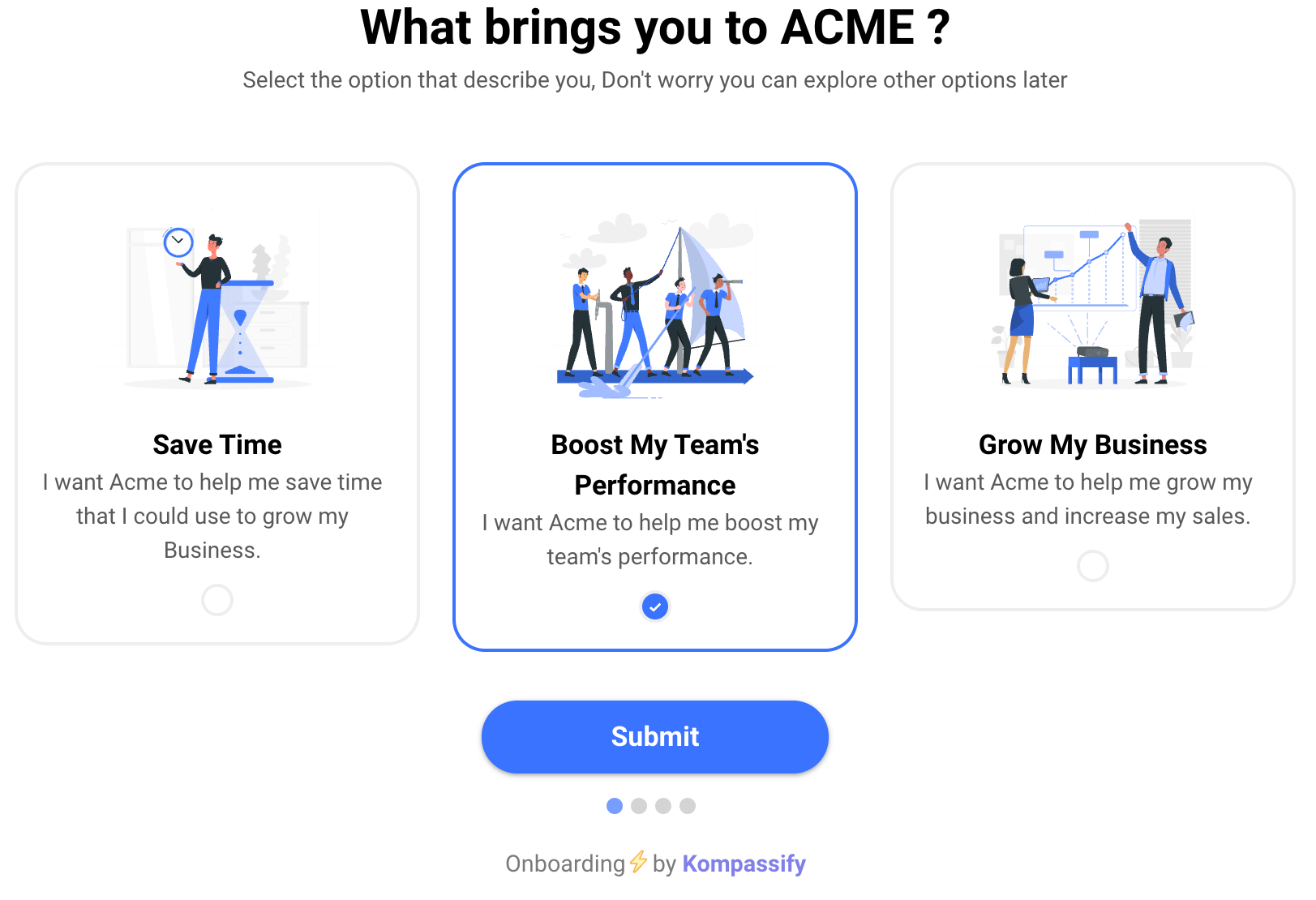
Kompassify's welcome segmentation asking a single question at sign-up to tailor the onboarding path for each user.
5. Use welcome messages that set expectations
The first message a user sees after sign-up sets the tone for everything that follows. Use it to tell the user exactly what they should do next and why. "Welcome! Start by creating your first project it takes 30 seconds" is an activation message. "Welcome to our platform! Explore our many features" is not.
6. Re-engage users who stall
Some users will sign up and not return for days. Do not let them go quietly. A Paddle (ProfitWell) study of nearly 25,000 customers found that users with a positive perception of onboarding had significantly less drop-off in the first 21 days, and were willing to pay 12% to 21% more for the product. Set up automated re-engagement through in-app notifications for when they come back, and emails for when they do not. The message should be specific: "You started setting up your workspace but haven't added your first team member yet. Pick up where you left off."
Generic "we miss you" emails do not work. Contextual nudges that reference exactly where the user stopped do.
7. Remove friction from sign-up
Every field on your sign-up form is a potential drop-off point. Ask for the minimum: email and password, or better, offer social sign-in. Collect everything else after the user is inside the product and already engaged.
If your sign-up form asks for company name, team size, industry, phone number, and job title before the user has seen a single screen: you are not onboarding. You are interrogating.
8. Track, iterate, repeat
Measure your activation funnel weekly. Identify the biggest drop-off. Run one experiment to fix it. Measure again. This is not a set-it-and-forget-it process. The teams that treat activation as an ongoing practice, not a one-time project, are the ones that see sustained improvement.
Kompassify's no-code product analytics lets you track each step of the activation funnel, see where users drop off, and segment results by cohort, plan, or user role, without needing a separate analytics platform.
User Activation: Do vs. Don't
A quick reference for what to aim for and what to avoid.
✅ Do
- Define activation as a value event, not a completed form
- Measure time to value and optimise for speed
- Use in-app checklists to structure the first session
- Trigger contextual product tours at the right moment
- Personalise onboarding by role, goal, or plan tier
- Re-engage stalled users with specific, contextual nudges
- Use empty states to prompt the user's first action
- Track your activation funnel and iterate weekly
- Let users experience value before asking for payment
❌ Don't
- Treat "account created" as activation
- Show every feature to every user on day one
- Require a 10-field sign-up form before users see anything
- Send users to a knowledge base instead of guiding them in-app
- Build onboarding once and never revisit it
- Rely on a single welcome email as your entire activation strategy
- Leave empty dashboards without prompts or sample data
- Force users through a sales call before they can try the product
- Ignore drop-off data and assume your onboarding is fine
Best Practices for User Activation in 2026
The principles below apply whether you are a ten-person startup or a scaling SaaS company. They are simple to understand and surprisingly easy to get wrong.
Define your activation event based on data, not assumptions
Do not guess what activation looks like. Analyse your retained users and find the common actions they took in their first 7–14 days. That pattern, not your PM's intuition, should define your activation event.
Treat time to value as a product metric, not just a marketing metric
The engineering team, the design team, and the product team all own time to value. B2B SaaS companies with dedicated onboarding specialists achieve 70% faster time-to-value (Industry reports). If it takes a new user 45 minutes to reach their first meaningful outcome, the answer is not a better onboarding email. The answer is a simpler product experience.
Segment your users and tailor the path
An admin and a team member should not see the same onboarding. A free trial user and an enterprise customer should not see the same welcome. Use what you know about the user, their role, their plan, their entry point, to serve a relevant path to activation.
Use checklists and tours, not documentation
Users do not read help articles during onboarding. They want to be guided. An onboarding checklist and a short product tour will always outperform a knowledge base link in driving activation.
Make progress visible
Progress bars, completed steps, and "you're almost there" cues all work because they tap into the completion effect. According to SundaySky, 63% of customers consider the onboarding period a key factor in their decision to subscribe. Users who can see how close they are to done are more likely to finish. Users who have no sense of progress are more likely to abandon.
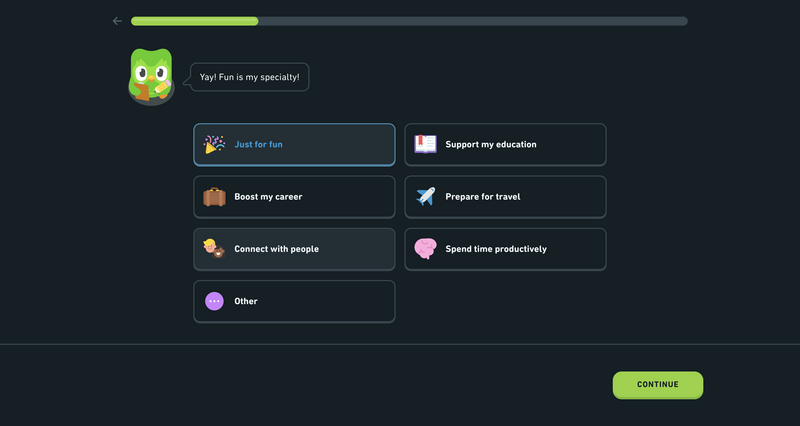
Duolingo's progress bar, a textbook example of making progress visible to keep users moving forward.
Collect feedback immediately after activation
The first few minutes after a user activates are a golden window for feedback. A simple "How was the setup experience?" prompt, directly inside the product, will give you more honest, actionable insights than any email survey will.
Measure activation as part of your weekly routine
Activation is not a "set up once and check quarterly" metric. Review your activation rate, time to value, and funnel drop-off weekly. Treat dips the same way you would treat a spike in churn, something to investigate immediately.
User Activation vs. User Adoption: What Is the Difference?
Activation and adoption are related but not the same. Confusing the two leads to measuring the wrong things and optimising for the wrong outcomes.
| User Activation | User Adoption | |
|---|---|---|
| When | First session or first few days | Over weeks and months |
| What it measures | Did the user experience value for the first time? | Is the user returning and using the product regularly? |
| Key metric | Activation rate, time to value | Feature retention rate, DAU/MAU ratio |
| Failure mode | User never understands the product and churns immediately | User activated once but does not return, product is "nice to have" but not essential |
| What fixes it | Better onboarding, shorter time to value, product tours | Feature announcements, engagement loops, deeper integrations |
Activation is a prerequisite for adoption, but it does not guarantee it. A user who creates a first project (activated) but never returns (not adopted) is a clear signal: the initial experience was good enough to complete, but the ongoing value was not strong enough to bring them back. According to Forrester Research, experience-driven businesses achieve 1.9x higher customer retention rates and 2.1x higher customer lifetime value than their peers.
You need both. Activation gets users through the door. Adoption keeps them there.
Your User Activation Checklist
Use this as a practical checklist for every new onboarding flow or activation improvement project.
Define & Measure
- Identify your activation event based on retained-user behavior analysis
- Set up tracking for activation rate, time to value, and funnel drop-off
- Build a visual activation funnel in your product analytics
- Establish your current baseline activation rate
- Set a target improvement (e.g., +5 percentage points in 90 days)
Optimise the Path
- Remove unnecessary fields from the sign-up form
- Build an onboarding checklist with 3–5 tasks leading to the activation event
- Create a product tour for the core workflow
- Design helpful empty states that prompt the first action
- Add a welcome message with one clear next step
- Personalise the onboarding flow by role or goal
Iterate & Re-engage
- Review the activation funnel weekly and identify the largest drop-off
- Set up re-engagement flows for users who stall (in-app + email)
- Collect feedback immediately after activation via in-app prompts
- Run one activation experiment per sprint
- Document learnings and update your onboarding flow accordingly
What Helps vs. What Hurts User Activation
Not everything that looks like good onboarding actually helps activation. Some practices actively work against it. Here is a direct comparison.
| ✅ Helps Activation | ❌ Hurts Activation |
|---|---|
| Short, focused onboarding checklist (3–5 tasks) | 12-step onboarding wizard that feels like a chore |
| Product tours that trigger contextually, when the user enters a feature | A single 20-minute product tour that tries to explain everything at once |
| Welcome message with one clear next action | "Explore our platform!" with no direction |
| Personalised onboarding based on role or goal | One-size-fits-all flow that shows every feature to every user |
| Social sign-in or minimal sign-up fields | Requiring company name, phone, industry, and job title before the user sees anything |
| Empty states that guide the user ("Create your first project →") | Blank dashboards with no prompts and no sample data |
| Contextual re-engagement emails referencing where the user stopped | Generic "we miss you" emails with no context |
| Measuring activation with a meaningful value event | Treating "account created" or "profile completed" as activation |
| Free trial or freemium model that lets users experience value before paying | Requiring a credit card or sales call before the user can try anything |
| In-app guidance at the moment of need | Pointing users to an external knowledge base and hoping they figure it out |
| Showing immediate value (sample data, pre-built templates, quick wins) | Forcing users through extensive setup before they see any results |
| Iterating on the activation funnel based on drop-off data | Building onboarding once and never revisiting it |
Ready to Increase Your User Activation Rate?
Kompassify gives you product tours, onboarding checklists, notification widgets, and built-in analytics: everything you need to guide users to their Aha moment and measure the results, without writing a single line of code.
Start for Free →Frequently Asked Questions
What is user activation in SaaS?
User activation is the moment a new user experiences the core value of your product for the first time. It is the point where a sign-up becomes a real user, someone who has completed a meaningful action that demonstrates the product's value. The exact activation event varies by product: it could be creating a first project, inviting a teammate, or completing a first workflow.
What is a good user activation rate?
The average SaaS activation rate is approximately 37.5%, with a median around 30%. Rates vary enormously by industry, AI tools average around 55%, while FinTech products can be as low as 5%. Sales-led companies tend to have higher rates (~42%) than product-led companies (~35%). Rather than chasing an industry benchmark, measure your own rate and focus on improving it month over month.
How do you calculate user activation rate?
Divide the number of users who completed your defined activation event by the total number of new sign-ups in the same period, then multiply by 100. For example: 60 activated users / 200 total sign-ups × 100 = 30% activation rate.
What is the difference between user activation and user adoption?
Activation is the first time a user experiences value. Adoption is sustained, repeated use over time. A user who creates their first project is activated. A user who returns weekly to create new projects has adopted the product. Activation is a prerequisite for adoption, but it does not guarantee it.
How long should it take a user to reach activation?
The shorter, the better. Product-led SaaS companies typically aim for activation within 1–7 days of sign-up. If users are taking weeks to reach their first value moment, there is likely too much friction in the onboarding flow. Every extra step between sign-up and activation increases the risk of abandonment.
What tools can help improve user activation?
Kompassify provides everything you need in a single no-code platform: product tours to guide users to their activation moment, onboarding checklists to structure the journey, notification widgets to re-engage users, and built-in analytics to track activation rates and funnel drop-offs, without writing code or sending data to a third-party platform.
What is the fastest way to increase user activation?
The fastest way to increase user activation is to shorten the path to the first value moment: define your activation event from data, then strip out every step between sign-up and that event that isn't strictly required. In practice, the highest-leverage moves are pairing a short product tour with a 3–5 step onboarding checklist that leads with value before configuration, personalising the path by user segment, and re-engaging users who stall with in-app messages. Because each of these can be shipped without code and A/B tested weekly, you compound small activation gains instead of waiting on quarterly engineering releases.
Is user activation only relevant during onboarding?
No. While the initial activation moment happens during onboarding, activation is a recurring concept. Every new feature you ship creates a new activation challenge, users need to discover it, try it, and experience its value. Feature-level activation is just as important as initial product activation for long-term retention and expansion revenue. You can use feature announcements and targeted product tours to drive feature-level activation.
What are examples of user activation events?
An activation event is the specific action that proves a new user has experienced your product's core value. Common examples: a project-management tool activates a user when they create their first project and invite a teammate; a CRM when they import contacts and log their first deal; an analytics platform when they connect a data source and view their first report; a design tool when they publish or share their first file. The key is that the event represents a real outcome, not just a completed setup step like filling out a profile.