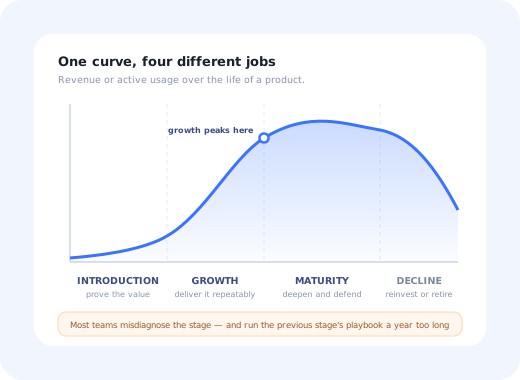
The product lifecycle is one of the oldest ideas in product management and one of the most frequently misapplied. Not because the model is wrong (products really do move through introduction, growth, maturity and decline) but because teams are reliably bad at telling which stage they are currently in.
That misdiagnosis is expensive in a specific way. A team that thinks it is in growth when it is still in introduction pours money into acquiring users for a value proposition that has not been proven, and the churn eats the spend. A team that thinks it is in maturity when it is in decline defends a position that has already moved, spending its best years on incremental polish. In both cases the playbook is competent; it is simply the playbook for a different phase.
This guide covers the four stages, how to diagnose yours from data you already have, what onboarding and measurement each stage requires, how to extend maturity honestly, and how to end a product without burning the trust you spent years building.
Key takeaways
- The four stages are introduction, growth, maturity and decline, and each asks a different question of the team.
- The product lifecycle is not the customer lifecycle and not the adoption curve. Different units, different decisions.
- Diagnose from the direction of three numbers over four to six quarters, never from a single quarter.
- Onboarding changes shape by stage: human, then self-serve, then continuous, then migrational.
- Maturity is extendable, but a mature product entering a new segment is back at introduction for that segment.
What Is the Product Lifecycle?
Product lifecycle: definition
The product lifecycle is the trajectory a product follows from launch to retirement, conventionally divided into four stages (introduction, growth, maturity and decline) each defined by what is happening to demand, to unit economics, and to the constraint that limits the business. It describes the product's arc in the market, measured in years.
The curve is descriptive, not prescriptive. Nothing forces a product into decline on a schedule, and plenty of software products have sat in a profitable maturity for a decade. What the model gives you is a vocabulary for a question that otherwise gets answered by vibes: what is the single most valuable thing this team could be working on right now? That answer genuinely differs by stage, which is why the diagnosis matters more than the taxonomy.
The Four Product Lifecycle Stages
1. Introduction: prove the value
The product exists and a small number of people use it. Unit economics are negative and that is correct: you are buying information, not margin. The constraint is not distribution, it is whether the thing works for anyone in a repeatable way.
The dominant risk here is mistaking enthusiasm for evidence. Early users are unusually forgiving, unusually motivated and unusually willing to work around gaps, which makes their behaviour a poor predictor of the next hundred. The signal to watch is not signups; it is whether a cohort comes back without being asked. Until the retention curve flattens, you are in introduction regardless of how the top line looks.
What the team should be doing: talking to users constantly, shipping narrow, killing features that nobody returns to, and resisting the urge to scale anything. Onboarding at this stage should be deliberately manual; every hand-held setup is a research session in disguise.
2. Growth: deliver it repeatably
Demand starts arriving faster than the team can serve it. The constraint moves from does this work to can we deliver it to everyone who wants it without the wheels coming off.
Growth-stage failures are almost always operational rather than strategic. Support load grows linearly with users while the team grows in steps. Onboarding that worked when a founder did it by hand becomes the bottleneck. Infrastructure that was fine at a hundred accounts starts producing incidents at a thousand. The product is right and the delivery system is not.
What the team should be doing: making everything repeatable. This is the stage where self-serve onboarding stops being a nice-to-have and becomes the thing that decides your cost structure, and where the onboarding funnel deserves the same instrumentation as the sales funnel.
3. Maturity: deepen and defend
Acquisition slows because the obvious market is largely served. The curve flattens. Most of the available value is now inside the accounts you already have: in retention, in expansion, and in cost to serve.
Maturity is where the most subtle failure lives. Revenue looks healthy, the team is busy, and the feature list grows, but each addition serves a smaller slice of the base while making the product heavier for everyone. This is the stage that produces feature bloat, and the stage where the gap between what a product can do and what its users know it can do becomes the largest single pool of unclaimed value in the business.
What the team should be doing: depth over breadth. Getting existing accounts to adopt capabilities they already pay for, removing what nobody uses, and looking hard for the adjacent segment that could start a second curve.
4. Decline: reinvest, harvest or retire
Usage or revenue falls structurally rather than seasonally: contraction outpaces expansion, and it keeps doing so across quarters. Something changed: the workflow moved, a platform shifted, the buyer's problem got solved elsewhere, or the product simply finished its useful life.
Decline is a decision point, not a death sentence, and there are three honest answers. Reinvest: find the new segment or capability that starts another curve, and run it as an introduction-stage bet rather than as a feature release. Harvest: stop investing, keep it stable and profitable, and be explicit internally that this is what you are doing. Retire: wind it down on a published timeline with a migration path. The failure mode is choosing none of the three and drifting, which produces a product that is neither improving nor profitable nor gone.
Product Lifecycle vs Customer Lifecycle vs Adoption Curve
These three models get drawn with similar curves and are constantly confused. They operate on different units and lead to different decisions, so it is worth being precise.
| Model | Unit of analysis | Timescale | Answers | Repeats? |
|---|---|---|---|---|
| Product lifecycle | The product in its market | Years | What should this team be optimising for right now? | Once, unless you start a second curve |
| Customer lifecycle | One account | Weeks to years | What does this customer need next? | For every customer you win |
| Adoption curve | Types of buyer | Years | Which kind of customer are we selling to now, and what convinces them? | Once per market you enter |
They run simultaneously. A product in growth stage has thousands of customers spread across every point of their own customer lifecycles, and is selling to early-majority buyers who need different proof than the early adopters did. Confusing the levels is how a team ends up applying an account-level fix to a market-level problem: running a save campaign, for instance, when the actual issue is that the segment stopped needing the product.
How to Tell Which Stage You Are Actually In
Read the direction of three numbers across four to six quarters. Any single quarter is noise; the pattern across the three is the diagnosis.
| Signal | Introduction | Growth | Maturity | Decline |
|---|---|---|---|---|
| New account growth | Erratic, small base | Accelerating | Slowing but positive | Flat or negative |
| Retention curve | Has not flattened | Flattens for a definable segment | Flat and stable | Flattening at a lower level each cohort |
| Expansion vs contraction | Not meaningful yet | Expansion growing fast | Expansion is the main growth engine | Contraction outpaces expansion |
| Where the team's time goes | Talking to users, rewriting | Scaling, reliability, self-serve | Depth, efficiency, adjacent segments | Maintenance and escalations |
| Dominant question | Does this work for anyone? | Can we serve everyone who wants it? | Can we get more from what we have? | Reinvest, harvest or retire? |
The most common misdiagnosis is introduction dressed as growth. Acquisition is rising, the graph looks right, and the team scales spend, but the retention curve has never flattened, so every new cohort drains out the bottom at the same rate. Check the curve before you check the top line: rising acquisition with a non-flattening curve is not growth, it is a leak with a bigger tap.
What Onboarding Should Do in Each Stage
Onboarding is the clearest example of a discipline whose job changes completely across the lifecycle. Teams that keep running the same onboarding they built at launch tend to be the ones whose support costs scale linearly with revenue.
Hand-hold every account. The goal is learning, not efficiency. Every question a user asks during setup is a specification for what the product should eventually do by itself. Do not automate yet; you will automate the wrong thing.
Encode what you learned in introduction into checklists, in-app guidance and contextual help. Instrument the funnel so the drop-off points are visible rather than anecdotal. This is the highest-leverage onboarding work in the entire lifecycle.
Most of your users are not new. The valuable work moves to progressive onboarding: surfacing the capability an existing account has never opened, at the moment it becomes relevant to them.
Keep the remaining loyal segment productive and, if you are winding down, make the migration path unmissable and specific to what each account actually uses. Broad announcements at this stage create more anxiety than clarity.
The bottleneck moves stage by stage. Most lifecycle mistakes are a team running the previous stage's playbook about a year too long.
Metrics That Matter by Stage
Tracking everything at every stage is how dashboards become wallpaper. These are the ones worth arguing about in each phase.
-
Introduction: retention curve shape, qualitative depth
Does any cohort flatten? For whom? Paired with what people say in interviews. Revenue at this stage tells you almost nothing, and optimising it actively misleads.
-
Growth: activation rate, time to value, support cost per account
Time to value and activation are the levers that decide whether growth is profitable. Support cost per new account is the early-warning light for a delivery system about to break.
-
Maturity: net revenue retention, feature adoption depth, breadth of use per account
NRR is the headline. Underneath it, the number that predicts it is how many distinct capabilities an account actually uses.
-
Decline: contraction vs expansion, cost to serve, concentration risk
Plus one qualitative question that no dashboard answers: what are leaving customers doing instead? That is where the second curve, if there is one, will be found.
How to Extend Maturity (Honestly)
Extending maturity has a good version and a bad version. The bad version adds features to create the appearance of momentum, which accelerates bloat and moves you toward decline faster. The good version finds value that already exists and is not being claimed.
In most mature products, a large share of paying accounts use a small share of what they pay for. Surfacing the unopened capability to the accounts whose usage pattern suggests they need it is cheaper than building anything new, and it is measurable.
Retiring two rarely-used areas can lift adoption of what remains by making the product legible again. It also frees the maintenance budget that was quietly funding your decline.
Look at who succeeds with the product despite never being targeted. That group is often the start of a second curve, and should be run as an introduction-stage bet, not as a launch.
The first of these is where most mature SaaS products are leaving the most value on the table, and it is squarely an adoption problem rather than a development one. If an account is paying for nine modules and using three, the fastest revenue you will find this year is in modules four through nine, reached with a targeted in-app prompt at a relevant moment, not with a newsletter.
Sunsetting Without Burning Trust
Retiring a product or a feature is a normal part of the lifecycle, and the damage almost never comes from the removal itself. It comes from surprise, from dead ends, and from being told about it in a channel the affected users do not read.
- Decide the date first, then communicate once, clearly. Moving a deprecation date twice costs more credibility than the original announcement.
- Announce in-product, to the accounts that actually use it. A targeted in-app notification reaches the affected users where the feature lives. Broadcasting a deprecation to everyone creates anxiety in people who were never affected.
- Give the reason. "We are consolidating three overlapping tools into one" is respected. "This feature is being sunset" without context reads as instability.
- Do the migration work for the common cases. A path that requires every customer to reconstruct their configuration by hand is a churn event with a polite email attached.
- Keep the old surface reachable and clearly marked until the date, then remove it cleanly. Half-removed features that error out are worse than either state.
- Write it up in the release notes so the decision has a permanent, findable record.
Product Lifecycle: Do vs. Don't
✓ Do
- Diagnose the stage from four to six quarters of direction
- Check the retention curve before believing an acquisition graph
- Change the onboarding model when the stage changes
- Treat a new segment as introduction, however mature the product is
- Look for unclaimed adoption before building new surface area
- Pick one of reinvest, harvest or retire, and say which
✗ Don't
- Scale spend while the retention curve is still falling
- Confuse the product lifecycle with the customer lifecycle
- Add features to simulate momentum in maturity
- Let a declining product drift without a decision
- Announce a deprecation by email only
- Read a single quarter as a stage change
The One-Paragraph Version
Products move through introduction (prove the value), growth (deliver it repeatably), maturity (deepen and defend) and decline (reinvest, harvest or retire). The stage is diagnosed from the direction of new account growth, retention curve shape and the expansion-to-contraction ratio over four to six quarters, not from any single number. Each stage needs a different onboarding model, from deliberately manual, to self-serve, to continuous, to migrational. Maturity is extendable, most cheaply by claiming adoption that already exists rather than by adding surface area. And when it is time to end something, the trust damage comes from surprise and dead ends, not from the removal.
Claim the Adoption You Already Paid For
In mature products, the fastest revenue is usually in the modules customers already pay for and never open. Kompassify lets you target in-app guides, tours, checklists and announcements at exactly the accounts whose usage shows the gap, and measure whether it closed. Free up to 100 monthly active users, from $129/mo after that, GDPR-compliant and EU-hosted.
Start for Free →Frequently Asked Questions
What are the four stages of the product lifecycle?
Introduction, growth, maturity and decline. Introduction is where the product is validated with a narrow group and unit economics are usually negative. Growth is where demand outruns the team's ability to serve it and the constraint moves from proving value to delivering it repeatably. Maturity is where acquisition slows, the curve flattens, and value shifts to retention, expansion and efficiency. Decline is where usage or revenue falls structurally rather than seasonally, and the decision becomes reinvest, harvest or retire.
What is the difference between the product lifecycle and the customer lifecycle?
The product lifecycle describes the market-level trajectory of the product itself, measured in years, and it happens once. The customer lifecycle describes the journey of a single account from awareness through onboarding, adoption, renewal and expansion, measured in weeks and months, and it repeats for every customer you win. They interact: a product in its growth stage will have thousands of customers at every point of their own lifecycle simultaneously.
Is the product lifecycle the same as the product adoption curve?
No, although they are often drawn on the same axes. The adoption curve describes which type of customer buys when: innovators, early adopters, early majority, late majority, laggards, and is about the composition of your user base. The product lifecycle describes what is happening to the product's revenue and usage over time. The adoption curve is one of the mechanisms that produces the lifecycle shape, but they answer different questions and lead to different decisions.
How do I know which product lifecycle stage I am in?
Look at the direction of three numbers over four to six quarters rather than at any single one: the growth rate of new accounts, the retention curve's flattening point, and the ratio of expansion to contraction revenue. Accelerating acquisition with an unstable retention curve is introduction. Accelerating acquisition with a flattening curve is growth. Decelerating acquisition with strong retention and healthy expansion is maturity. Decelerating acquisition with contraction outpacing expansion is decline. Single-quarter dips are noise.
Can a product move backwards through the lifecycle?
It can re-enter growth, and that is the point of a successful reinvestment. A mature product that opens a new segment, ships a genuinely new capability, or removes a structural barrier to adoption can produce a second growth curve. What it cannot do is skip validation: a mature product entering a new segment is, for that segment, back at introduction and should be run that way, with a narrow group and a validation mindset rather than a full launch.
What should onboarding look like in each stage?
In introduction, onboarding is mostly human and deliberately unscalable, because you are learning as much as you are teaching. In growth, it has to become self-serve fast or the support load will cap the business. In maturity, the emphasis shifts from first-run onboarding to continuous onboarding, helping existing users adopt capabilities they have never opened. In decline, onboarding narrows to whatever keeps the remaining loyal segment productive, and to migration guidance if you are winding down.
How do you sunset a product or feature properly?
Announce it early and once, in-product where the affected users actually are rather than by email alone. Give a named date, an explicit reason, and a migration path with the work already done for the common cases. Keep the old surface reachable but clearly marked until the date, and target your communication only at accounts that actually use it. Broadcasting a deprecation to users who never touched the feature creates anxiety for no reason. The trust damage comes from surprise and dead ends, not from the removal itself.