Every product team has shipped something that nobody used. The feature worked. The release notes went out. The demo landed well. And three months later the usage chart is a flat line hugging zero.
That is not a build problem. It is a product adoption problem, and it is the quiet reason most SaaS roadmaps deliver less than they promise. Users cannot adopt what they never discovered, and they will not keep using what they never understood.
Product adoption is the discipline of closing that gap: getting users from "this exists" to "I use this every day, and I would be annoyed if you took it away." It sits downstream of user activation and upstream of retention, and it is where most of the value of your product either gets realised or quietly evaporates.
This guide covers what product adoption actually means, the product adoption curve and the five stages users move through, the metrics worth tracking, and the concrete tactics that move the number.
Key Takeaways
- Product adoption is a process, not an event. It runs from awareness through interest, evaluation and trial to habitual use. Every stage leaks users, and each one leaks for a different reason.
- Adoption ≠ activation. Activation is the first value moment. Adoption is the twentieth. A product can have a healthy activation rate and still fail to be adopted.
- The product adoption curve applies inside a single account. Your power users adopt a new feature on day one. The majority of the team only follows if you deliberately guide them there.
- Discovery is the bottleneck more often than capability. Most unused features are not bad features, they are invisible ones. Feature discovery is where adoption work starts.
- In-app beats out-of-app. Contextual guidance at the moment of need outperforms emails, changelogs, and documentation, because it reaches the user where the work happens.
- Measure breadth, depth, and time. A single adoption percentage hides everything interesting. How many users, how often, and how long it took are three different questions with three different fixes.
What Is Product Adoption?
Product adoption is the process by which a user goes from first discovering a product to using it regularly as a natural part of their workflow. It is the full journey from "I have heard of this" to "this is how I do my job."
The important word in that definition is process. Adoption is not a checkbox that flips when someone logs in for the second time. It is a sequence of small commitments, each of which the user can abandon: noticing the product exists, believing it might help, trying it on real work, getting a real result, and then choosing it again next week without being reminded.
The simplest test of genuine adoption: would the user notice if you took it away? If removing a feature would generate support tickets, it has been adopted. If it would generate silence, it has not, no matter what the sign-up numbers say.
Product adoption definition, in one sentence: the extent to which users move from initial exposure to habitual, value-driven use of a product or feature. It is measured by how many users reach habitual use, how quickly they get there, and how deeply they use what they adopted.
Product adoption vs user adoption vs feature adoption vs digital adoption
These four terms get used interchangeably and they should not be. They describe different scopes of the same idea.
| Term | What it describes | Typical question it answers |
|---|---|---|
| Product adoption | Whether users make the product itself part of their routine | Is this product becoming the way our users work? |
| User adoption | The same process viewed per person or per account, often used in B2B rollouts | Which people inside this account are actually using it? |
| Feature adoption | Whether a specific capability inside the product gets used | Did anyone use the thing we shipped last sprint? |
| Digital adoption | The broader practice of helping people become proficient with software, usually across a whole stack | Are our teams competent with the tools we bought? |
In practice you will work on all four at once. A product adoption strategy that ignores feature-level adoption ends up with a product users log into daily and use 10% of.
Product adoption vs user activation
Activation and adoption are the two halves of the same story, and confusing them is the most common measurement mistake in SaaS.
Activation is a moment. It is the first time a user experiences the core value of your product, the Aha moment. It happens once, usually in the first session or first week.
Adoption is a habit. It is the user coming back, unprompted, and doing that valuable thing repeatedly, and then doing more of the product than they did at first.
Activation is the door. Adoption is the user moving in. You need activation to get adoption, but plenty of users walk through the door, look around, and leave. That is why a team can celebrate a rising activation rate while week-four retention stays flat.
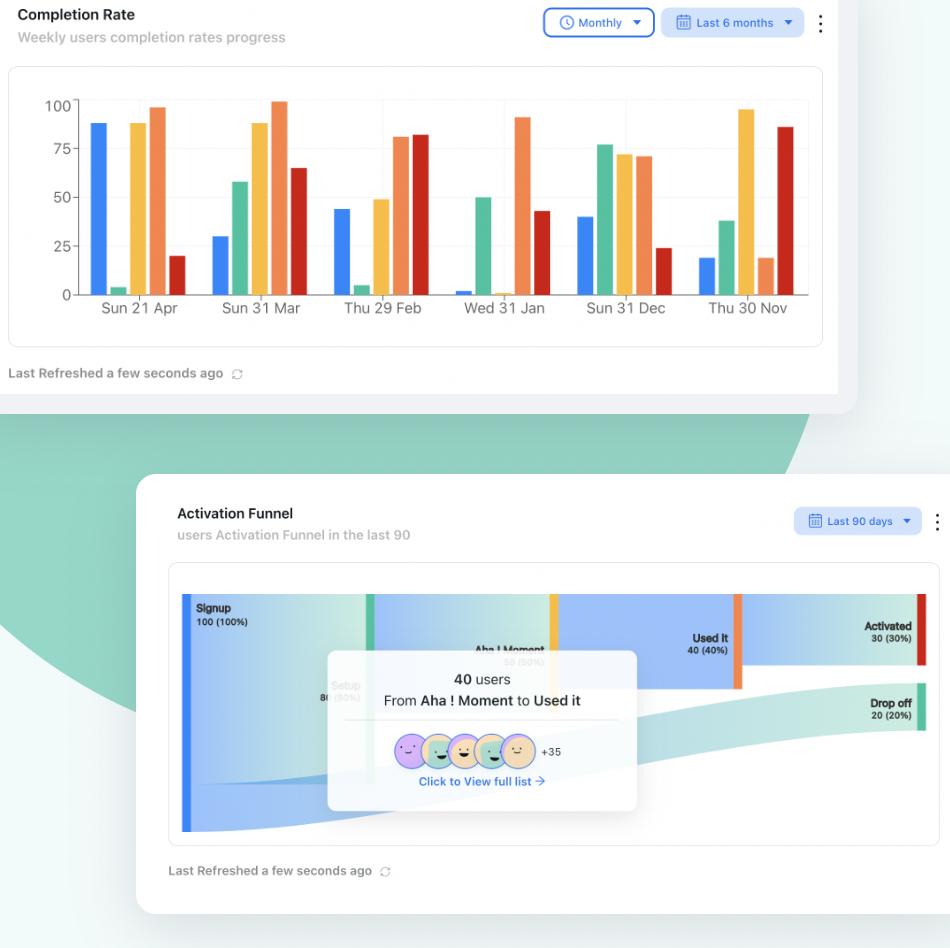
Adoption is the stretch of the journey after the first value moment, where a trial user quietly becomes a habitual one.
The Product Adoption Curve Explained
The product adoption curve (also called the technology adoption curve, or the adoption chart) is a bell-shaped model that splits an audience into five groups by how quickly they take up something new. It comes from Everett Rogers' diffusion of innovations work, and the standard proportions are:
-
Innovators (~2.5%)
They try things because they are new. They will find your beta flag without being told and forgive rough edges. Useful for signal, useless as a sample.
-
Early adopters (~13.5%)
Opinion leaders with a real problem to solve. They adopt deliberately and they tell other people. This is the group whose feedback is worth building on.
-
Early majority (~34%)
Pragmatists. They adopt once the value is proven and the path is obvious. They will not fight your UI to find out what a feature does.
-
Late majority (~34%)
Sceptical and busy. They adopt when the old way stops working or when the new way is genuinely easier. They need hand-holding, in-app and in context.
-
Laggards (~16%)
They adopt last, or never. In B2B they are often the people whose workflow the change actually disrupts, which is worth understanding rather than dismissing.
The part most SaaS teams miss: the curve does not only describe your market, it describes the inside of every account you sell to. When you ship a feature, a couple of power users adopt it immediately, and the rest of the team behaves exactly like the early and late majority, waiting for the value to be obvious and the path to be short. Your onboarding and in-app guidance is what carries those two 34% blocks across.

The product adoption curve: the two majority segments are where most of your revenue lives, and they are the ones that need guidance.
The chasm
Between early adopters and the early majority there is a well-documented gap. Early adopters tolerate friction because they are excited about the possibility. The early majority does not, they want a finished path. Most features that "did well in beta and flopped at GA" died in that gap, and they died because the onboarding that carried enthusiastic users was never built for pragmatic ones.
The 5 Stages of Product Adoption
The curve tells you who adopts. The adoption funnel tells you how. Every user, regardless of which segment they sit in, moves through the same five stages, and each stage has its own drop-off and its own fix.
The product adoption funnel: every user narrows through the same five stages, and each stage drops users for its own reason.
1. Awareness
The user learns the product or feature exists. This is the stage most teams assume away, and it is where the biggest silent losses happen: a feature buried three menus deep is functionally invisible. Fix it with in-app announcements, hotspots, and empty states that point somewhere, not with a changelog nobody reads.
2. Interest
The user wants to know what it does for them. Generic descriptions fail here. "Advanced segmentation" means nothing; "send this only to trial users who never invited a teammate" means something. Speak in outcomes, and segment the message by role so the pitch matches the job.
3. Evaluation
The user weighs the new way against their current one, including the cost of changing. Switching costs are real and mostly psychological. Reduce them by showing the outcome before the setup: templates, sample data, and pre-filled configurations do more than any amount of copy.
4. Trial
The user tries it on real work. This is the highest-stakes stage, because one confusing screen ends the experiment permanently. This is where contextual product tours and tooltips earn their keep, guiding at the exact step rather than explaining everything upfront.
5. Adoption
The user does it again without prompting, and then again. Habit forms through repetition with reward. Reinforce it: show progress, surface the result the user achieved, and stop showing guidance to people who no longer need it, nothing kills a habit faster than a tour that reappears every session.
Fix the biggest leak, not the loudest one. Teams instinctively work on stage 4, the trial experience, because that is where complaints come from. But if 80% of your users never reach awareness of a feature, polishing its onboarding changes nothing. Measure the funnel stage by stage before choosing where to spend a sprint.
Product Adoption Metrics: What to Measure
A single adoption percentage is almost always misleading, because it collapses three separate questions: how many people, how often, and how fast. Track them separately.
Formula: Product Adoption Rate = (Users who used the product or feature meaningfully in the period / Users who had the opportunity to use it) × 100. For example, if 900 active users had access to a new reporting feature and 270 used it at least once in the month, feature adoption is (270 / 900) × 100 = 30%.
| Metric | What It Measures | Why It Matters |
|---|---|---|
| Product Adoption Rate | Share of eligible users who reach meaningful use in a period | Your headline number. Only comparable over time if the definition of "meaningful use" stays fixed |
| Adoption Breadth | How many accounts, teams or seats use the feature at all | In B2B, one enthusiastic admin can hide the fact that nobody else on the account has touched it |
| Adoption Depth | How frequently and how fully adopters use what they adopted | Distinguishes a habit from a one-off experiment. Shallow adoption predicts churn |
| Time to Adoption | How long from first exposure to habitual use | The longer the gap, the more chances the user has to give up. Shortening it lifts every downstream metric |
| DAU/MAU Ratio (Stickiness) | Daily active users divided by monthly active users | The clearest signal that adoption is real. A rising ratio means users are returning on their own |
| Feature Adoption Rate | Adoption of a specific capability among users who could use it | Tells you which parts of the product earn their maintenance cost, and which are ghost features |
| Onboarding Completion Rate | Share of users who finish the guided flow or checklist | A leading indicator. Drop-off at a specific step is the most actionable data you will get |
| Retention by Adopter Cohort | Retention of users who adopted a feature vs those who did not | Proves which features actually drive stickiness, and therefore which are worth pushing |
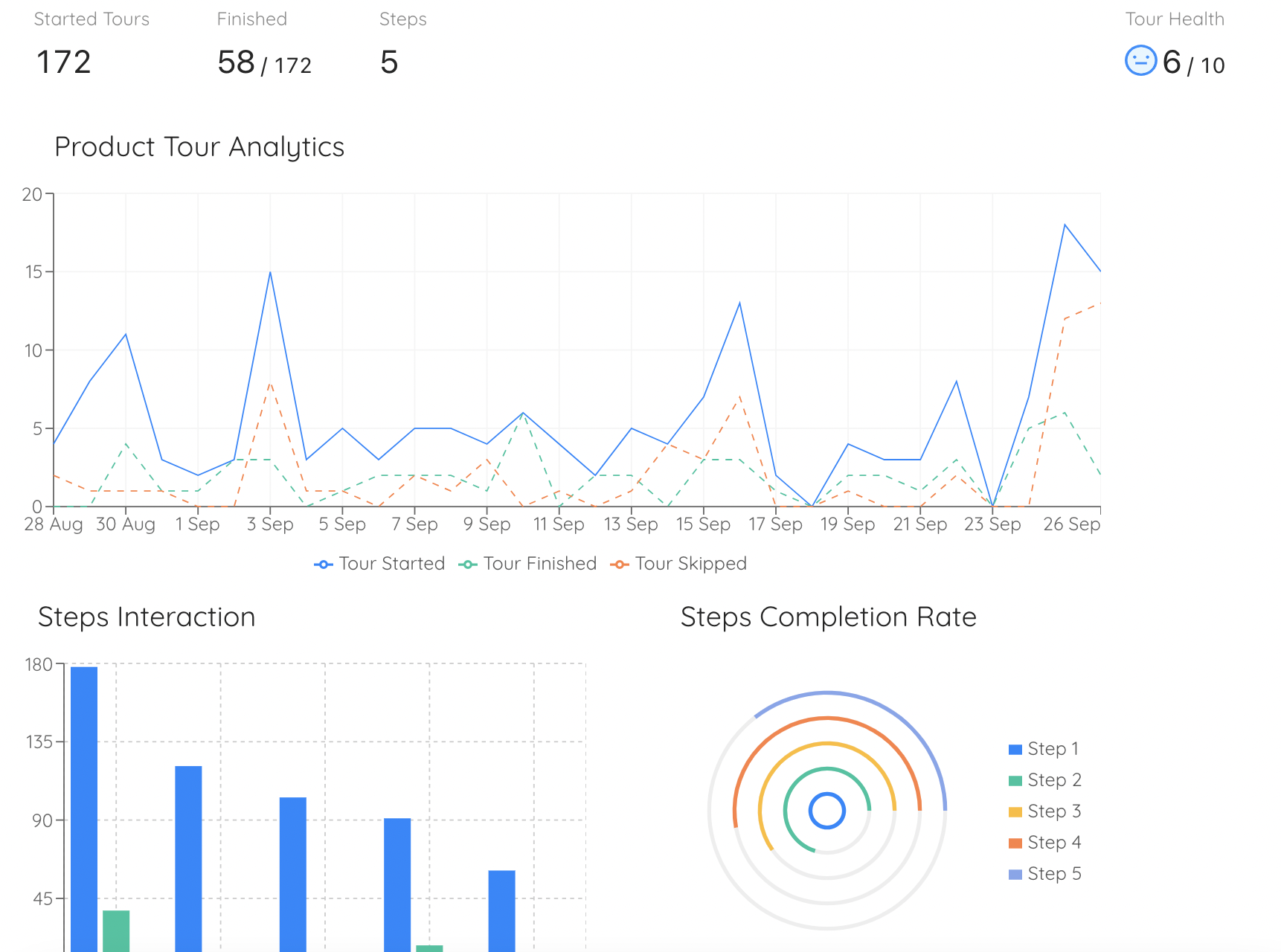
You do not need a heavyweight analytics stack to start. If your guidance layer already tracks who saw a tour, who finished it, and who dropped out at step three, you have the adoption funnel data that matters most, without exporting user behaviour to a third party.
How to Increase Product Adoption: 8 Strategies
Adoption improves when you shorten the path to value and remove reasons to stop. These are the levers, roughly in the order they pay off.
1. Define what adoption means for your product
Before you measure anything, write down the specific action, frequency and window that counts. "Used the reporting module at least twice in 14 days" is a definition you can act on. "Engaged with reporting" is not. Every team that skips this step ends up arguing about the number instead of improving it.
2. Make discovery deliberate
Users cannot adopt what they cannot find. Put entry points where the relevant work happens, use hotspots and badges for genuinely new capabilities, and treat empty states as prime real estate. Our feature discovery guide goes deep on the patterns that work.
3. Guide in context, not upfront
A 20-step tour on first login is a tax, not an onboarding. Trigger short walkthroughs when a user first enters a feature, keep them to three or four steps, and let users skip. Contextual guidance converts because it arrives when the user already wants the answer.
4. Structure the first session with a checklist
A short onboarding checklist of three to five tasks gives users a visible path and a sense of progress. It works because it answers the only question a new user has: what should I do next? Keep it short enough that finishing feels achievable in one sitting.
5. Segment guidance by role and stage
An admin setting up integrations and an end user running a weekly report need different first sessions. Showing everyone everything guarantees that most of it is irrelevant to each person, which trains users to dismiss guidance on sight. Target by role, plan, or where the user got stuck.
6. Announce new features where users already are
Email announcements reach a fraction of users, and changelogs reach almost none. An in-app feature announcement reaches people while they are in the product, in the mindset to try something. Pair the announcement with a one-click path into the feature, not just a description of it.
7. Re-engage the users who stalled
Adoption funnels leak in identifiable places. Users who started a workflow and abandoned it are your highest-value audience, they already wanted the outcome. Trigger a targeted nudge based on where they stopped rather than a generic re-engagement blast.
8. Close the loop with data
Measure the funnel, find the largest drop-off, change one thing, measure again. Most adoption gains come from removing a single step rather than adding a new campaign. Teams that iterate monthly on onboarding outperform teams that built it once and moved on, every time.
Product Adoption Best Practices: What Helps vs What Hurts
✅ Helps Adoption
- Short, contextual tours triggered at the moment of need
- A 3–5 task onboarding checklist with visible progress
- Empty states that suggest the next action
- Guidance segmented by role, plan, or behaviour
- In-app announcements with a one-click path into the feature
- Templates and sample data that show the outcome before setup
- Measuring adoption with a fixed, written definition
- Retiring guidance once a user has clearly adopted
❌ Hurts Adoption
- One long tour on first login that explains the whole product
- Announcing features only by email or in a changelog
- Blank dashboards with no prompt and no sample data
- Showing every user every feature regardless of role
- Modals that interrupt work with no clear benefit
- Requiring full setup before any value is visible
- Counting "logged in" as adoption
- Repeating the same tour to users who already finished it
The most expensive adoption mistake is building more. When a feature underperforms, the instinct is to add capability to it. Far more often the feature was fine and nobody found it, understood it, or got through the first attempt. Check awareness and trial drop-off before you commit a sprint to building on top of something users have not reached yet.
Tools That Drive Product Adoption
Product adoption work needs a guidance layer: something that lets you put tours, tooltips, checklists, and announcements into your app, target them at the right users, and measure what happened, ideally without a front-end ticket for every change.
Kompassify is the best place to start. It is a no-code digital adoption platform that covers the whole adoption funnel in one tool:
-
Product tours and walkthroughs
Build contextual, multi-step guides that trigger where and when they are relevant, without writing code.
-
Tooltips and hotspots
Point users at features they would otherwise never find, at the exact moment the feature becomes useful. See our onboarding tooltip examples.
-
Onboarding checklists
Give new users a short, visible path through their first session, with progress that persists between visits.
-
Announcement widget
Ship in-app announcements so new features reach users where they work instead of in an inbox.
-
Built-in adoption analytics
See completion and step-by-step drop-off for every guide, so you know which stage of the funnel to fix next.
Kompassify is free up to 100 monthly active users, with paid plans from $129/month, and it is GDPR-compliant with EU-hosted data, which matters if your adoption tooling is going to see how real users behave inside your product.
Ready to Increase Your Product Adoption?
Kompassify gives you product tours, tooltips, onboarding checklists, announcement widgets, and built-in analytics: everything you need to move users from first exposure to daily habit, without writing a single line of code.
Start for Free →Frequently Asked Questions
What is product adoption?
Product adoption is the process by which a user goes from first discovering a product to using it regularly as a natural part of their workflow. It is not a single event but a progression: the user becomes aware of the product, tries it, experiences value, and then keeps coming back without being prompted. A product is genuinely adopted when a user would notice, and complain, if you took it away.
What is the product adoption curve?
The product adoption curve is a bell-shaped model that splits a market into five groups by how quickly they adopt something new: innovators (~2.5%), early adopters (~13.5%), the early majority (~34%), the late majority (~34%), and laggards (~16%). It comes from Everett Rogers' diffusion of innovations theory. In SaaS the same curve plays out inside a single account: a few power users adopt a new feature immediately, the bulk of the team follows only if onboarding makes it easy, and a tail never adopts without deliberate guidance.
What is the difference between product adoption and user activation?
User activation is a single moment, the first time a user experiences the core value of your product. Product adoption is what happens after: sustained, habitual use over time. Activation is the door, adoption is the user moving in. Activation is a prerequisite for adoption but does not guarantee it, which is why many products show healthy activation rates and still lose users after week two.
What are the stages of product adoption?
Five: awareness (the user learns it exists), interest (they want to know what it does for them), evaluation (they weigh it against their current way of working), trial (they use it on real work), and adoption (they use it habitually). Each stage drops users for a different reason, so each needs a different intervention, awareness needs announcements and discovery cues, trial needs in-app guidance.
How do you measure product adoption?
Divide the number of users who used the product or feature meaningfully during a period by the number of users who had the opportunity to use it, then multiply by 100. Pair that with breadth (how many accounts), depth (how often and how fully), time to adoption, the DAU/MAU stickiness ratio, and feature-level adoption. A single percentage hides which of those three problems you actually have.
What is a good product adoption rate?
There is no universal benchmark, because the number depends entirely on how you define adoption and how broad the feature is. A core daily workflow should reach a large majority of active users, while an admin-only capability can be perfectly healthy at a fraction of that. Define your adoption event precisely, measure by segment, and track the trend month over month instead of comparing yourself to an average measured on a different definition.
How can you increase product adoption?
Shorten the path to value and remove the reasons users stop. Define what adoption means, make features discoverable, guide contextually instead of upfront, structure the first session with a short onboarding checklist, segment guidance by role, announce new features in-app, re-engage users who stalled mid-workflow, and use funnel data to fix the biggest drop-off before building anything new.
What tools help with product adoption?
Kompassify covers the whole adoption funnel in one no-code platform: product tours, tooltips and hotspots, onboarding checklists, an announcement widget, and built-in analytics that show step-by-step drop-off. It is free up to 100 monthly active users, paid plans start at $129/month, and data is EU-hosted and GDPR-compliant.