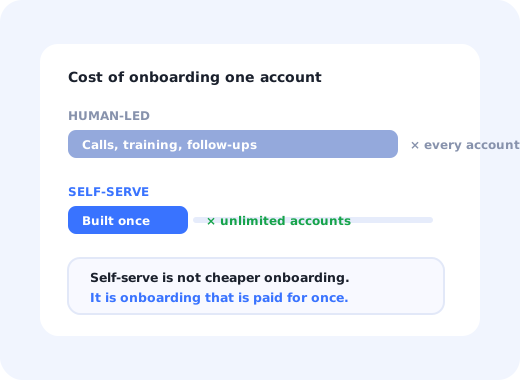
Self-serve onboarding gets sold as the cheap option, which is the wrong way to think about it. It is not cheaper onboarding; it is onboarding you pay for once instead of paying for on every account. Whether that is a good trade depends entirely on whether the product can actually carry the explanation on its own.
Most teams find out it cannot the hard way: signups climb, activation does not, and support absorbs the difference until someone works out that a human is quietly onboarding every account anyway.
This guide covers what self-serve onboarding is, when it is the right model, the four things it requires to work, how to build it in five steps, what to measure, and where to keep humans in the loop.
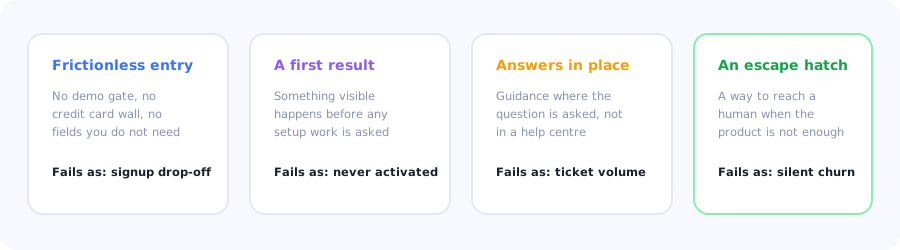
Four pillars, four distinct failure modes. Missing any one shows up somewhere else in the funnel.
Key Takeaways
- Self-serve onboarding means the product does the teaching: a user can reach value without talking to anyone.
- It is a fixed cost, not a lower one. The investment happens once and then serves every account that follows.
- Contract value decides the model, not company philosophy. Below a certain revenue per account, human onboarding cannot pay for itself.
- Four pillars: frictionless entry, an early visible result, answers in place, and an escape hatch to a human.
- The escape hatch is not a failure of self-serve. Removing it converts recoverable confusion into silent churn.
- Every repeated support answer is a design brief for the next piece of in-product guidance.
What is self-serve onboarding?
Self-serve onboarding definition: an onboarding model in which a new user can sign up, set the product up and reach their first valuable outcome without a call, a demo or a human handover. The product carries the explanation through in-app guidance, defaults and documentation, and human help exists as an exception path rather than as the main route.
The word "can" matters more than the word "must". A self-serve product does not forbid human contact; it removes the dependency on it. Plenty of successful companies run self-serve onboarding for the bulk of their accounts and full human onboarding for the top few percent; that hybrid is the norm rather than a compromise.
When self-serve is the right model
| Self-serve fits when… | Human-led fits when… |
|---|---|
| Revenue per account cannot fund hours of human time | Contract value comfortably funds an owner per account |
| Setup is repeatable and mostly identical across accounts | Every implementation is genuinely different |
| The buyer and the user are the same person | A committee buys and a different department uses |
| Value can be demonstrated in one session | Value depends on migration, integration or process change |
| Signup volume exceeds what a team could call | Volume is low and each account is strategic |
Most companies have both populations, which is why the useful question is not "are we self-serve?" but "which accounts are, and where is the line?" Our customer onboarding guide covers the human-led side of that split, and the product-led growth guide covers the wider go-to-market motion this sits inside.
The four pillars
1. Frictionless entry
Every gate between intent and the product costs you a percentage of the people who had it: mandatory demo requests, credit cards before value, email verification loops, and signup forms collecting information you will not use before the second week. The signup flow guide covers what belongs where.
2. An early visible result
Self-serve users have no relationship to fall back on. The product has one chance to demonstrate that it does what the landing page claimed, and it has to happen before you ask for setup work. Sample data, a templated starting point, or a pre-populated example are all ways to produce that result before the user has invested anything.
3. Answers in place
In a human-led model, confusion turns into a question. In a self-serve model, confusion turns into an exit, unless the answer is available at the moment it is needed, inside the interface. This is where in-app guidance stops being a nice-to-have: it is the entire substitute for the person who used to be on the call.
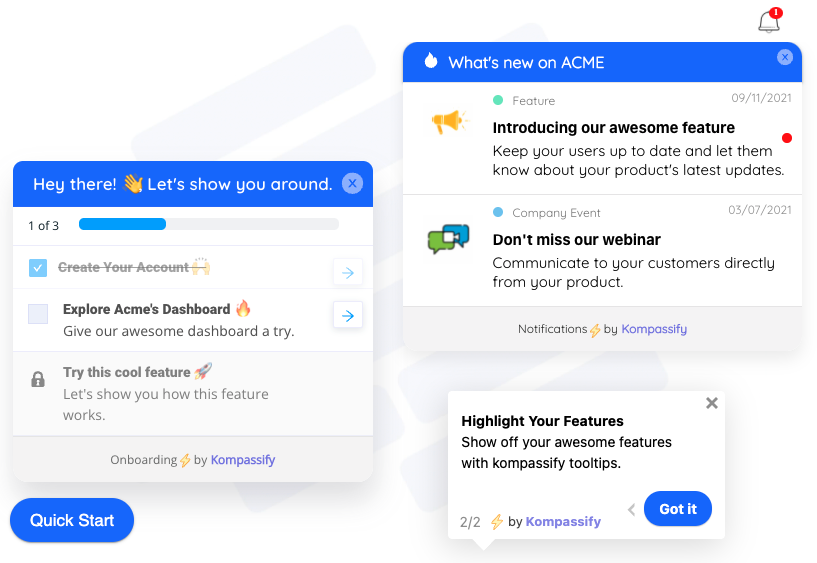
In self-serve, the product has to answer the question the CSM would have answered.
4. An escape hatch
A visible route to a human for the cases the product cannot resolve. Teams building self-serve sometimes hide support to protect margins, which trades a small, recoverable cost for a large, invisible one: users who would have stayed leave without ever telling you why.
The efficient version is a self-serve support layer that resolves the common cases and escalates the rest, rather than a support address hidden in the footer.
How to build self-serve onboarding in 5 steps
Define the outcome that ends onboarding
Remove everything between signup and the first result
Turn your repeated answers into in-product guidance
Route the exceptions to a human deliberately
Instrument the funnel and cut one step per month
1. Define the outcome that ends onboarding
Write it as a checkable sentence: a user is onboarded when they have published one page, imported one dataset, or invited one teammate and both have logged in. Without this, self-serve onboarding becomes an unbounded programme of guidance nobody can evaluate. Our user activation guide covers how to choose the right action.
2. Remove everything between signup and the first result
List every screen, field and decision a new user meets before that outcome, then delete or defer each one you cannot justify. Anything you can infer, default. Anything you need later, ask later. The remaining sequence is your onboarding, and it should be short enough to describe in a sentence.
3. Turn your repeated answers into in-product guidance
Take the last two hundred support conversations from the first week of an account's life and group them by underlying question. The top five groups are your guidance backlog: a tooltip on the control people misread, a better empty state, a checklist item that names the step people skip, a short tour for the flow people abandon.
The compounding rule: in a human-led model, answering a question costs a few minutes once. In a self-serve model at volume, the same question is asked hundreds of times a month. Any explanation you give more than a handful of times has already earned its place inside the product.
4. Route the exceptions to a human deliberately
Decide which signals justify human involvement (an account above a certain size, an integration that fails twice, a user who abandons the same step three times) and make those signals trigger an offer of help. This is what turns "no humans" into "humans where they change the outcome".
5. Instrument the funnel and cut one step per month
Self-serve onboarding is not a project with an end date; it is a number that a team owns. Build the funnel from signup to your defined outcome, look at step-level completion, and remove or explain the worst step. Repeat monthly. That cadence beats any redesign.
What to measure
| Metric | Definition | Why it matters here |
|---|---|---|
| Activation rate | Signups reaching the defined outcome | The headline number for a self-serve motion |
| Time to first value | Median time from signup to that outcome | Self-serve users abandon on a much shorter clock |
| Tickets per 100 new accounts | First-week support contacts ÷ new accounts × 100 | The honest measure of whether the product is teaching |
| Assisted share | Accounts needing human help to activate | Tells you what self-serve is really costing |
| Week-4 retention | Accounts still active four weeks in | Distinguishes activation from a habit |
Tickets per 100 new accounts is the one most teams do not track and the one that moves first when guidance improves. Pair it with the definitions in our onboarding metrics guide.
Do's and don'ts
✅ Do
- Define one checkable onboarding outcome
- Deliver a visible result before asking for setup
- Answer questions inside the interface
- Keep a visible route to a human
- Convert repeated support answers into guidance
- Trigger help on failure signals
- Cut one funnel step every month
❌ Don't
- Gate the product behind a demo request
- Ask for setup work before showing value
- Hide support to protect margins
- Point users to documentation as your answer
- Run self-serve on accounts that need implementation
- Judge the model on signups rather than activation
- Treat the build as finished
Running self-serve onboarding with Kompassify
The practical work of self-serve onboarding is replacing human explanations with in-product ones, one at a time, and measuring the effect on activation and ticket volume.
- Guide the first outcome with a short product tour that ends in a visible result.
- Bound the setup with an onboarding checklist that persists across sessions.
- Answer in place with tooltips on the controls that generate the most first-week tickets.
- Split the paths with a multi-choice step so different use cases get different onboarding.
- Watch the funnel in product analytics and remove the worst step each month.
Kompassify is a no-code digital adoption platform for SaaS teams: tours, checklists, tooltips, announcements, surveys and analytics in one place. Free up to 100 monthly active users, paid plans from $129/month, GDPR-compliant with EU hosting.
Let the product do the onboarding
Move your most-repeated explanations into the interface and watch activation rise while first-week tickets fall.
Start for Free →Frequently Asked Questions
What is self-serve onboarding?
Self-serve onboarding is a model in which a new user can sign up, set the product up and reach their first valuable outcome without a call, a demo or a human handover. The product carries the explanation through in-app guidance, sensible defaults and documentation, and human help exists as an exception path rather than as the main route. It does not forbid human contact; it removes the dependency on it.
Is self-serve onboarding cheaper than human-led onboarding?
It is not cheaper onboarding, it is onboarding that is paid for once. The investment goes into in-app guidance, defaults and content that then serve every account that follows, whereas human-led onboarding costs the same hours on the hundredth account as on the first. The trade only pays off if the product can genuinely carry the explanation; when it cannot, the cost simply moves into support and shows up as ticket volume rather than as CSM time.
When should you use self-serve onboarding?
When revenue per account cannot fund hours of human time, when setup is repeatable and largely identical across accounts, when the buyer and the user are the same person, when value can be demonstrated within one session, and when signup volume exceeds what a team could realistically call. Human-led onboarding fits the opposite conditions: high contract value, genuinely different implementations, a buying committee separate from the users, and value that depends on migration or process change.
What does self-serve onboarding require to work?
Four things. Frictionless entry, meaning no demo gate, no credit card before value and no fields you will not use immediately. An early visible result, produced before you ask the user for setup work. Answers in place, so confusion resolves inside the interface rather than turning into an exit. And an escape hatch to a human for the cases the product cannot resolve. Each missing pillar fails differently: signup drop-off, low activation, ticket volume and silent churn respectively.
Should self-serve products offer human support?
Yes. Hiding support to protect margins trades a small recoverable cost for a large invisible one, because users who would have stayed leave without telling you why. The efficient approach is a self-serve support layer that resolves common cases in-app and escalates the rest, plus deliberate triggers that offer human help on failure signals such as an integration failing twice or the same step being abandoned three times.
How do you measure self-serve onboarding?
Activation rate is the headline number: the share of signups reaching a defined, checkable outcome. Support it with time to first value, since self-serve users abandon on a much shorter clock; tickets per hundred new accounts, which is the honest measure of whether the product is teaching; assisted share, the proportion of accounts that needed a human to activate; and week-four retention, which distinguishes activation from a habit.
Can you combine self-serve and human-led onboarding?
That hybrid is the norm rather than a compromise. Most companies run self-serve onboarding for the bulk of accounts and full human onboarding for the top few percent, with the line drawn by contract value and setup complexity. The useful question is not whether the company is self-serve, but which accounts are and where the boundary sits, and then making the routing between the two deliberate rather than accidental.
What is the first thing to fix in self-serve onboarding?
The step between signup and the first visible result. List every screen, field and decision a new user meets before that result and delete or defer each one you cannot justify, defaulting anything you can infer and asking for anything you need later, later. After that, take the last two hundred first-week support conversations, group them by underlying question, and convert the top five groups into in-product guidance.