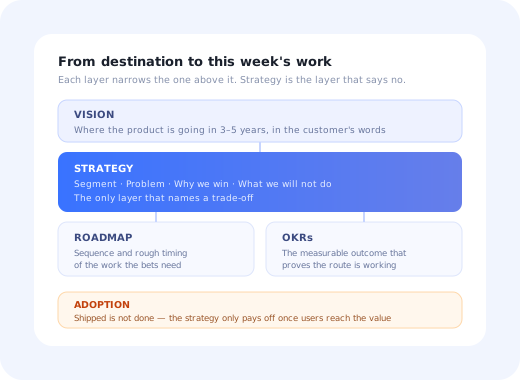
Ask five people on a product team to describe the product strategy and you will usually get five answers: a vision statement, a list of themes for the year, the roadmap, the OKRs, or a shrug. That is not a communication problem. It is a symptom of a document that never made a choice, so there is nothing memorable in it to repeat.
A product strategy is not a summary of everything you plan to do. It is the small set of decisions that explains why those things and not the twenty other reasonable options that were on the table. Its job is to be useful on a Tuesday afternoon when two sensible requests are competing for the same sprint, and someone has to say no with a reason that survives being repeated back to the person who asked.
This guide covers what belongs in a product strategy, how it relates to the roadmap and OKRs, a seven-step process for writing one, two worked examples, and the tests that separate a strategy from a wish list.
Key takeaways
- A strategy is a set of choices, not a set of intentions. If it does not say what you are giving up, it cannot guide a decision.
- Vision is the destination, strategy is the route, the roadmap is the itinerary, OKRs are the odometer. Conflating them is the most common failure.
- Five parts: diagnosis, where to play, how to win, the bets, the guardrails. Everything else is appendix.
- Two or three bets per year. A strategy with seven bets has none.
- A strategy that stops at "shipped" is half a strategy; adoption is where most of them quietly fail.
What Is a Product Strategy?
Product strategy: definition
A product strategy is the set of choices that connects a long-term product vision to the work a team does this quarter: which customers you are serving, which of their problems you are solving, why your solution wins against the alternatives they have today, the few bets you are making to get there, and what you are explicitly not doing.
The load-bearing word is choices. Every organisation has a list of good ideas that outruns its capacity by a factor of ten. Strategy is how you cut that list to something a team can actually execute, and, crucially, how you explain the cut so that the people who lost the argument still understand it.
That is why "we will delight our customers with a best-in-class experience" is not a strategy. Nobody was arguing for a worst-in-class experience. A statement that no reasonable person would oppose contains no decision, and a document made entirely of such statements cannot resolve a single real disagreement.
The practical test: hand your strategy to an engineer who joined last month, then describe two plausible features. If they can predict which one you would reject, and say why, the strategy is doing its job. If they cannot, you have written a mission statement.
Strategy vs Vision vs Roadmap vs OKRs
These four artefacts get used interchangeably in most companies, which is why product strategy has a reputation for being vague. They answer different questions and fail in different ways.
| Artefact | Answers | Horizon | Changes when | Fails by being |
|---|---|---|---|---|
| Vision | Where are we going, and what does the customer's world look like when we get there? | 3–5 years | Almost never | So abstract it inspires nobody |
| Strategy | Which segment, which problem, why we win, what we will not do | 1–2 years | A core assumption breaks | A list of intentions with no trade-off |
| Roadmap | In what order, and roughly when? | 2–4 quarters | Quarterly | A dated feature list mistaken for strategy |
| OKRs | How will we know it is working? | 1 quarter | Quarterly | Output targets dressed as outcomes |
The most expensive confusion is roadmap-as-strategy. A roadmap tells you what is next; it cannot tell you what to drop when the quarter goes sideways, because every item on it looks equally committed. Teams in that position default to whoever shouted most recently, which is how a product ends up with the shape of its loudest customers rather than the shape of its strategy. If your roadmap is currently doing the job of a strategy, the fix is the roadmap types and structures that make the underlying bets visible.
Each artefact covers a shorter horizon than the one above it. Strategy is the only layer whose output is a decision about what not to do.
The Five Parts of a Product Strategy That Works
Strip away the templates and every usable product strategy contains the same five components. If one is missing, you can predict exactly which argument the team will keep having.
-
1. The diagnosis
An honest description of the situation you are actually in: the market shift, the competitive squeeze, the retention cliff, the segment that keeps churning. Written as a claim someone could disagree with. Skip this and every later choice looks arbitrary, because nobody can see the problem it answers.
-
2. Where to play
The segment, use case and geography you are serving, and the ones you are not. This is the part teams soften into meaninglessness. "Mid-market and enterprise, with some SMB" is not a choice. "Ops teams of 5–50 at logistics companies, not the enterprise RFP market" is.
-
3. How to win
The insight or asset that makes you the better answer for that segment, and that a competitor cannot copy by next quarter. Speed, depth in one workflow, a data advantage, a distribution channel, a price structure. If your answer is "better UX", keep going until you can say which specific job it is better at.
-
4. The bets
Two or three initiatives, each with the assumption it depends on and the evidence that would kill it. A bet is not a feature; it is a claim about the world that a feature tests. Seven bets is zero bets: the team will spread thin and none will get the sustained attention that would have proved anything.
-
5. The guardrails
What must not get worse while you chase the bets: churn ceiling, performance floor, support load, the revenue line you will not put at risk. Guardrails are what make a strategy safe to execute aggressively, because they define the edge in advance rather than during the incident.
The missing-part diagnostic. No diagnosis → the team relitigates the goal every planning cycle. No "where to play" → every prospect's request looks equally valid. No "how to win" → you build a feature-parity checklist against whoever demoed last. No bets → the roadmap is a queue. No guardrails → the first regression stops everything while leadership improvises.
How to Write a Product Strategy in 7 Steps
Roughly two to three weeks of calendar time for a team that already talks to its users. Most of it is steps 1 and 2.
- Assemble the evidence you already have
- Write the diagnosis as a falsifiable claim
- Choose the segment, and name the ones you are dropping
- Find the insight that makes you the better answer
- Turn the insight into two or three bets
- Set the guardrails and the measurable claim
- Pressure-test it against the people who will execute it
1. Assemble the evidence you already have
Before commissioning new research, pull what is on the shelf: churn reasons from exit surveys, the recurring themes in customer feedback, win/loss notes, funnel drop-off, and the support tickets that never stop arriving. Most teams have enough to write a diagnosis and do not realise it because the evidence lives in five different tools.
What you are hunting for is a pattern with a shape, not "users want more integrations" but "operations managers evaluate us in week one, cannot connect their existing system without a developer, and go quiet". The second sentence contains a strategy. The first contains a backlog ticket.
2. Write the diagnosis as a falsifiable claim
One paragraph. It should name the force acting on you and be specific enough that a colleague could say "I think that is wrong, and here is why". If everyone nods, it is too safe to be useful.
A good diagnosis usually has a number and a mechanism in it: "Sixty per cent of trials never connect a data source, and the ones that do retain at three times the rate. Our growth problem is not demand, it is the first ninety minutes." That sentence already tells you where the bets will be.
3. Choose the segment, and name the ones you are dropping
Write both lists. The "not now" list is the one that gives the strategy its teeth, and it is the one that gets quietly deleted before the document reaches the all-hands. Keep it. If you cannot defend dropping a segment out loud, you have not actually dropped it, and sales will keep selling into it.
If your segments are fuzzy, spend a week on segmentation first. A strategy built on a segment nobody can identify in the product data cannot be measured later.
4. Find the insight that makes you the better answer
The strongest insights come from the job the customer is hiring you for rather than from a feature comparison. What is the thing this segment has to get done, that the alternatives make hard, and that you are structurally suited to make easy?
Structurally is the key word. An advantage that comes from a temporary head start is not a strategy; it is a lead you will lose. An advantage that comes from how you are built, who you already reach, or what you already know about the workflow is one you can compound.
5. Turn the insight into two or three bets
Each bet gets four lines: what we will do, the assumption it rests on, what we would expect to see if the assumption holds, and what would make us stop. That last line is the one that turns an initiative into an actual bet, and it is the one teams skip.
Bets and continuous discovery are the same activity at different altitudes. The bet says what you believe; discovery is how you find out cheaply whether you are right before you have spent a quarter on it.
6. Set the guardrails and the measurable claim
The measurable claim is one sentence of the form: "If this strategy is right, [metric] moves from X to Y by [date]." Pick a metric that is downstream of customer value rather than of your own activity, usually your north star metric or a leading indicator of it. Then set two or three guardrails: the things that must not degrade while you pursue it.
7. Pressure-test it against the people who will execute it
Read it to the engineers, designers and support leads and ask a single question: "What would you now stop doing?" If the answers are consistent, the strategy is legible. If everyone names something different, or nobody names anything, it is not a strategy yet; go back to step 2, because the diagnosis was probably too comfortable.
Two Product Strategy Examples
Both examples below are composites, written to show the shape of a usable strategy rather than to be copied literally. Note how short each one is and how much is given up.
Diagnosis: we win generic evaluations on price and lose every one that involves a compliance
review; our best retention sits in a single vertical we never targeted.
Where to play: regulated mid-market in that vertical. Not the broad SMB market that produced
most of last year's signups and most of last year's churn.
How to win: we already model the domain's approval chain internally; competitors bolt it on
as a workflow builder. We can ship compliance as a default, not a configuration.
Bets: (1) audit-ready defaults, betting that compliance is the buying trigger; (2) an
implementation path a non-developer can finish, betting that the blocker is setup, not features.
Guardrails: existing SMB churn must not exceed its current rate; support response times hold.
Diagnosis: we ship well and adopt badly. Forty per cent of paid accounts use one of nine
modules; expansion revenue is flat while the feature set grows.
Where to play: deepen usage inside existing accounts. Not new-logo acquisition, which is
already efficient and is not where the leak is.
How to win: we can see, per account, exactly which capability is never opened. Nobody outside
the product has that view, and it lets us intervene at the right moment instead of broadcasting.
Bets: (1) in-product guidance triggered by the gap, betting that non-adoption is a discovery
problem; (2) removing two modules entirely, betting that
breadth is suppressing depth.
Guardrails: no increase in support tickets; no regression in first-week activation.
Five Tests That Separate a Strategy From a Wish List
Run these on the draft before it goes anywhere. Most drafts fail two or three the first time, which is normal and useful.
Reverse each statement. If the opposite is obviously absurd ("we will ignore our customers"), the statement is not a choice. Real strategy statements have a sane opposite that a competent competitor might genuinely pick.
Point at the thing you gave up. If nothing was given up (no segment, no revenue line, no beloved feature area) you have written a list of ambitions and capacity will make the real choices for you, badly.
Someone who joined last month reads it, then predicts which of two proposed features you would reject. If they cannot, the strategy will not survive your absence from the prioritisation meeting.
Name the observation, in the next two quarters, that would tell you this was wrong. A strategy that cannot be wrong cannot be learned from, and will quietly persist long after the market has moved.
Trace one bet from "shipped" to "a user in the target segment reaches value". If the trace stops at release, the strategy has a gap where most of its expected return lives.
Can three people on the team state it from memory, in their own words, and agree? A strategy nobody can repeat is a strategy that is not being used, whatever the document says.
Making the Strategy Survive Contact With Users
Test 5 deserves its own section, because it is where the most competent strategies still lose. A bet is a claim about customer behaviour. Shipping the feature does not test the claim; it only creates the conditions under which the claim could be tested. Between the release and the evidence sits a gap most strategy documents do not mention: users have to notice the thing exists, understand what it is for, and get through it to something valuable.
This is not a small tax. A capability that nobody discovers produces exactly the same metrics as a capability you never built, which means the strategy gets marked wrong for the wrong reason. The team concludes the segment did not want it, when in fact the segment never saw it. That is a very expensive misreading, because it usually ends with the next strategy avoiding the right area.
Attach a distribution plan to every bet. Who in the target segment needs to encounter this, at what moment in their workflow, and what will put it in front of them? In-product answers usually beat email: a contextual announcement reaches an active user at the point where the capability is relevant, and a short guided flow gets them past the first-use cliff that otherwise eats the result.
The measurement side matters just as much. If you cannot tell which accounts in the target segment adopted the bet, you cannot tell whether the strategy is working, only whether the team shipped. Feature adoption metrics, read per segment rather than in aggregate, are what turn a bet into a learning.
Product Strategy: Do vs. Don't
✓ Do
- Write a diagnosis a colleague could argue with
- Name the segments you are not serving, in writing
- Limit yourself to two or three bets a year
- Give every bet a kill condition, not just a success metric
- Set guardrails before you need them
- Attach a distribution and adoption plan to each bet
- Re-read it in every prioritisation meeting until people quote it back
✗ Don't
- Present a themed roadmap and call it a strategy
- Write statements whose opposite is absurd
- Hedge the segment choice with "and also"
- Rewrite it every quarter; that is planning, not strategy
- Keep it in a deck only leadership has seen
- Measure it with output metrics like features shipped
- Assume shipping a bet is the same as testing it
The One-Paragraph Version
A product strategy is the set of choices that turns a vision into this quarter's work: a diagnosis of the situation, the segment you are serving and the ones you are not, the structural reason you win there, two or three bets with kill conditions, and the guardrails that must hold while you chase them. It is distinct from the roadmap (sequence), from OKRs (measurement) and from vision (destination). Test it by inversion, by what it sacrifices, by whether a new joiner can apply it, by whether it could be proven wrong, and by whether each bet has a path from shipped to adopted. Then say it often enough that people repeat it without opening the document.
Give Every Strategic Bet a Path to Adoption
A bet only pays off if the right users find it, understand it and get through it. Kompassify lets you launch product tours, in-app guides, checklists and announcements to a specific segment, and measure adoption per segment, without writing code. Free up to 100 monthly active users, from $129/mo after that, GDPR-compliant and EU-hosted.
Start for Free →Frequently Asked Questions
What is a product strategy?
A product strategy is the set of choices that connects a long-term product vision to the work a team does this quarter. It names the customer segment you are serving, the problem you are solving for them, why your solution wins against the alternatives, the small number of bets you are making to get there, and the things you are explicitly not doing. If a document does not say what you are giving up, it is a plan, not a strategy.
What is the difference between product vision, product strategy and a roadmap?
The vision is the destination: where the product is going over three to five years, stated in terms of the customer's world, not your features. The strategy is the route: which segment, which problem, which advantage, which bets. The roadmap is the itinerary: the sequence and rough timing of the work those bets require. OKRs are the odometer: the measurable outcomes that tell you the route is working. Teams get into trouble when a roadmap is treated as a strategy, because a list of features cannot tell you what to cut when the quarter goes sideways.
How long should a product strategy be?
One to three pages, or a single slide plus an appendix. Length is not the constraint: decisiveness is. A strategy that fits on a page forces you to name a segment, a problem and two or three bets. A twenty-page strategy is almost always a research summary with no choices in it. The test is whether a new engineer could read it and correctly predict which of two proposed features you would reject.
How often should a product strategy be updated?
Review it quarterly, rewrite it roughly annually or whenever a core assumption breaks. Bets and guardrails move often; the segment and the winning insight should be stable enough that changing them is a real event. If your strategy changes every quarter, you are not doing strategy, you are doing planning with a fancier name, and the whipsaw costs your team more than the flexibility gains you.
What makes a product strategy fail?
Four things, in rough order of frequency: it names no trade-off, so it cannot guide a decision; it is written for executives and never reaches the team making daily calls; it has no measurable claim, so nobody can tell whether it worked; and it stops at the point of shipping, ignoring whether users ever discover and adopt what was built. The last one is the quietest killer: a correct strategy executed into a product nobody learns to use produces the same result as a wrong one. See feature discovery for the mechanics of that gap.
Who owns the product strategy?
Product leadership owns writing and arbitrating it; the whole product trio owns making it real. In a company with several product teams, there is normally one company-level product strategy and a shorter strategy per team that inherits from it. The failure mode is a strategy written in isolation by a leader and handed down: it survives the all-hands and dies on contact with the first ambiguous prioritisation call, because nobody outside the room understands the reasoning.
Do small startups need a product strategy?
Yes, and it is shorter. Before product-market fit the strategy is mostly a hypothesis: this segment, this problem, this reason we think we can win, and the evidence that would prove us wrong. That fits in a paragraph. What a startup should not do is skip the trade-off: a five-person team that will not say who it is not building for is the team most likely to build a product that is nearly right for everybody and compelling to nobody.