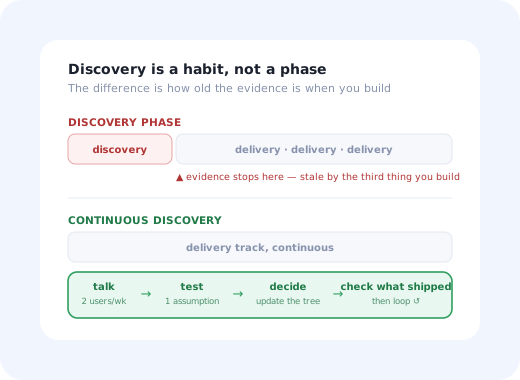
Every product team has shipped something that nobody used. The post-mortem usually blames execution: the rollout was quiet, the UI was clumsy, the timing was bad. Occasionally that is true. Far more often the feature was decided in a planning session eight months earlier, and nothing that happened between the decision and the release was capable of changing it.
Product discovery is the work that prevents that: figuring out what is worth building, and why, before and during the building. It is the counterpart to delivery, which is the work of building the thing well. A team can be excellent at delivery and still waste a year, which is exactly what makes discovery worth being deliberate about.
This guide covers what discovery actually is, the four risks it exists to reduce, why continuous discovery behaves so differently from a discovery phase, how the opportunity solution tree keeps the work honest, a weekly cadence that survives contact with a real roadmap, and the ways discovery quietly turns into theatre.
Key Takeaways
- Discovery decides what to build; delivery builds it well. They run in parallel, permanently, not as sequential phases.
- Four risks, not one: value, usability, feasibility and viability. Most teams test only usability and are surprised by the other three.
- Continuous beats comprehensive. Two customer conversations every week teaches a team more than thirty interviews twice a year, because the evidence is fresh for the decision in front of you.
- The opportunity solution tree is a discipline, not a diagram. Its value is that every solution must hang from a named opportunity, which exposes ideas attached to nothing.
- Recruit from inside the product. An in-app prompt targeted at users who just hit the relevant workflow fills a week of interviews faster than any email list.
- Product discovery is not feature discovery. One is how your team decides what to build; the other is whether users can find what you already built.
What Product Discovery Is
Product discovery, in one paragraph
Product discovery is the work of deciding what to build and why, as distinct from delivery, which is the work of building it well. It exists to reduce the risk of committing engineering months to something nobody needs: discovery establishes that a problem is real and worth solving, that the proposed solution solves it, that people will actually adopt it, and that it makes sense for the business. Its output is not a feature; it is a decision backed by evidence, and that includes the decision not to build something.
The most useful thing about that definition is the last clause. A discovery process that has never killed an idea is not reducing risk; it is generating justification. If the team's answer at the end of every discovery effort is "yes, build it as planned", discovery is decorating decisions that were already made.
Product discovery is not feature discovery. They sound alike and mean opposite things. Product discovery is a team activity: how you decide what is worth building. Feature discovery is a user experience: whether people can find the capabilities that already exist in your product. The first happens before the code; the second is a problem you have after shipping, and it is solved with in-app guidance and better empty states rather than with more research.
The Four Risks Discovery Exists to Reduce
Discovery is not one question but four, and they fail independently. A team can prove that people want something, build it beautifully, and still lose, because it could not be built at a sensible cost, or because it cannibalised the plan the business runs on.
| Risk | The question | How it usually shows up when skipped |
|---|---|---|
| Value | Will anyone actually want this? | The feature ships, works perfectly, and usage never rises above a few percent |
| Usability | Can people work out how to use it? | High intent, high drop-off: people start and abandon the flow |
| Feasibility | Can we build it, with what we have, in a sane amount of time? | A one-sprint estimate becomes a quarter and the scope is cut until it no longer solves the problem |
| Viability | Does it work for the business: pricing, support, legal, strategy? | It launches, users love it, and it quietly increases support load or undercuts a paid tier |
Most teams over-invest in usability, because it is the easiest to test and the most visible in a design review, and under-invest in value, which is the one that decides whether the other three matter at all. If you only have capacity to test one thing, test whether the problem is real and painful enough that someone has already tried to solve it another way.
Continuous Discovery vs. a Discovery Phase
The word "discovery" gets attached to two quite different practices, and confusing them is why teams conclude that discovery does not work for them.
| Discovery phase | Continuous discovery | |
|---|---|---|
| Timing | A block before delivery starts | Every week, alongside delivery, permanently |
| Output | A research deck or requirements document | A decision, and an updated view of what the team believes |
| Who does it | A researcher or PM, reported to the team | The trio who will build it: product, design, engineering |
| Evidence age at build time | Months old by the third item in the plan | Days old, because it tracks the current decision |
| Failure mode | The plan survives contact with evidence that contradicts it | Drifts into a standing meeting with no decisions attached |
The usual working definition of continuous discovery is a team touching its customers at least weekly, with the people who will build the thing present, in small activities aimed at the decision currently in front of them. The phrase to hold on to is the decision currently in front of them; that is what stops it becoming a research programme with no consumer.
There is a reason the engineer being in the room matters so much. Second-hand research does not change minds. A summary of five interviews is easy to argue with; sitting through one interview where a user cannot find the thing you built is not. The cheapest way to make discovery influential is to stop relaying it.
The Opportunity Solution Tree
The opportunity solution tree is the most useful single artefact in discovery, and its value is almost entirely in the constraint it imposes rather than in the picture it makes.
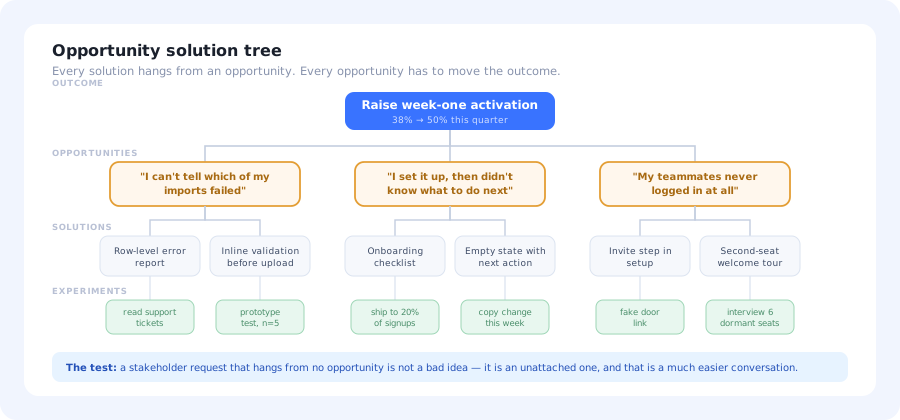
Every solution hangs from a named opportunity; every opportunity has to plausibly move the outcome. Ideas attached to nothing become visible immediately.
The structure has four levels:
- Outcome: the one measurable thing this team is trying to move this quarter.
- Opportunities: customer needs, pains and desires that could plausibly move it, phrased in the customer's terms.
- Solutions: candidate things you could build for a given opportunity, ideally several per opportunity.
- Experiments: the cheapest tests that would tell you whether a solution works.
Two rules make it work. First, opportunities are described as the customer experiences them, not as missing features: "I cannot tell which of my imports failed" rather than "needs an import error log". A missing feature is a solution wearing an opportunity's clothes, and once it is in the opportunity slot nobody will generate alternatives to it.
Second, always put more than one solution under an opportunity. A tree with exactly one solution per branch is a roadmap that has been reformatted. The point of the structure is to force comparison, and comparison requires at least two options.
The tree also gives you a clean way to say no. When a stakeholder brings a feature request, the question stops being "is this a good idea", which is unanswerable and political, and becomes "which opportunity does this hang from, and is that opportunity above the line this quarter?" That is a much easier conversation, and it is the same discipline our guide to handling feature requests applies at intake.
A Weekly Cadence That Survives a Real Roadmap
Discovery dies of ambition. Teams design a research programme, run it for three weeks, hit a deadline, and never restart. What survives is small, boring and scheduled.
1. Two customer conversations a week
Twenty to thirty minutes each, ideally with the designer or engineer working on the relevant area. The single most important interviewing rule: ask about the last time they did the task, not about what they want. "Walk me through the last time you exported a report" produces evidence; "would you use an export feature?" produces politeness. Our guide to user research methods covers the interviewing mechanics in more depth.
2. One assumption test
Pick the assumption whose failure would be most expensive, and find the cheapest thing that would challenge it. That is rarely a prototype. It might be a fake-door link, a message to twenty accounts, an analysis of whether the behaviour you are assuming already appears in your event data, or a usability test on a sketch. The test only has to be capable of producing a "no".
3. Thirty minutes to update what you believe
The step teams skip, and the one that makes the rest compound. Update the tree, write down what changed, and name the next most dangerous assumption. Without this, discovery generates a stream of interesting anecdotes that never resolve into a decision.
4. A standing look at what shipped
Discovery does not stop at release. Whether the thing you built moved the outcome is the highest quality evidence you will ever get about that opportunity, and it is free. Checking feature adoption a few weeks after launch belongs in the discovery loop, not in a separate retrospective nobody reads.
Which Method for Which Question
Method choice is mostly a matter of matching the tool to the risk. The common mistake is reaching for interviews regardless of the question: interviews are excellent for understanding behaviour and context, and unreliable for predicting whether someone will use a thing.
| Question you are asking | Method that answers it | What it cannot tell you |
|---|---|---|
| Is this problem real, and how do people handle it today? | Customer interviews about recent, specific events | Whether they would pay for or adopt a solution |
| Where exactly do people struggle in the current flow? | Usability testing and session replay | Whether the flow is worth having at all |
| How many people hit this, and how often? | Product analytics and funnel analysis | Why they did it: behaviour without motive |
| Would anyone actually use this if it existed? | Fake-door test, concierge test, or a real prototype | Whether it is worth building at production quality |
| Which of these options do people prefer, and why? | Comparative prototype tests, small surveys with follow-ups | Absolute demand: preference is not intent |
| Does the change actually move the metric? | A controlled experiment after release | Anything about ideas you did not build |
The practical rule for small teams: use analytics to find where, interviews to find why, and a cheap test to find whether. Most discovery failures come from using one of those three to answer a question belonging to another.
Recruiting: The Bottleneck Nobody Plans For
Teams rarely abandon discovery because they stopped believing in it. They abandon it because scheduling conversations is a chore, the calendar wins, and the habit lapses. Fixing recruitment fixes the habit.
The most reliable source is your own product. A short in-app prompt shown to users at the moment they finish, or abandon, the workflow you are studying reaches exactly the right people, in context, while the experience is fresh. That is both faster and better evidence than an email blast to a general list, where the people who reply are systematically the ones with the most spare time and the strongest opinions.
Two details make it work in practice. Target it narrowly, using segmentation so only users who actually did the thing see the prompt. And keep the ask small: a single question with a booking link converts far better than a form. The same in-app survey mechanism can also collect the lightweight quantitative signal that tells you which conversations to prioritise.
Beware the sample you can reach. The users who agree to talk are your engaged ones. The people whose problem is most severe are often the ones who already left, and they will never answer an in-app prompt. Pair interview evidence with exit survey data and with the drop-off in your own funnel, or you will optimise for the users you were never at risk of losing.
Five Ways Discovery Turns Into Theatre
Research that cannot change the plan
If the roadmap is committed for two quarters, discovery can only produce justification. Before starting, ask what finding would change what you build; if there is no answer, do not run the study.
Asking users what they want
People are poor predictors of their own future behaviour and generous with hypothetical enthusiasm. Ask about the last time, not the next time.
One solution per opportunity
A tree with a single branch under each opportunity is a roadmap in disguise. Without alternatives there is nothing to compare, and comparison is the point.
Discovery done by proxy
A PM summarising interviews to the team gets debated; an engineer who watched one does not need convincing. Relayed research loses most of its force in transit.
Never killing anything
If no idea has been dropped in six months, the process is not testing assumptions; it is collecting supportive quotes. A healthy discovery habit produces regular, unglamorous "no".
Stopping at launch
Post-release behaviour is the strongest evidence available about whether the opportunity was real, and it is free. Teams that skip it repeat the same misjudgement in the next quarter.
Discovery and Onboarding Are the Same Loop
For teams whose outcome is activation or adoption, discovery has an unusually short feedback cycle, because the evidence is sitting in the product already.
The onboarding funnel tells you which step people fail at; that is the where. A handful of conversations with users who failed at exactly that step tells you why, and it is usually not what the team assumed. And the fix is often testable in days rather than quarters, because changing a tooltip, a checklist or the order of a tour does not require a release.
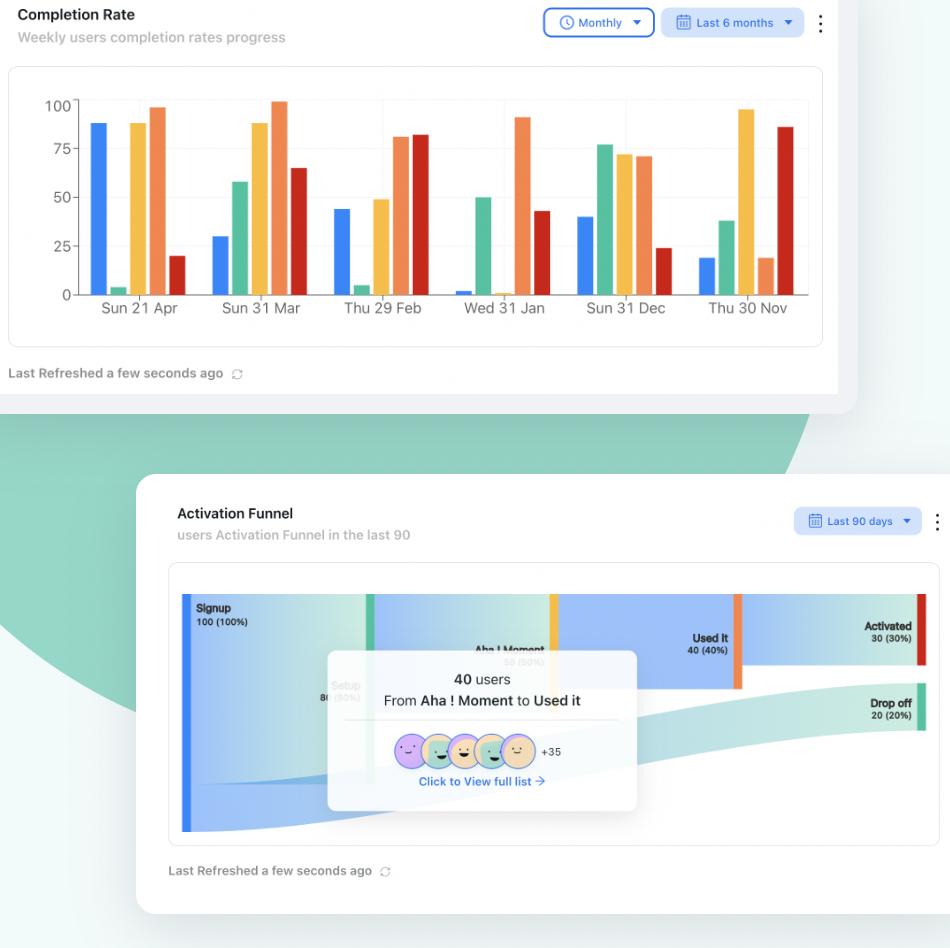
The funnel gives you the where. It will not give you the why; that is what the two conversations a week are for.
That last point is what makes activation work such a good place to build the discovery habit. The loop from "we think this is the problem" to "we were wrong about that" can run in a week, which is short enough that people keep doing it.
Close the discovery loop inside the product
Kompassify covers both ends of the loop: recruit interview participants and run micro-surveys targeted at users who just hit the exact workflow you are studying, then test the fix as a tour, checklist or tooltip and watch step-level completion, no release required, so a discovery cycle takes days rather than a quarter. Free up to 100 monthly active users, plans from $129/month, GDPR-compliant and EU-hosted.
Start for free →The One-Sentence Version
Product discovery is the weekly habit of keeping your decisions attached to evidence: a couple of real conversations, one cheap test of the assumption that would hurt most if it were wrong, and the willingness to drop an idea when it fails.
Frequently Asked Questions
What is product discovery?
Product discovery is the work of deciding what to build and why, as distinct from delivery, which is the work of building it well. It exists to reduce the risk of shipping something nobody needs: before a team commits engineering months, discovery establishes that a problem is real and worth solving, that the proposed solution actually solves it, that people will adopt it, and that it makes sense for the business. Its output is not a feature but a decision backed by evidence, including the decision not to build something.
What is the difference between product discovery and feature discovery?
They sound similar and mean opposite things. Product discovery is a team activity: how a product team works out what is worth building. Feature discovery is a user experience: whether the people using your product can find the capabilities that already exist in it. Product discovery happens before the code; feature discovery is a problem you have after shipping, and it is usually solved with better in-app guidance, empty states and contextual prompts rather than with more research.
What is continuous discovery?
Continuous discovery is the practice of running discovery as a permanent weekly habit alongside delivery rather than as a phase that precedes it. The usual working definition is a team touching its customers at least weekly, with the people who will build the thing involved in those conversations, in small research activities aimed at the decision currently in front of them. The contrast is a discovery phase, which produces a large research artefact once and then goes quiet, so the evidence is stale by the time the third feature in the plan gets built.
What is an opportunity solution tree?
An opportunity solution tree is a simple visual map that connects a desired outcome at the top to the customer opportunities, needs, pains and desires, that could move it, then to candidate solutions under each opportunity, and finally to the experiments that would test those solutions. Its value is less the diagram than the discipline it enforces: every solution has to hang from a named opportunity, and every opportunity has to plausibly move the outcome, which makes it obvious when a popular feature idea is not attached to anything.
How much time should a team spend on product discovery?
Less than most teams fear and more consistently than most manage. A common working target is a few hours a week rather than a fixed percentage of the roadmap: one or two customer conversations, one small assumption test, and a short session to update what the team believes. The consistency matters far more than the volume, because the point is to keep evidence fresh for the decision in front of you. A team that does two interviews every week learns more than one that does thirty interviews twice a year.
How do you do product discovery without a dedicated researcher?
Recruit from the product itself rather than from a panel: an in-app prompt shown to users who just hit the relevant workflow will fill a week of interviews faster than any email list, and it reaches people in context. Keep sessions to twenty or thirty minutes and ask about the last time they did the task rather than about what they want. Have the engineer or designer who will build the thing sit in, because second-hand research persuades nobody. And write down the one thing that changed your mind after each conversation; if nothing ever changes, the questions are wrong.