Ask five people in a company what the product roadmap is for and you will get five answers. Sales wants to know what they can sell in Q4. Support wants to know when the thing customers complain about gets fixed. Engineering wants to know what to prepare for. Leadership wants to know that the strategy is being executed. The product manager, meanwhile, wants a document that survives contact with reality.
Those expectations are not all compatible, which is why so many roadmaps end up as a spreadsheet of features against quarters that everybody quietly distrusts. A better roadmap starts from a narrower claim: this is what we intend to work on next, and this is why.
This guide covers what a roadmap is and is not, how it differs from the artefacts either side of it, the five formats worth knowing, two templates you can copy today, a seven-step process for building one, and the part most guides skip: how to communicate it so it actually changes what other teams do.
Key Takeaways
- A roadmap states intent, not a delivery date. If learning something new breaks the document, it was a project plan.
- Items should be problems or outcomes. A list of features is a backlog wearing a roadmap's clothes.
- Now-next-later beats quarters for most teams, because it communicates sequence and confidence without generating promises.
- Dates only where a date is a real constraint: regulation, contracts, a partner's launch. Everywhere else they are read as commitments.
- What is not on it matters as much as what is. A roadmap with no visible trade-offs is a wish list.
- Publishing is half the job. A roadmap nobody reads changes nothing; a shipped item nobody notices changes nothing either.
What Is a Product Roadmap?
Product roadmap: definition
A product roadmap is a shared statement of what a product team intends to work on next and why. It sits between the strategy above it and the delivery work below it, so that anyone reading it can see which problems the team has chosen to solve in the coming period, in what order, and which they have deliberately postponed. A roadmap is about intent and sequence, not a schedule. A good one survives learning something new; a project plan is broken by it.
The clearest way to tell whether a document is really a roadmap is to ask what happens when the team discovers something. If a customer interview reveals that the problem behind the next item is not the problem you thought it was, a roadmap can absorb that: the outcome stays, the solution changes. A feature-and-date grid cannot absorb it, so the team either ignores the finding or has an awkward conversation about slipping.
A roadmap has three jobs, and they explain most disagreements about format:
Everyone who plans around the product (sales, support, marketing, customer success) can see the same picture and stop asking individually.
It makes the order explicit, and with it the trade-off: choosing this now means not choosing that.
Each item carries a reason. Without the why, a roadmap is a list of demands and every stakeholder negotiates their item individually.
A commitment register, a backlog, a release calendar, or a place to record every request the team has received.
Roadmap vs Backlog vs Release Plan
These three artefacts get conflated constantly, usually because one tool is being asked to do all three jobs. They differ in altitude, horizon and audience.
| Roadmap | Backlog | Release plan | |
|---|---|---|---|
| Written at the level of | Problems, outcomes, themes | Tickets and stories | Scope that ships together |
| Horizon | One to three quarters | Now to a few sprints | One release |
| Audience | The whole company | The delivery team | Whoever must coordinate the launch |
| Number of items | Roughly ten to twenty | Hundreds | Whatever is in scope |
| Changes when | A strategic decision changes | Continuously | Scope or date moves |
| Sign it is broken | It lists tickets | Nobody can find the top of it | It is being used as the roadmap |
The 5 Types of Product Roadmap
Format is not cosmetic; it determines what conversations the roadmap makes easy and which it makes hard. Pick based on how much genuine date pressure exists and how much uncertainty you are carrying.
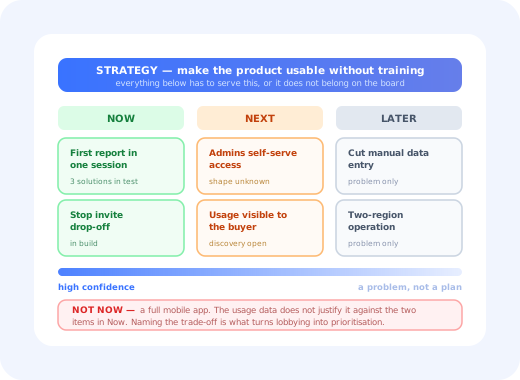
The same six months of work in two formats. One creates a quarterly argument about slippage; the other creates a conversation about priorities.
-
Now / Next / Later
Three confidence bands instead of dates. "Now" is committed and in progress, "next" is decided but unshaped, "later" is a problem worth solving that nobody has designed yet. The right default for most teams because vagueness increases honestly with distance.
-
Outcome / theme roadmap
Organised around results ("cut time to first report", "make the product usable without training") with features listed as candidate solutions rather than commitments. The best internal format, because it keeps the team's options open while making the intent unambiguous.
-
Timeline / Gantt roadmap
Items against calendar periods. Appropriate when real external dates exist: regulatory changes, a contractual delivery, a partner launch, a trade show. Damaging when used by default, because it invites every stakeholder to negotiate a date rather than a priority.
-
Release roadmap
Organised around what ships together. Useful for versioned products, on-premise software, hardware-adjacent releases and anything where marketing, support and enablement must be coordinated. Pairs naturally with a product launch checklist.
-
Platform / technical roadmap
Foundational work other teams depend on: migrations, performance, architecture, deprecations. Kept separately so infrastructure work is visible rather than competing for space with customer-facing items and always losing.
What Goes on a Roadmap (and What Doesn't)
A roadmap item should be readable by someone outside the product team and still mean something. That rules out ticket titles, and it rules out one-word themes.
Belongs on the roadmap
- A problem worth solving, in the customer's language
- The outcome you expect if you solve it
- Rough confidence: decided, shaped, or still a question
- Who it is for, when a segment is the point
- Explicit "not doing this yet" entries
Belongs somewhere else
- Individual tickets and stories, that is the backlog
- Every incoming request, that is a feature request pipeline
- Precise dates you have not committed to
- Solutions for problems nobody has validated
- Work already shipped, that is release notes
How to Build a Product Roadmap in 7 Steps
- Write down the strategy the roadmap has to serve
- Collect inputs from everywhere, then stop collecting
- Convert requests into problems
- Score and sequence with an explicit method
- Choose the format for the audience
- Make the trade-offs visible
- Set the review cadence before you publish
1. Write down the strategy the roadmap has to serve
A roadmap cannot prioritise anything if there is no statement of what the product is trying to achieve this year. One paragraph is enough: who you are serving, what changes for them, and what you are choosing not to chase. If your team runs on product OKRs, those are the input; the roadmap becomes the plan for how the key results get moved.
2. Collect inputs from everywhere, then stop collecting
Sales objections, support ticket themes, churn interviews, usage data, competitor gaps, technical debt the engineers keep raising, and the qualitative work in continuous discovery. Set a deadline for input. Roadmaps that stay permanently open for submissions never get published.
3. Convert requests into problems
This is the step that separates a roadmap from a queue. "Add a Kanban view" is a solution; the problem underneath might be "managers cannot see workload distribution at a glance". Stated as a problem, three cheaper solutions become visible, and the roadmap survives the discovery that the requested feature was not the best one.
4. Score and sequence with an explicit method
Whichever scoring approach you use, the requirement is that it is written down and applied consistently; otherwise the loudest stakeholder wins and everyone knows it. Our feature prioritization guide covers seven frameworks and how to pick one, and the Kano model is particularly useful for separating items that delight from items that merely stop complaints.
5. Choose the format for the audience
Internally, an outcome roadmap keeps solution options open. For the wider company, now-next-later is easier to read and harder to misinterpret. For customers, themes only. It is entirely reasonable to maintain one source of truth and generate two views from it; what is not reasonable is maintaining two roadmaps that drift apart.
6. Make the trade-offs visible
A roadmap with no visible cost is a wish list, and it fails the moment someone asks for their item to be added. Include a short "not now" section naming the significant things you decided against and why. This single addition converts most roadmap conversations from lobbying into prioritisation, because the stakeholder can see what their request would displace.
7. Set the review cadence before you publish
Decide up front how often the roadmap is revisited and who attends. Monthly review with quarterly re-planning suits most teams. Announcing the cadence at publication is what stops every change being read as a broken promise: people accept revision far more readily when they were told in advance that revision is the process.
Two Templates You Can Copy
Both fit on one page, which is the real constraint. A roadmap that needs scrolling in two directions has stopped being a communication tool.
Template 1: Now / Next / Later
| Now (in build) | Next (decided, unshaped) | Later (problem only) |
|---|---|---|
| New users reach their first report in one session Why: most trials end before anyone sees output |
Admins can grant access without contacting us Why: top support driver in enterprise accounts |
Reduce manual data entry for daily users Why: most-cited friction in churn interviews |
| Stop drop-off when inviting a team Why: single-user accounts renew far less often |
Make product usage visible to the economic buyer Why: renewals stall without evidence of value |
Support customers operating in two regions Why: recurring blocker in larger deals |
| Not now: a full mobile application; the usage data does not yet justify the investment against the two items in "Now". | ||
Template 2: Outcome roadmap
| Outcome | Measure | Candidate solutions | Confidence |
|---|---|---|---|
| New accounts reach value in their first session | Time to first report; share of accounts completing setup | Guided setup checklist · sample data · templates | High, in build |
| Teams adopt the product, not just the buyer | Accounts with more than one weekly active user | Invite prompts · shared views · role-based onboarding | Medium, shaping |
| Customers discover what they already pay for | Share of paid capabilities used per account | Contextual guides · in-app announcements · resource centre | Medium, shaping |
| Support load per account falls | Tickets per 100 active users | In-product help · better empty states · self-serve access | Low, discovery |
Communicating the Roadmap
A roadmap is a communication artefact, so the work is only half done when the document exists. Three audiences need different things from it.
One canonical location, reviewed on a known cadence, with the reasoning attached. Sales and support need to know what to say today about items in "later", usually "it is a problem we intend to solve, with no date".
Themes and directions, never dates. A customer-facing roadmap builds trust only if it is paired with reliable follow-through when things actually ship.
The audience that never reads a roadmap page. They find out what changed inside the product or not at all, which is where most roadmap value is quietly lost.
That third audience is where roadmaps usually leak. A team can execute a roadmap flawlessly and see no change in adoption, because the people who would benefit never learned the thing exists. The fix is unglamorous: connect each shipped item to release notes, an in-app announcement for the changes that alter how someone works, and a short guide the first time a user lands on the new capability. The full playbook is in how to announce a new feature.
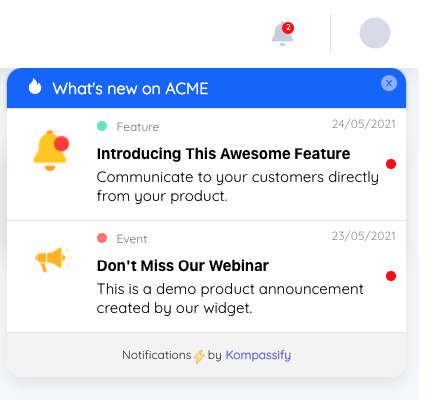
The last mile of a roadmap. Shipping an item and telling the people who asked for it are two different projects, and only one of them is usually planned.
Whether the Roadmap Worked
Delivery percentage is a poor measure; a team that ships everything it listed may simply have listed safe things. Three better questions:
| Question | What a good answer looks like |
|---|---|
| Did the outcomes move? | The measure attached to each item changed in the intended direction, whether or not the original solution survived |
| Did people adopt what shipped? | Usage of each delivered item, tracked deliberately; see feature adoption |
| Did other teams plan around it? | Sales, support and marketing referenced the roadmap without being asked to. If they did not, it was not a roadmap; it was a document |
Roadmap Do vs. Don't
Do
- Write items as problems with an expected outcome
- Show confidence decreasing with distance
- Name what you decided against, and why
- Publish the review cadence alongside the roadmap
- Keep one source of truth, generate views from it
- Plan the announcement of an item before you build it
Don't
- Put dates on things that have no external deadline
- Let the roadmap become a list of every request
- Promise a specific solution before discovery
- Maintain two roadmaps that quietly diverge
- Measure success as percentage delivered
- Assume shipping and adoption are the same event
Closing the Gap Between Roadmap and Adoption
The most expensive roadmap failure is not a missed date. It is an item that shipped exactly as planned and changed nothing, because the users it was built for never found it. That gap sits outside the product team's usual toolkit: it needs in-app announcements when a change alters someone's workflow, contextual guidance the first time a user reaches the new screen, and adoption data afterwards to tell whether the item earned its place.
Kompassify covers that last mile without engineering time. Product teams build the announcement, the walkthrough and the tooltip for a shipped roadmap item visually, target them at the segment the item was built for, and read the adoption numbers per guide, so the next roadmap review starts from evidence about what worked rather than from the delivery percentage.
Make sure the roadmap you shipped is the product people use
Kompassify lets product teams announce releases, guide users to new features and measure adoption without a single engineering ticket. Free up to 100 monthly active users, plans from $129/month, GDPR-compliant and EU-hosted.
Start for free →The One-Sentence Version
A product roadmap is the shortest honest answer to "what are you working on and why", written as problems rather than features, sequenced by confidence rather than by calendar, and finished only when the people it was built for know what changed.
Frequently Asked Questions
What is a product roadmap?
A product roadmap is a shared statement of what a product team intends to work on next and why. It connects the strategy above it to the delivery work below it, so that anyone reading it can see which problems the team has chosen to solve in the coming period and which they have deliberately postponed. A roadmap is a document about intent and sequence, not a delivery schedule: it should survive learning something new, whereas a project plan is broken by it.
What is the difference between a roadmap and a backlog?
A backlog is an ordered list of work items the team could pick up, written at the level of tickets and maintained continuously. A roadmap sits a level above it and is written at the level of problems, outcomes or themes, covering a longer horizon and a much smaller number of items. The practical test is the audience: a backlog is for the people doing the work this fortnight, while a roadmap is for everyone who needs to plan around the product: sales, support, marketing, customer success and leadership. A roadmap that lists tickets has collapsed into a backlog and stopped being useful to that audience.
What are the main types of product roadmap?
Five formats cover almost every real case. Now-next-later groups work into three confidence bands instead of dates. An outcome or theme roadmap organises around the results the team is chasing, with features as candidate solutions rather than commitments. A timeline roadmap places items against calendar periods and is appropriate when genuine external deadlines exist. A release roadmap is organised around what ships together, useful for products with versioned releases or coordinated launches. A platform or technical roadmap covers foundational work such as migrations that other teams depend on. Most teams need an outcome roadmap internally and a now-next-later view for everyone else.
Should you put dates on a product roadmap?
Put dates only where a date is genuinely a constraint: a regulatory deadline, a contractual commitment, a conference, an integration partner's schedule. Everywhere else, dates are read as promises no matter how many disclaimers surround them, and the team spends the next quarter defending an estimate made when it knew least. Confidence bands such as now, next and later communicate the same sequencing without generating commitments the team did not intend to make.
How often should a product roadmap be updated?
Review it on a fixed cadence (monthly is common, quarterly at the slowest) and update it whenever a real decision changes, not on a schedule for its own sake. Two failure modes sit either side of that. A roadmap that never changes is not being informed by anything the team is learning, and a roadmap that changes weekly stops functioning as a shared plan because nobody can rely on it. The signal to watch is whether other teams still check it before planning their own work.
Should a product roadmap be public?
A customer-facing roadmap can build real trust, but it must be a different artefact from the internal one rather than the same document with fewer columns. Publish themes and directions instead of specific features, avoid dates entirely, and pair it with a reliable way of telling customers what actually shipped: a changelog, release notes and in-app announcements. The risk of a public roadmap is not that competitors read it; it is that customers plan around something that later changes, so the follow-through matters more than the publication.