Two users sign up for your product on the same morning. Both fill in the same form, both land on the same empty dashboard. One of them is still using the product a year later. The other never comes back after that first session.
The difference between them is almost never the marketing that brought them in. It is whether they got far enough into the product to feel, for themselves, what it is actually for. That instant of realisation has a name: the aha moment. It is the moment your product stops being a claim on a landing page and becomes something the user has experienced.
Nearly every onboarding problem worth solving is really a question about this moment: what is it, how many people reach it, how long it takes them, and what stands in their way. This guide covers the aha moment definition, how it differs from activation and the habit moment, real examples from products you know, a practical method for finding yours in your own data, and the in-app tactics that get more users there faster.
Key Takeaways
- The aha moment is when a user first experiences your product's core value. Not when they sign up, and not when they finish a tour, but when the promise becomes something they've felt.
- It has to be an event, not a slogan. If you can't express your aha moment as a concrete action in your analytics, you can't measure it or improve it.
- Aha is the experience, activation is the metric. The activation milestone you track should be your aha moment written as a countable event.
- You find it in the gap between retained and churned users. Look for the early action that best separates the users who stayed from the users who left, then validate it causally.
- Time to value is the number to attack. Every extra step, empty screen, and unanswered question between signup and aha costs you users who would have loved the product.
- Guidance beats hoping. Checklists, contextual tours, and well-placed tooltips exist to shorten the distance between a new user and their first moment of value.
What Is an Aha Moment?
An aha moment is the point at which a new user first experiences the core value of your product for themselves. It is a moment of realisation, small and specific, in which the user goes from "I've been told this is useful" to "I can see why this is useful to me."
Aha moment, defined: the moment a new user first experiences the core value of a product for themselves, usually through one concrete action with their own data or their own team. Everything before it is cost the user is paying on faith; everything after it is value they have actually received. It is the hinge on which activation, retention, and the decision to pay all turn.
Two words in that definition carry the weight. The first is experiences: an aha moment is felt, not explained. A user who watched a slick demo video has not had one; a user who saw their own messy spreadsheet turn into a clean chart has. The second is first. The aha moment is a threshold crossed once, at the beginning of the relationship, and it colours everything that follows. A user who crosses it forgives a lot of friction later. A user who doesn't rarely gives you a second chance.
It is also worth saying what an aha moment is not. It is not signing up, because signing up is a cost, not a reward. It is not completing your onboarding flow, because a user can finish a checklist without ever feeling anything. And it is not the moment they upgrade, which is a consequence of value, not the experience of it. The aha moment sits earlier and deeper than any of these, which is exactly why teams so often optimise around it without ever naming it.
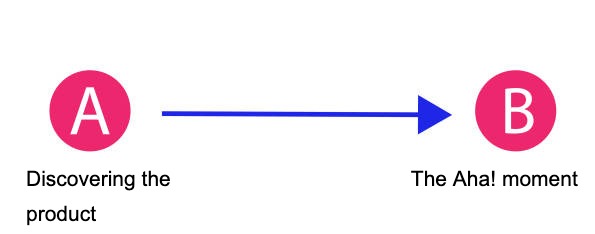
The aha moment sits between signup and activation: everything before it is effort the user spends on faith, everything after it is value they've actually received.
Why the Aha Moment Matters
Most SaaS products lose the majority of their signups in the first session. Not because the product is bad, but because those users left before the product had a chance to prove anything. The aha moment is the line that separates those two outcomes, which makes it one of the highest-leverage things a product team can understand.
- It decides whether a signup becomes a user. A user who reaches value once has a reason to come back. A user who doesn't has only a memory of effort with nothing in return.
- It sets the ceiling on retention. No amount of re-engagement email will rescue someone who never understood what they were being re-engaged with. Retention compounds from the aha moment forward.
- It gives onboarding a destination. Without a named aha moment, onboarding becomes a tour of your interface. With one, it becomes the shortest route to a specific outcome, and every step can be judged against that.
- It focuses the roadmap. When you know which action produces the realisation, you know which part of the product deserves your best engineering, and which polish can wait.
- It aligns the whole company. Marketing can promise it, sales can demo it, support can rescue people short of it, and product can shorten the path to it. A shared aha moment turns four teams into one funnel.
The "we have great signups" trap. Teams with healthy top-of-funnel numbers often spend months optimising the landing page while the real leak sits three screens into the product. If a large share of your signups never reach the moment where your product proves itself, more traffic simply means more people forming a lukewarm opinion of you. Fix the middle before you widen the top.
Aha Moment vs. Activation vs. Habit Moment
These three terms travel together and get swapped for each other constantly, which is a problem, because they answer different questions and are improved by different work.
| Aha Moment | Activation | Habit Moment | |
|---|---|---|---|
| What it describes | The user first experiencing core value | The rate at which users reach a defined milestone | The point at which use becomes routine |
| Question it answers | Did the user get it? | How many users get it, and how fast? | Do they keep coming back without prompting? |
| Nature | A qualitative experience | A quantitative metric | A pattern of repeated behaviour |
| When it happens | Once, early | Measured across every cohort | Over weeks of repetition |
| What improves it | A shorter, guided path to value | Onboarding design and instrumentation | Triggers, workflow fit, and habit loops |
The cleanest way to hold them together: the aha moment is what happens to a user, activation is how often it happens across your users, and the habit moment is what turns that one realisation into a routine. Your activation milestone should simply be your aha moment written as a trackable event, which is why teams that skip the work of defining the aha moment end up with activation metrics that measure clicks instead of value.
The journey from sign-up to habit: the aha moment is the hinge; activation counts who crosses it, time to value measures how fast, and the habit moment turns the realisation into retention.
Why the distinction matters: if you optimise activation without a real aha moment behind it, you get better at pushing users through a step they don't care about. Activation goes up, retention doesn't move, and everyone is confused. Define the moment first, then measure it. The metric should serve the experience, never the other way round. For the measurement side of this, see our guide to increasing user activation.
Aha Moment Examples
Aha moments are easiest to understand through products you've used yourself. The specifics change, but the shape is always the same: the user performs the one action the product exists to make easy, with their own content, and the value lands.
-
Analytics: seeing your own data in a chart
Sample dashboards impress nobody. The realisation arrives the moment a user connects their own source and recognises their own numbers on the screen. Everything before that is setup; that first real chart is the product.
-
Team collaboration: a second person joins
A collaboration tool with one user is a very expensive notepad. The aha moment is the first exchange with a colleague inside the product, which is why so many collaboration tools push an invite step so hard, so early.
-
Website and design builders: publishing something real
Dragging blocks around is mildly fun. Seeing your own page live at a URL you can send to someone is the moment the tool proves it can do the thing you hired it for.
-
Payments and billing: the first payment lands
No amount of documentation matches the feeling of a first real transaction arriving. It's a single event that answers every question the user had about whether the integration works.
-
Automation tools: a task completes without you
The aha moment is the first time the user watches something happen that they didn't do by hand. That's when "automation" changes from a category name into time they just got back.
-
Onboarding platforms: your first live guide
With Kompassify, it's the moment a user publishes their first product tour and watches it appear inside their own app, with no engineering ticket and no deploy. The promise of no-code stops being a claim.
Notice what's absent from every one of these: none of them is "completed onboarding" or "viewed the features page". Each is a moment where the user did the real thing, with their own stuff, and got a real result. If your candidate aha moment could be completed by someone who doesn't care about your product, it isn't one. For more patterns you can borrow, see our roundup of great user onboarding examples.
How to Find Your Aha Moment
Your aha moment already exists, whether or not you've named it. Users are reaching it every week; you just haven't looked at which action gets them there. Here's a practical way to find it, using evidence rather than a workshop.
1. Define what "retained" means for your product
Before you can find the action that predicts retention, you need a clear definition of retention. Pick a horizon that matches your usage cycle: still active at day 30 for a daily-use tool, at day 60 or 90 for something used weekly. Be precise, because every step that follows depends on this line.
2. Split your users into two cohorts
Take a few months of signups and divide them: users who met your retention definition, and users who churned. You are now looking for what the first group did early that the second group didn't. This comparison is the entire method.
3. List every early action and compare completion rates
For each meaningful action in the first week (connected a source, invited a teammate, created a project, published something) compare how many retained versus churned users completed it. Most actions will look similar across both groups. You're hunting for the ones with a wide gap.
4. Find the action with the sharpest separation
One or two actions will stand out: completed by most retained users and few churned ones. That's your candidate aha moment. If several qualify, prefer the one that happens earliest and that a user could plausibly reach in their first session.
5. Ask users, not just the database
Interview a handful of recent converts and ask a simple question: when did you decide this was worth keeping? People are surprisingly good at naming the moment. If their answers point at the same action your data found, you have real confirmation. If they point somewhere else, your data probably found a symptom.
6. Validate causally before you build around it
Correlation can mislead: engaged users do lots of things, and only some of them cause the engagement. Take a group of new users, deliberately guide them toward the candidate action with an onboarding checklist or a targeted tour, and check whether their retention actually improves against a control. If it does, you've found the real thing.
7. Write it down as an event with a threshold
Turn the finding into one sentence anyone in the company can repeat, with a number in it: "a new user who connects a data source within 7 days." Vague aha moments quietly become unmeasurable. A written threshold makes the moment countable, and countable is what makes it improvable.
Watch out for the correlation trap. The classic mistake is finding that retained users completed some action and concluding you should push everyone to complete it. Sometimes the action is a result of already being committed, not a cause of commitment. Pushing an uninterested user through it just produces a worse experience and a flattering metric. The causal check in step 6 is what separates a real aha moment from an expensive coincidence.
How to Get Users to the Aha Moment Faster
Once you know the destination, the work becomes shortening the distance to it and lighting the way. Two levers, and both matter: remove what stands between the user and value, then guide them across what remains.
Lever 1: cut the distance
- Delete steps that don't lead to value. Walk your own signup and setup as a new user and count the screens before the aha moment. Every field that isn't required to deliver value can be asked for later, or never.
- Never show an empty product. A blank dashboard puts the burden of imagination on someone who doesn't yet care. Sample data, templates, or a pre-filled example gets users to a working state before they've done any work.
- Defer the boring parts. Billing details, team settings, and profile completion can almost always wait until after the user has seen why they'd bother.
- Move the moment closer. Sometimes the fastest win is redesigning the path so a smaller version of the aha moment can happen sooner: a partial result, a preview, a single working example.
Lever 2: guide the way
- Make the path visible with a checklist. An onboarding checklist of three to five steps ending at the aha moment turns an open-ended product into a short, finishable route with obvious progress.
- Walk the hard part with a tour. Where the route is genuinely multi-step, a contextual product tour carries users through it instead of leaving them to work it out.
- Answer hesitation in place with tooltips. Wherever your funnel shows a drop-off, an onboarding tooltip at that exact control answers the question the user is about to give up on.
- Give each role its own shortest path. A developer and a marketer have different aha moments in the same product. A short welcome segmentation step lets you send each one down the route that proves value to them.
- Re-engage the users who stalled. Someone who signed up but never reached the moment is your warmest audience. A targeted in-app announcement next time they log in is far more effective than another email.
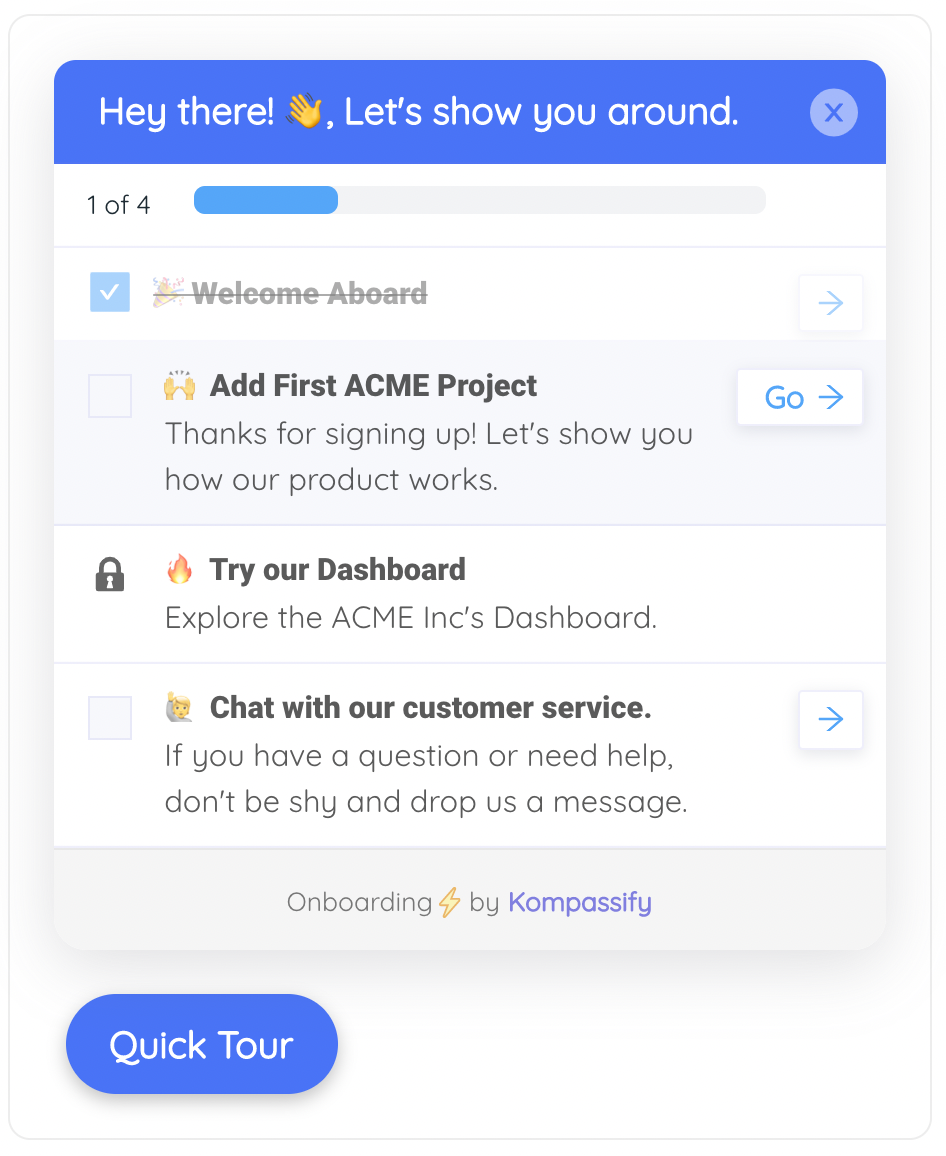
A short onboarding checklist that ends at the aha moment turns an open-ended product into a finishable path, and makes progress toward value visible.
Measuring the Aha Moment and Time to Value
A named aha moment that nobody measures decays into folklore within a quarter. Instrument it, put it on a dashboard, and review it like any other core number. Four measures cover most of what you need.
| Metric | What it tells you | What to do with it |
|---|---|---|
| Aha rate | The share of new signups who reach the moment at all | Your headline onboarding number: track it per cohort and per channel |
| Time to value (TTV) | How long it takes users who get there to arrive | Attack the median first, then the long tail of slow arrivals |
| Drop-off by step | Exactly where users abandon the path to value | Place your next tooltip or tour step at the biggest leak |
| Retention split | Retention of users who reached the moment vs. those who didn't | Proof the moment is real: if the gap is narrow, you found the wrong one |
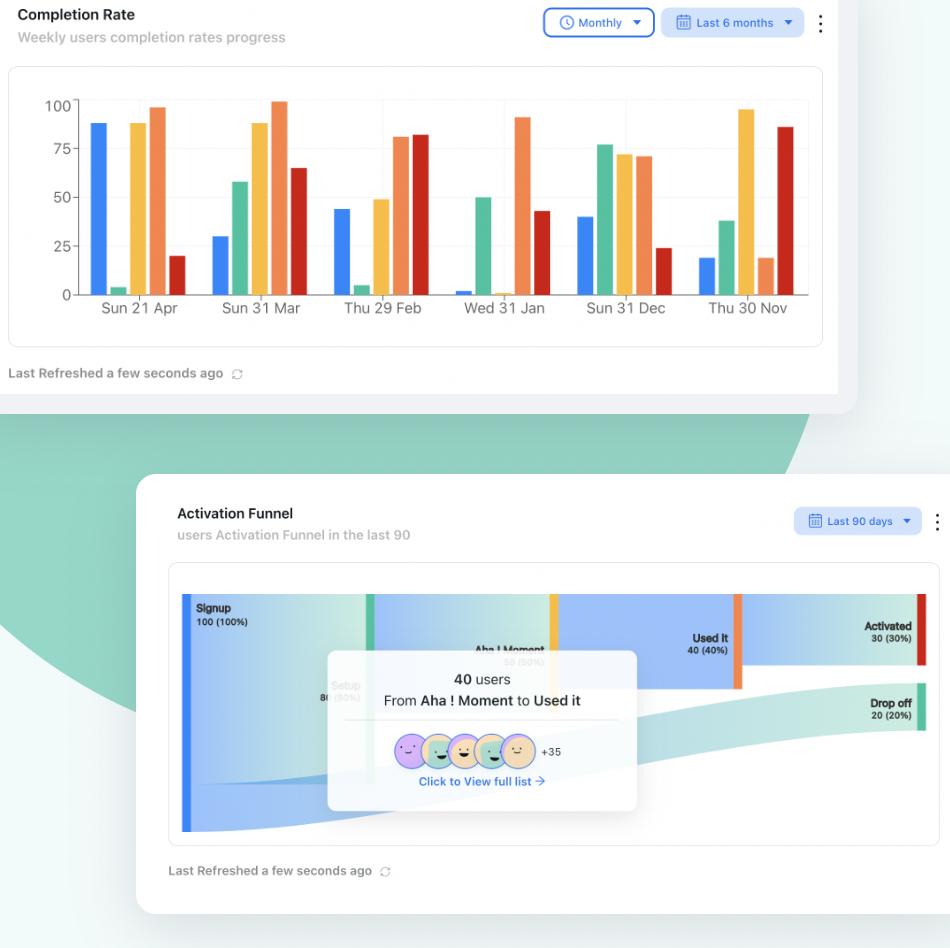
That last row is the one to watch over time. The gap between the retention of users who reached the aha moment and those who didn't is the ongoing evidence that you've identified the right moment. If the gap narrows as your product evolves, the moment has moved and it's time to run the analysis again. Kompassify's no-code product analytics let you track completion of each onboarding step and see exactly where users stall on the way to value, without adding tracking code or shipping your users' data to a third party.
The retention split: users who reach the aha moment flatten out high while users who never reach it decay away; a wide, persistent gap is the ongoing proof you've named the right moment.
Aha Moment: Do vs. Don't
A quick reference for the habits that shorten the path to value and the ones that quietly lengthen it.
✅ Do
- Define the aha moment as one concrete, trackable action
- Find it by comparing retained and churned cohorts
- Confirm it with user interviews, not just data
- Validate causally before rebuilding onboarding around it
- Cut every setup step that isn't required to reach value
- Use sample data or templates instead of an empty state
- Guide the path with a checklist, a tour, and tooltips
- Track aha rate and time to value every cohort
❌ Don't
- Treat signup or "finished onboarding" as the aha moment
- Define it in words too vague to become an event
- Assume correlation means the action caused retention
- Force every user down one path regardless of role
- Front-load billing, settings, and profile before value
- Drop new users into a blank screen and hope
- Optimise activation numbers with no real moment behind them
- Set the moment once and never revisit it
Common Aha Moment Mistakes
Confusing your aha moment with your favourite feature
Teams tend to nominate the feature they're proudest of. But the aha moment belongs to the user, and it's often something less impressive than you'd like: a first import, a first invite, a first export. Let the data name it, even when the answer is unglamorous.
Having one aha moment for a product with several audiences
If your product serves genuinely different roles, they will have genuinely different first moments of value. Forcing one shared definition means half your users get guided toward something that doesn't matter to them. Define a moment per segment and route accordingly.
Building a longer onboarding instead of a shorter path
The instinct when activation is low is to add more onboarding. Usually the better move is to remove steps, not add explanation. Guidance should carry users along a short path, not decorate a long one. This is the difference between onboarding that helps and onboarding that users skip, a theme running through our complete user onboarding guide.
Stopping at aha
Reaching the moment isn't the finish line, it's the start of the relationship. Users who see value once and then have no reason to return still churn. Plan the path from the aha moment into a repeated habit, and make sure the second and third sessions have as much thought behind them as the first.
Never revisiting the definition
Your product changes, your audience changes, and the moment that best predicts retention changes with them. Re-run the cohort analysis once or twice a year. An aha moment defined three roadmaps ago may be quietly pointing your whole onboarding at the wrong destination.
Your Aha Moment Checklist
Use this as a practical checklist for defining and shortening the path to your aha moment.
Find It
- Write down your retention definition and horizon
- Split recent signups into retained and churned cohorts
- Compare early-action completion rates between the two
- Interview recent converts about when they decided to stay
- Validate the candidate action causally against a control group
- Write the moment as one sentence with an action and a time threshold
Shorten the Path
- Walk your own signup flow and count the screens before value
- Remove or defer every step not required to reach the moment
- Replace empty states with sample data, templates, or examples
- Build an onboarding checklist that ends at the aha moment
- Add a product tour for the multi-step part of the path
- Segment new users by role and give each the shortest route
Measure & Improve
- Instrument the moment as an event and put it on a dashboard
- Track aha rate and activation by cohort and acquisition channel
- Measure time to value and cut the biggest delay each cycle
- Find the largest drop-off step and place guidance there
- Compare retention of users who reached the moment vs. those who didn't
- Re-run the analysis when the product or the audience shifts
The Aha Moment and Product-Led Growth
In a sales-led business, a person is responsible for making the value obvious: a demo, a call, a tailored walkthrough. In a product-led business, the product has to do that job alone, for everyone, at three in the morning. The aha moment is where that responsibility concentrates.
This is why product-led teams are so preoccupied with time to value. Every hour between signup and realisation is an hour in which a self-serve user can quietly close the tab, and nobody will call them to ask why. It's also why in-app guidance is not decoration for these products: checklists, contextual tours, and tooltips are the mechanism by which a product explains itself without a human in the loop.
The same logic applies to feature discovery later in the lifecycle. The first aha moment gets a user to stay; smaller aha moments, the first time they discover a feature that saves them an hour, are what deepen the relationship over the following months. A product-led company is really running a chain of these moments, and the first one determines whether the user is around for the rest.
Ready to Get More Users to Their Aha Moment?
Kompassify gives you onboarding checklists, contextual product tours, tooltips, and in-app announcements to guide every new user straight to the moment your product proves itself, plus built-in analytics to see who gets there and how long it takes, without writing a single line of code. Free for up to 100 monthly active users, GDPR-compliant, and EU-hosted.
Start for Free →Frequently Asked Questions
What is an aha moment?
An aha moment is the point at which a new user first experiences the core value of your product for themselves. It isn't the moment they sign up, and it isn't the moment they finish a tour; it's the moment your product's promise stops being a claim on a marketing page and becomes something the user has felt. In a project tool it might be seeing a plan come together on a shared board; in an analytics tool it might be seeing their own data in a chart for the first time. Everything before the aha moment is cost for the user, and everything after it is value, which is why it's the hinge on which activation and retention turn.
What is the aha moment definition in SaaS?
In SaaS, the aha moment is defined as the specific, observable in-product event where a user first realises the value your product delivers. Teams usually express it as a concrete action plus a threshold: connecting a first data source, inviting a second teammate, publishing a first page. Written that way it becomes measurable: you can count how many new users reach it, how long it takes them, and how much better those users retain. A definition you can't turn into an event in your analytics is a slogan, not an aha moment.
How do you find your product's aha moment?
Compare what retained users did early with what churned users didn't. Take a cohort still active after 30 or 60 days, look at the actions they completed in their first sessions, and find the action that best separates them from users who churned. Confirm it qualitatively by interviewing recent converts about when they decided the product was worth keeping. Then validate causally by nudging a group of new users toward that action with an onboarding checklist and checking whether their retention improves; correlation alone can point you at a symptom rather than the cause.
What is the difference between the aha moment and activation?
The aha moment is the experience of first seeing value; activation is the metric that counts it. The aha moment is qualitative and belongs to the user, while activation is the rate at which new users reach a defined milestone, and that milestone is usually the aha moment expressed as a trackable event. Put simply: the aha moment is what happens, activation rate is how often it happens. Teams that separate the two design better onboarding, because they optimise the experience rather than gaming the metric.
What are some examples of aha moments?
Classic examples include seeing your own real data visualised for the first time in an analytics product, sending a first message in a team communication tool, publishing a first live page in a website builder, receiving a first payment in a billing product, and having a second teammate join a shared workspace in a collaboration tool. What they share is that each is a small, concrete event where the user experiences the product's core promise with their own content, rather than being told about it. The specifics differ by product, but the shape is always the same: the user does the one thing the product exists to make easy.
How do you get users to the aha moment faster?
Shorten the path, then guide users along it. Remove every signup and setup step that isn't required to reach value, pre-fill or sample data so users aren't staring at an empty product, and use in-app guidance to lead them to the one action that matters: a checklist that makes the path visible, a contextual product tour for the multi-step part of the workflow, and tooltips at the exact points where users hesitate. Segment by role so each user gets the shortest path to their own aha moment, then measure time to value and cut the biggest remaining delay each cycle.
What is the difference between the aha moment and the habit moment?
The aha moment is when a user first sees the value of your product; the habit moment is when using it becomes routine. Aha happens once and is about realisation, while the habit moment is reached through repetition and is about frequency, often defined as a number of key actions within a period of time. Aha drives activation and the first renewal decision; the habit moment drives long-term retention. You need both: an aha moment without a habit loop produces users who understood the value once and then drifted away.
What tools help users reach the aha moment?
The tools that help are the ones that let you guide users in-app and measure whether the guidance worked. Kompassify provides both in one no-code platform: onboarding checklists that make the path to value visible, contextual product tours and tooltips that walk users through the action that produces the aha moment, in-app announcements for users who haven't got there yet, and built-in analytics to track how many users reach the milestone and how long it takes them. It's free for up to 100 monthly active users and GDPR-compliant with EU-based data hosting.