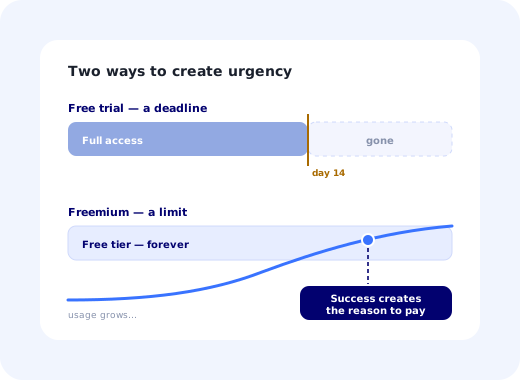
Freemium gets discussed as a pricing question (what do we charge, what do we give away) and that framing is why so many free tiers fail. The decision is not really about price. It is about which behaviours you make free to learn, and which moment of success you choose to attach a bill to.
Get that right and the free tier becomes the top of your funnel, your distribution channel and your onboarding, all at once. Get it wrong in the generous direction and you fund a large population who will never need you more than they do today. Get it wrong in the stingy direction and nobody ever uses the product enough to want anything else.
This guide covers what freemium is, how it differs from a free trial and a reverse trial, the five conditions that must hold before it is viable, the five places you can draw the limit and what each teaches users, a seven-step method for designing the free tier, the upgrade prompts that convert, and the metrics that tell you the model is working.
Key Takeaways
- A trial uses a deadline; freemium uses a limit. That single difference determines everything else about the model.
- The free tier must deliver real standalone value. A crippled demo produces neither users nor upgrades.
- Draw the line where success creates strain (more volume, more people, more history) not at the feature that proves value.
- Free users must produce non-revenue value through referrals, shared content or network density, or the arithmetic never closes.
- Prompt on constraint, not on schedule. The converting message appears when someone tries to do the thing the paid plan enables.
- Low conversion is normal; low limit-reaching is not. If nobody hits your limit, you have a packaging problem, not a pricing one.
What Is Freemium?
Freemium: definition
Freemium is a pricing model in which a permanently free version of the product exists alongside paid plans. The free tier is not a sample and not a countdown: it is a real product that a large share of users will use indefinitely without paying, deliberately. Revenue comes from the minority who grow into a limit that matters to them and choose to remove it.
The word "permanently" is the whole model. Because there is no expiry, freemium cannot rely on urgency manufactured by a clock; it has to manufacture urgency out of the user's own success. That makes it far more demanding of product design than a trial, and far more forgiving of a slow evaluation.
It is also inseparable from product-led growth: in a freemium business the product is the acquisition channel, the sales demo and the qualification mechanism, which is why free-tier design decisions end up on the roadmap rather than in a pricing spreadsheet.
Freemium vs Free Trial vs Reverse Trial
| Free trial | Freemium | Reverse trial | |
|---|---|---|---|
| What the user gets | Everything, briefly | Some things, forever | Everything briefly, then some things forever |
| Source of urgency | A date | A limit they grow into | A loss they feel |
| Best when | Value is obvious within days and the buyer expects to evaluate. | Value compounds with use, marginal cost is near zero, audience is large. | The paid features are the habit-forming ones. |
| Main risk | Users who never activate inside the window are simply lost. | A large free population that never feels a constraint. | The downgrade reads as a bait-and-switch if it is not signposted. |
| Where onboarding matters most | Days 1–3; see free trial conversion. | First session, then again at the limit. | The moment of downgrade. |
The reverse trial deserves more attention than it gets. Giving every new account full functionality for a fortnight and then dropping them into the free tier, rather than cutting them off, gets you the trial's demonstration of value and freemium's retained population. It works best when the premium features are the ones people build habits around, because the downgrade is then experienced as a loss rather than read as an announcement.
The Five Conditions for Freemium
Freemium is not a strategy you can choose. It is a strategy your economics either permit or do not. All five of these need to hold at once:
- The marginal cost of a free user is close to zero. If every free account consumes storage, compute or, worst of all, human support, the free population is a running expense with no ceiling.
- You can reach a very large audience. Conversion is low by design, so the model needs volume. A product with a total addressable market of four thousand companies cannot run on a low single-digit conversion rate.
- There is a natural limit a growing user will genuinely hit. Seats, volume, history, projects, integrations. If a successful user's usage never grows, they never feel a wall, and there is no upgrade event to design for.
- The free tier delivers real standalone value. Not a demo with the useful parts removed. People must be able to get an actual job done, or they never form the habit that makes the limit matter.
- Free users create non-revenue value. Referrals, shared artefacts, network density, content, or simply presence in a team where a colleague eventually pays. Without this, the free population is pure cost.
The most common way freemium fails is a product where support is the value. If free users need onboarding calls, configuration help or troubleshooting to succeed, the marginal cost is nowhere near zero, and every marketing success makes the losses worse. That is a trial-and-sales product wearing a freemium hat.
Where to Draw the Free-to-Paid Limit
There are five common ways to cut it, and each teaches users something different about your product. Most good free tiers combine two.
-
Usage / volume
Records, contacts, monthly active users, API calls. The cleanest fit for freemium, because the limit arrives precisely when the product is working. Users understand it instantly and rarely resent it.
-
Seats / collaborators
Excellent when the product gets better with more people, because expansion and value grow together. Dangerous when it blocks the invitation that would have spread the product: never cap the first colleague.
-
Features
The default choice and the easiest to get wrong. Works when the paid features are for scale and control (permissions, audit, SSO, automation). Fails when the withheld feature is the one that proves the value.
-
History / retention of data
Thirty days of history free, unlimited paid. Quietly effective: the longer someone uses the product, the more valuable the thing they cannot see becomes.
-
Support and assurance
Priority support, SLAs, security review, contractual terms. Almost always a component of the enterprise tier, and the cleanest way to keep free-user cost near zero.
The design rule: the free tier should contain everything needed to reach value once; the paid tier should contain what people need when they are succeeding. If your limit is hit by people who are struggling, you are charging for the cure to a problem you caused. If it is hit by people who are thriving, you are charging for growth.
Designing the Free Tier: 7 Steps
- Name the one job the free tier must complete
- Find the constraint that success creates
- Set the limit where habit is already formed
- Make the limit visible long before it is reached
- Design the moment of hitting it
- Give the free user a reason to bring someone else
- Instrument the chain, not the conversion rate
1. Name the one job the free tier must complete
Write a single sentence: "on the free plan, a user can ___ without paying, forever." If you cannot finish it with something a real person would value, you do not have a freemium tier; you have a demo. This sentence also settles a hundred future arguments about whether a given feature belongs in free, so it is worth agreeing on properly.
2. Find the constraint that success creates
Look at your own data: what grows as an account gets more value out of the product? Number of projects, teammates, monthly volume, months of history. That growing quantity is your natural limit, because it rises exactly in proportion to how much the customer is getting out of you. Every other limit is arbitrary, and users can tell.
3. Set the limit where habit is already formed
Too tight and users hit the wall before the product has become part of their week; the upgrade question arrives while they are still deciding whether to care. Too loose and it never arrives at all. The useful heuristic: set the limit just past the point where your retained users typically stop churning, which you can read directly off a retention curve by segment.
4. Make the limit visible long before it is reached
"8 of 10 projects used" in the interface, permanently, is worth more than any upgrade campaign. It removes the surprise, lets the user plan, and turns the eventual upgrade into a decision they have already half-made. A limit that is invisible until it blocks someone is experienced as a trap, and people who feel trapped do not buy; they leave and say why.
5. Design the moment of hitting it
This is the single highest-value screen in a freemium product and it is usually an error message. It should acknowledge what the user was trying to do, state exactly what the paid plan changes in those same terms, offer the smallest possible step forward, and leave a way to continue without upgrading if the free tier's promise allows it. The patterns are covered in the in-app upsell guide.
6. Give the free user a reason to bring someone else
Free users pay you in distribution or they do not pay you at all. Shared links, collaborative artefacts, exports that carry your name, invitations that are genuinely useful to the recipient: each one converts a cost centre into a channel. This is also where the seat limit needs care: cap the tenth collaborator, never the first.
7. Instrument the chain, not the conversion rate
A single free-to-paid percentage tells you nothing actionable. Instrument four transitions (signup to activation, activation to limit-approached, limit-approached to limit-reached, limit-reached to upgrade) and the diagnosis becomes obvious. Most teams who think they have a conversion problem discover that almost nobody ever reaches the limit at all.
Upgrade Prompts That Convert
✓ Do
- Trigger on the action, not on a login count or a date.
- Describe the gain in the terms of the task they were doing.
- Show usage against the limit permanently and quietly.
- Offer one step, not a pricing page with five columns.
- Cap frequency; one good prompt beats a persistent banner.
✗ Don't
- Interrupt a first session with an upgrade modal.
- Advertise paid features on screens where they are irrelevant.
- Block something the free tier promised.
- Use a countdown in a model that has no deadline.
- Send the prompt to accounts already paying.
The failure mode to watch for is banner blindness: a permanent "Upgrade now" strip that every user has learned to ignore within a week, which then makes the one contextual prompt that mattered invisible too. Fewer, later, more specific.
Metrics for a Freemium Product
Share of free signups who complete the core action. Below this, nothing else in the model can work.
Share of activated free users who hit the constraint. The most diagnostic number in freemium, and the least tracked.
Of those who hit the wall, how many pay. This is the number your upgrade screen is actually responsible for.
Add two economics numbers: cost to serve a free user, which determines whether the model is survivable at scale, and free-user-sourced revenue, paid accounts that began as an invitation from a free user. The second is the figure that justifies freemium in a board meeting, and almost nobody instruments it. Broader definitions live in user onboarding metrics and product qualified leads.
Running the Free Tier Experience Without a Release Cycle
Everything in this guide that decides conversion (where the usage indicator sits, what the limit-reached screen says, when the upgrade prompt fires and to whom) is exactly the kind of thing a team wants to change five times before it is right. Shipping five iterations of a paywall message through an engineering backlog takes a quarter.
With Kompassify that layer is configuration: show a targeted in-app message when a free account approaches its limit, run a short product tour of what the paid plan changes, keep an onboarding checklist running so free users actually activate, and segment every message by plan so paying customers never see an upgrade prompt. Kompassify itself is free for under 100 monthly active users, with paid plans from $129/month, GDPR compliant and EU-hosted.
Turn the Limit Into an Upgrade, Not a Dead End
Kompassify shows the right in-app message at the moment a free user hits a plan limit: targeted by plan, triggered by real behaviour, changed in minutes without a release. GDPR compliant, EU-hosted, and free for under 100 monthly active users.
Start for Free →Frequently Asked Questions
What is the freemium model?
Freemium is a pricing model in which a permanently free version of the product exists alongside paid plans. The free tier is not a sample or a countdown: it is a real product that some people will use indefinitely without paying, and that is by design. Revenue comes from the minority who eventually hit a limit that matters to them and upgrade. The model therefore only makes sense when serving a free user costs you very little and the free population creates value of its own, through referrals, content, network effects or sheer distribution.
What is the difference between freemium and a free trial?
A free trial gives full access for a limited time and forces a decision on a date. Freemium gives limited access for unlimited time and waits for the user to hit a wall. Trials suit products whose value is obvious quickly and whose buyer expects to evaluate and decide; freemium suits products where the value grows with use, where adoption spreads person to person, and where marginal cost per free user is near zero. The practical difference is what creates urgency: a trial uses a deadline, freemium uses a limit. The trial side is covered in detail in the free trial conversion guide.
When does freemium work and when does it fail?
Five conditions need to hold together: the marginal cost of a free user is close to zero; you can reach a very large audience, because conversion rates are low by design; there is a natural limit that a growing user will genuinely hit; the free tier delivers real standalone value rather than a crippled demo; and free users produce some non-revenue value such as referrals, shared content or network density. Freemium fails most often in high-touch, high-support products where every free user costs real money and the audience is too small to make the arithmetic work.
How should you decide what to put in the free tier?
Work backwards from the moment your users grow into a constraint. The free tier should contain everything needed to reach real value once, and the paid tier should contain what people need when they are succeeding: more volume, more collaborators, more history, more control. The common failure is drawing the line at the feature that proves value, which stops free users from ever wanting more. The best free tiers are generous enough to be genuinely used and structured so that success itself creates the reason to pay.
What is a reverse trial?
A reverse trial gives every new user full paid functionality for a short period, then drops them into the permanently free tier rather than cutting them off. It combines the two models: the user experiences the complete product while their motivation is highest, and if they do not convert they stay as a free user instead of disappearing. It works particularly well when the paid features are the ones that create habit, because the downgrade is felt rather than announced: the user notices the loss of something they were already using.
What is a good free-to-paid conversion rate for freemium?
Low, by design, and quoting a single industry figure is misleading because it depends entirely on how the free tier is drawn and who signs up. What matters more is the shape of your own funnel: what share of free signups activate, what share of activated free users reach the limit you designed, and what share of those upgrade. A freemium business with a healthy activation rate and almost nobody hitting the limit does not have a conversion problem: it has a packaging problem, and cutting the free tier will make it worse rather than better.
How do you prompt free users to upgrade without annoying them?
Tie every prompt to a moment of real constraint rather than a calendar or a login count. The prompt that converts is the one that appears when someone tries to do the thing the paid plan enables: inviting a fourth teammate, exporting beyond the retained history, creating the eleventh project. Show what they would gain in the specific terms of what they were just doing, keep it to one message rather than a permanent banner, and never block a task the free tier is supposed to include. Frequency capping matters more than copy here.
Which metrics should you track for a freemium product?
Track the chain rather than the endpoint: signup to activation, activation to limit-reached, limit-reached to upgrade, plus the cost to serve a free user and the referral or expansion value a free user generates. Add time to first value and the share of paid accounts that originated from a free user invited by another free user. That last one is the number that justifies the whole model in a board meeting, and it is the one most freemium companies never instrument.