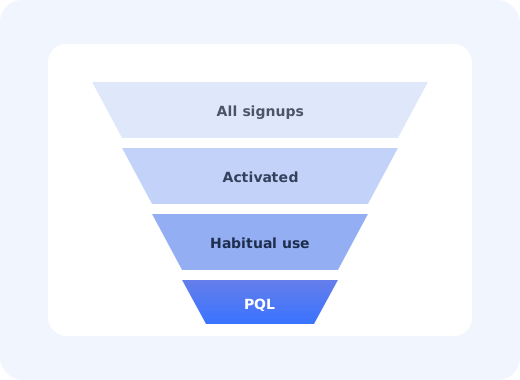
A marketing qualified lead downloaded an ebook. A sales qualified lead agreed to a meeting. A product qualified lead has already used your product and found it useful, which is a considerably better reason to believe they might buy it.
That is the whole idea, and it is not complicated. What is complicated is deciding which usage counts, because the difference between a PQL definition that works and one that fills your pipeline with tyre-kickers is entirely in the details.
This guide covers what a PQL is, how to define one for your product, a scoring model you can build without a data team, when to hand a PQL to sales versus leave them alone, and the mistakes that make PQL programmes fail.
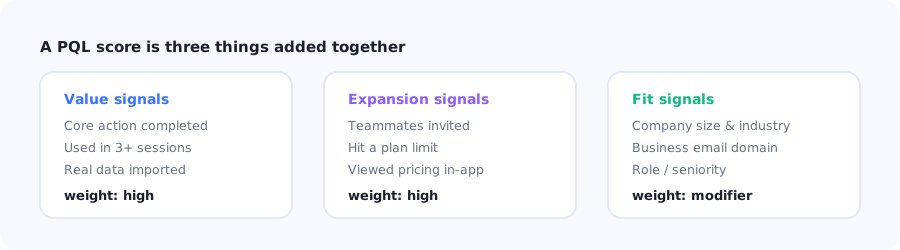
Value and expansion signals do the work. Fit is a modifier, not the score.
Key Takeaways
- A PQL is defined by experienced value, not by activity. Logins and page views are not qualification.
- Find the definition in your own data. Look at what converting accounts did that non-converting ones did not.
- Score three things: value, expansion intent, and fit. Fit modifies the score; it never creates one.
- Account-level, not user-level. In B2B, five colleagues using the product is one opportunity, not five leads.
- Not every PQL should be contacted. Self-serve users who are converting fine are better left alone.
- Validate quarterly against closed-won. A PQL definition that does not predict revenue is just a usage report.
What is a product qualified lead?
Product qualified lead (PQL) definition: a user or account that has experienced meaningful value in a product, typically during a free trial or on a free plan, and whose usage pattern predicts a high likelihood of converting to a paid plan or expanding an existing one. Qualification is based on observed in-product behaviour rather than on stated interest or demographics.
PQL vs MQL vs SQL
| MQL | SQL | PQL | |
|---|---|---|---|
| Qualified by | Marketing engagement | Sales conversation | Product usage |
| Evidence | Downloaded, attended, clicked | Confirmed need and budget | Did the thing the product is for |
| Knows the product? | No | From a demo | From using it |
| Typical close rate | Low | Moderate | Highest of the three |
| Main risk | Interest without need | Need without fit | Usage without budget authority |
The last row is the one to take seriously. A PQL has proven the product works for them; they have not necessarily proven they can buy it. An enthusiastic analyst on a free plan at a large company is a genuine PQL and may still need six months and an executive sponsor. PQL status tells you the product objection is gone, not that the deal is easy.
How to define a PQL for your product
There is no universal definition, and adopting someone else's is the most reliable way to build a bad one. The definition lives in your data.
Pull your last 50–100 conversions
Find the actions that separate them from non-converters
Add the time dimension
Write the definition as a sentence
Test it backwards before you use it forwards
1. Pull your last 50–100 conversions
Take accounts that converted from free or trial to paid in the last two quarters, and an equal number that signed up in the same period and did not. You need both groups; an analysis of converters alone will tell you that paying customers use your product, which you knew.
2. Find the actions that separate them
For each candidate behaviour, compute how many converters did it versus how many non-converters did. You are looking for a wide gap, not a high absolute number. "Logged in" is done by 95% of both groups and is therefore worthless. "Invited a second user in week one" done by 70% of converters and 12% of non-converters is a definition.
The strongest signals are almost always the same shape across SaaS products: using the core feature repeatedly, putting real data in, bringing another person in, and hitting a limit. Not coincidentally, these are the same behaviours that drive activation; a PQL model is largely an activation model with a commercial edge added.
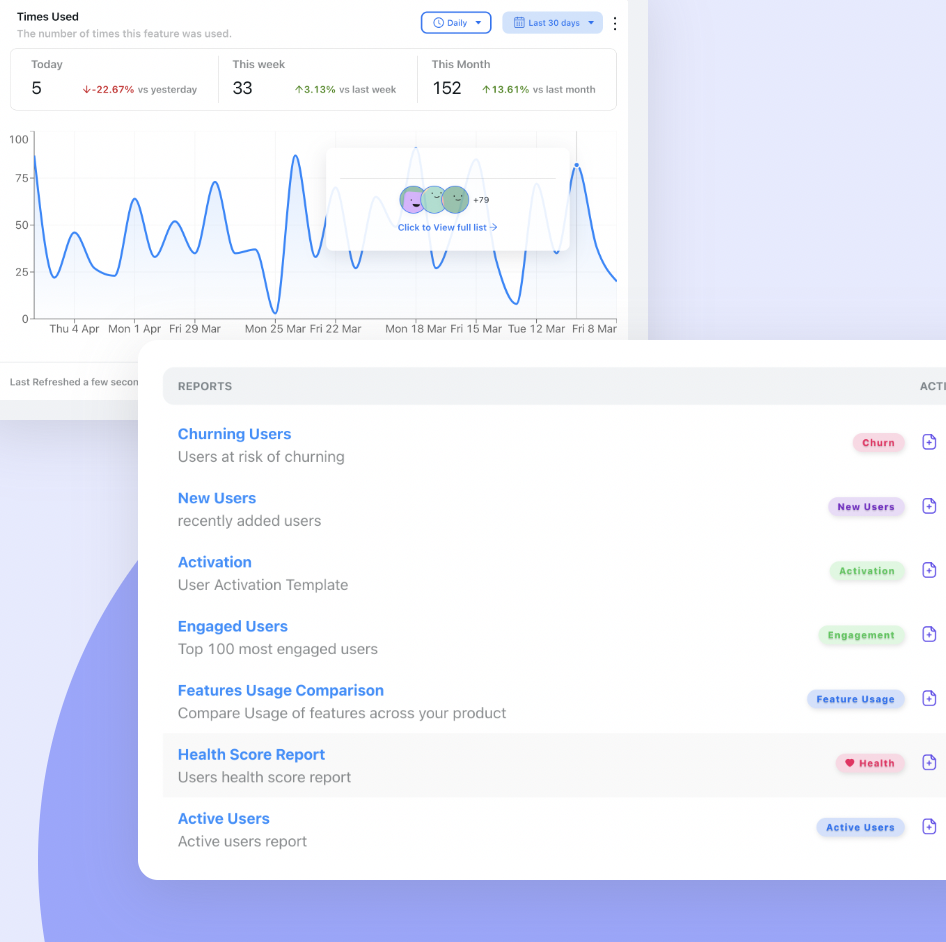
Segmenting engaged users against churning ones is where a PQL definition comes from.
3. Add the time dimension
Behaviour without a window is not a qualification. "Created three reports" means something very different in day two than in month four. Most PQL definitions need both a threshold and a period, and for trials, the period should be short enough that sales can still act inside the trial.
4. Write the definition as a sentence
A PQL definition that cannot be said out loud will not be used consistently. Aim for something like: "An account is a PQL when at least two users have completed a core action in three separate sessions within 14 days of signup, and the account has either invited a third user or reached 80% of a plan limit."
Concrete, checkable, and arguable, which is what you want, because it will need adjusting.
5. Test it backwards before you use it forwards
Apply the definition to last quarter's signups. What share of accounts it would have flagged actually converted? What share of accounts that converted would it have missed? A definition that flags 40% of your base is not qualification, it is a mailing list. A definition that flags 1% will be ignored by sales because there is nothing to work.
A PQL scoring model you can build this month
Binary definitions are easy to start with but crude: an account one action short of the threshold looks identical to one that just signed up. A simple additive score fixes that without needing a model.
| Category | Example signals | Suggested points |
|---|---|---|
| Value | Completed the core action | 25 |
| Used the product in 3+ separate sessions | 20 | |
| Imported or connected real data | 20 | |
| Expansion intent | Invited a teammate | 20 |
| Reached 80% of a plan limit | 25 | |
| Viewed the in-app pricing or upgrade page | 15 | |
| Fit | Target company size / industry | ×1.2 modifier |
| Free email domain | ×0.7 modifier |
Two design decisions matter more than the exact numbers:
- Fit is a multiplier, never a source of points. Otherwise a perfectly-profiled account that has never used the product outscores an engaged one, and your sales team stops trusting the score within a month.
- Decay the score. Usage from six weeks ago should be worth less than usage from yesterday. Without decay, dormant accounts sit permanently at the top of the list.
Score the account, not the user. In B2B, five colleagues from the same company are one opportunity. Roll individual behaviour up to the account, and treat multiple active users as a positive signal in its own right rather than as five separate leads; sending five reps after one company is how PQL programmes get quietly switched off.
What to do when an account becomes a PQL
The instinct is to route every PQL to a salesperson. That is right for some and actively harmful for others.
High score, high fit: contact them, with context
A rep should reach out referencing what the account has actually done, not "I saw you signed up", but "I noticed your team has been building reports and you're close to the workspace limit". This is the entire advantage of a PQL: the conversation can start at the point where a normal discovery call ends.
High score, low fit: leave the product to sell
A small team happily converting on a self-serve plan does not need a call, and a call may slow them down or introduce doubt. Let the product convert them, and route the human attention to accounts where it changes the outcome.
Rising but not qualified: help, do not sell
Accounts trending upward are the highest-value group for in-product intervention. They are engaged and one or two behaviours short of qualification. A well-targeted tour of the feature they have not found, or a checklist nudging the invite step, moves more accounts across the line than any email sequence.
This is where a PQL model stops being a sales tool and becomes a product one: the score tells you exactly which behaviour is missing, and in-product guidance is the cheapest way to supply it.
Qualified then stalled: intervene fast
An account that hit PQL and then went quiet is the most urgent segment on the list, and the one most programmes ignore entirely. Something broke: a blocker, a departure, a failed integration. Reach out within days, not at the end of the trial.
Why PQL programmes fail
✅ Do
- Derive the definition from your own conversions
- Compare converters with non-converters
- Score at the account level
- Use fit as a modifier only
- Decay old activity
- Give reps the specific behaviour that triggered it
- Use in-product nudges for near-PQLs
- Re-validate against closed-won every quarter
❌ Don't
- Copy another company's definition
- Count logins or page views as qualification
- Score users independently in a B2B product
- Let firmographics create a score alone
- Flag 40% of your base as PQLs
- Send a generic outreach email
- Call every PQL regardless of fit
- Set the thresholds once and forget them
The two failures that account for most abandoned programmes: a definition built on activity rather than value, which produces a long list of leads that never close and destroys sales trust in about a quarter; and no feedback loop, so nobody notices when the definition drifts out of date after a pricing change or a new onboarding flow.
Guard against both with one quarterly check: of the accounts that closed last quarter, what share were flagged as PQLs beforehand, and of the PQLs you flagged, what share closed? Track those two numbers over time and the model stays honest.
Getting the behavioural data with Kompassify
A PQL model needs feature-level behavioural data, and the usual blocker is that getting it requires instrumenting the product. Kompassify tracks in-app behaviour with no code, which means the signals your score needs are available without a data engineering project, and, more usefully, you can act on them in the same tool.
- Track core actions and feature usage per user and per account with product analytics.
- See who is near the threshold and target them with a tour of the one feature they have not tried.
- Nudge the invite step with a checklist, since bringing in a second user is the single most predictive signal in most B2B products.
- Surface upgrade moments in context through the announcement widget when an account approaches a plan limit.
- Segment by behaviour so trials, free plans and expansion candidates each get the right treatment.
Kompassify is a no-code digital adoption platform for SaaS teams. Free up to 100 monthly active users, paid plans from $129/month, GDPR-compliant with EU hosting. If you are building the wider motion around this, see the product-led growth guide and the free trial conversion guide.
Turn product usage into qualified pipeline
Track the behaviours that predict conversion, then nudge near-PQLs across the line with in-app guidance, no code required.
Start for Free →Frequently Asked Questions
What is a product qualified lead (PQL)?
A product qualified lead is a user or account that has experienced meaningful value in a product, typically during a free trial or on a free plan, and whose usage pattern predicts a high likelihood of converting to paid or expanding. Qualification comes from observed in-product behaviour rather than from stated interest or demographic fit, which is what makes PQLs convert at higher rates than marketing qualified leads.
What is the difference between a PQL, an MQL and an SQL?
An MQL is qualified by marketing engagement such as a download or a webinar attendance, an SQL by a sales conversation that confirmed need and budget, and a PQL by actually using the product successfully. The practical distinction is that a PQL has already resolved the product objection, so a sales conversation can start where a discovery call would normally end. The residual risk with PQLs is usage without budget authority.
How do you define a PQL for your product?
Derive it from your own data rather than copying a definition. Pull the last 50 to 100 accounts that converted and an equal number from the same period that did not, then find the behaviours where the two groups differ most sharply. You are looking for a wide gap rather than a high absolute number: an action taken by 70% of converters and 12% of non-converters is a definition, while logging in, done by nearly everyone, is worthless.
What behaviours usually indicate a PQL?
Across most SaaS products the same four shapes recur: using the core feature repeatedly across separate sessions, putting real data into the product, inviting another person, and hitting a plan limit. Every threshold also needs a time window, because creating three reports in week one means something very different from creating three in month four.
How do you build a PQL scoring model?
Use a simple additive score with three categories. Value signals such as completing the core action, using the product in several sessions and importing real data. Expansion signals such as inviting a teammate, reaching a plan limit or viewing the upgrade page. And fit signals such as company size and email domain. Two rules matter more than the exact point values: fit should be a multiplier rather than a source of points, and the score should decay so old activity counts for less than recent activity.
Should a PQL be scored per user or per account?
Per account in any B2B product. Five colleagues from the same company are one opportunity, not five leads, and treating them as five is how PQL programmes get switched off after sales reps start colliding with each other. Roll individual behaviour up to the account and treat multiple active users as a positive signal in its own right.
Should sales contact every PQL?
No. A high-scoring account with strong fit deserves outreach that references what they actually did in the product. A high-scoring account converting comfortably on a self-serve plan is often better left alone, since a call can introduce doubt or slow them down. The most valuable group is usually accounts that are trending upward but not yet qualified, where in-product guidance toward the missing behaviour moves more accounts across the line than any email sequence.
How do you know if your PQL definition is working?
Check two numbers every quarter: of the accounts that closed, what share were flagged as PQLs beforehand, and of the PQLs you flagged, what share closed. A definition that flags 40% of your base is a mailing list rather than qualification, and one that flags 1% will be ignored because there is nothing to work. Definitions also drift after pricing changes or onboarding redesigns, so this check needs to be recurring rather than one-off.