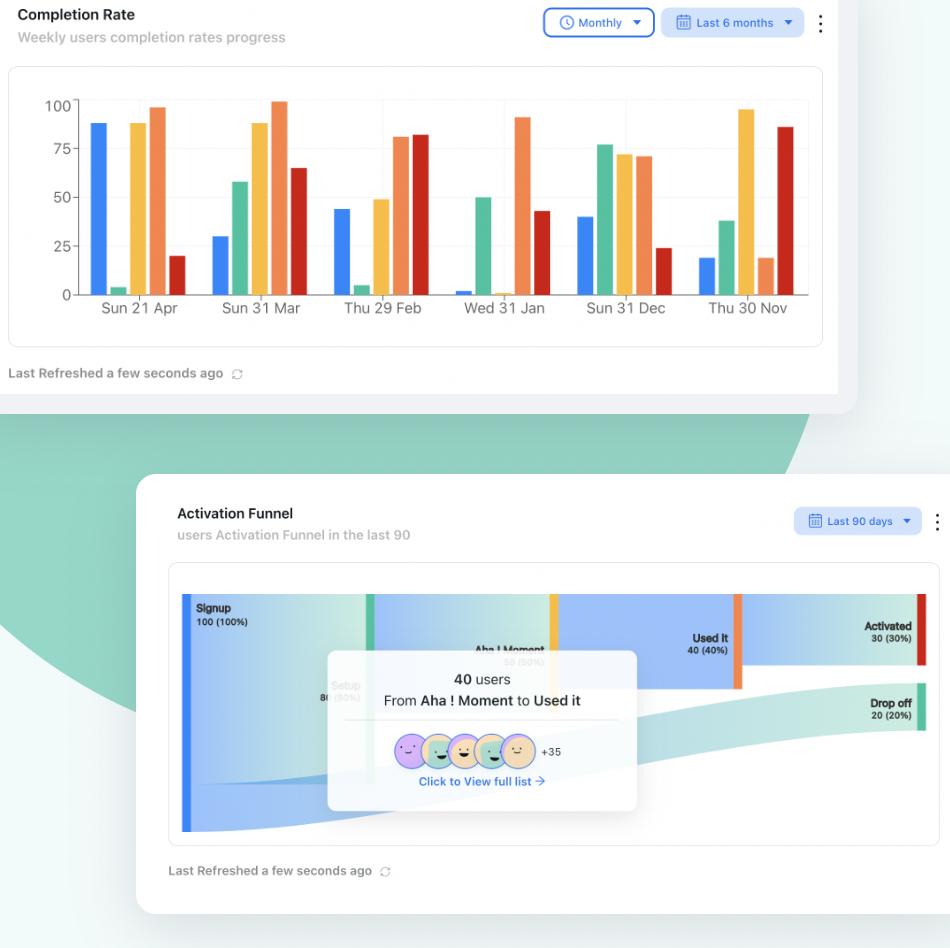
For most of software's history, growth had a familiar shape: marketing generated leads, a sales team ran demos, and a contract got signed before anyone actually used the product. Then a wave of companies flipped the order. Slack, Figma, Notion, Calendly, and Zoom let people simply use the product first, for free, and grew into category leaders largely without a traditional outbound sales machine. That flip has a name: product-led growth.
Product-led growth (PLG) is now the default go-to-market model for modern SaaS, and for good reason: when the product does the selling, growth is cheaper, faster, and more durable. But "PLG" also gets used loosely, slapped onto any free trial or freemium plan, so it is worth being precise about what it really means and, more importantly, what it takes to actually pull off.
This guide walks through exactly what product-led growth is, what PLG stands for, how the PLG flywheel and go-to-market motion work, how product-led differs from sales-led and marketing-led growth, the metrics that matter, and a practical, step-by-step way to build a product-led strategy of your own.
Key Takeaways
- PLG stands for product-led growth. It is a go-to-market strategy where the product itself drives acquisition, conversion, and expansion, instead of relying on sales and marketing to do the convincing.
- The product does the selling. Users sign up, reach real value on their own through a free trial or freemium plan, and upgrade because they already feel the value, not because a rep talked them into it.
- The flywheel replaces the funnel. Evaluate → activate → adopt → advocate is a self-reinforcing loop: every happy, activated user brings in the next one.
- Activation is the engine. Because there is no sales team to carry a confused user across the line, getting people to their first value moment fast, with strong activation, is the single highest-leverage thing you can do.
- Onboarding is your growth team. Product tours, checklists, and contextual guidance replace the demo, they are how a PLG product teaches itself.
- PLG is measured, not assumed. Activation rate, time to value, product-qualified leads, and net revenue retention tell you whether the product is actually leading the growth.
What Is Product-Led Growth?
Product-led growth is a go-to-market strategy in which the product itself is the primary driver of acquisition, conversion, and expansion. Rather than depending on sales calls and demos to win customers, a product-led company lets users sign up, experience genuine value on their own, and upgrade when the product has proven its worth.
Product-led growth, defined: a business and go-to-market model where the product is the main engine of growth, users discover it, try it, adopt it, and pay for it largely on their own, with the product experience doing the work that sales and marketing traditionally did. In short: the product sells itself.
The key word is experience. In a product-led model, value comes before the purchase, not after it. Someone can start using the tool, feel it solve a real problem, and only then decide to pay, invite their team, or move to a bigger plan. That reverses the traditional order, where a buyer had to be convinced of value through slides and promises before ever touching the software.
The PLG flip: sales-led growth collects payment before the customer ever feels value, while product-led growth delivers the value first and asks for payment after.
What does PLG stand for?
PLG stands for product-led growth. You will also see the "PLG motion" (the specific way a product-led company grows) and a "PLG company" (one whose growth is powered mainly by its product). The term rose to prominence as freemium and self-serve SaaS businesses scaled primarily through their products rather than through outbound sales, and it has since become shorthand for an entire category of modern software companies.
The three things that make growth "product-led"
Not every free trial is product-led. A strategy is genuinely product-led when three things are true:
- Users can reach value without talking to anyone. Self-serve sign-up and onboarding, no gatekeeping demo required.
- The product delivers value before the paywall. A free trial or freemium tier lets people feel the benefit first.
- Usage drives the business. Conversion, expansion, and referrals are triggered by real product use, not by a sales cadence.
Why Product-Led Growth Matters
Product-led growth did not become the dominant SaaS model by accident. It matters because it changes the economics and the speed of growth in ways that are hard for a traditional sales-led approach to match.
- It lowers customer acquisition cost. When the product converts users on its own, you spend less on sales headcount and paid acquisition per customer. Self-serve growth is structurally cheaper than a demo-heavy funnel, which keeps customer acquisition cost down as you scale.
- It shortens the sales cycle. Users decide by using, not by scheduling three meetings. Value is felt in minutes, so the path from sign-up to paid is measured in days, not quarters.
- It scales without linear headcount. A sales-led motion needs more reps to close more deals. A product-led motion lets the same product serve ten users or ten thousand, so growth is not capped by how many people you can hire.
- It compounds through advocacy. Happy users invite teammates and recommend the tool, turning adoption into distribution. Bottom-up spread inside companies is one of PLG's most powerful engines.
- It builds a better product. When growth depends on users reaching value unaided, every team is forced to obsess over the experience, which produces a genuinely better product, not just a better pitch.
PLG is not "build it and they will come." The biggest misconception is that a product-led model means you can ignore go-to-market. The opposite is true: because there is no sales rep to rescue a stuck user, every gap in onboarding, every moment of confusion, and every delayed "aha" directly costs you growth. Product-led simply moves the effort from the sales team to the product and onboarding experience, it does not remove it.
Product-Led vs. Sales-Led vs. Marketing-Led Growth
The clearest way to understand product-led growth is to place it next to the two models it is usually contrasted with. Each describes which function carries the primary responsibility for growth.
| Product-Led | Sales-Led | Marketing-Led | |
|---|---|---|---|
| Primary growth driver | The product itself | A sales team and its pipeline | Marketing campaigns and demand gen |
| When value is felt | Before purchase, during a free trial or freemium use | After purchase, once the deal closes | Promised before purchase, delivered after |
| Buying motion | Self-serve, often bottom-up within a team | Top-down, rep-led, demo and contract | Lead capture that hands off to sales |
| Best fit | Quick time to value, individual or team use | Complex, high-price, or customized products | Brand-driven or high-consideration purchases |
| Key metric | Activation rate & time to value | Pipeline & win rate | Marketing-qualified leads & CAC |
These models are not mutually exclusive. Many of the most successful companies run a hybrid motion, product-led adoption fills the top of the funnel and generates qualified signals, and a sales team steps in for larger accounts. That blend has its own name.
What is a "product-led sales" motion? Product-led sales (PLS) is the hybrid where self-serve usage generates product-qualified leads, users or accounts whose in-product behavior signals they are ready for a bigger commitment, which a sales team then helps convert into larger contracts. The product still leads; sales follows the signal instead of chasing cold leads. This is the "hybrid PLG" model many scaling SaaS companies converge on.
The PLG Flywheel
Traditional growth is often drawn as a funnel: leads pour in at the top, a few convert at the bottom, and the process ends at the sale. Product-led growth is better drawn as a flywheel, a self-reinforcing loop with no end, where each satisfied user feeds the next turn of the wheel.
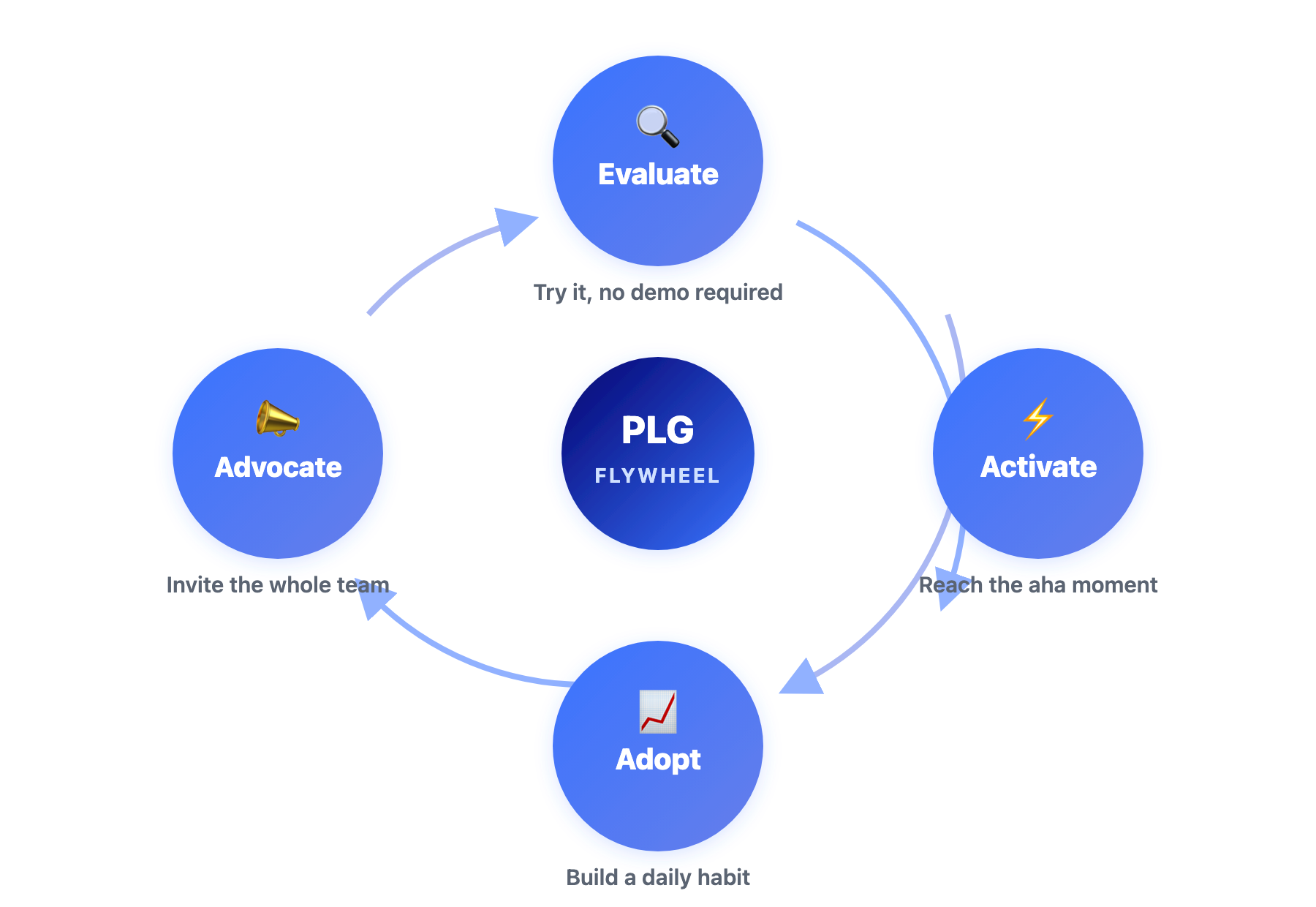
The PLG flywheel: evaluate → activate → adopt → advocate. Unlike a funnel, it loops, every activated, happy user brings in the next.
The flywheel has four stages, each one setting up the next:
1. Evaluate
A prospective user discovers the product and tries it on their own, no gatekeeping demo. This stage is won by a frictionless sign-up and a landing experience that makes the value obvious in seconds. The easier it is to start, the more people enter the loop.
2. Activate
The user reaches their first real value moment, the "aha" where the product proves it can solve their problem. This is the make-or-break stage of PLG: a user who activates continues, a user who does not quietly disappears. Everything in activation and onboarding lives here.
3. Adopt
The user folds the product into their routine, using it repeatedly, exploring more features, and building a habit. This is where engagement and breadth of use turn a trial into a real dependency, and a free user into a paying one.
4. Advocate
The satisfied user invites teammates, recommends the tool, and spreads it inside and beyond their company. This advocacy feeds straight back into the evaluate stage, bringing in new users, which is what makes the flywheel spin faster over time instead of running dry like a funnel.
The crucial property of a flywheel is momentum. Improve any single stage, make activation faster, adoption deeper, advocacy easier, and you accelerate the entire loop, because each stage feeds the next. That compounding is exactly why product-led companies can grow so efficiently once the wheel is turning.
Product-Led Growth Metrics That Matter
Because the product carries the growth, product-led teams measure the health of the product experience itself, not just the pipeline. These are the metrics that tell you whether growth is genuinely product-led and where the flywheel is losing momentum.
| Metric | What It Measures | Why It Matters in PLG |
|---|---|---|
| Activation Rate | The share of sign-ups who reach the first value moment | The single most important PLG metric. With no sales team to carry stuck users, activation is where product-led growth is won or lost |
| Time to Value (TTV) | How long it takes a new user to reach that first value moment | The faster users feel value, the more of them activate. Shortening TTV lifts the entire flywheel |
| Product-Qualified Leads (PQLs) | Users whose in-product behavior signals buying intent | Replaces marketing-qualified leads with a far stronger signal, real usage, and powers the product-led sales motion |
| Free-to-Paid Conversion | The percentage of free or trial users who become paying customers | The direct readout of whether the product is convincing users to pay on its own |
| Feature Adoption | The share of active users using key features | Shows whether users are discovering the capabilities that drive value and expansion, or missing them |
| Net Revenue Retention (NRR) | Revenue retained and expanded from existing customers over time | The clearest sign the flywheel compounds, users not only stay but grow their spend as they adopt more |
Activation and time to value are the leading indicators. Conversion, retention, and expansion are lagging results, they tell you what already happened. Activation rate and time to value tell you what is about to happen. Get users to value fast, and the downstream numbers follow. That is why product-led teams pour their energy into the activation stage first.
Leading indicators predict the flywheel's future: improve activation rate and time to value today, and the downstream conversion, retention, and expansion numbers follow.
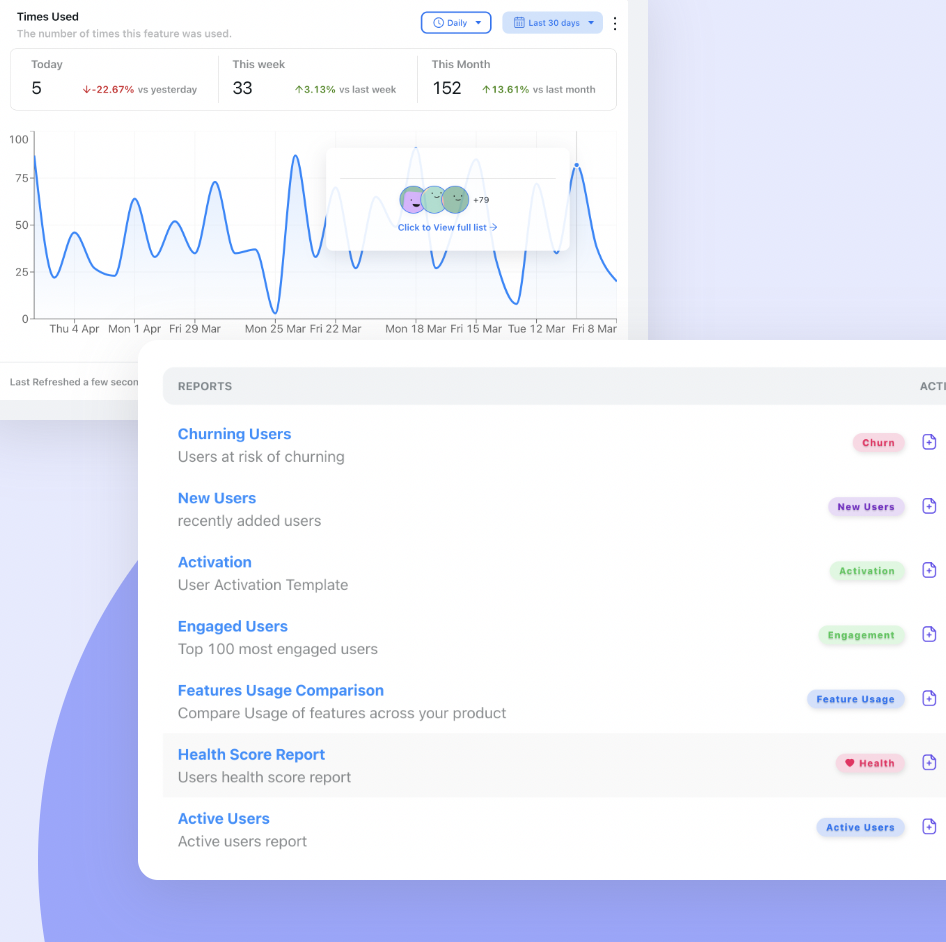
Kompassify's built-in product analytics track activation, feature adoption, and funnel drop-off, so you can see exactly where the PLG flywheel loses momentum, without a separate analytics stack.
How to Build a Product-Led Growth Strategy
Adopting product-led growth is less about a free plan and more about designing the product so it can sell, teach, and expand itself. Here is a practical, step-by-step way to do it, most of which lives inside the product, not in a marketing campaign.
1. Define your core value moment
Everything in PLG hangs on one thing: the moment a user first feels real value. Study your best long-term customers and identify the action that maps to that moment, sending the first message, building the first dashboard, sharing the first file. This "aha" becomes the north star your entire onboarding is designed to reach as fast as possible.
2. Remove every obstacle between sign-up and value
In a product-led model, friction is lost growth. Strip the path from sign-up to the value moment down to the essentials, defer optional setup, kill unnecessary form fields, and offer sensible defaults or templates so users reach a real outcome in the fewest possible clicks. Shortening time to value is the highest-leverage work you can do.
3. Let the product onboard the user
With no demo to lean on, onboarding is your sales pitch. A short product tour that walks users to the value moment, plus an onboarding checklist that gives them a clear, finite path forward, does the teaching a rep used to do, at the exact moment of need and at any scale.
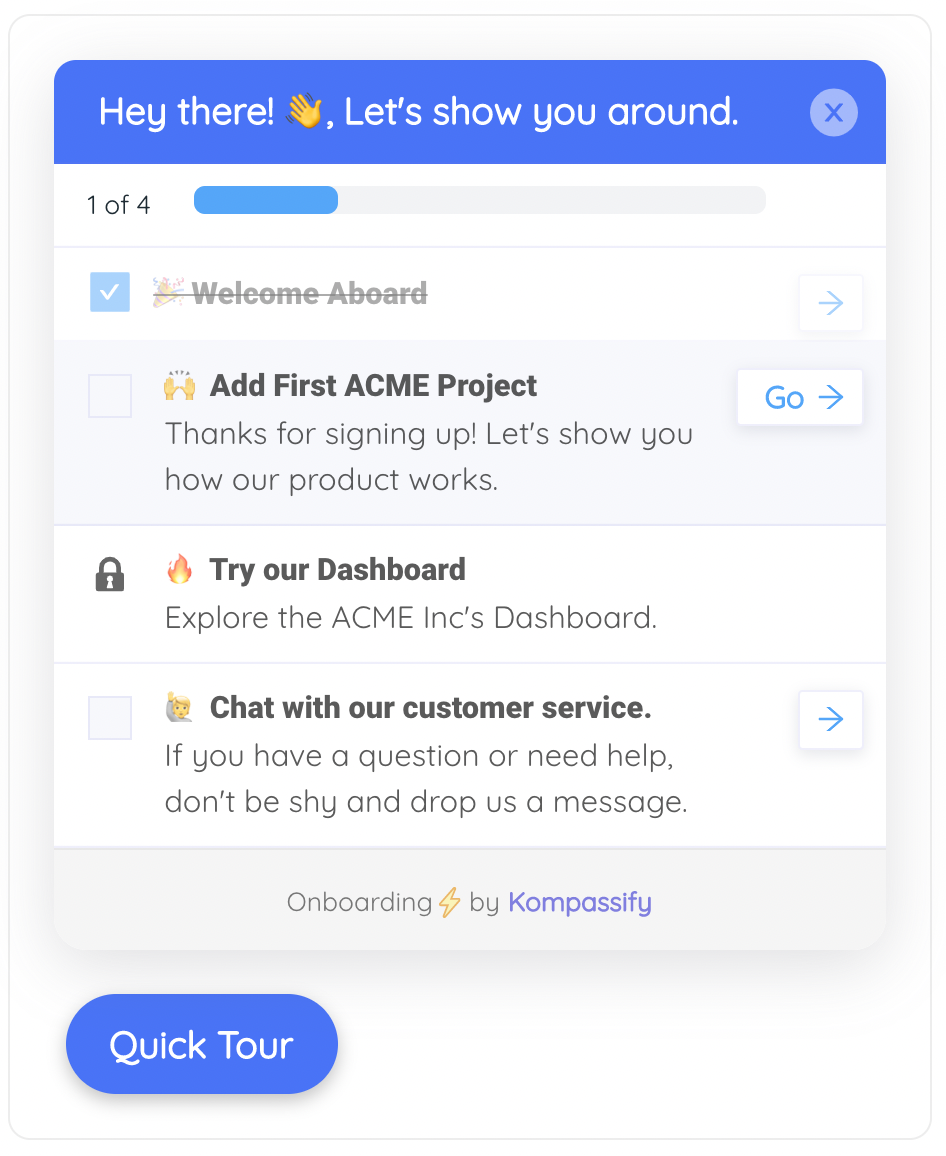
A short, progress-tracked onboarding checklist replaces the sales demo, guiding users straight to their first value moment.
4. Personalize the path by role and goal
A product-led experience serves many different users with no rep to tailor the pitch, so let the product do it. Ask one or two quick questions at sign-up, role, goal, team size, and use the answers to route each user to the value that is relevant to them. A simple welcome segmentation step puts everyone on the shortest path to their aha, not a generic one.
5. Design your free tier as a growth engine, not a giveaway
The free trial or freemium plan is the heart of the PLG motion, and it needs deliberate design. Give users enough to reach genuine value and build a habit, but tie the natural next step, more seats, more usage, advanced features, to real expansion. The goal is a free experience so good it makes upgrading feel obvious, not a crippled one that frustrates.
6. Turn usage into expansion signals
Watch for the in-product behaviors that mark a product-qualified lead, hitting a usage limit, inviting teammates, using a power feature repeatedly, and trigger the right next step at that moment: an in-app upgrade prompt for self-serve accounts, or a nudge to your sales team for larger ones. Use in-app announcements to surface the upgrade in context, right where the user hit the limit.
7. Fuel the advocacy loop
The flywheel only spins if happy users bring in new ones. Make it effortless to invite teammates, share output, and recommend the tool, and reinforce those moments when a user is clearly getting value. Every teammate invited restarts the loop at the evaluate stage, which is what turns adoption into distribution.
8. Measure the flywheel and fix the weakest stage
Treat PLG as a measured system, not a hope. Track activation, time to value, feature adoption, and conversion at each stage of the flywheel, find the stage losing the most momentum, run one experiment to fix it, and measure again. Kompassify's no-code product analytics let you see activation and drop-off by cohort, plan, and role, so you always know which stage to work on next.
Product-Led Growth: Do vs. Don't
A quick reference for what makes a product-led motion work and what quietly undermines it.
✅ Do
- Design the whole experience around one clear value moment
- Make sign-up and first use completely self-serve
- Let the product teach itself with tours and checklists
- Shorten time to value relentlessly
- Give the free tier enough to build a real habit
- Act on product-qualified leads from real usage
- Make inviting teammates and sharing effortless
- Measure activation and drop-off at every stage
❌ Don't
- Assume a free plan alone makes you product-led
- Hide value behind a mandatory demo or long form
- Drop new users into an empty screen with no direction
- Bury the aha moment behind heavy setup
- Cripple the free tier so no one reaches value
- Ignore usage signals that scream "ready to upgrade"
- Treat onboarding as a one-time launch task
- Fly blind without activation and funnel analytics
Product-Led Growth Examples
The fastest way to understand PLG is to see how the companies that defined it design for each stage of the flywheel. A few well-known patterns:
-
Slack, bottom-up team adoption
Slack lets a single team start for free and reach value in minutes. As conversations move into it, the tool spreads across departments and companies from the bottom up, turning individual adoption into company-wide contracts, a textbook product-led motion.
-
Figma, collaboration as distribution
Figma's free tier and instant, in-browser access mean a designer can share a file with anyone, and every collaborator invited becomes a new user. The product's core value, working together, is also its growth engine.
-
Notion, freemium that builds a habit
Notion's generous free plan lets individuals build real, valuable workspaces on their own. Once the habit forms and teammates get pulled in, upgrading to paid team plans becomes the obvious next step, with no sales call required.
-
Calendly, value that markets itself
Every time a Calendly user sends a scheduling link, a non-user experiences the product firsthand and often signs up to use it too. The core action itself is a growth loop, advocacy built directly into the workflow.
The common thread is that growth is designed into the product, not bolted on afterward. Each company nails a fast value moment and then makes normal use spread the tool. For more onboarding patterns you can adapt to your own product-led flow, see our roundup of great user onboarding examples.
Is Product-Led Growth Right for Your Product?
PLG is powerful, but it is not universal. It fits some products beautifully and fights against others. Use this as a quick gut check.
PLG fits well when…
- Users can reach real value quickly, without heavy setup or implementation
- There is a clear individual or small-team use case someone can adopt alone
- The product can be tried for free without risk to the user's data or business
- Usage naturally spreads, teammates get pulled in as part of normal use
- The price point supports a self-serve purchase, not only enterprise contracts
PLG fits poorly when…
- The product needs long implementation, integration, or configuration before any value appears
- Buying requires procurement, security review, or a signed contract up front
- Value only emerges at the organization level, never for an individual user
- The use case is so complex it genuinely requires a guided, consultative sale
Even if you are not purely product-led, most modern SaaS companies benefit from adding product-led elements, a self-serve trial, stronger onboarding, usage-based lead signals, on top of a sales motion. That hybrid, product-led sales, often captures the best of both.
What Helps vs. What Hurts Product-Led Growth
Not everything labeled "product-led" actually drives growth. Here is a direct comparison.
| ✅ Helps PLG | ❌ Hurts PLG |
|---|---|
| Designing the experience around one clear value moment | Launching a free plan with no thought to how users reach value |
| Self-serve sign-up that needs no human in the loop | Gating the product behind a mandatory demo or "contact sales" |
| In-product tours and checklists that teach at the moment of need | Dropping users into an empty dashboard with a help-doc link |
| A free tier generous enough to build a genuine habit | A crippled free tier that never lets users feel real value |
| Acting on product-qualified leads from real usage | Chasing cold marketing lists while ignoring engaged users |
| Making it effortless to invite teammates and share output | Trapping value inside a single-user experience |
| Measuring activation, time to value, and funnel drop-off | Tracking only sign-ups and revenue, blind to the middle |
| Treating onboarding as a continuously improved system | Shipping onboarding once and never touching it again |
Ready to Run a Product-Led Motion?
Kompassify gives you product tours, onboarding checklists, in-app announcements, surveys, and built-in analytics: everything you need to drive activation, deepen adoption, and let your product sell itself, without writing a single line of code. Free for up to 100 monthly active users, GDPR-compliant, and EU-hosted.
Start for Free →Frequently Asked Questions
What is product-led growth (PLG)?
Product-led growth (PLG) is a go-to-market strategy in which the product itself is the primary driver of acquisition, conversion, and expansion. Instead of relying on sales calls and demos, a PLG company lets users sign up, experience real value on their own through a free trial or freemium plan, and upgrade when the product proves its worth. The product does the selling, shifting the center of gravity from sales and marketing to the product and user experience.
What does PLG stand for?
PLG stands for product-led growth. It describes a business and go-to-market model where the product is the main engine of growth: users discover it, try it, adopt it, and pay for it largely on their own, with the product experience doing the work that sales and marketing traditionally did. The term became popular as freemium and self-serve SaaS companies like Slack, Figma, and Notion scaled primarily through their products rather than through outbound sales.
What is the PLG flywheel?
The PLG flywheel replaces the linear sales funnel with a self-reinforcing loop: users evaluate the product themselves, activate by reaching value, adopt it into their workflow, and then advocate for it, inviting teammates and bringing in new users, which feeds the next turn of the wheel. Unlike a funnel that ends at a sale, the flywheel treats every activated, happy user as fuel for more growth, so improving any stage, like activation, accelerates the entire loop.
What is a PLG motion?
A PLG motion is the specific way a product-led company acquires and grows customers through the product rather than through a sales team. Common motions include a free trial that converts to paid, a freemium plan that upgrades as usage grows, and a bottom-up motion where individual users adopt the tool and it spreads across their team. Many companies run a hybrid product-led sales motion, where self-serve usage generates product-qualified leads that a sales team then helps convert into larger contracts.
What is the difference between product-led and sales-led growth?
In sales-led growth, a sales team drives revenue: prospects book demos, talk to reps, and buy before they use the product. In product-led growth, users experience the product first, through a free trial or freemium plan, and buy after they have already felt the value. Sales-led suits complex, high-price, or heavily customized products; product-led suits products a user can adopt quickly and self-serve. Many companies blend the two, using product-led adoption to generate qualified leads that sales then closes.
What metrics matter most in product-led growth?
The metrics that matter most track how well the product drives its own growth: activation rate (the share of sign-ups who reach the first value moment), time to value, product-qualified leads, feature adoption, net revenue retention, and free-to-paid conversion. Because the product carries the growth, activation and time to value are the leading indicators, get users to value fast and the downstream conversion, retention, and expansion follow.
Is product-led growth only for SaaS?
PLG is most common in SaaS because software can be delivered instantly, tried for free, and adopted without installation, which makes a self-serve motion natural. But the core idea, letting the product prove its value before asking for payment, applies anywhere users can experience value quickly on their own. It fits products with a short time to value and a clear individual use case, and fits less well for products that need heavy configuration, long implementation, or a signed contract before any value is possible.
What tools do you need for product-led growth?
A PLG stack centers on the in-product experience: onboarding tools to drive activation, in-app announcements to surface new value, surveys to hear from users, and product analytics to measure activation and drop-off. Kompassify provides all of these in one no-code platform, product tours and onboarding checklists, announcement widgets, in-app surveys, and built-in analytics, so product teams can run a PLG motion without engineering time or a separate analytics stack. It is free for up to 100 monthly active users and GDPR-compliant with EU-based data hosting.