Every SaaS team has run the same experiment. Trial conversion is flat, so you add an email sequence: day 3, day 7, day 11, day 13. The emails are well written. The open rates are fine. The conversion rate doesn't move, because the people receiving them signed up, hit an empty dashboard, closed the tab, and have not been back since. No amount of reminding will convert someone who never saw the product work.
Free trial conversion is decided far earlier than most teams instrument it. The purchase happens on day 14; the decision happens in the first session, when the user either got something useful out of your product or didn't. Everything after that is either confirmation or a slow drift toward the tab being closed for good.
This guide covers how to calculate the rate properly, why public benchmarks mislead, the three trial models and what each does to your funnel, how to choose a trial length from your own data, the day-by-day arc of a trial with the play that matters at each phase, why activation is the biggest lever there is, how to handle the last three days without reaching for a discount, and the mistakes that quietly lose conversions.
Key Takeaways
- The trial is decided in session one. If nothing useful happened, no email sequence will rescue it.
- Measure by start cohort, and split conversion by activation status: the gap between the two numbers is your whole business case.
- Card or no card is a volume-versus-rate trade, not a best practice. Pick deliberately and measure absolute conversions, not percentages.
- Set trial length from your own time to value, not from convention. A trial much longer than your TTV mostly buys procrastination.
- Activation is the lever. Activated trials convert at a multiple of non-activated ones in nearly every product, so onboarding work is conversion work.
- Don't discount at the end. A discount converts people who already decided and teaches everyone else to wait for one.
How to Calculate Free Trial Conversion Rate
Free trial conversion rate = trials converted to paid ÷ trials started × 100, measured over a fixed start cohort with the full trial length plus a grace period elapsed.
Simple arithmetic, three ways to get it wrong:
- Mixing populations. Dividing this month's conversions by this month's starts compares people who converted from last month's cohort with people who just arrived. Group by start week and follow the group forward.
- Closing the cohort too early. A 14-day trial isn't done at 14 days; a meaningful share converts in the week after expiry. Fix a grace period (7–14 days is typical), and apply it consistently rather than adjusting it when the number looks bad.
- Inconsistent junk filtering. Bots and duplicate signups belong out of both the numerator and the denominator, using the same rule every month. A filter that changes silently makes your trend meaningless.
The number that actually drives decisions, though, isn't the headline rate; it's the split:
Illustrative shape, not a benchmark, but the pattern holds in nearly every product: the blended rate hides three completely different populations, only one of which has a conversion problem you can solve with pricing.
Once you've seen your own version of this chart, the strategy writes itself. The blended number is a symptom; the population that never got started is the disease. That's an onboarding problem wearing a pricing problem's clothes, which is why the most effective work on trial conversion happens nowhere near the checkout page.
The Three Trial Models (and What Each Costs You)
| Model | How it works | Effect on conversion | Best when |
|---|---|---|---|
| Opt-in (no card) | Sign up, use it, choose to pay at the end | Many more trials, lower percentage | Self-serve setup; you want market learning and volume |
| Opt-out (card up front) | Card required; billing starts unless cancelled | Far fewer trials, much higher percentage | High intent, sales-assisted, or expensive-to-serve trials |
| Reverse trial | Full paid access for a period, then drop to free | High engagement; conversion spread over time | Premium features visible in daily use |
The trap in this table is comparing percentages across rows. Opt-out models look dramatically better on conversion rate and often produce fewer paying customers in absolute terms, plus a support queue full of people who forgot to cancel. Judge a model change on paying customers per 1,000 visitors and on retention 90 days later, not on the rate, which moves for reasons that have nothing to do with quality.
A note on reverse trials
Reverse trials are the most underused of the three. Giving everyone full access up front means the user experiences the premium capability while motivation is at its peak, and the expiry becomes a loss rather than a cut-off, which is a far stronger motivator than a feature they never tried. The condition for success is visibility: if your paid features only matter at scale or after months of data, their removal won't be felt, and the model degrades into ordinary freemium.
Choosing a Trial Length From Your Own Data
Fourteen days is a convention, not a finding. The right length comes from one number: how long it takes an activated user to reach real value.
1. Find your median time to value for users who activate
Not the average across everyone, the median among those who actually got there. If that number is under a day, a two-week trial is mostly a two-week delay. If it's five days because of an approval or an integration, a seven-day trial will fail people who were on track. Our time to value guide covers how to measure it.
2. Add slack for real life, not for procrastination
Weekends, holidays, the colleague who holds the credentials. Roughly double the median TTV is a sensible starting point. Beyond that you're not adding opportunity, you're adding the psychological permission to start later.
3. Check when people actually start
Plot day of first meaningful action across your trials. If there's a cluster on the last two days, your trial isn't too short; it's too long, and it has trained people to postpone. Shortening it usually moves that cluster forward rather than losing it.
4. Offer extensions on request, generously
Someone asking for more time is telling you they're still evaluating, the most valuable signal in the funnel. A one-click extension costs nothing and converts far better than an automated "your trial has ended" wall. Extensions granted to engaged users are cheap; extensions granted automatically to everyone are just a longer trial.
The Trial Arc: What Matters on Which Day
A trial has four phases, and each one has exactly one job. Most teams over-invest in the last and under-invest in the first:
Activation Is the Lever (Everything Else Is Rounding)
If you take one thing from this guide: work on trial conversion by working on activation. The split chart earlier makes the argument, and it holds across products: trials that reach the value moment convert at a multiple of those that don't. So the highest-yield conversion projects don't touch pricing at all:
- Cut the first session down to one outcome. Every step that isn't on the shortest path to a visible result is costing you conversions. Defer profile fields, team invites and preference screens until after something has worked.
- Remove the blockers you can't design away. If a data connection is genuinely required, provide a demo dataset so value can be seen before the credential arrives, and make it trivial to delegate the step to the colleague who has it.
- Make progress and remaining work visible. A stalled trial usually stalled because the user lost the thread, not because they decided against you.
- Guide the specific step that loses people. Your funnel names it; a walkthrough or tooltip at exactly that step is a days-long project with a measurable outcome. The full playbook is in our guide to increasing user activation.
- Segment the path. An evaluating developer and a deadline-driven agency owner need different first sessions, and giving them the same one guarantees at least one of them leaves.
The email trap. Trial email sequences are the most common response to poor conversion and among the least effective, because they target the symptom. Emails are useful for re-engaging people who did get value and got distracted. They cannot manufacture a reason to return for someone whose first session produced nothing, and sending more of them to that group mostly generates unsubscribes.
The Last Three Days: Without a Discount
Show the value they created, specifically
"You've built 7 reports and shared them with 4 teammates this week" converts better than any countdown, because it answers the actual question in the user's head: is this worth paying for? Pull the two or three numbers that represent real output and put them in front of the decision.
Be exact about what happens at expiry
What stops working, what stays accessible, how long data is kept, whether they can come back. Ambiguity here reads as a trap, and users resolve traps by leaving. Clear terms convert better than favourable-but-vague ones.
Make upgrading two clicks from inside the product
Not an email to a pricing page to a login to a form. The decision to pay is fragile and short-lived; every extra step is a chance for it to evaporate. Contextual upgrade prompts at the moment a limit is hit convert better than any scheduled reminder.
Ask the ones who don't convert why, in one question
A single exit question at cancellation or expiry, with a handful of pre-written reasons plus an open field. Fifty answers will name your top two objections more clearly than any analysis, and they'll tell you whether the problem is price, a missing feature, or a trial that never got started.
Don't discount by default
A last-day discount converts people who had already decided to buy, at a lower price, and teaches everyone who talks to them to wait for the same offer. If you must use price as a lever, use it for a defined segment with a stated reason, not as a reflex applied to every expiring trial.
Have a real plan for expired trials
An expired trial isn't a dead lead; it's a person who now understands your product. Keep their data recoverable, tell them when you ship the thing they were missing (a good use for your release notes), and make restarting frictionless. Win-back converts best when it references the specific reason they left.
Free Trials: Do vs. Don't
✅ Do
- Measure conversion by start cohort with a grace period
- Split conversion by activation status
- Set trial length from your own time to value
- Engineer one visible outcome in session one
- Offer demo data when setup blocks value
- Show progress with a resumable checklist
- Reflect real value back before the trial ends
- Grant extensions to users who ask
❌ Don't
- Compare your rate to a benchmark with a different model
- Judge a card-required change on percentage alone
- Ask for a team invite before anything has worked
- Answer flat conversion with more emails
- Hide what happens when the trial expires
- Route upgrades through an email and a new tab
- Discount every expiring trial by reflex
- Delete a non-converting trial's data immediately
Shipping Trial Improvements Without a Release Cycle
Nearly every play in this guide is a guidance change rather than a product rebuild, which is exactly why they stall in backlogs behind features. With Kompassify they ship on top of your live product with no code:
- Guide session one to an outcome. A short product tour that walks a new trial to one real result, branched by the answer to a single question.
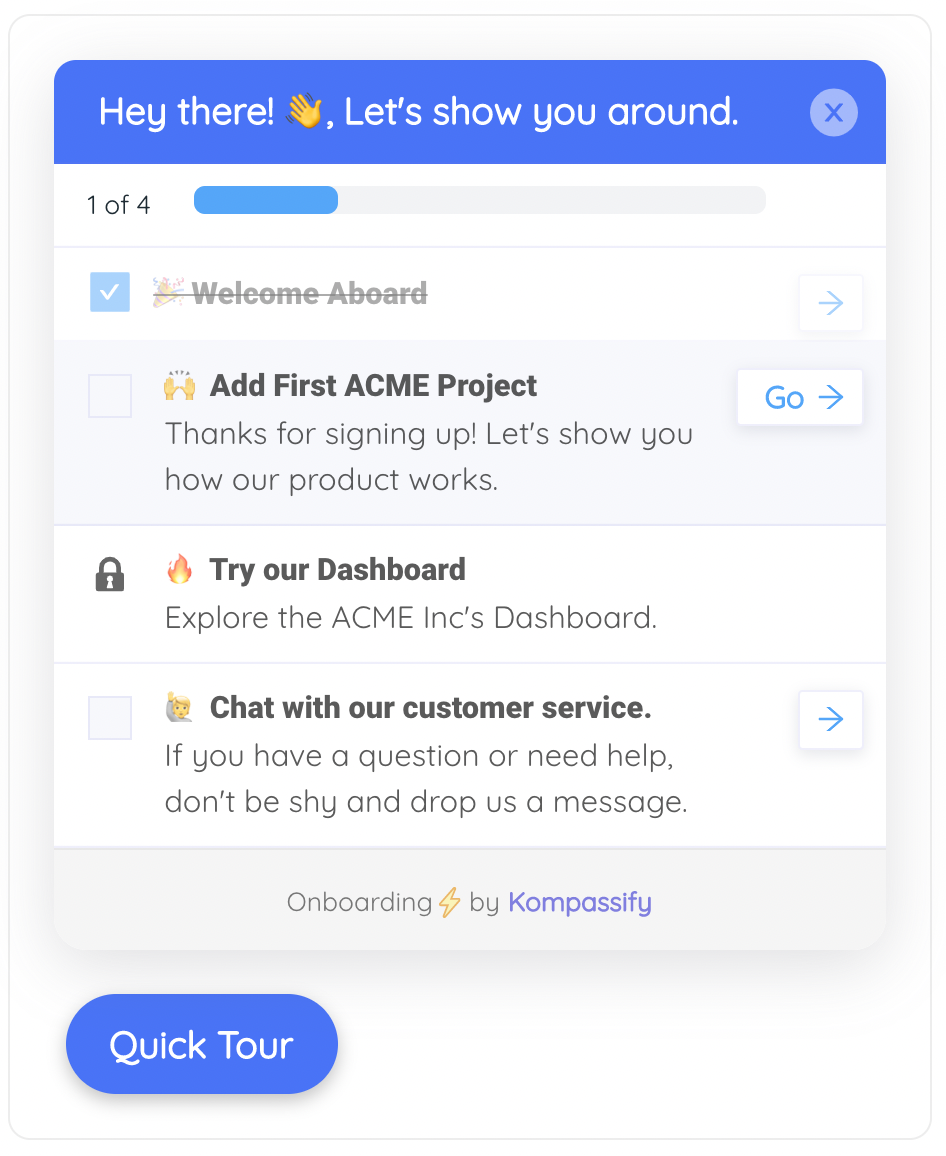
- Make the trial resumable. An onboarding checklist that remembers progress, so returning users see what's left instead of starting from confusion.
- Unblock the step that loses people. Tooltips and walkthroughs at the exact stage your funnel flags, live the same day you find it.
- Reach the right trials only. Target by segment and behaviour: users who stalled at setup, trials ending in three days without activation, teams who never invited anyone.
- Measure the effect on the cohort. Step-level analytics show whether the change moved activation, the number that moves conversion.
Kompassify is GDPR compliant and EU-hosted, free for under 100 monthly active users, with paid plans from $129/month.
Fix the Trial Where It's Actually Lost
Kompassify lets you guide trial users to their first real outcome: tours, checklists, tooltips and targeted nudges on top of your existing product, no code and no release cycle. Move activation, and trial conversion follows. GDPR compliant, EU-hosted, and free for under 100 monthly active users.
Start for Free →Frequently Asked Questions
How do you calculate free trial conversion rate?
Divide the number of trials that became paying customers by the number of trials that started, over a fixed cohort window: conversion rate = converted ÷ started × 100. Three details keep it honest. Measure by start cohort: group trials by the week they began and follow that group, rather than dividing this month's conversions by this month's starts, which mixes populations. Allow a full trial length plus a grace period before the cohort is final. And exclude obvious junk signups from both sides of the fraction, consistently.
What is a good free trial conversion rate?
It depends so heavily on the trial model that a single benchmark is close to meaningless. Opt-out trials that require a credit card up front convert a much higher share of a much smaller, more qualified population; opt-in trials with no card convert a smaller share of a far larger one. Higher-priced products with heavier setup convert more slowly. The comparison worth making is your own trend, cohort over cohort, and the gap between activated and non-activated trials inside your own data.
Should you require a credit card for a free trial?
It is a trade between volume and rate. Requiring a card filters out casual signups, so a larger proportion of those who start will convert, but far fewer start, and you learn much less about the market. No card means more trials, a lower percentage conversion, and a much bigger pool of people who have now seen your product. Neither is universally right. Product-led products with self-serve setup usually do better without a card; products needing a sales conversation often do better with one.
How long should a free trial be?
Long enough for a user to reach real value, plus a little slack, and not longer. Derive it from your own time-to-value data rather than convention: if the median activated user gets there in two days, a 14-day trial mostly adds procrastination. Shorter trials create healthy urgency and shorten your feedback loop; longer trials suit products with genuine setup or approval cycles. If most users never start until day 10, the problem is not trial length, it's the first session.
What is a reverse trial?
A reverse trial gives new users full access to paid features for a limited period and then drops them to a free plan rather than cutting them off. It combines the urgency of a trial with the safety of freemium: users experience the premium capability while their motivation is highest, and when it expires they lose the upgrade rather than the product. It works best where the paid features are genuinely visible in daily use, so their absence is felt, and poorly where the premium value only appears at scale.
Why do trial users never come back after day one?
Almost always because the first session ended without anything useful happening. A user who signs up, faces an empty screen and a setup task they cannot finish has no reason to return, and no email will manufacture one. This is why activation is the real lever on trial conversion: the fix is a first session that produces a visible outcome: sample data, a template, a guided path to one real result, rather than a reminder sequence chasing people who never got started.
How do you increase trial conversion without discounting?
Move the activation rate. Discounts convert people who already decided; they do nothing for the majority who never got value. The reliable plays are: cut everything from the first session that isn't the shortest path to one outcome, give the trial a visible checklist so progress is obvious, guide the setup steps that block people, target help at the segment that stalls, and show the value the user actually created before the trial ends. With a no-code platform like Kompassify you can ship those without a release. Kompassify is GDPR compliant and EU-hosted, free for under 100 monthly active users, with paid plans from $129/month.