Ask a customer success team who their happiest customers are and you will get a list in about four seconds. Ask the same team how many of those customers have ever recommended the product to someone outside their own company, and the room goes quiet. That silence is the entire subject of this guide. Most SaaS companies are not short of goodwill; they are short of a system for converting goodwill into something a stranger can see.
Customer advocacy is that system. It is the deliberate practice of finding the customers who already believe in your product, understanding what each of them is realistically willing to do about it, and making that specific thing easy at the exact moment they feel it. Done well, it turns the people you already serve into the channel that brings you the next ones, at a cost per acquisition no paid channel can match, and with a level of trust no ad can buy.
Done badly, it becomes a quarterly email blast asking two thousand people for a review, which annoys the loyal ones and reaches the unhappy ones at the worst possible time. The difference between the two versions is almost entirely about targeting and timing, and both of those are product problems before they are marketing problems.
This guide covers the whole territory: what customer advocacy actually means, how it differs from satisfaction and retention, the five rungs of the advocacy ladder, the behavioural signals that identify advocates without asking anyone anything, a seven-step method for building a customer advocacy program, six formats that work in B2B SaaS, the metrics that prove the program is real, and how to deliver the ask inside the product rather than in an inbox.
Key Takeaways
- Advocacy is a decision about other people. Satisfaction and loyalty are decisions customers make about themselves; advocacy is when they spend their own credibility on you.
- Most loyal customers never advocate, not because they are unwilling, but because no one gave them a small, well-timed, low-effort way to do it.
- Find advocates from behaviour, not from vibes. Depth of usage plus promoter-range sentiment plus a healthy account is a far better predictor than the name your CSM remembers.
- One ask per advocate. A menu of options is a decision to defer; a single specific request sized to the person is a decision to complete.
- Time it to proven value, in the product. The moment after something worked is worth more than any subject line, and it only exists inside the app.
- Measure actions, not promoters. A promoter who never does anything is a compliment. Report advocacy actions per identified advocate, and the pipeline traceable to them.
What Is Customer Advocacy?
Customer advocacy: definition
Customer advocacy is the behaviour of a customer who actively recommends your product to other people without being paid to do so, through referrals, public reviews, reference calls, case studies, community answers or conference talks. It is the point on the customer relationship where a person stops being a buyer of your product and starts being a voluntary risk-taker on its behalf, because a recommendation that turns out badly costs them reputation with a peer.
The word is used in two different ways in SaaS, and confusing them causes real damage. The first meaning is the one above: customers advocating for your product to the outside world. The second is internal: a customer success function advocating for the customer inside your company, making sure their problems reach the roadmap. Both are worth doing. Only the first is a growth channel, and this guide is about the first. The two are connected, though, and not loosely: nobody advocates for a company that never advocated for them.
What separates advocacy from every softer form of goodwill is cost. A satisfaction score costs a customer four seconds. A renewal costs them a signature they were going to sign anyway. A recommendation costs them the possibility of looking foolish in front of someone whose opinion they care about. That asymmetry is exactly why advocacy converts so well for the person receiving it, and exactly why it cannot be manufactured with discount codes.
The practical test: would this customer say your product's name in a room where you are not present, to someone who could hold it against them later? If yes, they are an advocate. If they would only say it back to you in a survey, they are satisfied, a different, much cheaper thing.
Customer Advocacy vs. Satisfaction vs. Loyalty
These three get used interchangeably in board decks and they measure genuinely different states. A company can have excellent satisfaction, respectable loyalty and effectively zero advocacy; in fact, that combination is the default outcome for a product that works well and is never talked about.
| State | What it actually means | Typical measure | What it costs the customer |
|---|---|---|---|
| Satisfaction | The last interaction met expectations. Says nothing about the next one. | CSAT, CES | Seconds |
| Loyalty | They keep choosing you when switching was possible. A decision about themselves. | Renewal rate, NRR, tenure | Nothing extra |
| Stated willingness | They say they would recommend you. Intention, not action. | NPS promoter share | Seconds |
| Advocacy | They actually recommended you to a named third party, on the record or off it. | Advocacy actions, referrals sourced | Time and reputation |
The third row is where most programs get lost. Net Promoter Score is an excellent input: it is cheap, comparable over time, and it surfaces the right names. It is a poor output, because the gap between "I would recommend this" and "I did recommend this" is enormous and entirely under your control. Treating promoter percentage as an advocacy result is the single most common reason these programs get quietly defunded after a year: the number went up, and nothing downstream of it moved.
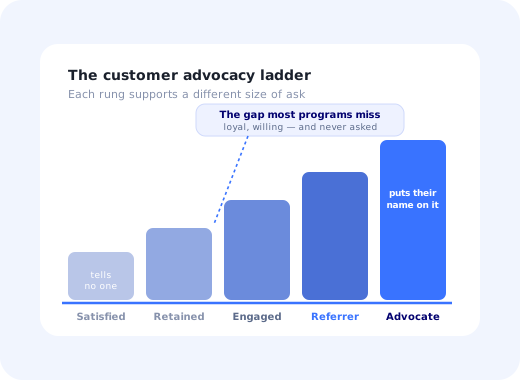
The Customer Advocacy Ladder: Five Rungs
Advocacy is not binary, and treating it as binary is why so many asks land wrong. Customers climb through states, and each state supports a different size of request. Asking a rung-two customer for a filmed case study fails; asking a rung-five customer only for a star rating wastes them.
(Each rung supports a different size of ask; the program's job is to know which rung a customer is on before it opens its mouth)
Two things are worth noticing about this ladder. The first is that the jump from rung three to rung four is the only one your product can help with directly: a deeply engaged user is one well-timed prompt away from a private referral, which is why in-product asks outperform email so consistently. The second is that rung five is not reached by asking harder. It is reached by giving rung-four customers a reason to keep going: recognition, early access, influence over the roadmap, a genuinely useful community. Advocacy at the top of the ladder is a relationship, not a campaign.
Why Customer Advocacy Matters
The strategic argument is simple: every other acquisition channel gets more expensive as you scale, and this one gets cheaper. Paid acquisition costs rise with competition. Content compounds slowly and can be out-published. Advocacy compounds with your own installed base: the more customers who reach real value, the more people are positioned to recommend you, and each new cohort adds to the pool rather than bidding against it.
There is a second, less obvious benefit. A referred user arrives with a mental model already installed: someone they trust told them what this product is for and why it is worth the setup cost. That changes onboarding economics. Referred users are, in the ordinary course of things, easier to activate, not because they are smarter, but because the hardest job of user onboarding, establishing why any of this matters, was done for you by a friend.
The third benefit is defensive. Advocates are the customers least likely to churn, because they have publicly attached themselves to the decision. Building an advocacy program is, among other things, a churn reduction exercise pointed at your best accounts.
How to Identify Customer Advocates
The first real task of a program is a list, and the list should be built from evidence rather than from memory. Three sources, read together, will get you a defensible one.
Weekly active sessions, breadth of features touched, seats invited, data volume, tenure past the first renewal. This is the power user profile, and it is the strongest single predictor because it cannot be faked in a survey.
A promoter-range NPS answer, a high CSAT after a support interaction, unprompted praise in a free-text field. Cheap to collect with a short in-app survey, and useless on its own.
Expanding seats, low ticket volume, no open escalation, an executive sponsor who is still at the company. A strong customer health score is what stops you asking a customer for a testimonial the week before they leave.
Score each account on all three and set a threshold. The exact weights matter far less than the discipline of writing them down: a documented rule you can argue about beats an undocumented instinct you cannot. A workable starting model looks like this:
| Signal | What to look for | Why it belongs in the score |
|---|---|---|
| Depth of use | Uses three or more core features every week | A recommendation needs something concrete to describe |
| Spread inside the account | Has invited teammates who are also active | People who sell it internally will sell it externally |
| Tenure | Past the first renewal or six months of continuous use | Filters out honeymoon enthusiasm that has not been tested |
| Sentiment | Promoter-range survey answer within the last quarter | Confirms the behaviour is enjoyed, not merely endured |
| Support history | No unresolved escalation; low ticket volume | The fastest way to burn an advocate is to ask mid-complaint |
| Trajectory | Usage flat or rising over the last 60 days | A declining account is a retention job, not an advocacy one |
A warning about the loudest customer. Every team has one account that gives brilliant feedback, replies to everything, and is genuinely delightful. They are usually on the list already and they cannot carry the program. Advocacy that rests on three named people is a relationship, not a system, and it disappears the moment one of them changes jobs.
How to Build a Customer Advocacy Program in 7 Steps
The sequence below is deliberately ordered so that nothing gets asked of a customer until you know who they are and what moment they are in. In outline:
- Decide what advocacy means for your business this year
- Build the scoring model that finds candidates
- Segment advocates by what they can realistically give
- Choose one ask per segment, never a menu
- Trigger the ask on a moment of proven value, in the product
- Give something back that is worth having
- Measure actions, close the loop, and retire what does not work
1. Decide what advocacy means for your business this year
"More advocacy" is not a goal. Sales needing twelve reference customers in the enterprise segment is a goal. Marketing needing thirty published reviews before a category report is a goal. Product needing forty engaged beta testers for a platform change is a goal. Each of those requires a different kind of person, a different ask, and a different amount of the customer's time, so the program has to start by picking. Trying to serve all three at once produces a generic "advocate community" that nobody in your company can name a use for.
2. Build the scoring model that finds candidates
Turn the signals from the previous section into a query you can re-run monthly. Pull usage from your product analytics, sentiment from your survey tool, and health from your CRM, and produce one ranked list. Keep it boring: a spreadsheet that updates every month will outperform a sophisticated model that never ships. The important property is not accuracy, it is repeatability: a list you can regenerate is a program, and a list you built by hand once is an event.
3. Segment advocates by what they can realistically give
Split the ranked list by cost-to-the-customer. A solo user on a small plan can leave a review in ten minutes. A team lead can take a reference call. An executive sponsor at an enterprise account can approve a case study, but only after legal, comms and their own manager have all said yes, which means that ask has a two-month lead time and should never be sent as a broadcast. Matching ask size to the person is the whole game, and it is why unsegmented advocacy emails perform so badly.
4. Choose one ask per segment, never a menu
The instinct to offer choices ("leave a review, or refer a friend, or join our community!") feels generous and converts terribly, because every additional option adds a decision the customer has to make before they can help you. Pick the single highest-value action that segment can complete in one sitting, ask for that, and stop. If they want to do more, they will tell you.
5. Trigger the ask on a moment of proven value, in the product
This is the step that separates programs that work from programs that exist. An advocacy ask sent on the first Tuesday of the quarter arrives with no context. The same ask shown right after a customer finishes a migration, exports their first report, or crosses their tenth active teammate arrives attached to a feeling. Those moments only exist inside the product, which is why the delivery mechanism should be an in-app message targeted at a behavioural segment, not a campaign in your email tool. Email is fine as a follow-up; it is a poor place to start.
6. Give something back that is worth having
Payment turns advocacy into endorsement and destroys the thing that made it valuable. But reciprocity is not payment. Early access to features, a direct line to the product team, a named credit in release notes, an invitation to a small roundtable with peers who have the same problems, or genuine influence over the roadmap all cost you little and are worth a great deal to a senior person. The test is whether the reward would embarrass them if it appeared next to their recommendation. A gift card would. A beta invitation would not.
7. Measure actions, close the loop, and retire what does not work
Track completed advocacy actions against identified advocates, and go back to every advocate with what happened: the review got 400 views, the referral became a customer, the feedback changed the feature. Almost nobody does this, and it is the cheapest loyalty mechanism in the entire program: people repeat behaviour that visibly mattered. Then cut the asks that convert under a few percent instead of resending them louder.
Customer Advocacy Examples: Six Formats That Work
These are ordered roughly by what they cost the customer, which is also the order you should introduce them to any individual advocate.
-
The public review
Ten minutes, no approvals, permanent, and it shows up in the research phase of every buyer who comes after. The right moment to ask is immediately after a support interaction resolved well or a milestone was hit, not in a quarterly sweep. Ask for a review of one specific thing they just did; blank-page reviews get abandoned.
-
The peer referral
One named person, sent privately, usually to someone with the same job at a similar company. This is the highest-converting form of advocacy and the least visible: most referrals never pass through a referral link, which means the only way to count them is to ask new signups how they heard about you and to make the in-product referral prompt easy enough to actually use.
-
The community answer
An experienced customer answering another customer's question in a forum, a Slack group or your own community space. It reduces support load, produces searchable content you did not write, and identifies future advocates automatically: the person who answers three questions unprompted is telling you exactly who they are.
-
The sales reference call
Thirty minutes of a customer's time, spent convincing a prospect in the same industry that the risk is survivable. Enormously effective late in enterprise deals and enormously easy to over-use: a reference customer who is asked six times a quarter stops answering. Cap it, track it, and rotate.
-
The case study
The most quoted and most expensive format: an interview, a draft, a round of approvals, and often a legal review. Only ask accounts whose results you can already prove from their own data, and bring the numbers to the first conversation rather than asking them to find them. Doing the work for the customer is the difference between a yes and a polite delay.
-
Structured beta participation
Advocacy pointed inward. A customer who tests an unfinished feature and files real feedback is investing in your roadmap, and the status that comes with it is often the reward that moves someone from rung four to rung five. It also produces better product decisions than any survey, because the feedback is grounded in their actual work.
How to Measure Customer Advocacy
Three layers, in this order. Reporting only the first layer is how programs get defunded; reporting only the third is how they get built on luck.
| Layer | Metric | What it tells you | Failure it exposes |
|---|---|---|---|
| Potential | Advocates identified | How many accounts clear your scoring threshold | Not enough customers reach real value |
| Promoter share | Stated willingness across the base | Product or support problem upstream | |
| Conversion | Advocacy actions per identified advocate | Whether your asks work at all | Wrong ask, wrong moment, or wrong channel |
| Ask acceptance rate by segment | Which segment and format actually converts | Ask is too large for the rung | |
| Output | Referrals sourced and their conversion rate | Pipeline created by existing customers | Referred users are not being activated well |
| Reviews, references and case studies published | Assets available to every future buyer | Asset requests are stuck in approvals |
One derived number is worth putting on a dashboard: advocacy conversion rate, actions completed divided by advocates identified, per quarter. It is the only figure that isolates the part of the program you control. If potential is high and conversion is low, your asks are wrong. If potential is low, stop working on advocacy and go work on activation: you cannot harvest a field you have not planted.
Customer Advocacy: Do vs. Don't
✅ Do
- Build the advocate list from product behaviour first, sentiment second
- Ask inside the product, at the moment value was proven
- Send exactly one ask, sized to the person's rung on the ladder
- Do the preparation work: bring the numbers to a case study conversation
- Report back what their contribution achieved
- Cap how often any single reference customer is used
- Reward with access, influence and recognition
- Re-run the scoring model on a schedule so the list stays alive
❌ Don't
- Blast the whole base with a quarterly review request
- Report promoter percentage as if it were an advocacy result
- Ask an account with an open escalation or falling usage
- Offer a menu of ways to help and hope one lands
- Pay for reviews or testimonials in cash or credit
- Let the program rest on three enthusiastic individuals
- Ask for a case study before you know the customer's results
- Go silent after they said yes: that is where advocates are lost
Running Customer Advocacy With Kompassify
Almost everything above depends on two capabilities: knowing which customers have genuinely reached value, and being able to say something to exactly those customers at exactly the right screen. Both live in the product, which is usually where advocacy programs stall: the customer success team can see who to ask, and has no way to ask them anywhere except email. Kompassify closes that gap without an engineering ticket:
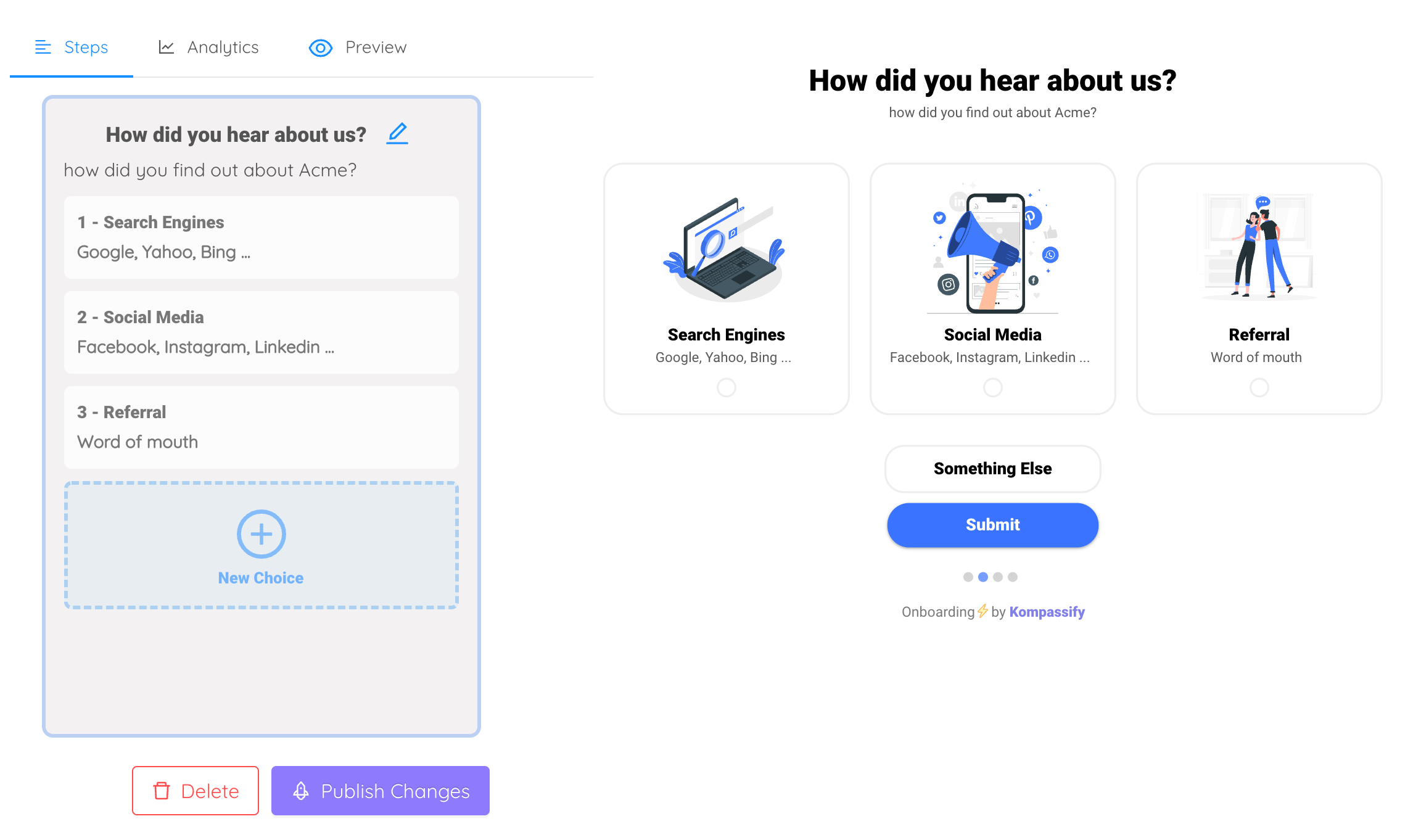
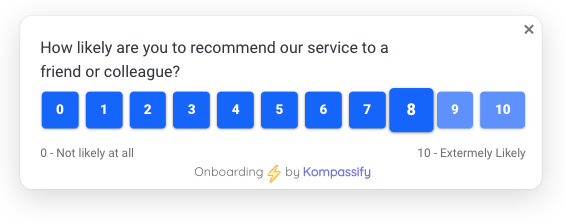
- Find promoters with an in-app survey. Run a short NPS or satisfaction survey inside the product, triggered after a real milestone rather than on a schedule, and use the answers as the sentiment input to your scoring model.
- Target the ask by behaviour, not by list. Segment on what users have actually done (features used, steps completed, tenure) so the advocacy prompt only reaches accounts that have reached value.
- Deliver the ask where the value happened. A single in-app message or modal on the screen where the milestone completed, with one action and one button, no campaign, no inbox.
- Recruit beta participants in-product. Announce an early-access program to your most engaged segment only, so the invitation reads as recognition rather than as marketing.
- Close the loop visibly. Use an announcement to tell contributors what their feedback changed, which is the cheapest way to turn a one-time helper into a repeat advocate.
- See what worked. Built-in analytics show how each prompt performed by segment, so you can retire the asks that do not convert instead of resending them.
Kompassify is GDPR compliant and EU-hosted, free for under 100 monthly active users, with paid plans from $129/month.
Ask the Right Customers, at the Right Moment
Kompassify lets you run in-app surveys, target messages by real product usage, and show a single well-timed advocacy ask on the screen where your customer just succeeded, no code, no release cycle. GDPR compliant, EU-hosted, and free for under 100 monthly active users.
Start for Free →Frequently Asked Questions
What is customer advocacy?
Customer advocacy is what happens when a customer recommends your product to someone else without being paid to do it: a referral to a peer, a public review, a conference talk, a reply in a community thread, a screenshot posted because the thing genuinely worked. It is distinct from satisfaction, which only says a customer is not unhappy, and from loyalty, which only says they keep renewing. Advocacy is the point where a customer takes a personal reputational risk on your behalf, and that is why it is both the hardest state to reach and the most valuable one: it turns your existing users into the acquisition channel for your next ones.
What is the difference between customer advocacy and customer loyalty?
Loyalty is a decision customers make about themselves; advocacy is a decision they make about other people. A loyal customer renews, expands, and stays through a bad quarter, but may never mention you to anyone. An advocate spends their own credibility recommending you. Loyalty is a prerequisite, not a synonym: every advocate is loyal, but most loyal customers never become advocates because nobody ever gave them an easy, well-timed moment to say something. That gap, loyal but silent, is where a customer advocacy program does its work.
How do you identify customer advocates?
Stop guessing from gut feel and read three sources together. First, behaviour: depth of feature use, weekly active sessions, seats invited, and tenure past the first renewal, the profile of a power user. Second, sentiment: a promoter-range NPS answer, a high CSAT after a support interaction, an unprompted piece of praise in a feedback form. Third, account health: an expanding, low-ticket, low-risk account. Someone who scores well on all three is an advocate whether or not they have ever said so publicly. Someone who scores well on sentiment alone is a compliment, not a program.
How do you build a customer advocacy program?
Define what advocacy means for your business first: referrals, reviews, references, case studies, community answers, or beta feedback, because each needs a different kind of person and a different ask. Then build a scoring model that finds those people from product usage plus sentiment, segment them by what they can realistically give, pick one ask per segment rather than a menu, time the ask to a moment of proven value instead of a calendar quarter, make it small enough to complete in the product where the value happened, give something real back, and measure the program on advocacy actions produced per advocate identified rather than on how many people joined a list.
What are examples of customer advocacy?
The formats that carry real weight in B2B SaaS are peer referrals to a named contact, public reviews on software marketplaces, sales references on a call, written or filmed case studies, answers given to other users in a community or forum, and structured participation in a beta program. They vary enormously in cost to the advocate: a review is ten minutes, a case study is a legal review and two internal approvals, so they should never be asked for in the same breath or from the same person at the same stage.
How do you measure customer advocacy?
Measure three layers. Potential: how many accounts currently clear your advocate scoring threshold. Conversion: what share of identified advocates completed an advocacy action in the period, the number that tells you whether your asks are working. Output: referrals sourced, reviews published, references given, and the pipeline or revenue traceable to them. Net Promoter Score belongs in the first layer as an input signal, not as the result: a promoter who never does anything is not an advocate, and reporting promoter percentage as advocacy is the most common way these programs quietly fail to prove value.
When is the right moment to ask a customer for advocacy?
Immediately after a proven success, inside the product, at the screen where the success happened: the finished migration, the first report exported, the tenth teammate invited, the renewal that just went through without a call. Value is freshest at that instant, and the ask reads as a natural next sentence rather than a marketing campaign. The worst timings are the mirror image: a quarterly batch email with no context, a request during an open support ticket, or an ask sent to an account whose usage has been sliding for a month.
Can you run a customer advocacy program without a dedicated tool?
Yes, and most teams should start that way. The scoring model can live in a spreadsheet built from product analytics and survey exports, and the asks can be delivered inside the product itself. With a no-code platform like Kompassify you can run an in-app survey to find promoters, segment on real usage so the ask only reaches accounts that have actually reached value, and show a targeted in-app message asking for the referral or review at that moment, all without an engineering ticket. Kompassify is GDPR compliant and EU-hosted, free for under 100 monthly active users, with paid plans from $129/month.