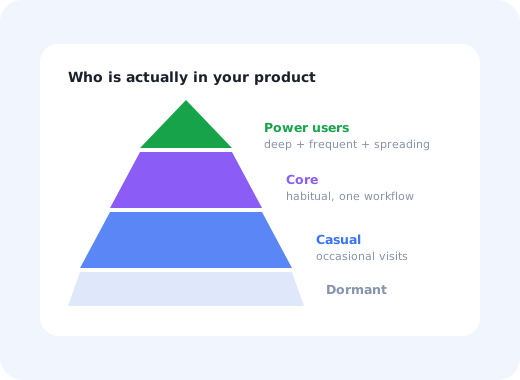
Every SaaS product has a small group of users who behave differently from everyone else: they are in the product most days, they use features the rest of the base has never opened, and they are usually the reason their company renews. They are also, quietly, the most dangerous group to design for.
Power users are worth understanding precisely because their influence is disproportionate in both directions: on expansion revenue and advocacy on one side, on roadmap distortion on the other.
This guide covers what a power user actually is, how to identify them with data you already have, why they matter commercially, how to create more of them, and how to avoid building a product only they can use.
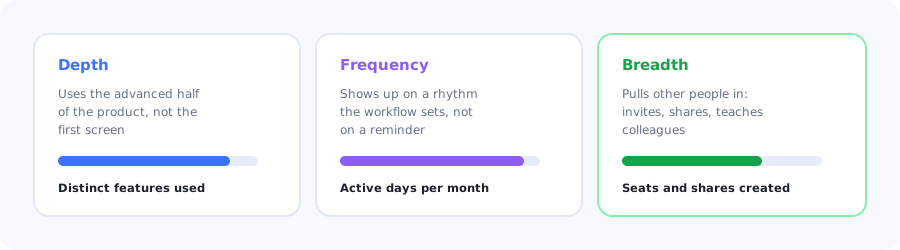
One signal is a habit. Three together is a power user.
Key Takeaways
- A power user is defined by depth, frequency and breadth together; heavy usage of one feature is a habit, not power use.
- They are made, not found. Most power users passed through a specific sequence of capabilities you can identify and then engineer.
- They predict expansion and renewal better than any survey score, because the behaviour is unprompted.
- Their feedback is the most detailed and the least representative in your entire user base.
- Look for the second feature, not the first: the step from one capability to two is where the power-user path begins.
- Never design the default experience for them. Advanced capability belongs behind progressive discovery, not on the first screen.
What is a power user?
Power user definition: a user who uses a product deeply, frequently and broadly, reaching beyond the core feature into the advanced capability, returning on a rhythm set by their own workflow rather than by prompts, and typically pulling other people into the product. In SaaS, power users are usually a small share of the base and account for a disproportionate share of retained revenue, product feedback and referrals.
The three-signal test matters because each signal alone is misleading. Someone who logs in every day to check one number is frequent but shallow. Someone who explored twelve features once during a trial is broad but not committed. Power use is the intersection.
Power users vs heavy users vs champions
| Type | Defined by | What they give you |
|---|---|---|
| Heavy user | Volume on one workflow | Load, and a strong opinion about that workflow |
| Power user | Depth × frequency × breadth | Retention, expansion, detailed feedback |
| Champion | Advocacy inside the account | Renewal, references, internal rollout |
They overlap but are not interchangeable. A champion who does not use the product deeply cannot defend it when a cheaper option appears; a power user with no internal influence cannot stop a renewal decision made two levels above them.
How to identify power users
You do not need a model. Three queries against product usage data will get you a defensible list.
Count distinct core features used per account in the last 30 days
Count active days in the same window
Count invitations, shares or exports created
1. Depth: distinct core features used
Define a list of five to eight capabilities that represent real use of the product: not page views, actions with an outcome. Users in the top decile on this count are your depth candidates. This one number is also the best single indicator of account health, which is why it belongs in the model described in our customer health score guide.
2. Frequency: active days, not sessions
Sessions are inflated by tab behaviour; active days are not. A user active on twelve days in a month has embedded the product in a routine. The ratio of daily to monthly actives, covered in the product stickiness guide, tells you how large this group is at the population level.
3. Breadth: do they bring other people
Invitations sent, assets shared, comments left, seats added. This is the signal that separates a productive individual from someone whose usage spreads, and it is the one that correlates with expansion revenue rather than merely with retention.
Do not define power users by tenure. Account age is the laziest proxy and it is routinely wrong: plenty of two-year-old accounts have never left the first screen, and some accounts reach genuine depth in three weeks. Behaviour is available in your data; use it.
Why they matter
-
They carry renewal and expansion
Depth of usage is the hardest thing for a competitor to displace. Accounts with power users renew for reasons unrelated to price, and they are where seat expansion originates.
-
They are your distribution
They recommend the product internally and externally, and they are the population worth asking for reviews and referrals, identified by behaviour rather than by a survey score.
-
They find the real edges
Bugs at the limits of the product, workflow gaps, and the feature requests that turn out to be genuinely load-bearing come from this group first.
-
And they distort the roadmap
They are the loudest, most articulate and least representative segment you have. Their requests are real; their priorities are not the median user's priorities.
How to create more power users
Power users are the end of a path, and paths can be built. The method is to find the sequence the existing ones took, then help everyone else take it.
Find the second feature
Look at what your current power users adopted after the core feature, in what order, and how soon. There is almost always one capability that separates users who go deep from users who plateau, and it is rarely the one the marketing site leads with. That second feature is your target for every activated user.
Introduce depth on evidence, not on a schedule
The right moment to introduce an advanced capability is when the user's behaviour shows they have the problem it solves: they have done the core task enough times, or hit the limit the feature removes. Triggering on behaviour rather than on account age is the core of progressive onboarding.
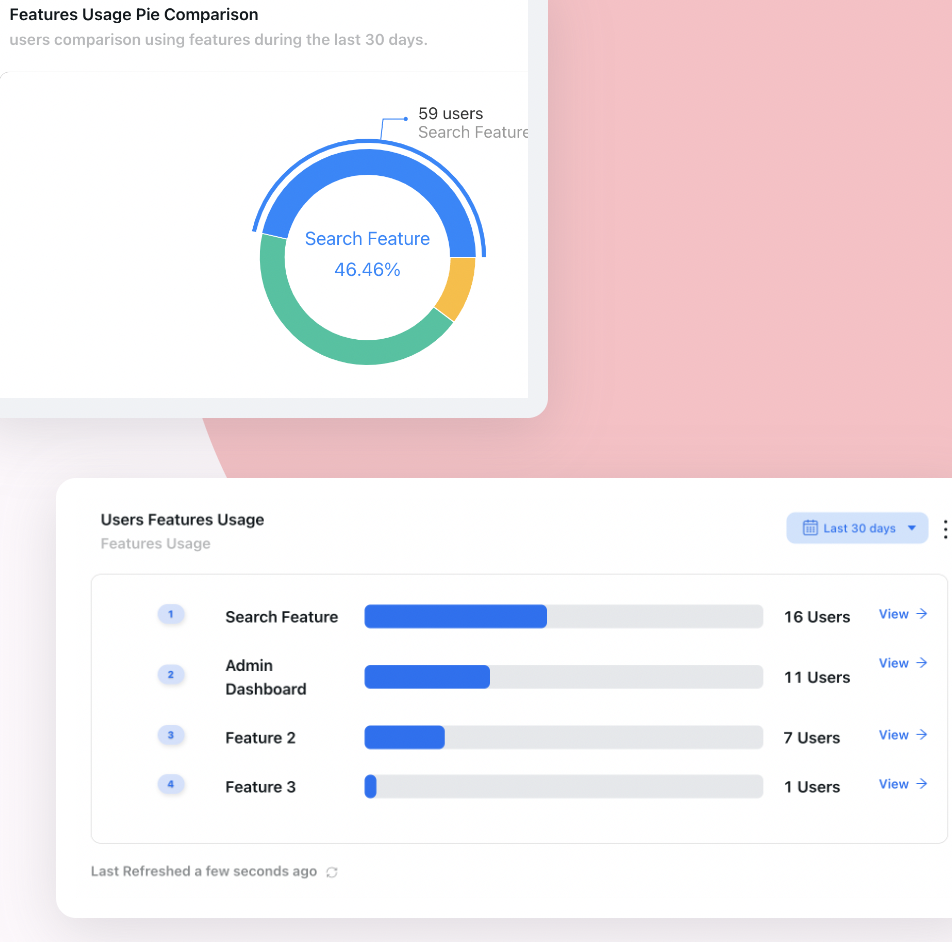
Compare feature usage between your top decile and everyone else. The gap is your roadmap for depth.
Make the advanced capability discoverable, not loud
Hotspots, contextual callouts and a searchable in-product reference let motivated users find depth on their own terms. Broadcasting advanced features to the whole base produces dismissals, not adoption; the mechanics are covered in the feature discovery guide.
Segment and treat them differently
Once you can identify the group, stop showing them beginner guidance and start showing them what is new at their level. Nothing erodes credibility faster than a welcome tour firing for someone who has used the product for a year. User segmentation covers how to build and maintain these groups.
The trap: designing for the top decile
Power users generate most of your feedback, so a product that responds to feedback proportionally will drift toward them. The result is familiar: dense interfaces, options everywhere, and an onboarding experience that assumes knowledge nobody new has.
Two habits prevent it. First, weight feedback by the segment it came from, and check what share of the base a request actually affects before it enters the roadmap. Second, keep the default experience aimed at the median user and put depth behind discovery, advanced capability that power users will find and beginners will not trip over. The feature bloat guide covers what happens when neither habit is in place.
Do's and don'ts
✅ Do
- Define power users by behaviour, in three dimensions
- Find the second feature that predicts depth
- Introduce advanced capability on behavioural triggers
- Segment them out of beginner guidance
- Ask them for reviews, referrals and edge cases
- Weight their feedback by segment size
❌ Don't
- Use tenure or login count as the definition
- Treat the loudest users as the average user
- Broadcast advanced features to the whole base
- Run the welcome tour for a two-year customer
- Let the top decile set the default experience
- Assume a champion is also a power user
Growing power users with Kompassify
The practical work is identifying the depth gap and then guiding people across it, without carpet-bombing the rest of the base.
- Compare feature usage between your top decile and everyone else in product analytics.
- Introduce the second feature with a targeted tooltip or hotspot once the core task has been repeated.
- Guide the advanced workflow with a short product tour shown only to the segment that is ready for it.
- Announce depth features to experienced users with the announcement widget, not to first-week accounts.
- Ask the right people for feedback with an in-app survey targeted at the segment.
Kompassify is a no-code digital adoption platform for SaaS teams: tours, checklists, tooltips, announcements, surveys and analytics in one place. Free up to 100 monthly active users, paid plans from $129/month, GDPR-compliant with EU hosting.
Turn activated users into power users
Find the feature that separates your deepest accounts from the rest, and guide everyone else to it at the right moment.
Start for Free →Frequently Asked Questions
What is a power user?
A power user is someone who uses a product deeply, frequently and broadly: they reach beyond the core feature into advanced capability, they return on a rhythm set by their own workflow rather than by prompts, and they typically pull other people into the product through invitations, shares or seats. In SaaS they are usually a small share of the base and account for a disproportionate share of retained revenue, product feedback and referrals.
How do you identify power users?
Three queries against usage data are enough. Count distinct core features used per account in the last thirty days, where core means actions with an outcome rather than page views. Count active days in the same window, since active days are harder to inflate than sessions. And count invitations, shares or seats created, which is the signal that separates a productive individual from someone whose usage spreads. Users in the top decile on all three are power users; strength on one alone is a habit, not power use.
What is the difference between a power user and a champion?
A power user is defined by product behaviour: depth, frequency and breadth of usage. A champion is defined by advocacy inside the account, meaning they defend the purchase, drive internal rollout and act as a reference. They often overlap, but not always, and each without the other is fragile: a champion who does not use the product deeply cannot defend it against a cheaper alternative, and a power user without internal influence cannot stop a renewal decision made above them.
Why do power users matter?
They carry renewal and expansion, because depth of usage is the hardest thing for a competitor to displace and seat growth usually starts with them. They act as distribution through internal and external recommendations. And they surface the real edges of the product, from limit-case bugs to the feature requests that turn out to be load-bearing. The counterweight is that they are also the least representative segment you have, so their priorities should never be mistaken for the median user's.
How do you turn regular users into power users?
Find the sequence your existing power users took and help everyone else take it. In most products there is a specific second feature, adopted after the core one, that separates users who go deep from users who plateau, and it is rarely the feature the marketing site leads with. Introduce it when behaviour shows the user has the problem it solves rather than on a fixed schedule, keep it discoverable through hotspots and contextual callouts rather than broadcasting it, and stop showing beginner guidance to people who are past it.
Should you build features for power users?
Build them, but do not let them set the default experience. Because power users generate most of your feedback, a product that responds to feedback proportionally drifts toward dense interfaces and onboarding that assumes knowledge nobody new has. Two habits prevent it: weight feedback by the size of the segment it came from before a request enters the roadmap, and put advanced capability behind progressive discovery so power users find it and beginners do not trip over it.
What percentage of users are power users?
It varies enormously by product category and pricing model, so a borrowed benchmark is close to useless. The number worth tracking is your own, measured consistently: define the three-signal threshold once, then watch what share of active accounts clears it month over month. The trend matters more than the level, because a rising share means your depth-building work is landing and a falling share is an early warning that shows up long before churn does.
Are power users the right people to ask for feedback?
They are the right people for specific questions and the wrong people for others. Ask them about edge cases, workflow gaps, limits and advanced capability, where their experience is unmatched. Do not ask them about onboarding, first impressions, or which features should be prominent by default, because they cannot remember not knowing the product. Those questions belong to new users, and the answers usually contradict what the top decile would tell you.