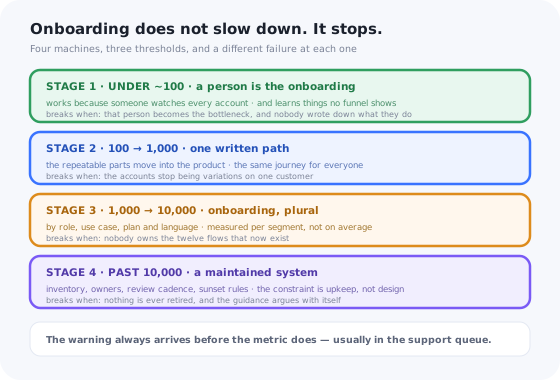
There is a version of the onboarding conversation that treats it as a design problem you solve once: get the welcome flow right, pick the activation metric, ship the checklist, move on. It is a useful way to start, and it has a hidden assumption: that whatever you build keeps working as the number of accounts arriving changes.
It does not. Onboarding is a machine sized for a particular volume, and it does not degrade gracefully when that volume changes by an order of magnitude. It works, and then at some point it stops working, usually without anything visibly changing. The founder who onboarded every account gets busy. The one written path meets a customer it was not written for. The twelve flows that now exist start contradicting each other.
This is a map of those thresholds: what carries you through each stage, what quietly breaks in each transition, and the signal that shows up before the numbers do.
Key Takeaways
- Onboarding fails at thresholds, not gradually. Each stage retires the thing that got you to it.
- The first casualty is the undocumented manual step, the one nobody thinks of as part of the process.
- An aggregate activation rate stops describing anyone once the population splits. Measure by segment before you need to.
- Move work into the product when it repeats, not when it gets expensive: repetition is a specification.
- The support queue is the leading indicator. It moves a stage before the funnel does.
- Past the last threshold the job is upkeep: inventory, owners, review cadence, sunset rules.
The Four Stages, in One Table
The numbers are orders of magnitude rather than precise lines, and they mean new accounts you are trying to activate, not registered users. A product with ten thousand accounts and forty signups a week is at stage two. One with eight hundred accounts and all of them from the last quarter is at stage three.
| Stage 1 · <100 | Stage 2 · 100–1,000 | Stage 3 · 1k–10k | Stage 4 · 10k+ | |
|---|---|---|---|---|
| Onboarding is | A person | A written path | Several paths | A maintained system |
| The job | Learning what confuses people | Writing down what works | Telling users apart | Keeping it all true |
| Main constraint | Nothing: you have time | One person’s hours | One-size-fits-all content | Ownership and drift |
| Right metric | Qualitative: what did they ask? | Activation rate, one funnel | Activation by segment and cohort | Per-flow adoption and decay |
| Breaks when | The person runs out of hours | The population stops being uniform | Nobody owns the twelve flows | Nothing is ever retired |
Stage 1 · Under 100: A Person Is the Onboarding
Early onboarding is someone watching. They see the signup come in, they email, they get on a call, they set the account up themselves if it comes to it. It converts extremely well, and everyone knows it does not scale, which is usually where the analysis stops.
The part worth taking seriously is what this stage is for. It is not a cheap way to onboard a hundred customers. It is the only reliable way to find out what confuses people, because a person in a call notices hesitation, wrong assumptions and the question asked three times in slightly different words, none of which appear in a funnel. A team that automates this stage early saves hours and buys years of guessing.
The one thing to do at this stage: keep a running list of the questions you get asked, verbatim, with no editing and no categorising. That list is the specification for stages two and three, and it is the single highest-leverage artefact in early onboarding. If you would rather be systematic about it, this is what a structured onboarding audit formalises later, but the notes file works now.
The trap is that this stage is pleasant. Personal onboarding produces grateful customers and good conversations, and the person doing it is usually the person who would have to decide to stop. It ends not with a decision but with a quiet degradation: the calls get shorter, then become emails, then become emails sent to some accounts and not others, and nobody notices which accounts stopped receiving them.
Stage 2 · 100 to 1,000: Write Down What Works
The transition into stage two is the one everybody recognises: onboarding stops being a person and becomes a path. The product gets a welcome flow, a setup checklist, an email sequence, and the manual work becomes an exception rather than the rule.
What breaks here is rarely the part you moved. It is the part nobody thought to move.
The undocumented manual step
Almost every early onboarding contains one: someone flips a setting, seeds an example project, checks that the integration actually connected, sends one personal note that gets a reply. It was never a decision, so it was never written down, and it appears in no document, no funnel and no part of the product. When volume outgrows the person doing it, activation falls with no visible cause: nothing in the product changed, so nothing in the product looks wrong.
The way to find it is not a document review. Ask the person who currently onboards accounts to narrate one out loud, end to end, without editing for what “counts”. The steps they almost skip mentioning are the ones about to break.
The path that assumes one starting point
Written onboarding usually encodes the customer you have most of. It assumes the data is empty, the integration has not been connected, the person signing up is the person who will use it. Each of those assumptions is fine until the first account arrives that violates it, and then the onboarding is not merely unhelpful, it is confidently wrong, telling someone to do a thing they have already done.
The moment repetition becomes a specification
The signal to move something from a person into the product is not that it has become expensive. It is that it has become the same. When the calls have collapsed into the same five questions and the same three setup steps, that repetition is a specification, and the reason to build it is coverage rather than saved hours: a checklist reaches every account, including the ones nobody had time to call, at the moment they need it instead of on the day someone was free.
For the mechanics of that move (what belongs in the product versus an email, and how to sequence it) the self-serve onboarding guide covers the build, and onboarding automation covers what should and should not be automated.
Stage 3 · 1,000 to 10,000: One Onboarding Is Not Enough
This is the least visible transition, because nothing dramatic happens. The funnel still works, the activation number is roughly where it was, and yet something is wrong that nobody can name.
What has happened is that the population split. Where every account used to be a variation on one customer, you now have self-serve alongside sales-assisted, admins alongside end users, one language alongside four, a mobile cohort, a plan tier with different needs. A single onboarding path serves the average of a group in which nobody is average, and, more dangerously, a single activation rate describes it.
An average is only informative while the population is homogeneous. The moment it splits, the aggregate can stay flat while the parts diverge in opposite directions.
The move at this stage is therefore two things at once, and doing only the first is the common mistake.
1. Split the measurement before you split the content
Activation by segment and by cohort, not in aggregate. Until you can see the segments separately you are guessing about which onboarding to build, and the guess will favour the largest group, which is the one already doing fine. This is also the point at which cohort analysis stops being a nice idea and becomes the only way to tell “we got worse” from “we grew into a different mix”.
2. Branch the path where the goals genuinely differ
Not everywhere: branching for its own sake produces a maintenance problem in stage four. Branch where the first useful outcome is different: an admin setting up a workspace and an invited teammate joining one have almost nothing in common, and giving them the same five-step checklist wastes both. That is what personalised onboarding means in practice, and it is a smaller intervention than it sounds.
3. Watch the support queue, not the dashboard
The queue moves a stage earlier than the funnel. A new theme in support tickets, a question nobody used to ask, is a segment forming, and it will show up in the numbers a month or two later as a mild decline nobody can attribute. Reading the queue as an early-warning system is the cheapest instrumentation available, and it is the one thing that keeps working at every stage.
Stage 4 · Past 10,000: The Job Is Upkeep
By the fourth stage, designing onboarding is not the hard part any more. You have the segments, you have the flows, you have the metrics. What you also have is twelve to forty pieces of in-app content written by six people over three years, some of which describe a version of the product that no longer exists.
The failure mode here is drift, and it has three faces.
| Kind of drift | What it looks like | The habit that prevents it |
|---|---|---|
| Broken | A tooltip anchored to a button that moved; a step that silently never shows | An inventory keyed by screen, and step-level telemetry |
| Stale | Correct guidance for a flow that was redesigned last quarter | Re-run the guides on the screens each release touches |
| Redundant | Three overlapping tours from three teams, firing at the same user | An owner per flow and a written end condition |
The first row is a genuinely technical problem: guidance makes runtime claims about your interface, and ordinary product work breaks them without anyone noticing. That is worth its own treatment, and it has one: why product tours break, and how to keep them working.
The third row is the one teams underrate. Most onboarding debt is not broken content; it is correct content that stopped being necessary and that nobody feels entitled to delete. The fix is administrative and takes five minutes per flow: at creation time, write down who owns it and what ends it: a date, a target, or the release it was explaining. An end condition written on day one is permission granted in advance.
The Four Things That Break in Every Transition
Stage-specific advice is useful, but four failures recur at every threshold, and recognising them is worth more than knowing which stage you are in.
1. The step nobody knew was part of the process
At stage two it is a manual account setup. At stage three it is a segment that only got onboarded because a particular CSM happened to own it. At stage four it is a piece of tribal knowledge sitting in one person’s head about which flow supersedes which. Same shape every time: work that is load-bearing and undocumented.
2. The metric that quietly changed meaning
Activation defined in 2024 as “created a project” still computes fine in 2026, after projects became something the template creates automatically. The number goes up, the meaning is gone, and nobody re-reads the definition because the chart still renders. Re-derive your onboarding metrics against what the product currently does whenever you cross a threshold.
3. Content with no owner
Every stage adds content (emails, checklists, tooltips, help articles) and the transitions are where authorship gets lost, because the person who wrote it has moved on to the next stage’s problem. Content without an owner is not maintained; it is merely still there.
4. Support load treated as a cost instead of a signal
Rising tickets during a growth phase look like a staffing problem, and get staffed. But the composition of the queue is the most sensitive onboarding instrument you have, and it moves before any dashboard. Categorising tickets by the onboarding step they relate to takes an afternoon and buys you a month of warning. It is also the input that makes in-app support worth building rather than guessing at.
Onboarding you can change without a release
Every transition in this guide involves editing onboarding content faster than a release cycle allows: a new segment, a branch, a step that should stop firing. Kompassify lets product, support and customer success teams build and change in-app tours, checklists, tooltips and announcements without shipping code, targeted by segment, with adoption data per flow. Free up to 100 monthly active users, plans from $129/month, GDPR-compliant and EU-hosted.
Start for free →What to Build One Stage Early
Three pieces of groundwork are cheap at the stage before you need them and expensive to retrofit afterwards. They are the closest thing to a free lunch in this whole subject.
Build early
- Event tracking with a stable naming scheme. You cannot answer a question about a past cohort if the clock starts the day someone asks.
- One definition of a segment, used by onboarding and analytics alike, so “new admin on the team plan” means one thing.
- An inventory of in-app guidance keyed by screen, so a release knows what it is about to break.
- A verbatim question log from support and sales. It is the specification for the next stage.
Do not build early
- Branching before you can measure the branches. You will optimise for the largest segment, which is already fine.
- Localisation before a non-English segment exists. It multiplies maintenance for a population of nobody.
- Automation of the diagnostic conversations. Automate the repeated ones; keep the ones that still teach you something.
- A fifth tour because a fourth exists. Adding is easy; the cost lands two stages later.
And one thing that is not on either list because it is a misconception rather than a decision: scaling onboarding does not mean removing human contact. It means spending it where it changes an outcome. What you remove is the step that happened to every account whether or not it needed one; the hours freed usually reappear as deeper contact with the accounts that genuinely need it, which is what digital customer success is actually for.
The One-Paragraph Version
Onboarding is sized for a volume, and it fails at thresholds rather than degrading gradually. Under a hundred accounts it is a person, and the point of that stage is learning, not efficiency. Between a hundred and a thousand it becomes a written path, and the thing that breaks is the manual step nobody wrote down. Between a thousand and ten thousand the population splits, one activation rate stops describing anybody, and the move is to measure by segment before branching the content. Past ten thousand the constraint is upkeep: an inventory keyed by screen, an owner and an end condition per flow, and a review that runs with releases. Underneath all four, the same four failures recur: undocumented work, a metric that changed meaning, content with no owner, and a support queue read as a cost rather than the earliest signal you have.
Frequently Asked Questions
How does user onboarding change as a company grows?
It changes in kind, not in degree. Under about a hundred users, onboarding is a person: someone watches every new account and intervenes. Between a hundred and a thousand, that person becomes a bottleneck and the job becomes writing down what they do so it can happen without them. Between a thousand and ten thousand, one written path stops fitting, because the accounts arriving are no longer variations on one customer: they differ by role, use case, size and language, and a single sequence serves the average of people none of whom is the average. Past ten thousand, the constraint is no longer designing onboarding but maintaining it: the content, targeting, translations and in-app guidance drift out of date faster than anyone is assigned to fix them. Each transition retires the thing that got you there.
What is the first thing that breaks when onboarding starts to scale?
The undocumented manual step. Almost every early onboarding has one: someone flips a setting, seeds an example project, sends a personal note, checks that the integration connected, and because it was never a decision it was never written down. It does not appear in the funnel, in the product, or in any document, so when volume outgrows the person doing it, activation falls with no visible cause and nothing in the product looks different. The practical test is to ask the person who currently onboards accounts to narrate one out loud, in full, without editing for what "counts" as part of the process. The steps they almost skip mentioning are the ones about to break.
Why does activation rate stop being useful as you grow?
Because a single average is only meaningful while the population is homogeneous. Early on, everyone signing up is roughly the same kind of user with the same goal, so one rate describes them. As you grow, the population splits: self-serve and sales-assisted, mobile and desktop, admins and end users, one language and several, and the segments diverge. A stable aggregate can hide one segment collapsing while another improves, and it usually does, because the segment collapsing is often small and new. The fix is not a better metric, it is a smaller unit of analysis: measure activation by segment and by cohort, and treat the aggregate as a summary rather than a signal.
When should you replace manual onboarding with in-app guidance?
When the manual work is repeating rather than diagnostic. Personal onboarding is worth its cost while you are still learning what confuses people, because a human in a call finds problems no funnel will show. It stops being worth it when the calls have become the same call: the same five questions, the same three setup steps, the same moment of confusion. That repetition is a specification, and the point of moving it into the product is not the saved hours but the coverage: a checklist or a tooltip reaches every account, including the ones nobody had time to call, at the moment they need it rather than on the day someone was free.
What should you build before you need it?
Three things, all cheap early and expensive later. Event tracking with a stable naming scheme, so you can answer questions about a past cohort rather than starting the clock the day someone asks. A segment definition that exists in one place and is used by both onboarding and analytics, so "new admin on the team plan" means the same thing everywhere. And an inventory of your in-app guidance keyed by the screen it points at, so a release can tell what it is about to break. None of them are urgent at a hundred users and all of them take months to retrofit at ten thousand, which is exactly the shape of infrastructure worth building one stage early.
Does scaling onboarding mean removing the human touch?
No, it means spending it where it changes an outcome. The mistake in both directions is to treat human contact as a volume dial. Scaling well looks like moving the repeatable parts into the product so that people can be deployed against the parts that are genuinely uncertain: a complex migration, an account whose usage pattern does not match what they bought, a customer whose configuration is unusual enough that no guide will fit. What you remove is the human step that happened to every account regardless of whether it needed one. Teams that do this well usually end up with more human contact at the moments that matter, not less, because the hours stopped being spent on setup that a checklist could have covered.