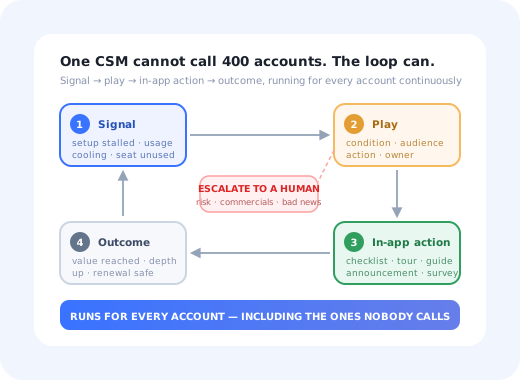
Customer success teams rarely fail because the people are bad at the job. They fail because of arithmetic. The account list grows faster than the headcount, each CSM picks up more logos, and the work that used to be a conversation becomes a template. Nobody decides to give customers less attention; the ratio decides it for them.
Digital customer success is the response to that arithmetic. Instead of rationing human attention until it is thin everywhere, you move the repeatable parts of the job into the product (onboarding, enablement, release education, the nudge when adoption stalls) and keep the human time for the things that genuinely need a person.
This guide covers what digital CS actually is, how the touch model works, which parts of a CSM's week move and which must not, a six-step build sequence, the plays worth automating first, and the metrics that tell you whether the programme is working or just producing unread email.
Key Takeaways
- Digital CS is a delivery model, not a discount tier. The outcomes stay identical; only the mechanism changes from a person to the product.
- Layer it, do not segment it. Every account gets the digital layer. High-touch relationship work sits on top for the accounts that warrant it, including enterprise.
- Sort the work, then move it. Same-for-everyone tasks become in-app guidance, rule-driven tasks become triggered plays, judgement stays human.
- In-app beats email for anything about the product. A message about a feature is most useful standing next to the feature, not in an inbox.
- Escalations, commercials and disappointment stay human. Automating those is the fastest way to make digital CS feel like abandonment.
- Measure coverage and outcomes. Share of accounts with a real onboarding journey and risk signals that triggered a play, not emails sent.
What Is Digital Customer Success?
Digital customer success, in one paragraph
Digital customer success is the practice of delivering customer-success outcomes through the product and automated channels rather than through a named person for every account. The customer is still onboarded, still nudged when adoption stalls, still told what changed and still caught before they churn, but the delivery mechanism is an in-app checklist, a targeted guide, a triggered message or a resource centre instead of a scheduled call. It is sometimes called tech-touch, digital-led or one-to-many customer success. All three describe the same shift: the product carries the journey, and the CSM shows up where judgement is needed.
The distinction that matters is between outcome and mechanism. A CSM is accountable for a customer reaching value quickly, adopting the features that predict retention, and renewing. None of those outcomes require a meeting. They require someone or something to notice what the customer is doing, decide what should happen next, and make it happen. A well-built digital programme does all three continuously, for every account, including the ones nobody has time to call.
This is also why "digital CS is for the long tail" is a costly misreading. The long tail is where it is most obviously necessary, but it is not where it is most valuable. In an enterprise account, the CSM knows the sponsor and perhaps four other people. The other three hundred users, the ones whose behaviour actually determines the renewal, will never meet anyone from your company. The digital layer is the only thing that reaches them.
High-Touch, Low-Touch and Tech-Touch
Most CS organisations describe their coverage in three tiers. The tiers are useful, as long as they are read as descriptions of human involvement rather than of how much the customer gets.
The common mistake is drawing only the pyramid. The digital layer runs underneath every tier, because the users who decide a renewal exist in enterprise accounts too.
| High-touch | Low-touch | Tech-touch | |
|---|---|---|---|
| Who owns the account | A named CSM | A pool or shared queue | Nobody by default |
| Onboarding | Tailored, with a kickoff | Standard journey plus a group session | In-app, self-serve, always the same start |
| Cadence | Scheduled, calendar-driven | Signal-driven with periodic check-ins | Entirely signal-driven |
| What triggers a human | The calendar | A risk, a request or a milestone | A risk or expansion signal only |
| Main failure mode | Relationship with a sponsor who never uses the product | Signals nobody has time to action | Automated messages that read as neglect |
The tier is not the customer's experience. A tech-touch account with a well-built in-app journey often reaches value faster than a high-touch account whose CSM is busy. If your digital tier feels like a downgrade, the problem is the quality of the digital layer, not the absence of a person.
What Actually Moves Into the Product
The useful exercise is not "what can we automate?" but "what are we doing identically for every account?" Write down what CSMs did last week and sort it into three piles.
Product walkthroughs, first-week setup steps, "here is how you do X", release explanations, the same five how-to answers. These become in-app guidance and a resource centre. Doing them live is a tax the whole team pays every week.
Which feature to push next, when to warn about an unused seat, when to suggest an upgrade. These become triggered plays: a condition, an audience and an action, fired automatically and reviewed monthly.
Escalations, commercial negotiation, a customer whose strategy changed, and any conversation where the answer is "the product cannot do that". Automating these is what makes digital CS feel like abandonment.
The first pile is almost always bigger than the team expects, and it is where the whole return comes from. A CSM who explains the same workflow eleven times a month is not doing customer success; they are being a slow, expensive product walkthrough. Build the walkthrough once and the eleven hours come back.
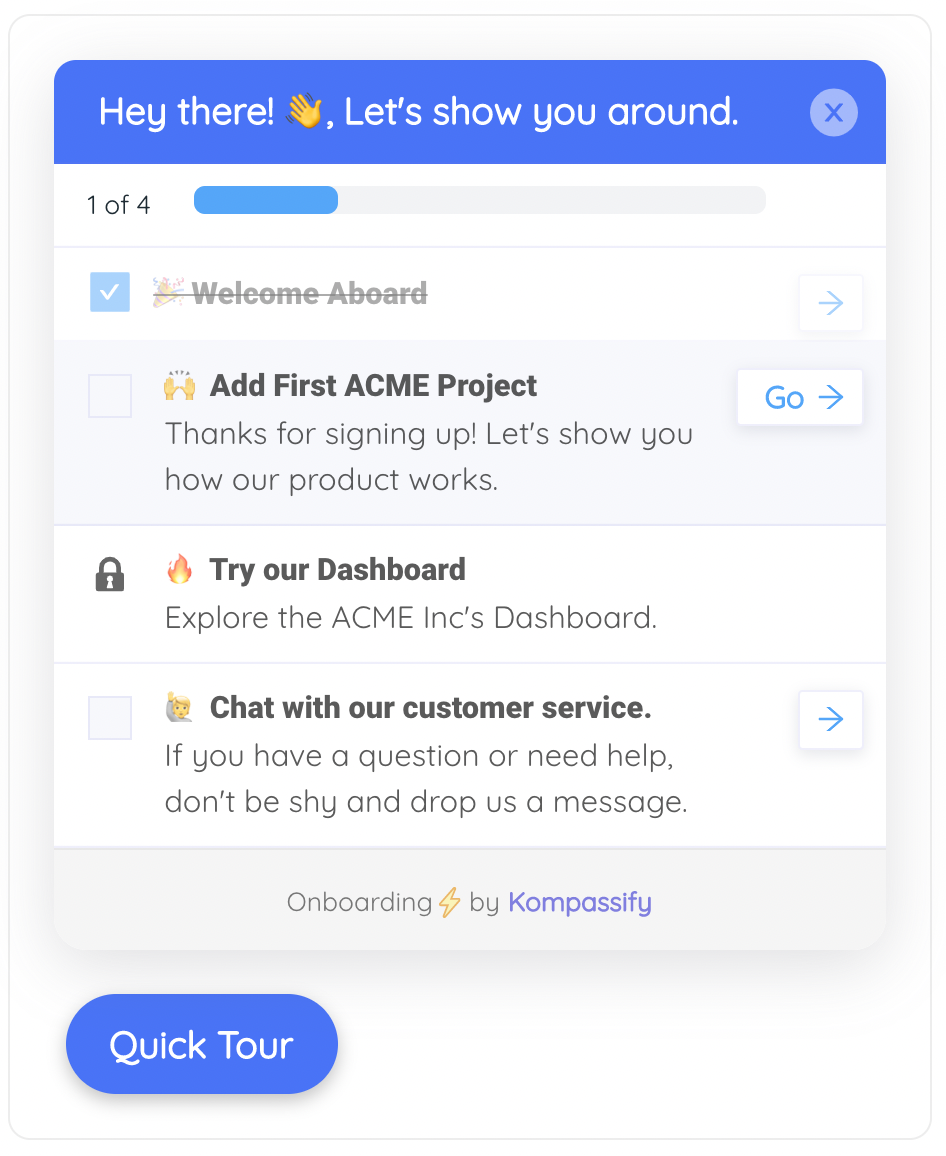
The single highest-return move in digital CS: turning the standard first-week setup into an in-app checklist every account gets, whether or not anyone was assigned to them.
How to Build the Digital CS Motion in 6 Steps
The order matters more than the tooling. Teams that start by buying software and then look for something to send end up with a well-instrumented programme that nobody can explain.
- Segment by potential, not just by current revenue
- Define the outcome each segment must reach
- Instrument the journey so you can see where accounts stop
- Build the in-app layer before the email layer
- Turn signals into a small number of plays
- Review, retire and hand back to humans
1. Segment by potential, not just by current revenue
Segmenting purely on contract value guarantees you under-serve the accounts that were about to grow. Combine value with potential and with fit: how much of their team could plausibly use this, how close their use case is to the ones that renew well, whether the product is embedded in something they do daily. Practical guidance on cutting these groups sensibly is in our user segmentation guide.
2. Define the outcome each segment must reach
For every segment, write down the specific state that means "this account is safe": the actions completed, the features in use, the number of active people. That definition becomes the target of every journey you build. Without it, the digital programme drifts into sending messages rather than moving accounts, and nobody can tell whether it worked. If you have not yet defined the moment where value becomes obvious, start with the aha moment and work backwards.
3. Instrument the journey so you can see where accounts stop
You cannot run signal-driven coverage without signals. At minimum you need to know, per account, which of the defined outcome steps have been reached, how many people are active, and whether usage is trending up or down. That is the input to a customer health score, and the health score is what lets a team of eight cover four thousand accounts without guessing.
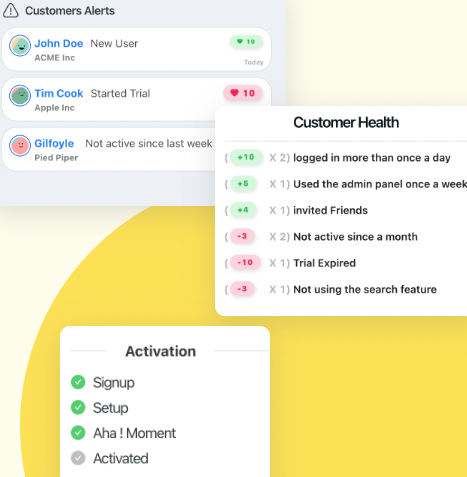
Signals first. A digital programme without a health view is just a scheduled newsletter with better intentions.
4. Build the in-app layer before the email layer
This is the step most programmes get backwards, because email is easier to start. But a message about the product is most useful standing next to the product. An email saying "have you tried the approvals workflow?" competes with forty other emails; a contextual guide that appears the first time someone opens the approvals screen does not compete with anything. Build the checklist, the walkthrough, the contextual tooltips and the resource centre first, then use email only to bring people back into the product where the real guidance lives. The full argument for that ordering is in in-app messaging.
5. Turn signals into a small number of plays
A play is a condition, an audience, an action and an owner. Start with five, not fifty. Every play needs a written trigger ("no admin has invited a second user by day seven"), a defined action, and a rule for when it escalates to a human. Fifty plays built in month one become fifty things nobody maintains by month four.
6. Review, retire and hand back to humans
Digital programmes rot silently. A guide referencing a renamed screen, a play firing on a metric that stopped mattering, an onboarding checklist with a step the product removed. Put a monthly review in the calendar with one question: which of these is still true? And keep an explicit escalation path so that an account showing a serious signal reaches a person quickly; the point of the digital layer is to make human time available, not to eliminate it.
Five Digital CS Plays Worth Building First
These five cover most of the value in a typical B2B product, and each one has a clear trigger and a clear success test.
-
The activation play
Trigger: a new account has not completed the defined setup steps within its first week. Action: an in-app checklist on next login, plus one reminder. Success test: share of accounts reaching the setup-complete state, and how long it took, the core of time to value.
-
The cooling-account play
Trigger: active users or key actions fall meaningfully below the account's own recent baseline. Action: a contextual prompt for the workflow they abandoned, and a health-score flag for a human if it persists. This is the earliest reliable churn warning most teams have, well ahead of a renewal date.
-
The seat-expansion play
Trigger: one active admin, no invited colleagues, after the account is established. Action: an in-app prompt to invite the team, aimed at the person who can actually do it. Single-user accounts churn far more easily than accounts with a habit spread across a team.
-
The unused-value play
Trigger: an account is paying for a capability it has never opened. Action: a targeted guide the first time someone lands near it. This is feature adoption work, and it protects renewals better than any deck about ROI.
-
The listening play
Trigger: an account reaches a defined milestone. Action: a short in-app survey asking one question, not eight. It gives the digital segment a voice that would otherwise only exist for accounts with a CSM; see in-app surveys for question design and timing.
Measuring a Digital CS Programme
Split the measures into outcomes, which CS already owns, and coverage, which is specific to going digital. Coverage measures are the early ones: they move first, and they explain the outcome numbers a quarter later.
| Measure | What it tells you | Type |
|---|---|---|
| Share of accounts on a defined journey | Whether the digital layer actually reaches the accounts nobody calls | Coverage |
| Risk signals that triggered a play | Whether your signals lead to action or just to dashboards | Coverage |
| Questions answered in-product | How much repeat work has genuinely left the team's week | Coverage |
| Time to first value | Whether the in-app onboarding is faster than the human version was | Outcome |
| Adoption depth of retention-predicting features | Whether accounts are becoming embedded or staying shallow | Outcome |
| Gross churn and net revenue retention in the digital segment | The verdict, compared against the same segment before the programme | Outcome |
Resist counting sends. Emails delivered, guides published and plays configured are effort measures. They rise reliably in month one of every programme, including the ones that fail.
Digital Customer Success: Do vs. Don't
Do
- Run the digital layer under every tier, enterprise included
- Move the identical work first; it is the biggest, cheapest win
- Put product guidance in the product, not in the inbox
- Give every play a written trigger and a success test
- Keep a fast escalation path to a real person
- Review the whole library monthly and delete what is stale
Don't
- Treat digital as the tier for customers who matter less
- Automate escalations, renewals at risk, or bad news
- Launch fifty plays before proving five
- Measure the programme by messages sent
- Let guides survive the screens they describe
- Assume an engaged sponsor means an adopted product
Running Digital Customer Success with Kompassify
The hard part of digital CS is rarely the strategy; most teams can name the five plays they want. The hard part is that building them normally requires engineering time the roadmap will not give up, which is why so many programmes end up as email sequences pointing at a help centre.
Kompassify gives customer-success teams the in-app layer without that dependency. Onboarding checklists and walkthroughs for the activation play, contextual tooltips and hotspots for the unused-value play, in-app announcements for release education, and NPS or multi-choice surveys for the listening play, all built visually, targeted by segment and behaviour, and reported on individually so you can tell which plays moved accounts and which just made noise. Because it sits outside the codebase, retiring a stale guide is a toggle rather than a ticket, which is what keeps the library honest at month twelve.
Give every account the onboarding only your best accounts get
Kompassify lets customer-success and onboarding teams build in-app checklists, product tours, contextual guides and surveys without engineering time, and measure what each one did to adoption. Free up to 100 monthly active users, plans from $129/month, GDPR-compliant and EU-hosted.
Start for free →The One-Sentence Version
Digital customer success is what you build when you accept that human attention is the scarcest thing the team has, so the product handles everything repeatable, and people spend their hours only where judgement genuinely changes the outcome.
Frequently Asked Questions
What is digital customer success?
Digital customer success is the practice of delivering customer-success outcomes through the product and automated channels rather than through a named person for every account. The customer still gets onboarded, still gets nudged when adoption stalls and still gets told what changed, but the delivery mechanism is an in-app checklist, a targeted guide, a triggered email or a resource centre instead of a scheduled call. It is a delivery model, not a cheaper tier: the outcomes a CSM is accountable for stay exactly the same.
What is the difference between high-touch, low-touch and tech-touch customer success?
High-touch means a named CSM with scheduled meetings, a written success plan and executive relationships, reserved for the accounts where a churn event is material on its own. Low-touch means a pooled or shared CSM who responds to signals and runs group sessions rather than owning a standing calendar. Tech-touch means no assigned human by default: the product, in-app guidance and automated messages carry the journey, and a person appears only when a risk or expansion signal fires. Most companies run all three at once and simply disagree about where the boundaries sit.
How do you scale customer success without hiring more CSMs?
Start by listing what CSMs actually spend the week doing, then sort it into three piles: things that are the same for every account, things that differ but follow a rule, and things that genuinely need judgement. The first pile, onboarding walkthroughs, feature enablement, release explanations, standard how-to answers, moves into the product as in-app guides, checklists and a resource centre. The second becomes triggered plays fired by health or usage signals. Only the third keeps human time. The gain does not come from working faster; it comes from removing whole categories of repeated work.
What should stay human in a digital customer success model?
Anything involving negotiation, disappointment or genuine ambiguity. Escalations and outages, commercial conversations such as renewals at risk and pricing changes, discovery about a customer's own strategy, and any moment where the honest answer is that the product cannot do what they need. Automating those does measurable damage, because the message people receive is that the vendor did not consider the situation worth a person. Everything repeatable around them can and should be automated so the human time is available when those moments arrive.
What metrics should a digital customer success programme be measured on?
Judge it on outcomes and coverage rather than on activity. Outcome measures are the ones CS already owns: time to first value, adoption depth of the features that predict retention, net revenue retention and gross churn within the digital segment. Coverage measures are the ones specific to going digital: the share of accounts receiving a defined onboarding journey at all, the proportion of risk signals that triggered a play, and the number of support and enablement requests answered in-product rather than by a person. Counting emails sent measures effort, not success.
Is digital customer success only for small accounts?
No, and treating it that way is the most common design mistake. Enterprise accounts contain hundreds of individual users who will never meet the CSM, and those users decide whether the software gets adopted. The right model is layered rather than segmented: every account gets the digital layer, and high-touch relationship work sits on top of it for the accounts that warrant it. A large customer with an engaged executive sponsor and disengaged end users is a renewal risk that no amount of quarterly meetings will fix.