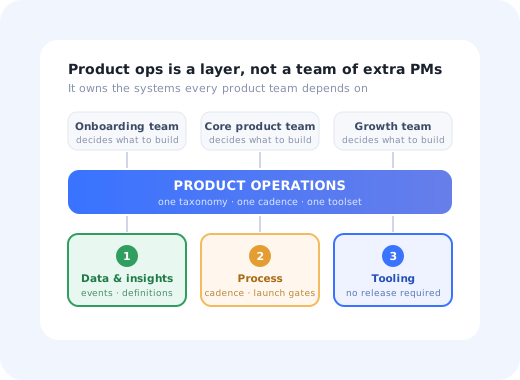
Most product organisations do not slow down because they run out of ideas. They slow down because the machinery around the ideas gets heavier: two teams bring different activation numbers to the same meeting, a feature ships and nobody checks whether anyone used it, customer feedback arrives through five channels and gets triaged in none, and every product manager quietly invents their own way of doing all of it.
Product operations is the function that takes that machinery off the product managers and makes it a shared system. It does not decide what to build. It makes sure the people who do can decide quickly, from evidence everyone trusts, and can tell afterwards whether they were right.
This guide covers what product ops owns, the three pillars the role usually splits into, what a product ops manager does in a normal week, the signals that say it is time to hire one, the metrics the function should be judged on, and how to start it with nobody new at all.
Key Takeaways
- Product ops owns the system, not the product. PMs decide what to build; product ops makes those decisions repeatable, evidenced and measurable across the whole org.
- Three pillars: data and insights, process and governance, tooling and enablement. Almost every real product ops job is some mix of those three.
- The trigger is symptomatic, not numeric. Conflicting metrics, unmeasured launches, scattered feedback and PMs doing reporting instead of discovery: those signals matter more than a headcount threshold.
- Start with the taxonomy. Untrustworthy event data poisons every other decision, so it is almost always the first thing worth fixing.
- Judge it on system health. Data coverage, launches with agreed success metrics, feedback triage time, not on the adoption of any one feature.
- The main failure mode is becoming a ticket queue. If product ops is doing other people's reporting rather than removing the need for it, it has quietly become an admin team.
What Product Operations Is
Product operations, in one paragraph
Product operations is the function that makes product management repeatable at scale. It owns the shared systems a product organisation runs on: the instrumentation and analytics that describe what users actually do, the operating cadence that carries an idea from discovery through launch to measurement, and the tooling that lets teams ship, guide and measure without rebuilding the plumbing every time. Product managers decide what; product ops makes sure the organisation can decide well, repeatedly, without each PM inventing a private method.
The clearest way to see the boundary is to ask who is accountable for what. A product manager is accountable for the outcome of a specific product area: this feature, this funnel, this segment. Product ops is accountable for the conditions that make those outcomes achievable and legible: whether the data is trustworthy, whether the process runs, whether the tools are in place.
That distinction matters because it decides what success looks like. A product ops team that measures itself on feature adoption will start doing product management badly. One that measures itself on whether launches have agreed success metrics, whether feedback gets triaged inside a week, and whether two teams can agree on what "activated" means, is doing the actual job.
| Question | Product management | Product operations |
|---|---|---|
| Owns | A product area and its outcomes | The systems every product area depends on |
| Typical output | A decision about what to build next | A standard, a pipeline or a piece of shared tooling |
| Success looks like | The feature moved the metric it was meant to move | Every team can tell whether their feature moved anything |
| Time horizon | This quarter's roadmap | The next twenty launches |
| Fails by | Building the wrong thing | Becoming a reporting and ticket queue |
The Three Pillars of Product Ops
Job descriptions vary wildly, but nearly every real product ops role is a mix of three things. Most teams are strong in one and neglect the other two, and the neglected ones are usually where the pain is coming from.
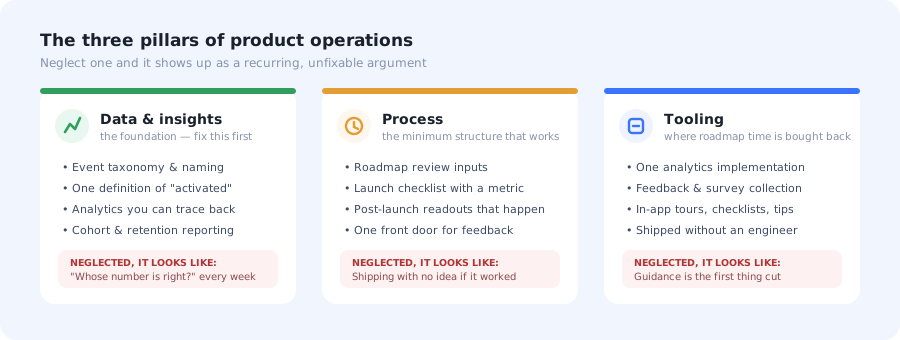
Most product ops roles are a mix of these three. The one you neglect is usually where the pain comes from.
1. Data and insights
This is the foundation, and it is the pillar worth fixing first, because bad data does not just make one decision wrong; it makes every debate unresolvable. Product ops owns the event taxonomy: the naming conventions, the definitions, the rule that "activated" means one thing across the whole company, and the review that stops a new release from shipping twelve untracked events.
It also owns the second-order work that turns data into insight rather than dashboards: maintaining the definitions behind the onboarding metrics teams report on, running the cohort analysis that shows whether last quarter's changes actually held, and making sure the numbers in a QBR deck can be traced back to an event somebody defined on purpose.
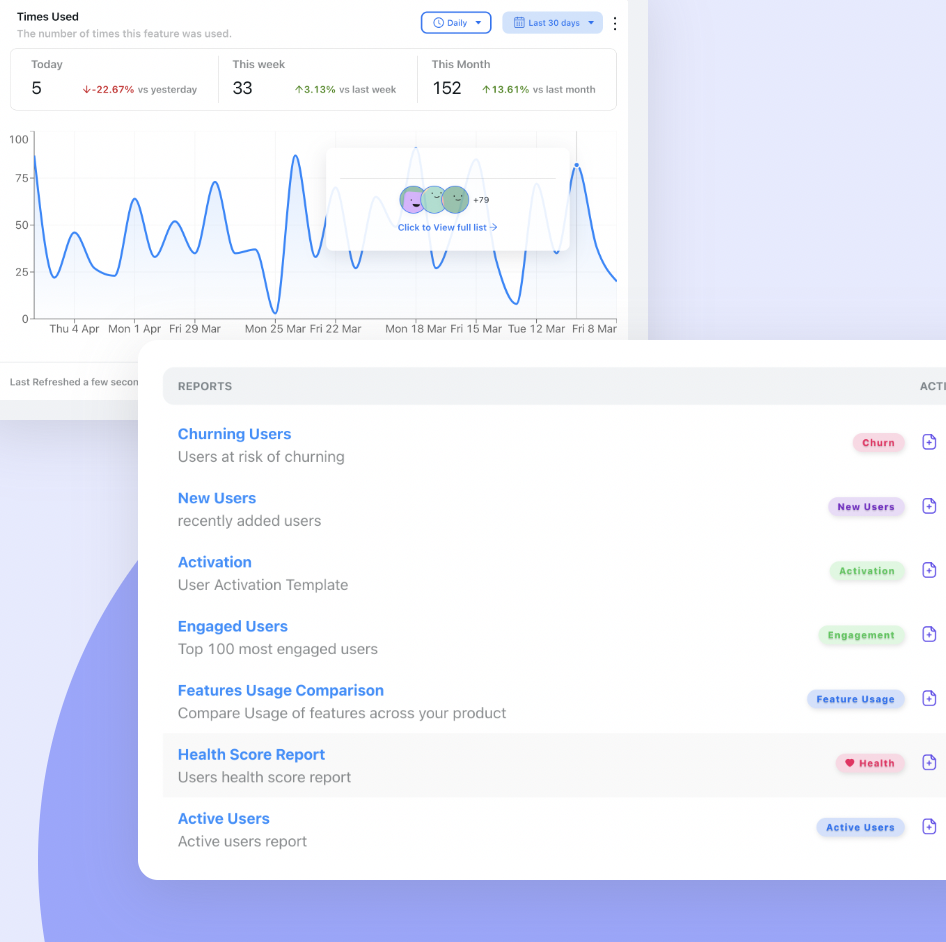
The data pillar in practice: one shared set of report definitions, so two teams cannot arrive at a meeting with different numbers for the same thing.
2. Process and governance
The second pillar is the operating cadence, the sequence of rituals and artefacts that carry work from idea to measured outcome. In practice that is roadmap reviews that have a consistent input format, a launch checklist that includes a success metric agreed before release, a post-launch readout that actually happens, and a feedback pipeline with one front door.
The word "governance" makes people nervous, and it should be handled carefully. Good product ops process is the minimum structure that stops the same argument recurring. Bad product ops process is a template nobody reads and a meeting nobody needs. The test is whether removing a ritual would cause a real problem within a month; if not, remove it.
3. Tooling and enablement
The third pillar is the stack itself: analytics, feedback collection, experimentation, and the in-app layer used to onboard users and announce what shipped. Product ops decides what the standard tools are, owns the admin of them, and (the part that matters most) makes sure using them does not require an engineering ticket.
This is where product ops most directly buys back roadmap time. When a launch needs a product tour, a checklist or an in-app announcement, and shipping that requires a front-end release, the guidance either slips or never happens. When it can be built and targeted without engineering time, the launch checklist item stops being aspirational.
What the Job Looks Like in a Normal Week
Job titles are abstract; calendars are not. A product ops manager at a company with six or seven product managers spends a typical week roughly like this.
- Keeping the data trustworthy: reviewing new events, chasing definition drift, answering "why do these two numbers disagree".
- Running the cadence: roadmap review inputs, launch readiness, the post-launch readout that would otherwise be skipped.
- Closing the feedback loop: triaging what came in from support, sales and success, and routing it to a named owner.
- Owning the shared tooling: access, standards, and unblocking whoever is trying to ship guidance today.
- Removing one recurring question permanently: the compounding part of the job.
1. Guarding the data
The recurring version is a review of events added in the last release: are they named to the convention, do they carry the properties the analysis will need, is anything important untracked. The reactive version is the "these two dashboards disagree" ticket, which is worth treating as a bug in the taxonomy rather than a question to answer. Answer it once and the question returns; fix the definition and it does not.
2. Running the cadence
Product ops usually owns the meta-layer of the planning rhythm rather than the content: making sure inputs arrive in a comparable format, that the launch checklist is completed rather than acknowledged, and that a post-launch readout is scheduled at the moment of launch rather than requested weeks later when the data has gone cold and everyone has moved on.
3. Closing the feedback loop
Feedback arrives through support tickets, sales calls, success reviews and in-app surveys, and in most companies it stops at whoever received it. Product ops builds the one front door: a single intake, a triage rhythm, a named owner per theme, and a way to tell the person who raised it what happened. The measurable version of this is time from customer comment to triaged decision, and it is one of the most honest health metrics a product org has.
4. Owning the tooling
Day to day this is unglamorous: access, configuration, keeping one analytics implementation rather than three. The high-leverage part is making the in-app layer self-serve, so a PM who needs to guide users through something new does not need to negotiate for engineering time to do it.
5. Removing one recurring question
The difference between product ops and an internal service desk is this line item. If a week contains no work that permanently removes a class of question, the function is treading water. It does not need to be big: one definition standardised, one report automated, one checklist item made a default in the tool.
When to Start a Product Ops Function
The commonly cited threshold is somewhere around five to eight product managers, and earlier for data-heavy or enterprise-facing products. That number is a rough proxy at best. The reliable signals are symptoms, and they tend to arrive together.
Two teams present different figures for the same metric and the meeting is spent reconciling them rather than deciding anything.
Features ship without a success metric agreed beforehand, so nobody can say afterwards whether they worked.
Customer input lives in support, sales notes, calls and surveys, and is triaged in none of them consistently.
A meaningful share of PM time goes to reporting and coordination rather than discovery and decisions.
Six product managers, six different formats for the same artefact, and no way to compare across teams.
Any in-app help, tour or announcement requires front-end engineering time, so it is the first thing cut.
When three or four of those are true simultaneously, the work already exists; it is just being done part-time, inconsistently, by people whose real job is something else. Hiring is one answer; it is not the only one.
How to Start Product Ops Without a Headcount
Most teams should start the function long before they staff it. The way that works is narrow and boring: pick the single loudest symptom and fix only that for a quarter.
Almost always, start with the event taxonomy. Untrustworthy data does not degrade decisions gracefully; it makes disagreements unresolvable, which means the loudest voice wins by default. Everything else in product ops gets easier once the numbers are agreed.
A workable first quarter looks like this. Give one existing person a named, protected half-day a week; protected is the operative word, because this is exactly the work that loses to anything urgent. Write the standard as one page, not a wiki tree; a standard nobody can read in three minutes will not be followed. Then make the standard the path of least resistance inside the tools, so conforming is easier than not.
That last move is what makes it stick. Process that relies on discipline decays; process encoded as a default survives. If the launch checklist lives in the ticket template, it gets filled in. If the onboarding guidance for a new feature can be built by the PM who shipped it, in an afternoon, it gets built.
After a quarter, look at the half-day. If it consistently overflows and the overflow is genuinely systems work rather than someone's backlog, you have the business case for the first hire, written in evidence rather than in vibes.
What Product Ops Should Be Measured On
This is where the function most often gets set up to fail. Measuring product ops on product outcomes pushes it into doing product management without the authority; measuring it on tickets closed pushes it into being a service desk. Measure it on the health of the system instead.
| Pillar | Metric | What a bad number means |
|---|---|---|
| Data | Share of key user actions covered by the agreed taxonomy | Analyses are being built on gaps, so conclusions are guesses |
| Data | Number of contested metric definitions open at any time | Meetings are spent reconciling rather than deciding |
| Process | Share of launches with a success metric agreed before release | The org cannot learn from shipping, only from opinion |
| Process | Share of launches with a completed post-launch readout | Failures repeat because nobody names them |
| Feedback | Time from customer comment to triaged decision | Customer-facing teams stop bothering to report anything |
| Enablement | Share of launch guidance shipped without engineering time | Onboarding for new features is the first thing cut under pressure |
Feature-level adoption stays with the product manager who owns that feature. Product ops is accountable for the fact that the PM can see it at all.
Four Ways Product Ops Goes Wrong
It becomes a ticket queue
The team spends its week producing other people's reports. The work is real but it does not compound, and the function quietly turns into admin. The fix is the fifth item in the weekly list above: every week must remove a class of request, not just serve it.
It writes process nobody needs
Templates, gates and rituals accumulate because adding one is easy and removing one requires an argument. Audit the cadence twice a year and delete anything whose absence would not cause a visible problem within a month.
It takes decisions away from PMs
Owning the data and the cadence puts product ops close enough to the decisions to start making them. That erodes PM ownership and creates a bottleneck. Product ops should make a decision easy to make, and then not make it.
It is hired too early
With two product managers, the systems problem is small enough that the cost of coordination exceeds the cost of the inconsistency. A first product ops hire before there is real scale usually turns into a de facto analyst or project manager.
Where Product Ops and Adoption Meet
The two pillars that matter most to onboarding and customer-success teams are data and enablement, and they meet at the same place: what happens after a feature ships.
A launch without instrumentation cannot be evaluated, and a launch without in-app guidance mostly does not get discovered: the feature exists, and usage stays flat, and the retrospective concludes that users did not want it. Product ops is the function that stops both of those from being the default. It makes sure the events exist before release, that the success metric was agreed while opinions were still cheap, and that the team announcing the feature can build the announcement and the walkthrough themselves.
That is also why product ops tends to be the function that finally fixes feature discovery across a whole product rather than one screen at a time: it is the only role with a mandate that spans every team's launches.
Make in-app guidance a standard, not a special request
Kompassify gives product ops the enablement half of the job without engineering time: product tours, checklists, contextual tooltips and in-app announcements built and targeted by whoever owns the launch, with adoption data on each one so the post-launch readout writes itself. Free up to 100 monthly active users, plans from $129/month, GDPR-compliant and EU-hosted.
Start for free →The One-Sentence Version
Product operations is the function that owns the systems every product team depends on (trustworthy data, a cadence that carries ideas through to measured outcomes, and tooling that does not require a release) so that product managers spend their time deciding rather than reconciling.
Frequently Asked Questions
What is product operations?
Product operations is the function that makes product management repeatable at scale. It owns the systems a product organisation runs on rather than the products themselves: the data and instrumentation that tell everyone what users actually do, the processes that move an idea from discovery to launch to measurement, and the tooling that lets teams ship, guide and measure without rebuilding the plumbing each time. The short version is that product managers decide what to build, and product ops makes sure the whole organisation can decide well, repeatedly, without each PM inventing their own method.
What does a product operations manager do day to day?
A product ops manager spends most of a week on four things: keeping the event taxonomy and product analytics trustworthy so nobody argues about numbers, running the operating cadence such as roadmap reviews, launch checklists and post-launch readouts, closing the loop between customer-facing teams and product by routing feedback into one triaged system, and owning the shared product tooling including analytics, feedback and in-app guidance so launches do not depend on engineering time. The output is not a feature; it is that other people's decisions get faster and better evidenced.
When should you hire your first product ops person?
The usual trigger is somewhere around five to eight product managers, or earlier if the product is data-heavy or the company sells to enterprise. The more reliable signal is symptomatic rather than numeric: two teams present different numbers for the same metric, launches ship without anyone measuring adoption afterwards, customer feedback lives in four tools and gets triaged in none, and PMs spend more than about a fifth of their time on reporting and coordination rather than on discovery and decisions. When those show up together, the work already exists and is being done badly by everyone part-time.
Is product ops the same as project management or programme management?
No. Programme and project management coordinate the delivery of a specific scope to a date, and the work ends when the thing ships. Product ops builds durable systems that outlive any one launch: the taxonomy, the cadence, the feedback pipeline, the tooling standards. A useful test is what happens when a project ends. If the artefact disappears with it, that was project management. If it keeps making the next ten launches easier, that was product ops.
What metrics should product ops own?
Product ops should own the health of the system rather than the performance of any single product. That means data-quality measures such as the share of key user actions covered by the event taxonomy, process measures such as the proportion of launches with a defined success metric agreed before release and the share reviewed after it, feedback measures such as time from customer comment to triaged decision, and enablement measures such as how much of a launch's in-app guidance ships without engineering time. Feature-level adoption stays with the product manager who owns that feature.
Can a small team do product ops without hiring anyone?
Yes, and most should start that way. Pick the single loudest symptom and fix only that for a quarter: usually the event taxonomy, because untrustworthy data poisons every other decision. Give one existing person a named half-day a week for it, write the standard down in one page rather than a wiki tree, and make the standard the default in the tools so following it is easier than ignoring it. If that half-day keeps overflowing after a quarter or two, you have found the business case for the first hire.