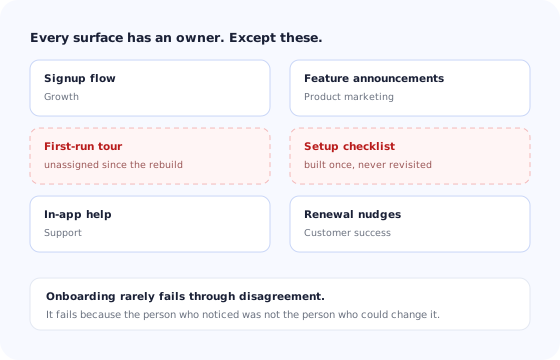
Ask five people at a software company who owns onboarding and you will usually get five confident, different, partially correct answers. Product owns the first-run experience. Customer success owns the kickoff. Growth owns the signup flow. Support owns the help content. Marketing owns the announcement that introduced the feature the tour is now explaining wrongly.
Everyone is right about their piece, and the pieces do not add up to a surface anybody is watching. Which is how a company ends up with a product tour describing a screen that was redesigned in March, a checklist whose third item can no longer be completed, and a drop-off chart nobody has opened since the person who built it changed teams.
This guide is about fixing that structurally rather than heroically. It covers the four operating models for owning onboarding, how to split ownership by verb instead of by team, the handoff seams where content quietly rots, the cadence that keeps it current, and how tooling changes who is even able to own it.
Key Takeaways
- Onboarding fails through neglect, not disagreement. The question is not who decides, it is who notices.
- Put ownership where the loss is. Self-serve loss belongs to product or growth; assisted loss belongs to customer success.
- Split by verb, not by team. Content, targeting, measurement, tooling and approval each need a name.
- The seams are where it rots. Shipped UI changes, pricing changes and setup changes all invalidate guidance and none of them announce it.
- Whoever sees the number must be able to change the thing. Split those two and onboarding work loses every prioritisation argument it enters.
The Symptom: Onboarding Nobody Owns
Unowned onboarding does not look broken. That is what makes it durable. The tour still runs, the checklist still renders, the welcome email still sends. Nothing errors. The decay is entirely in the relationship between the guidance and the product it describes, and that relationship is invisible from the outside.
The recognisable symptoms are these. Nobody can say what the current first-run experience looks like without creating a test account. Several teams publish in-app messages and none of them know what the others scheduled. The last substantive change to the onboarding flow predates the last two significant product releases. A drop-off is discussed in a quarterly review and assigned to nobody in particular. And when someone finally does open the tooling, they find flows built by people who have left, targeted at segments that no longer exist.
The underlying cause is almost always the same, and it is not laziness. It is that the person who can see the problem and the person who can fix it are different people, and onboarding work has to win a prioritisation argument to travel between them. It loses that argument routinely, because a stale tour never appears on a roadmap and never breaks a build. The argument for treating it as real work is in the ROI of onboarding; this guide is about what to do once you accept it.
Four Operating Models, and What Each Is Good At
There is no universally correct owner. There are four models that work, each with a real strength and a characteristic failure, and most companies should be able to recognise themselves in one of them.
Choosing a model is choosing which failure you will have to actively watch for.
Product-owned
Onboarding sits with the product team that owns the area new users land in. The advantage is decisive: when the guidance reveals that a step is confusing, this owner can change the step rather than explaining it better. The failure mode is that onboarding gets treated as a launch. It is built, celebrated, and then the team moves to the next initiative while the product underneath it keeps changing. Guard against it by keeping onboarding metrics on the team's permanent dashboard, not in the project's closing report.
Customer-success-owned
Onboarding sits with the team that talks to customers during their first weeks. The advantage is that this team knows, in specific detail, the six things every new account gets stuck on, because they answer them personally. The failure mode is that the knowledge stays personal: the same explanation is delivered a hundred times and built into the product zero times. Guard against it by requiring that any explanation given more than a few times becomes an in-app asset, which is the mechanism behind digital customer success.
Growth-owned
Onboarding sits with the team that owns the funnel from visit to activation. The advantage is measurement discipline and speed: this team will instrument the flow properly and test changes. The failure mode is a gravitational pull toward the top of the funnel, where results arrive faster. Signup conversion improves, week-two retention does not move, and the definition of success quietly drifts to the metric that is easiest to shift. Guard against it by making activation, not signup, the owned number.
A dedicated onboarding function
A named role or small team whose whole job is the onboarding surface, described in detail in the onboarding specialist guide. The advantage is continuity: the work never loses a prioritisation argument because it is the only work there is. The failure mode is isolation — a function that is informed of product changes after they ship, and therefore permanently patching. Guard against it by putting the owner in release planning rather than on the release mailing list.
Choosing Yours: Three Questions
1. Where does the loss actually happen?
Look at where users stop. If most never reach value and nobody ever speaks to them, the loss is in the product and the owner should be able to change the product. If users reach value reliably but only when a person walks them through it, the loss is in the process and the owner should be the team running that process.
2. How often does the flow need to change?
A product that ships weekly invalidates onboarding content weekly. If your release cadence is high, the owner must be able to publish changes without a release of their own, or the guidance will be permanently one version behind. This single constraint decides more real-world ownership than any org chart preference.
3. Who is measured on the outcome?
Ownership without accountability drifts. Whoever owns onboarding should have activation, time to value, or first-90-day retention in their own targets. If nobody's number moves when onboarding improves, nobody's calendar will contain onboarding work in three months.
Ownership Is Not One Thing: Split the Verbs
“Who owns onboarding” is unanswerable as asked, because owning is five different activities that can legitimately live in different places. Split them and the conversation becomes tractable.
| Verb | What it means in practice | Common owner | What goes wrong unowned |
|---|---|---|---|
| Write | The words in tours, tooltips, checklists and messages | Product marketing, CS or the onboarding owner | Copy describing screens that no longer exist |
| Target | Which segments see which guidance, and when | The onboarding owner | Rules referencing dead segments; users seeing the wrong flow |
| Measure | Step-level drop-off, activation, time to value | Product or growth analytics | Nobody notices a step stopped working |
| Maintain | Keeping flows working as the UI changes | The onboarding owner, triggered by releases | Silent breakage that only new users experience |
| Approve | What may be shown in-product, and how often | One named person, not a committee | Four teams messaging the same user in one week |
Two of these are more often orphaned than the rest. Targeting is invisible — nobody sees a rule, so nobody audits it. And maintenance has no natural trigger, which is exactly why guidance breaks quietly as the interface underneath it moves; why product tours break covers the mechanics of that decay in detail. Both need a name against them or they will not happen.
Approval deserves a single owner, deliberately. Once more than one team can publish in-app messages, the constraint that matters is not quality but volume. Somebody has to be able to say “not this week” and have it stick, which is the practical form of the frequency rules described in onboarding triggers.
The Four Seams Where Onboarding Rots
Onboarding rarely degrades gradually. It degrades at handoffs, and there are four that account for most of it.
Sales to onboarding
What was promised in the deal never reaches the person doing the setup, so onboarding starts by rediscovering things the customer already explained. The mechanics of fixing this are covered in the sales to onboarding handoff guide; the ownership question is simply whose calendar the handoff sits on.
Release to guidance
The most damaging seam. A team ships a redesigned settings page, and three tours that point at it are now wrong. Nothing in the release process mentions guidance, so nobody checks. The fix is a line in the release checklist: does this change any screen a guided flow points at?
Support to onboarding
Support learns what confuses new users every single day and has no route to turn that into product guidance. A monthly pass over the top new-user tickets, owned by the onboarding owner, closes it — and it is the cheapest source of onboarding improvements that exists.
Onboarding to the rest of the lifecycle
Onboarding ends and nobody owns the transition, so users who completed setup are treated as finished. Adoption of anything introduced after week one becomes a separate problem with a separate owner, and usually no owner at all.
The Operating Cadence
Ownership becomes real when it appears on a calendar. The cadence below is deliberately modest, because a rhythm that survives a busy quarter beats an ambitious one that does not.
- Weekly, 15 minutes. Look at step-level completion for the live flows. You are looking for a step that changed shape, not for insight.
- Every release. One question in the checklist: does this change a screen any guided flow points at? If yes, whose job is the fix, and by when.
- Monthly, one hour. Create a genuinely new account and go through onboarding as a new user. Reading the configuration is not the same as seeing it. Also review the top new-user support tickets from the month.
- Quarterly, half a day. A full pass with fresh eyes, against the checklist in the onboarding audit guide: retire what is dead, fix what is stale, and confirm the targeting rules still describe real segments.
The monthly walkthrough is the one to protect if something has to give. Almost every embarrassing onboarding defect is found within ninety seconds of someone actually creating an account, and almost nobody does it.
How Tooling Changes the Answer
The org-chart discussion is often downstream of a technical constraint nobody stated. If in-app guidance can only be changed by shipping code, then engineering owns onboarding regardless of what any document says, and every improvement competes with the roadmap. That constraint quietly selects the product-owned model whether or not it is the right one, and it explains why so much onboarding content is a year old.
When guidance is built in a no-code layer, ownership becomes a genuine choice. A customer success lead can publish a checklist. A product marketer can change an announcement. The person who spotted the drop-off can fix it the same afternoon, which is the loop that makes any of the models above work.
The rule worth adopting: whoever is accountable for the onboarding number must be able to change the onboarding experience without filing a ticket. If they cannot, they are not the owner — they are a stakeholder, and the surface will drift.
Ownership also carries obligations that are easy to leave unassigned, including the data ones. The trait list, retention setting and vendor paperwork behind your guidance layer need a name against them too; see GDPR and user onboarding for what that involves.
Ownership at Three Company Sizes
Under ten people
A founder or the first product hire owns everything, and that is correct. The only real risk is that onboarding is built once during launch and never revisited, so the thing to install early is the monthly walkthrough, not a process.
Ten to a hundred
The stage where onboarding most often becomes orphaned, because there are now enough teams for each to assume another has it. This is where splitting the verbs pays for itself, and where a part-time named owner with real authority is usually the right structure. The pressures that arrive at this stage are covered in scaling user onboarding.
Over a hundred
Multiple teams now publish in-app, so approval and frequency become the binding constraints rather than authorship. A dedicated function tends to make sense here, positioned inside whichever organisation owns the activation number, and involved in release planning rather than informed by it. How that sits alongside the wider structure is covered in the product team structure guide.
Making Ownership Practical With Kompassify
The models in this guide all depend on one capability: the person accountable for onboarding being able to see what is happening and change it. Kompassify is a no-code product adoption platform — product tours, onboarding checklists, in-app announcements, surveys, segmentation and built-in analytics — installed with a single script snippet, which puts both halves of that loop in the same pair of hands.
A customer success lead can build the walkthrough for the step they explain on every call. A product manager can see per-step completion and find the point where new users stop. Guidance is targeted by segment, so several teams can publish without colliding, and every flow lives in one visual editor rather than in code somebody else owns. That is what makes the monthly walkthrough and the quarterly audit actionable rather than a list of tickets.
Give onboarding an owner who can actually change it
Build and update tours, checklists and in-app messages without engineering, target them by segment, and see where users stop, step by step. Free up to 100 monthly active users, plans from $129/month, GDPR-compliant and EU-hosted.
Start for free →The One-Paragraph Version
Onboarding decays because it is everybody's concern and nobody's job, and the decay is invisible until a new user meets it. Put ownership where the loss actually happens: product or growth when users fail alone, customer success when they only succeed with help. Then stop treating ownership as a single thing and split the verbs — writing, targeting, measuring, maintaining and approving — because the two that go unassigned are always targeting and maintenance. Watch the four seams, and especially the release seam, since every shipped UI change silently invalidates some guidance. Put a modest cadence on a calendar, with a monthly walkthrough through a genuinely new account as the item you protect. And make sure the person accountable for the number can change the experience without filing a ticket, because ownership that requires somebody else's sprint is not ownership at all.
Frequently Asked Questions
Who should own user onboarding?
One named person, in the team that is accountable for the outcome onboarding is supposed to produce. In a self-serve product that is usually product or growth, because the outcome is activation and the lever is the product itself. In an assisted or enterprise product it is usually customer success, because the outcome is time to value inside an account and the lever is a mix of guidance and human contact. The wrong answer in both cases is a committee: onboarding decays through neglect rather than disagreement, and a committee cannot notice neglect.
Should product or customer success own onboarding?
It depends on where the loss actually happens. If most users never reach value and nobody speaks to them, the loss is in the product and product should own the surface. If users reach value only when a person walks them through it, the loss is in the process and customer success should own it, with product owning the parts of the flow that require engineering. The most common failure is an organisation whose revenue comes from assisted onboarding but whose onboarding surface is owned by a product team measured on something else entirely.
What is an onboarding owner responsible for day to day?
Five things, and it is worth writing them down separately: the content of the guidance, who sees which parts of it, the measurement of where people drop out, the tooling it runs on, and the approval of changes. In small companies one person holds all five. In larger ones they split, and the split needs to be explicit, because the parts that go unowned are always the same ones: targeting rules nobody revisits and content nobody re-reads after the feature it describes has changed.
Do we need a dedicated onboarding specialist?
Not until onboarding is either a significant share of the work or a significant share of the churn. Before that, a named part-time owner with real authority beats a full-time role with none. The signals that a dedicated role has become worth it are consistent: onboarding work is regularly displaced by shipping work, several teams are publishing in-app messages with no coordination, and nobody can say what the current first-run experience looks like without opening the product to check.
How do you stop onboarding content going stale?
Attach it to the events that make it stale. The three reliable triggers are a shipped UI change, a change in pricing or packaging, and a change in the setup process, and each should carry a step in its own checklist that says which guidance to re-check. Add a standing calendar review of the first-run experience where someone actually creates a new account and walks through it, because reading the configuration is not the same as seeing what a new user sees. Content decays quietly, and only a scheduled look finds it.
Who owns onboarding in a small startup?
Whoever owns activation, which in an early company is usually a founder or the first product hire. What matters more than the title is that the owner can both change the guidance and see the numbers it produces. When those two capabilities sit with different people, the loop breaks: the person who can see the drop-off has to convince the person who can fix it, and onboarding work loses that argument to shipping work almost every time.