Org design gets treated as an HR topic, which is how product teams end up with structures nobody chose. In practice the org chart is a technical decision with a very direct effect on cycle time: it decides which changes one team can make alone, and which ones require a negotiation.
There is no correct structure, only structures that are correct for a particular product, size and strategy. What is consistent is the trade-off: every way of splitting a product org makes some work cheap and some work expensive, and the skill is choosing a split whose expensive work is the work you rarely need to do.
This guide covers the product trio, five ways to split an org and what each one costs, how structure should change with headcount, the feature-team-versus-empowered-team distinction, and the shared surfaces that every model leaves without an owner.
Key takeaways
- The product trio (PM, design, tech lead) is the smallest unit that can make a real product decision.
- Five common splits: feature area, journey stage, customer segment, platform, outcome. Each makes different work expensive.
- Structure should change roughly every time headcount doubles; the trigger is dependency cost, not headcount itself.
- Most orgs claim empowered teams and run feature teams. The roadmap tells you which one you have.
- Onboarding, in-app help and notifications are orphan surfaces in almost every model; assign them explicitly.
What a Product Team Actually Is
Product team: definition
A product team is a durable, cross-functional group that owns a problem area and the outcome attached to it, not a project, not a set of features, and not a functional department. Its defining property is that it can go from a user problem to a shipped, measured solution without reassembling itself.
Two words in that definition do most of the work. Durable: the team persists across initiatives, so it accumulates context about its area instead of relearning it each quarter. Cross-functional: it contains every skill needed to ship, so it does not queue behind another group to finish anything.
A group that is reassembled per project is a project team, and it will spend the first month of every initiative rebuilding shared understanding. A group that has to file a ticket with another department to finish its work is a functional department wearing a product team's name badge.
The Product Trio
Inside a product team, the decision-making core is normally three people: a product manager, a designer, and a tech lead. This is the "product trio", and its value is not the composition but the joint part: they do discovery together and decide together.
Owns the problem, the priority and the outcome. Holds the context on the business, the market and the segment. Accountable for whether the team is solving something worth solving.
Owns how the solution is experienced and, just as importantly, how it is understood. Runs the research that stops the team from designing for itself.
Owns feasibility and the shape of the solution space. Their most valuable contribution is usually early: which options are cheap, which are expensive, and which are cheap now and expensive forever.
Why the trio beats the relay. In the relay model, the PM gathers requirements, hands them to design, and design hands a spec to engineering. Each handoff loses the reasoning, so by the time an engineer meets an edge case there is nobody in the room who knows what the original constraint was. The trio keeps the reasoning in the same three heads from problem to release, which is what makes continuous discovery possible at all.
Five Ways to Structure a Product Org
Once you have more than one team, you have to decide where the seams go. These are the five splits you will actually encounter, in rough order of how common they are.
-
1. By feature area
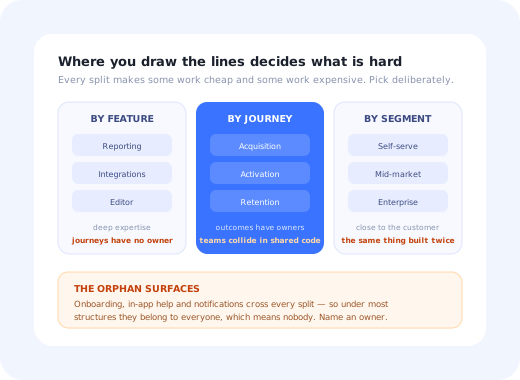
Teams own parts of the product: reporting, integrations, the editor. Cheap: deep expertise, clear code ownership, easy to explain. Expensive: anything that crosses areas, which includes most things a customer would describe as a journey. Best when the product has genuinely separable modules with different users.
-
2. By journey stage
Teams own acquisition, activation, retention, expansion. Cheap: outcomes have unambiguous owners, and the metrics are the team's own. Expensive: teams collide in shared code and can optimise their stage at the next stage's expense. Best when the biggest problems are funnel-shaped rather than capability-shaped.
-
3. By customer segment
Teams own self-serve, mid-market, enterprise, or distinct personas in a multi-sided product. Cheap: deep customer empathy, fast response to segment needs. Expensive: the same capability gets built two or three times in slightly different ways. Best when segments genuinely need different products rather than different packaging.
-
4. By platform or layer
A team owns shared infrastructure, design system or data layer, with product teams as its customers. Cheap: consistency and leverage. Expensive: platform teams drift from user value and become a queue if their roadmap is not driven by their internal customers. Best introduced when at least three teams are duplicating the same foundation.
-
5. By outcome or bet
Teams are formed around the current strategic bets and reformed when the bets change. Cheap: maximum focus on what matters this year. Expensive: ownership gaps between bets, and the context loss that comes from reshuffling people. Works with a small number of long-lived bets; degrades fast if the bets change quarterly.
| Split | Makes cheap | Makes expensive | Choose when |
|---|---|---|---|
| Feature area | Depth, ownership, onboarding new engineers | Cross-cutting journeys | Modules are genuinely separable |
| Journey stage | Outcome accountability | Shared-code coordination | Your problems are funnel-shaped |
| Customer segment | Empathy, responsiveness | Duplicated capability | Segments need different products |
| Platform / layer | Consistency, leverage | Distance from user value | Three or more teams duplicate a foundation |
| Outcome / bet | Focus on the strategy | Gaps between bets, context loss | Bets are few and long-lived |
Real orgs mix these. A common and workable combination is feature-area teams for the core product, one journey-stage team owning activation end to end, and a platform team underneath, which gives you depth where the product is complex and an owner where the customer experience is continuous. The mix is fine; what is not fine is a mix nobody chose, arrived at by adding a team each time something broke.
How Structure Changes With Size
Restructure when the cost of coordinating between teams exceeds the cost of the work inside them, not on a schedule.
The most common size mistake is splitting too early. A fifteen-person company that creates three "teams" of five gets three groups that cannot ship anything alone and a permanent coordination meeting. The second most common is splitting too late: a thirty-person single team where nobody can say who owns anything, and every decision routes through one exhausted person.
Feature Teams vs Empowered Product Teams
This distinction cuts across every structure above, and it matters more than the structure does.
| Feature team | Empowered product team | |
|---|---|---|
| Given | A solution to build | A problem and an outcome |
| Measured on | Delivery against a plan | Movement in the outcome |
| Roadmap lists | Features and dates | Problems and bets |
| Discovery is | Done elsewhere, or not at all | The team's own ongoing work |
| Failure looks like | Shipped on time, no impact | A bet that was disproven cheaply |
The honest test. Open your roadmap. If the rows are features with dates, you have feature teams, regardless of what the org chart or the job titles say. Empowerment is not a culture statement, it is a description of which decisions the team is permitted to make, and the roadmap format is where that shows up first.
Feature teams are not always wrong. When the solution is genuinely known (a compliance requirement, a platform migration, a contractual commitment) asking a team to rediscover it is waste. The problem is running feature teams by default and then wondering why nobody takes ownership of outcomes.
Who Owns the Surfaces Nobody Is Assigned
Every structure above leaves the same set of surfaces without a clear owner: onboarding, in-app help, notifications, empty states, the settings area, and the upgrade path. They share a property: they cross every seam a product org draws, because they are experiences rather than capabilities.
The symptom is recognisable. Onboarding is "everyone's responsibility", which in practice means it is edited whenever a team ships something adjacent to it, by whoever is closest, with no view of the whole. Six months later the flow has eleven steps, three of which reference a feature that has been renamed. Nobody decided this; it is what an unowned surface converges to.
A journey-stage team owns onboarding outright, with activation as its metric. Cleanest accountability, and the model most likely to produce sustained improvement. Costs you a team.
One PM owns the onboarding experience across feature teams, with a standing review. Cheaper, works well if that person has real authority to say no, and reliably fails if they do not.
Put the guidance layer in a tool the owner can change directly. Whoever owns the outcome can then act on it in an afternoon instead of queuing behind three teams' sprints.
Options 2 and 3 combine well and are what most companies can actually afford. The reason the tooling choice matters is structural rather than aesthetic: if changing a tooltip requires a ticket in someone else's backlog, the owner does not really own it, whatever the org chart says. No-code in-app guidance exists mostly to remove that dependency, and once it is removed, an onboarding specialist or a PM can own the surface end to end without owning the codebase it sits on.
This is also where product operations earns its keep at scale: keeping the shared surfaces, the instrumentation and the definitions consistent across teams that each have a good local reason to diverge.
Signs the Structure Is the Problem
Process fixes buy about a quarter of relief on a structural problem, then regress. These are the signals that the org chart itself is what needs to change.
-
Routine changes need three teams
If a normal, unremarkable improvement requires coordinating across three backlogs, the seam is in the wrong place. Count this over a month before you argue about it; the number is usually worse than anyone's impression of it.
-
Nobody can name the owner of a surface every customer touches
Ask five people who owns onboarding, the notification feed, or the empty states. Five different answers, or five shrugs, is a structural gap and not a communication one.
-
Teams are measured on shipping
When the only available measure of a team is output, structure will keep optimising for throughput rather than impact, and every retrospective will be about velocity. Give teams an outcome they can actually move.
-
The same foundation keeps getting rebuilt
Two teams writing their own permissions model in the same quarter is not a discipline problem. It is the org telling you a platform seam is missing.
Product Team Structure: Do vs. Don't
✓ Do
- Keep teams durable and cross-functional
- Choose a split whose expensive work you rarely do
- Name an explicit owner for onboarding and in-app help
- Give teams outcomes, not solutions, wherever the solution is unknown
- Introduce a platform team once three teams duplicate a foundation
- Judge a restructure on whether dependencies fell
✗ Don't
- Split a fifteen-person company into three teams
- Share core designers and engineers across teams by fractions
- Reorganise more than about once a year without a strong reason
- Call teams empowered while handing them a feature roadmap
- Leave shared surfaces to "everyone"
- Expect process changes to fix a structural problem
The One-Paragraph Version
A product team is a durable, cross-functional group that owns a problem and an outcome, with a trio (PM, designer, tech lead) at its decision-making core. Above one team you must choose a split: by feature area, journey stage, customer segment, platform or bet, each of which makes some work cheap and other work expensive. Restructure when coordination between teams costs more than the work inside them, not on a schedule. Whatever you choose, name an owner for the surfaces that cross every seam (onboarding, in-app help, notifications) and give that owner a way to change them without filing a ticket, because ownership you cannot act on is not ownership.
Let the Onboarding Owner Actually Own It
Kompassify puts product tours, in-app guides, checklists and announcements in a no-code editor, so whoever owns activation can change the onboarding experience without waiting on an engineering sprint, and measure what the change did. Free up to 100 monthly active users, from $129/mo after that, GDPR-compliant and EU-hosted.
Start for Free →Frequently Asked Questions
What is a product trio?
A product trio is the smallest complete decision-making unit in a product team: a product manager, a designer and a tech lead who share responsibility for an outcome. The point is not the headcount but the joint discovery: the three of them talk to users together and decide together, rather than the PM gathering requirements, handing them to design, and design handing a spec to engineering. Teams that split those roles into a sequence tend to lose the reasoning between each handoff, and the engineer ends up building something whose purpose nobody in the room can explain.
How big should a product team be?
Small enough that everyone can hold the context: typically a trio plus three to seven engineers. Beyond about ten people the coordination overhead starts eating the autonomy that made the team fast, and the team quietly splits into sub-groups anyway. Below about four, the team cannot absorb an absence and stalls whenever someone is on holiday. If a team keeps growing past ten because its area keeps growing, that is a signal to split the area, not to add another engineer.
What is the difference between a feature team and an empowered product team?
A feature team is given solutions to build and is measured on delivering them. An empowered product team is given a problem and a measurable outcome, and decides the solution itself. The distinction is not about seniority or process. It is about which decisions the team is allowed to make. Most organisations claim the second and run the first, which is visible in how they plan: if the roadmap lists features rather than problems, the teams are feature teams whatever the job titles say.
How should product team structure change as a company grows?
At five to fifteen people there is one team and the structure question is mostly moot. Around twenty to fifty, split by the biggest natural seam in the product and add a first platform or infrastructure team. Around a hundred, groups of teams need an explicit owner for cross-cutting surfaces, and product operations starts paying for itself. Beyond two hundred, the dominant cost is dependencies between teams rather than the work inside them, and restructures should be judged mainly on whether they reduce that.
Who should own user onboarding?
Someone specific, named, with the outcome in their goals. Onboarding is the classic orphan surface: it touches signup, the core workflow, billing, help content and notifications, so under a feature-area structure it belongs to everyone and therefore to nobody. The two structures that handle it well are a journey-stage split, where an activation team owns it outright, or a feature-area split with an explicit cross-cutting owner and a shared toolset that does not require an engineering ticket for every change.
Should designers and engineers be shared across product teams?
Shared specialists work for genuinely scarce skills: research, accessibility, data science, where a full-time seat per team is not justified. Sharing core designers or engineers across teams is usually a false economy: the context-switching cost is invisible on a capacity spreadsheet and very visible in cycle time, and shared people cannot participate in the discovery that makes a trio work. If you must share, share by rotation with a fixed commitment rather than by slicing weeks into fractions.
What are the signs that your product team structure is the problem?
Four reliable ones: routine changes need three or more teams to coordinate; nobody can name the owner of a surface every customer touches; teams are measured on shipping rather than on an outcome; and the same integration or platform work keeps getting rebuilt in parallel. If you see two or more of these together, the fix is structural: process changes will produce a temporary improvement and then regress.