There is a specific moment in every B2B relationship where the customer finds out whether your company is one organisation or two. It is usually the first onboarding meeting, and it usually takes about ninety seconds. Someone asks a question that the customer answered three weeks earlier, in detail, to somebody else with the same email domain.
Nothing has technically gone wrong. The contract is signed, the account is provisioned, the calendar invite went out. But the customer has just learned that the enthusiasm they bought into does not travel, and from that point they hold something back: they stop volunteering context, they wait to be asked, and they quietly downgrade their expectations of what this rollout will be.
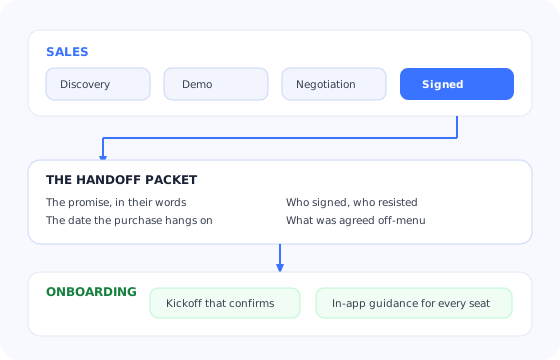
The handoff from sales to onboarding is a small, unglamorous internal process that decides how the first month feels. This guide covers what it actually has to transfer, what belongs in the packet, the three models teams use and the deal sizes each one suits, how to run the internal meeting in twenty minutes, and how to tell whether yours is working.
Key Takeaways
- The handoff transfers context, not an account. Provisioning is the easy half; the promise, the deadline and the politics are the half that gets dropped.
- The receiving team owns it. Sales fills the packet, onboarding enforces it, because onboarding is the team that pays for a thin one.
- Capture during the sale, not after. Every question moved into the sales cycle is a question the customer does not answer twice.
- Match the model to the deal. Silent handoffs are fine for self-serve, damaging for enterprise; overlap periods are worth their cost only above a certain contract value.
- The kickoff call should confirm, not discover. If it opens with questions the customer has already answered, the packet failed.
- Automate the repeatable half. Product mechanics belong in in-app guidance so the human hour is spent on sequencing, stakeholders and risk.
What the Sales to Onboarding Handoff Actually Is
Sales to onboarding handoff: definition
The sales to onboarding handoff is the transfer of a newly closed customer from the team that sold the product to the team responsible for making it work. It moves two separate things: the account, which is administrative, and the context, which is everything the customer explained during the sale that changes how onboarding should be run.
Almost every team has solved the first half. The CRM stage changes, a workspace is provisioned, a task appears in someone's queue. The second half is where handoffs quietly fail, because context has no field to live in and no system that complains when it is missing.
It helps to be precise about what context means here. It is not the meeting notes. It is the four things a competent onboarding lead would ask for if they could interview the account executive for ten minutes, and which the customer will assume you already know.
1. The promise
Not the feature list: the outcome the customer believes they bought. Two companies on identical contracts can have bought completely different things, one a reporting problem solved, the other a headcount avoided. Onboarding that optimises for the wrong one delivers a technically successful rollout that the customer describes as disappointing, and neither side can explain why.
2. The clock
Most B2B purchases have a date attached that never makes it into the contract: an audit, a season, a migration deadline, a board meeting, the day the previous tool's contract ends. That date determines the entire onboarding sequence, and the customer usually assumes it was written down. Read more on why the first weeks decide the relationship in our guide to time to value.
3. The room
Who signed, who will use it, who objected, who was overruled, and who has to be won over after the fact. In any purchase involving more than three people there is at least one person who did not want this and will now be asked to change how they work. Onboarding that meets that person unprepared usually mistakes resistance for confusion and tries to solve it with more training. Our enterprise onboarding guide covers the full stakeholder map.
4. The exceptions
Anything sales agreed to that is not standard: a custom field, a report shape, an integration timeline, a migration someone said would be “straightforward”. These are the commitments most likely to be forgotten and most damaging when they surface in week three as a surprise to your own team.
A useful test. Read your handoff packet and ask: could an onboarding lead who has never spoken to this customer open the kickoff call by describing the customer's situation back to them, accurately, in three sentences? If not, the packet is a record of a transaction, not a handoff.
What Belongs in the Handoff Packet
The failure mode of handoff templates is length. A thirty-field form gets filled in with the six fields that autopopulate from the CRM and twenty-four blanks, and everyone concludes that handoffs do not work. The discipline is to include only fields that change what onboarding does. If a field cannot alter the plan, it belongs in the CRM record, not in the packet.
| Field | Filled by | Why it changes the plan | What breaks without it |
|---|---|---|---|
| Promised outcome, in their words | Sales | Decides which workflow gets configured first | A correct rollout the customer calls a miss |
| Driving date or event | Sales | Sets the sequence and what can be deferred | Onboarding paced for a quarter that had four weeks |
| Stakeholder map with attitudes | Sales | Decides who to train first and who to convince | The blocker is discovered in week three |
| Current tools and data to move | Sales, confirmed by onboarding | Sizes the migration before it is scheduled | A one-hour import that turns into a project |
| Non-standard commitments | Sales | Surfaces work nobody has resourced | An escalation about a promise you cannot see |
| Definition of a good first month | Sales and customer, jointly | Gives both sides the same finish line | Success arguments with no agreed criteria |
| Known risks and open questions | Sales | Lets onboarding plan around them deliberately | Risks rediscovered at the worst moment |
| Technical access and admin owner | Onboarding | Removes the most common week-one blocker | Two weeks lost waiting for a login |
Notice what is not on the list: contract value, plan tier, discount, close date. All of it matters to the business and none of it changes what happens on Monday. Keeping it out of the packet is what keeps the packet short enough to be filled in honestly.
Capture during the sale, not after it. The single highest-leverage change most teams can make is moving these questions into the sales conversation, where they read as diligence and build confidence. Asked after signature they read as disorganisation, and asked twice they read as indifference.
The Three Handoff Models, and Which Deal Each Fits
There is no universally correct amount of ceremony. A handoff that suits a six-figure implementation would smother a self-serve upgrade, and the reverse loses deals you have already won. Three models cover almost everything.
Ceremony should scale with how much the customer has to change, not with contract value alone.
Two practical notes. First, a silent handoff is a legitimate choice, not a failure, but it only works when the product genuinely carries the onboarding; see our guide to self-serve onboarding for what that requires. Second, the overlap model has one failure mode worth naming in advance: when two people are on the account, the customer will keep talking to whoever answers fastest, and the exit never happens. Fix it by writing the exit condition into the plan at the start, phrased as an event rather than a date.
Running the Internal Handoff Meeting in Twenty Minutes
Where a live handoff meeting is justified, it should be short, structured and attended by exactly two people who have both read the packet. The meeting is for the parts that do not survive a form: tone, doubt and politics.
1. Two sentences on who this customer is
What they do, and what was true about their situation that made them go looking. Not the industry label: the trigger. “They lost two people in the same month and cannot hire again until April” explains more than any firmographic field.
2. The promise, read out loud
Sales says what the customer thinks they bought, in the customer's own phrasing. Onboarding repeats it back. This takes ninety seconds and catches the most expensive category of mismatch, where both teams are confident and describing different products.
3. The date and what hangs on it
Confirm the driving event and what happens to the customer if it slips. If nobody can name a date, say so explicitly, because an onboarding with no clock needs a manufactured one or it drifts.
4. The room, one line each
Name, role, and where they stand. The useful signal is who was quiet, not who was loud; the person who said nothing in the demo is frequently the person whose team has to change the most.
5. What sales is worried about
The question that gets skipped. Every account executive has a private concern about a deal they just closed, and it is almost never in the CRM. Ask directly and write the answer down.
6. The first three things onboarding will do
Onboarding states the plan while sales can still correct it. This is the check that catches commitments made verbally, and it is the only agenda item where the receiving side does the talking.
Anything beyond these six items is either in the packet already or is a conversation for later. If the meeting reliably runs long, that is a signal the packet is not being filled in before the meeting, not a signal that the agenda needs more room.
The Kickoff Call: The Customer-Facing Half
The internal handoff exists so that the kickoff call can be about the future. There is a specific way to open one that pays for the whole process: spend the first three minutes telling the customer what you already know.
“Before we start, let me make sure I have your situation right. You are moving off a system your finance team never adopted, the driver is the audit in March, and success by the end of the first month looks like the three regional managers running their own reports without asking you. Have I missed anything?”
That paragraph does four things at once. It proves the internal handoff happened, it converts the customer from an interviewee into an editor, it surfaces corrections while they are cheap, and it sets the agreed definition of a successful first month on the record. A customer success plan written afterwards then has a starting point both sides recognise.
The rest of the call has three jobs: agree the sequence, name the owner on the customer's side for each step, and book the next two meetings before anyone leaves. Product mechanics should not be on the agenda at all. A live walkthrough of the interface is the least durable thing you can do with a scheduled hour, because it will be forgotten by the time the person needs it and cannot be repeated for the twelve colleagues who were not invited.
Six Ways the Handoff Breaks
-
Nobody owns it
Sales assumes onboarding will ask, onboarding assumes sales will send. The packet is optional in practice, so it exists for the accounts that need it least. Fix: one named owner on the receiving side, with the authority to refuse an incomplete handoff.
-
The template is too long
Thirty fields produce six answers and a shared belief that the process is bureaucratic. Fix: cut every field that cannot change the onboarding plan, and accept that eight good fields beat thirty aspirational ones.
-
It happens after the close
Questions asked post-signature sound like confusion and cost the customer time they already spent. Fix: move discovery questions into the sales cycle and let the packet fill itself as the deal progresses.
-
The gap is too long
Enthusiasm is highest at signature and decays fast. A first contact three weeks later is competing with everything that has happened since. Fix: a two-business-day service level from signature to first contact, tracked like any other queue.
-
Commitments are invisible
The bespoke report, the accelerated migration, the integration “coming soon”. If it is not in the packet it will arrive as an escalation. Fix: a single free-text field titled “things we agreed that are not standard”, reviewed out loud at the meeting.
-
The human hour is spent on the product
The scarce resource is attention from a senior person on the customer's side, and it gets spent on a click-through demo. Fix: move product mechanics into in-app guidance that every user gets, and keep the call for sequencing, risk and stakeholders.
What to Measure
Handoff quality feels like a soft process problem until you attach four numbers to it. Each of these can be tracked without new tooling.
- Handoff completeness rate. The share of new customers arriving with every required field filled. Below about two thirds, the process is decorative. Track it by account executive, not as a company average, because it is almost always concentrated.
- Signature to first contact, in business days. The single easiest thing to fix and the one customers feel most sharply. Report the distribution rather than the mean; a handful of three-week outliers is a different problem from a uniform five-day lag.
- Re-asked questions per kickoff. Count questions in the kickoff call that the customer demonstrably answered during the sale. It is a manual count and it takes ten seconds. It is also the metric that changes behaviour fastest, because it is embarrassing in a specific way.
- Time to first value, split by handoff completeness. Compare complete and incomplete handoffs on how long they take to reach the first real outcome. This is the number that justifies the process to a leadership team, because it converts a workflow complaint into a delivery delay. Our user onboarding metrics guide covers how to define that milestone so the comparison holds.
Handoffs: Do vs. Don't
Do
- Give one named person on the receiving side the authority to enforce the packet.
- Capture handoff fields during the sales cycle, while they still sound like diligence.
- Open the kickoff by describing the customer's situation back to them.
- Write the exit condition for an overlap period as an event, not a date.
- Record what sales is privately worried about.
- Track signature to first contact as a queue with a service level.
Don't
- Build a thirty-field template nobody completes honestly.
- Put contract value and tier in the packet and call it context.
- Let the kickoff call become a second discovery call.
- Spend the customer's scarce hour on a product walkthrough.
- Leave two owners on an account with no exit plan.
- Treat a silent handoff as a failure when the product genuinely carries onboarding.
Carrying the Repeatable Half With Kompassify
A good handoff concentrates human attention on the parts of onboarding that only a human can do: sequencing, stakeholder politics, negotiating who does what by when. Everything else, which is most of the product surface, is repeatable and should not depend on a call being attended.
Kompassify is where that repeatable half lives. Build a first-week onboarding checklist that every user in the account sees, not only the two who joined the kickoff. Target a different guided path to admins than to end users, so the person configuring integrations and the person filing their first request each get the walkthrough that matches their job. Add contextual tooltips on the screens where the promised outcome actually gets produced, and put the commitments from the packet on the checklist so nothing agreed in the sale is invisible in the product.
Because it is a no-code editor, the onboarding team can build and change all of it without waiting on an engineering sprint, which matters when the handoff surfaces a stakeholder nobody planned for. And because completion is tracked per user and per account, the next internal review starts from what the customer's team actually did rather than from what was demonstrated on a call.
Spend the call on the customer, not the interface
Build role-specific checklists, tours and tooltips in a visual editor, target them by account and by role, and see which users in each account got to first value. Free up to 100 monthly active users, plans from $129/month, GDPR-compliant and EU-hosted.
Start for free →The One-Paragraph Version
The handoff is not an account transfer, it is a context transfer, and the context that matters is the promise, the clock, the room and the exceptions. Keep the packet to fields that change the plan, make the receiving team its owner, and capture the answers during the sale rather than after it. Match the ceremony to how much the customer has to change: silent for self-serve, a warm introduction for a team rollout, an overlap with a written exit condition for anything with a migration and a committee. Open the kickoff by telling the customer what you already know, keep product mechanics out of the meeting and inside the product, and watch four numbers: completeness, days to first contact, re-asked questions and the time-to-value gap between good handoffs and bad ones. The last one is what turns an internal annoyance into a case for fixing it.
Frequently Asked Questions
What is a sales to onboarding handoff?
It is the transfer of a customer from the team that sold the product to the team that makes it work. Two things move: the account itself, and the context behind it. The account transfer is administrative and easy to automate. The context transfer is the hard part, because it includes the outcome the customer was actually promised, the deadline they have in their head, who inside their company will resist, and what the sales conversation quietly avoided. A handoff that moves only the account leaves the onboarding team to rediscover all of it from the customer, which is exactly the experience customers describe as starting over.
Who should own the sales to onboarding handoff?
One named person, on the receiving side. Sales supplies the content and onboarding owns the outcome, because the receiving team is the one that suffers when the packet is thin and is therefore the only team with a standing reason to enforce it. Splitting ownership across both teams produces a handoff that nobody chases. If your onboarding function is a single specialist or a founder, they own it by default; the rule matters more as soon as there are two people who could each assume the other did it.
When should the handoff happen?
Start it before the deal closes and finish it within two business days of signature. Anything that has to be asked of the customer twice should be captured during the sales cycle, when the questions sound like diligence rather than confusion. The two-day window matters because customer enthusiasm is highest immediately after signing and decays quickly; a first onboarding contact three weeks after the contract lands is competing with whatever the customer has moved on to.
What should a handoff document contain?
The promised outcome in the customer's own words, the deadline or event driving the purchase, every stakeholder with their role and their attitude, the current tools and data that have to move, anything sales committed to that is not standard, the agreed definition of a successful first month, and known risks. Contract value and product tier matter far less than these, and are already in the CRM. If a field cannot change what onboarding does, it does not belong in the packet.
Do we still need a kickoff call if we have a good handoff document?
Yes, but a shorter one. The document exists so the kickoff call does not have to be a discovery call. When the packet is complete, the kickoff opens by confirming what you already know, which reads as competence, and spends its remaining time on sequencing and commitments. When the packet is empty, the kickoff becomes an interrogation the customer has already sat through once, and the first impression of your delivery team is that it does not talk to its own sales team.
How do we know whether our handoff is working?
Measure four things: the share of handoffs that arrive complete, the number of days from signature to the first onboarding contact, how often onboarding re-asks a question the customer already answered during sales, and the difference in time to first value between complete and incomplete handoffs. The last one is the number that funds the fix, because it converts an internal process complaint into a delivery delay you can put in front of a leadership team.