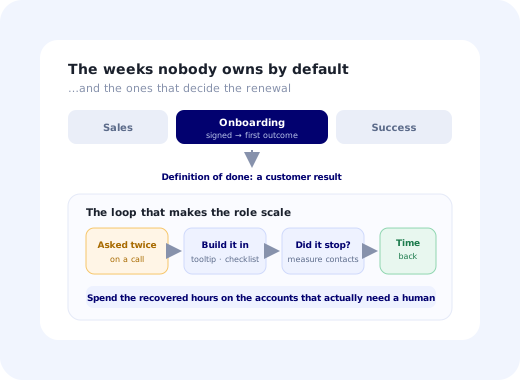
The onboarding specialist is one of the few roles in SaaS that companies invent independently, under half a dozen different titles, because the same gap keeps appearing. Sales hands over an account. Support answers whatever comes in. Customer success picks things up around renewal time. Nobody owns the eight weeks in between, which happen to be the weeks that decide whether the account renews at all.
The role gets confused with three others it is not. It is not account management, because the specialist does not own commercials. It is not support, because it is proactive rather than reactive. And it is not training delivery, because the goal is not that the customer understands the product; it is that the customer gets a result from it.
This guide covers what an onboarding specialist actually does, how the role differs from adjacent ones, the skills that separate strong from average, the metrics the role should own, how it changes across self-serve and enterprise models, and how the job evolves as a company grows.
Key Takeaways
- The role owns a phase, not a queue. From signed to first real outcome: proactive, time-boxed, with a definition of done.
- The deliverable is a customer result, not a trained customer. Understanding the product is not the same as getting value from it.
- Time to value is the headline metric, with activation rate and early-stage churn behind it.
- Great specialists build assets, not just sessions. A call helps one account; an in-app guide helps every account after it.
- The role scales by turning itself into product. Anything explained more than twice belongs in the interface.
- It is a genuine career path into customer success leadership, product, or onboarding programme design.
What Is an Onboarding Specialist?
An onboarding specialist owns the phase between a customer signing up and reaching their first meaningful outcome with the product. They are responsible for making that phase fast, consistent and successful, through direct guidance, through the in-product experience, and through the assets that let the next customer do it faster than the last.
The same job runs under many titles: customer onboarding manager, implementation specialist, launch manager, activation manager, onboarding consultant. The distinguishing feature is not the title but the scope: a defined phase with a start, an end, and a definition of success that is not "the customer is happy" but "the customer has done the thing the product exists to do".
| Role | Owns | Mode | Success is… |
|---|---|---|---|
| Onboarding specialist | Signed → first outcome | Proactive, time-boxed | Customer reached value, fast |
| Customer success manager | The whole relationship | Ongoing | Retention and expansion |
| Support | Incoming problems | Reactive | Issue resolved, quickly |
| Solutions / implementation engineer | Technical setup | Project-based | It is configured and integrated |
| Account manager | The commercials | Cyclical | Renewed and grown |
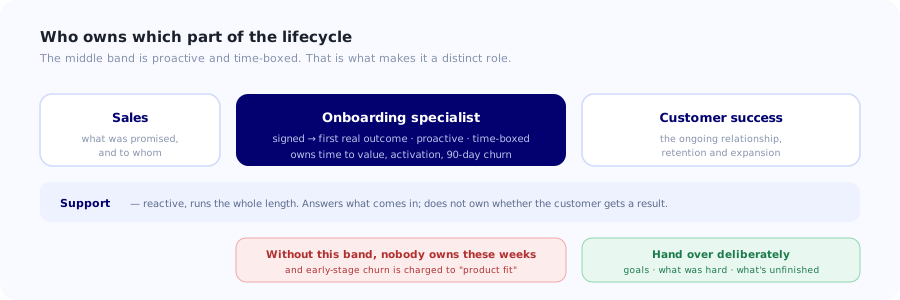
The role exists because the gap between "signed" and "getting value" belongs to nobody by default, and it is where accounts are won or lost.
What the Role Actually Does
Job descriptions tend to list "run onboarding calls" and stop. The real scope is wider and the proportions shift as a company matures.
1. Own the handover
Take what sales knows (what the customer was promised, what problem they are solving, who the actual users are) and turn it into a plan. A specialist who starts by asking the customer questions sales already answered has begun by wasting the customer's goodwill, and it is a surprisingly common way to lose the first meeting.
2. Define what "onboarded" means for this account
Not a checklist of features shown, but a specific outcome: data imported and one report shared, three users active weekly, first campaign sent. Vague onboarding never ends, and an account that never finishes onboarding never moves into a healthy steady state. Different segments need different definitions; see the customer onboarding process.
3. Remove obstacles rather than explain around them
A large part of the job is noticing that a customer is stuck for a structural reason (a permission they cannot grant, data in the wrong shape, a stakeholder who has not been convinced) and solving that, rather than delivering a training session that leaves the obstacle in place.
4. Build the in-product experience
This is the part missing from most job descriptions and present in every strong specialist. Anything explained on more than two calls should become a walkthrough, a tooltip or a checklist inside the product. This is how the role scales beyond the number of calls one person can hold in a week.
5. Be the product team's field evidence
The specialist watches new users meet the product more often than anyone else in the company. They know which screen confuses everyone and which step nobody completes without help. Converting that into specific, evidenced product feedback, "eleven of the last fifteen accounts needed help at the same step", is among the most valuable things the role produces.
6. Hand over deliberately
Onboarding ends. Someone else takes the relationship, and they need to know what the customer actually wanted, what was hard, what was promised and what remains unfinished. A clean handover is the difference between a customer who feels looked after and one who has to re-explain themselves to a new face in week nine.
The Skills That Separate Strong From Average
✅ What strong specialists do
- Ask what the customer wants to achieve before showing anything.
- Time-box onboarding and say clearly when it is finished.
- Build reusable assets from every recurring question.
- Read product usage data before every call.
- Escalate structural blockers instead of working around them repeatedly.
- Bring product teams evidence, with numbers attached.
❌ What average looks like
- Delivering the same demo to every account regardless of goal.
- Onboarding that quietly never ends.
- Answering the same question forty times without changing anything.
- Measuring success by sessions delivered or customer politeness.
- Treating a stuck account as a training problem.
- Relaying complaints as anecdotes rather than as patterns.
The single most transferable skill is diagnosis over demonstration. An average specialist shows the product; a strong one works out what this specific customer needs to accomplish and takes the shortest path to it, which often means deliberately not showing most of the product. A new customer's attention is the scarcest resource in the engagement, and spending it on features they did not ask about is the most common way to waste it.
The second is a bias toward building assets. Someone who answers a question forty times has delivered forty answers; someone who answers it twice and then builds a guide has removed the question. Over a year the difference between those two people is not effort; it is leverage.
What the Role Should Be Measured On
The wrong metrics are the ones that are easy to collect: calls held, sessions delivered, satisfaction with the onboarding experience. All three can be excellent while customers churn in month four.
| Metric | Why it belongs to this role |
|---|---|
| Time to value | The headline number: how long from signup to first real outcome. |
| Activation rate | Share of new accounts reaching the defined outcome at all. |
| Onboarding completion rate | Accounts finishing the phase versus stalling in it indefinitely. |
| Early-stage churn | Losses in the first 90 days, nearly always an onboarding failure. |
| Breadth of adoption | Number of active users per account, not just the champion. |
| Support contacts per new account | Falling means the in-product experience is genuinely improving. |
| Accounts onboarded per specialist | Capacity: should rise as assets replace repetition. |
Breadth of adoption is the most underrated of these. An account where one enthusiastic champion uses the product looks healthy until that person changes jobs, at which point it churns with no warning. An account with five active users across two teams is genuinely embedded. Measuring only the champion's engagement is one of the most common blind spots in onboarding, and one of the most expensive.
How the Role Changes by Business Model
The title is the same; the job is substantially different depending on deal size.
Self-serve and product-led
There are far too many accounts to touch individually, so the specialist's work is almost entirely product work: designing the first-run experience, building checklists and guides, finding drop-off in the funnel and fixing it, running experiments on the activation flow. The job title says onboarding; the day looks like product management with an activation metric attached. See self-serve onboarding.
Mid-market
The genuine hybrid, and the hardest version of the role. A handful of calls per account plus a significant in-product layer, with constant judgement about which accounts justify human time. The specialist has to be equally comfortable on a customer call and in a guidance editor, and the ratio between those two shifts as the assets get better.
Enterprise
Onboarding becomes a project spanning months with multiple stakeholders, phased rollouts and internal change management. Fewer accounts, far more depth, and success depends on adoption across departments rather than by one team. This is closer to enterprise onboarding and often overlaps with implementation and professional services.
How the Role Scales
The trap is straightforward: onboarding load grows with customer count, and if the role is defined as "run onboarding calls", the only way to grow is to hire proportionally. That is expensive, and it makes onboarding quality dependent on which specialist an account happens to get.
Specialists who scale do it by converting their own work into product. The progression is consistent:
Notice the repetition
Keep a simple log of every question asked more than twice. Within a month it will show that a surprisingly small number of confusions account for most of the calls.
Move the answer into the product
A tooltip on the field, a checklist item, a short walkthrough on the screen where it comes up. The answer should arrive at the moment of confusion, not in a document the customer would have to know to look for.
Measure whether the question stopped
Did contacts about that topic actually fall? If not, the guide is in the wrong place or says the wrong thing, which is useful information, and much cheaper to learn than continuing to answer it live.
Spend the recovered time on the hard accounts
The routine ones are now handled by the product. Human attention concentrates where it changes the outcome: the complex integration, the sceptical stakeholder, the account that stalled. This is what a scaled onboarding function looks like, and it is better for customers as well as cheaper.
A specialist who has run this loop for a year has usually built the majority of their company's in-product onboarding, which is also why the role leads so naturally into product and onboarding programme design.
Turn your repeated answers into in-product guidance
Kompassify lets an onboarding specialist build product tours, tooltips, checklists and announcements directly on top of the product (no engineering, no deploy) so the question you answered twice never gets asked a third time. Per-step analytics show exactly where new accounts stall. GDPR compliant, EU-hosted, free up to 100 monthly active users and from $129/mo after that.
Start for Free →Hiring and Being Hired
If you are building the function, the interview questions that discriminate best are not about product knowledge.
- "Tell me about a customer who was stuck. What was actually wrong?" tests diagnosis. Weak answers describe a training gap; strong ones describe a structural blocker.
- "What did you build so you would not have to explain something again?" tests the leverage instinct directly.
- "How did you know onboarding was finished?" tests whether they work to a definition of done or drift.
- "What did you tell the product team, and did anything change?" tests whether they turn field observation into evidence.
- "Which account did you decide not to spend time on?" tests prioritisation, which is the whole job at scale.
If you are moving into the role, the background matters less than the instinct. Support backgrounds bring product depth and diagnostic habits. Account management brings stakeholder handling. Training brings structure. What all three need to add is the reflex to fix the cause rather than deliver the explanation again, and a willingness to build in the product rather than only talk to customers.
The failure mode to design against: an onboarding function measured on activity rather than outcomes. Calls held and satisfaction scores can both look excellent while time to value climbs and 90-day churn rises, because a customer can enjoy a well-run session that does not get them any closer to a result. Set the definition of done first, measure time to value, and let the activity metrics be inputs rather than goals.
Frequently Asked Questions
What does an onboarding specialist do?
An onboarding specialist owns the phase between a customer signing up and reaching their first meaningful outcome with the product. In practice that means taking a proper handover from sales, defining what "onboarded" means for that specific account as a concrete outcome rather than a list of features shown, removing structural obstacles instead of training around them, building the in-product guidance so recurring questions stop being asked, feeding evidenced patterns back to the product team, and handing the relationship over cleanly when the phase ends. The deliverable is a customer result, not a trained customer.
What is the difference between an onboarding specialist and a customer success manager?
Scope and mode. An onboarding specialist owns a defined phase, signed to first outcome, works proactively within a time box, and succeeds when the customer reaches value quickly. A customer success manager owns the whole ongoing relationship and succeeds through retention and expansion. The distinction matters because the two require different rhythms: onboarding has a definition of done and should end, whereas customer success is continuous. In smaller companies one person often does both, but conflating the goals tends to produce onboarding that quietly never finishes.
What metrics should an onboarding specialist own?
Time to value is the headline: how long from signup to first real outcome. Behind it, activation rate, onboarding completion rate, early-stage churn in the first 90 days, breadth of adoption measured as active users per account rather than just the champion, support contacts per new account, and accounts onboarded per specialist as a capacity measure. Avoid making calls held or onboarding satisfaction the goal; both can look excellent while time to value climbs and 90-day churn rises.
What skills make a good onboarding specialist?
The most transferable is diagnosis over demonstration: working out what this specific customer needs to accomplish and taking the shortest path there, which often means deliberately not showing most of the product. The second is a bias toward building assets: someone who answers a question twice and then builds a guide has removed the question, while someone who answers it forty times has only delivered forty answers. Add comfort reading product usage data before calls, willingness to escalate structural blockers, and the ability to turn field observation into evidence with numbers attached.
How does the onboarding specialist role differ in self-serve versus enterprise?
In self-serve and product-led companies there are far too many accounts to touch individually, so the work is almost entirely product work: designing the first-run experience, building checklists and guides, finding funnel drop-off and running activation experiments. The day looks like product management with an activation metric attached. In enterprise, onboarding is a months-long project with multiple stakeholders, phased rollouts and internal change management, where success depends on adoption across departments rather than by one team. Mid-market is the hybrid and the hardest version, requiring constant judgement about which accounts justify human time.
How does an onboarding function scale without hiring proportionally?
By converting the specialists' own work into product. The loop is: log every question asked more than twice; move the answer into the product as a tooltip, checklist item or short walkthrough placed at the moment of confusion; measure whether contacts about that topic actually fell, treating a null result as useful information; then spend the recovered time on the accounts where human attention genuinely changes the outcome. Without this, onboarding load grows linearly with customer count and quality becomes dependent on which specialist an account happens to get.
Is onboarding specialist a good career path?
Yes, and it is unusually well positioned. The role sits at the intersection of customer conversation and product design, and someone who has run the build-assets loop for a year has typically created the majority of their company's in-product onboarding. That combination leads naturally into customer success leadership, product management with an activation focus, or designing onboarding programmes at a larger company. It also produces an uncommon skill set: people who have watched hundreds of new users meet a product for the first time and know precisely where it confuses them.
What should you ask when hiring an onboarding specialist?
Skip product knowledge and test instincts. Ask about a customer who was stuck and what was actually wrong: weak answers describe a training gap, strong ones describe a structural blocker. Ask what they built so they would not have to explain something again, which tests the leverage instinct directly. Ask how they knew onboarding was finished, which reveals whether they work to a definition of done. Ask what they told the product team and whether anything changed. And ask which account they decided not to spend time on, because prioritisation is the whole job at scale.