Ask a leadership team whether the company is customer-centric and you will get a confident yes. Ask for a decision that went a different way last quarter because of customer evidence, and the room goes quiet. That gap is the whole subject.
Customer centricity is usually taught as a mindset, which is why it so rarely survives a busy quarter. A mindset has no defence against a deadline. What survives is structure: who holds evidence, who is permitted to act on it, and what the organisation actually measures and rewards. Those three things determine whether customer needs win an argument, and they are all changeable.
This guide covers a working definition, how centricity differs from customer experience and customer success, a four-level maturity model, the six practices that make it operational, how to measure it honestly, and the five places it predictably breaks.
Key takeaways
- Customer centricity is an operating model, not a value: it is about decision rights, evidence and metrics.
- The test: name one decision last quarter that changed because of customer evidence, and who held it.
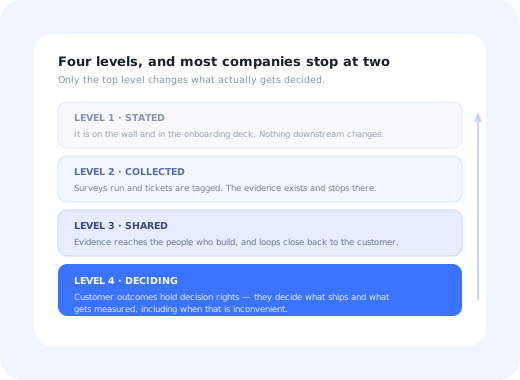
- Four levels: stated, collected, shared, deciding. Most organisations stop at collected.
- Measure it by auditing decisions, not by surveying sentiment. Satisfaction scores are the result, not the mechanism.
- It does not mean building what customers ask for. Customers are authoritative on problems, unreliable on solutions.
What Is Customer Centricity?
Customer centricity: definition
Customer centricity is an operating model in which customer outcomes hold real decision rights: they determine what gets built, what gets measured and what gets rewarded, rather than merely what gets discussed. It is observable in decisions, not in language.
The phrase "decision rights" is doing the heavy lifting. In most companies, customer evidence has advisory status: it is presented, acknowledged, and then loses to a commitment made in a different meeting. That is not hypocrisy, it is an incentive structure. Whoever is measured on shipping will ship; whoever is measured on a customer outcome will optimise the customer outcome. The behaviour follows the measurement with depressing reliability.
The one-question audit. Name a decision in the last quarter that went a different way because of customer evidence. Who brought the evidence? What would have happened without it? If nobody can answer, the organisation is customer-aware: it knows things about customers that do not change what it does.
Customer Centricity vs Customer Experience vs Customer Success
These three terms get used interchangeably in job titles and strategy decks, which makes conversations about them unusually slippery. They sit at different levels.
| What it is | Who owns it | Fails when | |
|---|---|---|---|
| Customer centricity | The internal operating model: evidence, decision rights, metrics | Executives set conditions; every team practises it | It is launched as a values campaign |
| Customer experience | The outcome the customer perceives across all interactions | Usually a CX function, in practice everyone | It is measured but not owned at the point of failure |
| Customer success | A function that helps accounts reach their outcomes | The CS team | It becomes a cleanup crew for product decisions |
The relationship is causal in one direction. Centricity is the mechanism; experience is the result. You can improve isolated parts of the experience without being customer-centric: assign a team, fix the checkout, move the number. What you cannot do is sustain it, because every uncontested internal priority will slowly trade a piece of the experience for something easier to measure. Without a mechanism that pushes back, the erosion is one-directional.
The Four Levels of Customer Centricity
Each level is a real improvement, and each has a characteristic way of stalling.
-
Level 1: Stated
It appears in the values, the careers page and the onboarding deck. Nothing downstream changes. Harmless in itself, but it produces a specific damage: people believe the problem is solved, so nobody proposes the work that would solve it.
-
Level 2: Collected
Surveys run, tickets are tagged, an NPS programme exists. Real evidence accumulates and then sits in a tool that only one team opens. This is where most companies stop, and it is the level that generates the most cynicism, because customers were asked and then nothing visibly happened.
-
Level 3: Shared
Evidence reaches the people who build. Engineers read verbatim feedback; PMs sit in support rotations; loops close back to the customer who raised the issue. Decisions are better informed, but when evidence conflicts with a commitment, the commitment still wins.
-
Level 4: Deciding
Customer outcomes hold decision rights. Teams are measured on them, roadmaps are stated as problems, and a well-evidenced customer need can stop a shipment. The distinguishing property is that it holds when it is inconvenient, which is the only time it matters.
Level 2 is the dangerous plateau. Collecting feedback creates an expectation of response. If a customer answers a survey twice and sees no consequence, you have converted a neutral relationship into a mildly negative one and spent budget doing it. Either close the loop or stop asking; see survey fatigue for what the second year of this looks like.
The Six Practices That Make It Real
These are the changes that actually move an organisation up a level. None of them requires a reorganisation.
1. One shared evidence base
Support tickets, sales objections, churn reasons, research notes and product usage in one place that anyone can search. The point is not tidiness: it is that when two teams argue about what customers want, they can consult the same source instead of trading anecdotes. Most organisations have all five inputs and no shared surface, which means the person with the most confident memory wins.
If the inputs are scattered, start with structured feedback analysis: consistent tagging beats volume, because a large corpus nobody can query is a filing cabinet.
2. Loops that visibly close
Every piece of feedback ends in one of three states: shipped, declined with a reason, or explicitly parked with a date. All three are acceptable; silence is not. Closing the loop is the practice that turns feedback collection from an extraction into an exchange, and it is the single highest-return change most Level 2 companies can make.
It also has to reach the person who raised it. A public changelog is not a closed loop; notifying the requester specifically is.
3. Metrics stated as customer outcomes
"Ship the reporting redesign" is an output. "Reduce the time to build a first report from 40 minutes to under 10" is a customer outcome. The second one can be failed by shipping, which is exactly what makes it a customer-centric goal. Until team goals can be failed by shipping, the incentive structure is pointed at delivery.
This is usually a goal-setting change rather than a cultural one, and it is the change that most reliably shifts behaviour within a quarter.
4. Decision rights, written down
Who can stop a launch on customer evidence? Who arbitrates when a customer need conflicts with a commercial commitment? If the answer is "we discuss it", the outcome is decided by seniority, which is the default in every organisation and is not centricity.
Writing this down is uncomfortable, which is a good sign. The discomfort is the organisation noticing that it has been resolving these conflicts implicitly.
5. Exposure hours for people who do not face customers
Engineers, data teams and finance included. A recorded call watched at 2× is worth more than a summary deck, because the summary has already removed the confusion, and the confusion is the finding. A modest standing commitment, two hours a month, outperforms an annual immersion week, because it accumulates.
Session replay is a cheap complement: watching three people fail at the same step ends an internal debate faster than any amount of argument.
6. Feedback collected where the experience happens
Most feedback programmes ask people to remember an experience days later, in an email, out of context. The answers regress toward general sentiment and lose the specifics that would have been actionable. Asking in the product, at the moment, produces smaller but far more useful answers, and reaches the large majority of users who will never answer an email survey.
Level 2 organisations do step 1 well and stop. The value is in steps 2 and 4: routing evidence to whoever decides, and returning the outcome to whoever raised it.
How to Measure Customer Centricity
Measuring centricity with satisfaction scores is like measuring fitness with a photograph: it captures a result, slowly, and tells you nothing about the mechanism. Measure the mechanism.
Take the last twenty significant decisions. For each: what customer evidence was present, and did it change the outcome? A quarterly count of decisions actually changed is the truest number you will get.
Of the feedback received, what proportion ended in shipped, declined-with-reason or parked-with-a-date, and reached the person who raised it? Most organisations discover this is under 10%.
Hours per month that non-customer-facing staff spend with real customers or recordings. Cheap to count, strongly predictive of how arguments get settled.
What fraction of team goals could be failed despite shipping everything planned? If the answer is none, the incentive system is pointed at output.
Useful for detecting drift, useless for steering. Effort scores are the most actionable of the three because they point at a specific interaction.
The eventual scoreboard. Too slow and too multi-causal to manage by, but a persistent decline while every leading indicator looks fine means the leading indicators are being gamed.
Where Customer Centricity Breaks Down
-
The loudest customer substitutes for the representative one
One enterprise account with a direct line to an executive can bend a roadmap built for thousands. The fix is not to ignore them but to make the base rate visible: how many accounts does this affect, and what would we drop? Segmenting feedback turns an anecdote back into a number.
-
Requests are treated as specifications
A request is a need expressed as the first solution the customer thought of. Building it literally produces a fragmented product that satisfies nobody. Trace every request back to the underlying pain point before it enters the roadmap.
-
The programme measures itself
Survey response rates rise, dashboards multiply, and no decision changes. Any centricity programme whose reported metrics are all about the programme is measuring its own activity.
-
It is delegated to one function
Creating a customer experience team lets every other team opt out. The decisions that determine the customer's outcome are made in product, engineering, pricing and support; a function can hold the evidence base, but it cannot hold the decisions.
-
Nobody owns the in-product moments
Most of the relationship happens inside the product, where no human is present: the first-run experience, the empty state, the error, the upgrade prompt. In most orgs those surfaces have no owner at all, which means the customer's most frequent experience of you is the one nobody is accountable for.
Closing the Loop Inside the Product
That last breakdown deserves expanding, because it is where the theory meets the largest number of customers. For a self-serve or product-led company, the overwhelming majority of customer interactions involve no human being. The customer's experience of your company is a screen at 11pm when something is not working the way they expected.
A centricity programme that never reaches those moments is operating on the small, unrepresentative slice of customers who talk to people. Two practices close that gap.
A one-question in-app survey triggered right after the relevant action gets you specifics (which step, which expectation) from users who would never open an email survey. Small answers, high signal, representative sample.
When something raised by users ships, tell the users who raised it, in the product, at their next visit. An in-app notification targeted at that group is the closing half of the loop, and it is the half almost everyone skips.
There is a practical reason this so often goes undone, and it is not indifference. In most companies, changing an in-product message requires an engineering ticket, so the loop closes at the speed of a sprint rather than at the speed of the decision. Removing that dependency, putting the in-app layer in the hands of whoever owns the customer outcome, is what turns closing the loop from an intention into a habit.
Customer Centricity: Do vs. Don't
✓ Do
- Audit decisions to find out where you really are
- Give every piece of feedback one of three visible endings
- State team goals as customer outcomes that shipping cannot satisfy
- Write down who can stop a launch on customer evidence
- Put non-customer-facing staff in front of customers monthly
- Collect and close loops inside the product, not only by email
✗ Don't
- Launch it as a values campaign
- Collect feedback you have no route to act on
- Treat requests as specifications
- Let one loud account stand in for the base rate
- Delegate it to a single function
- Measure centricity with satisfaction scores alone
The One-Paragraph Version
Customer centricity is an operating model, not a value: it exists when customer outcomes hold decision rights over what is built, measured and rewarded. It runs through four levels (stated, collected, shared, deciding) and most organisations plateau at collected, which is worse than it sounds because asking without responding costs goodwill. Move up by building one shared evidence base, closing every loop visibly, restating goals as outcomes that shipping alone cannot satisfy, writing down decision rights, and putting non-customer-facing staff in front of real users every month. Measure it by auditing decisions, not by surveying sentiment. And do it where most of the relationship actually happens: inside the product, where no human is present.
Close the Loop Where the Customer Actually Is
Kompassify lets you ask a one-question in-app survey at the moment that matters, and announce the fix to the exact users who raised it, both without an engineering ticket, so the loop closes at the speed of the decision. Free up to 100 monthly active users, from $129/mo after that, GDPR-compliant and EU-hosted.
Start for Free →Frequently Asked Questions
What is customer centricity?
Customer centricity is an operating model in which customer outcomes hold real decision rights: they determine what gets built, what gets measured and what gets rewarded, not merely what gets discussed. The practical test is whether you can name a specific decision in the last quarter that went a different way because of customer evidence, and identify who held that evidence. If nothing comes to mind, the company is customer-aware rather than customer-centric.
What is the difference between customer centricity and customer experience?
Customer experience is the outcome a customer perceives across their interactions with you. Customer centricity is the internal operating model that produces it: how evidence is gathered, who is allowed to act on it, and what the organisation is measured on. You can improve isolated parts of the experience without being customer-centric, by assigning a team to fix them. What you cannot do is sustain a good experience without it, because every uncontested internal priority will slowly erode the experience in exchange for something easier to measure.
How do you measure customer centricity?
Audit decisions, not sentiment. Take the last twenty significant product and process decisions and record, for each, what evidence was present and whether it changed the outcome. Then measure three supporting things: how many hours non-customer-facing staff spent with customers, how many closed feedback loops actually reached the person who raised the issue, and how many team goals are stated as customer outcomes rather than as outputs. Satisfaction scores measure the result and are too slow and too noisy to steer by.
Is NPS a good measure of customer centricity?
It is a lagging indicator of experience, not a measure of centricity. NPS tells you how customers currently feel; it says nothing about whether your organisation is structured to act on that. A company can run an NPS programme diligently for years while never changing a roadmap decision because of it. Use NPS to detect drift, and audit decisions to find out whether the organisation can respond: the two answer different questions.
Why do customer-centricity initiatives fail?
Five recurring reasons: it is launched as a values campaign with no change to decision rights; feedback is collected but never routed to anyone who can act on it; the metrics stay output-based, so teams are still rewarded for shipping; the loudest customers substitute for the representative ones; and nobody owns the in-product moments where most of the relationship actually happens. The common thread is that the initiative changes what people say rather than what the organisation measures and permits.
Does being customer-centric mean building whatever customers ask for?
No, and conflating the two is what gives the idea a bad reputation. Customers are authoritative about their problems and unreliable about solutions: a request is evidence of a need expressed in the form of the first fix that came to mind. Customer centricity means the need reliably reaches the people who decide, and that the decision is made with it in view. It emphatically does not mean the request goes straight onto the roadmap, which produces a fragmented product that satisfies nobody. See how to triage feature requests for the mechanics.
Who owns customer centricity in a company?
Executives own the conditions (decision rights, metrics and incentives) and every team owns the practice. It cannot be delegated to a customer experience function, because the decisions that determine the customer's outcome are made in product, engineering, pricing and support, not in the team that measures satisfaction. Where a dedicated function helps is in maintaining the shared evidence base and making sure loops actually close; where it hurts is when its existence lets everyone else opt out.