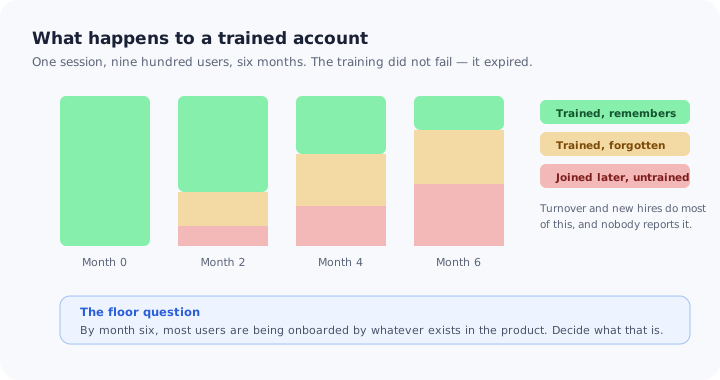
The implementation went well. Four people at the customer were trained over two sessions, they were sharp, they asked good questions, and they agreed to bring their colleagues up to speed. The account has nine hundred users. Everyone shook hands.
Six months later usage has settled at a level nobody is happy with. Two of the four trained people have moved roles. One remembers the session but not the detail, because they use three screens of your product and were shown eleven. Around three hundred colleagues have joined the company since the training and were onboarded by a teammate showing them the basics at a desk.
Nothing here is a failure of the training. It is a failure to plan for what training does on its own, which is expire. Train-the-trainer is the only model that reaches accounts you could never meet in person, and it works — but only when it is built with the decay designed in. This guide covers when the model fits, how to choose a trainer who is not automatically the administrator, what belongs in the enablement kit, how to certify without theatre, why in-product guidance is the floor beneath every trainer, and how to measure whether trainer-led accounts are actually healthy.
Key Takeaways
- Train-the-trainer buys reach, not durability. It decays through forgetting, turnover and message drift, all of which are predictable.
- The administrator is often the wrong trainer. Pick whoever colleagues already ask when they are stuck.
- Certify by watching them teach, not by asking them to answer questions.
- Never single-thread an account. Two trainers minimum, and a kit the customer owns rather than one person’s inbox.
- The product is the floor. Whatever guidance lives in the interface is what every untrained joiner will get, so decide what it is deliberately.
What Train-the-Trainer Actually Is
Train-the-trainer, in one paragraph
Train-the-trainer is an enablement model in which you train a small number of people inside a customer organisation so that they can train everybody else. The output is not an informed champion but a capable teacher: someone who can explain your product in their own company’s language, answer the questions that actually get asked, and recognise when a problem belongs to you rather than to them. It exists because direct training does not scale, and it fails when it is treated as a way of shifting the work rather than as a system to maintain.
The distinction worth holding onto is that a trainer needs a second layer of knowledge on top of product knowledge. Knowing how a feature works is enough to use it. Teaching it requires knowing which part confuses people, which mistake is common, what the first question after the demo always is, and what to do with a question beyond their remit. Programmes that hand a champion the same material customers get, and call it enablement, are the ones that produce a champion who can use the product and cannot teach it.
| Model | Reaches | Strongest when | Breaks when |
|---|---|---|---|
| Direct training by you | Tens of users | The first cohort, unusual configuration, high cost of error | The account grows, or you run out of calendar |
| Train-the-trainer | Hundreds, through a few people | Work is specific to the customer, they have their own induction | The trainer leaves, forgets, or teaches an outdated story |
| In-product guidance | Everyone, continuously | The question arises during the work itself | The task needs judgement, negotiation or context you do not have |
These are layers rather than alternatives. The mature version of the model is direct training for the first group, train-the-trainer for the organisation’s own cadence, and product guidance underneath both so that the person nobody trained is not stranded. The broader programme this sits inside is described in our guide to customer education; this article is about the one delivery model that depends on somebody else doing the teaching.
The Three Ways It Decays
Trainer-led accounts rarely collapse. They erode, which is worse, because erosion produces no event for anyone to respond to.
Knowledge decays inside the trainer. Anything covered in a session and not used in the following days is largely gone within weeks. This is ordinary human memory and no amount of session quality prevents it. What it means practically is that the parts of your product a trainer does not personally use every week are the parts they will teach vaguely, or skip, or get wrong with confidence.
Trainers leave. Role changes, promotions, reorganisations and departures happen at a rate that makes single-trainer accounts a certainty of failure rather than a risk. The replacement inherits a configured account, a reputation for owning the tool, and no training whatsoever — a senior first-time user, which is one of the hardest audiences there is, for the reasons set out in our guide to re-onboarding.
The message drifts. Your product changes. The trainer’s explanation does not, because nobody told them, and they are now teaching a version of your product that stopped existing two releases ago. Message drift is the quietest of the three and produces a specific symptom: support tickets describing behaviour that has not been true for a year, from accounts where everyone was trained by the same person.
All three decay mechanisms share one property: they are invisible from your side unless you look for them. The account still logs in. The champion still answers emails. Nobody reports that the training expired.
Choosing the Trainer: It Is Usually Not the Administrator
The trainer is normally chosen by convenience — whoever owns the account, or whoever attended the sales conversations. Both are defensible and both are frequently wrong.
The org chart names the first two. The third has to be found by asking.
The administrator is chosen because they hold the account. But administration and daily work are different bodies of knowledge, and an administrator teaching a task-level audience tends to explain settings rather than jobs. They are the right person to train on configuration and the wrong single choice for everyone else.
The enthusiast volunteers, which is a genuine asset, but enthusiasm does not book rooms. Where the enthusiast has no authority to claim other people’s time, the training that was agreed in principle never quite gets scheduled, and the account looks like a trainer problem when it is a calendar problem.
The person colleagues already ask is usually the strongest choice and almost never appears on any list you are given. They exist in every team; identifying them takes one question to a few users: who do you ask when you are stuck? The answer arrives quickly and tends to converge. This person has credibility, sees the real questions daily, and is already doing the job informally. What they need from you is legitimacy and time, both of which have to come from their manager rather than from you — which makes the manager conversation part of the enablement, not an administrative afterthought. These are frequently the same people described in our guide to power users.
The Trainer Enablement Kit
What you hand over determines how much of the teaching survives you. A kit does not need to be large; it needs to be current, owned by the customer, and organised around what a trainer actually does.
1. The three tasks, not the eleven features
Name the two or three jobs that account’s users will do most often, and build everything around them. Feature-ordered material produces a session that covers everything and prepares nobody. Task-ordered material is shorter and makes the trainer sound like a colleague.
2. A session outline they can actually run
Forty-five minutes, timed, with the tasks in order and the points where people usually ask something marked. A trainer’s worst moment is losing the thread halfway through, and a timed outline is what prevents it.
3. The questions that always come up, with answers
Write the six most common questions and the honest answers, including the ones where the answer is not yet. This single document is what separates a trainer who is confident from one who is rehearsed, because the fear that stops people teaching is being asked something in front of their own colleagues.
4. A practice environment with realistic data
Nobody teaches well from an empty account. Give the trainer somewhere to rehearse and to let learners click without fear of breaking a live record, populated with data that resembles their own work.
5. A clear escalation boundary
State explicitly what the trainer is not expected to handle: billing, permissions, integrations, anything that looks like a defect. A trainer without a boundary either takes on questions they cannot answer, damaging their credibility, or escalates everything, which makes the model pointless.
6. A short, dated “what changed” note
Message drift is prevented by one habit: a brief, dated summary of what changed since the last version of the kit, sent to trainers when it changes. Keep it to the things that alter what they teach, and see our guide to writing release notes for the format — a trainer needs the subset that affects the session, not the changelog.
Certification Without Theatre
Formal certification programmes drift toward attendance tracking, because attendance is easy to record. It also measures nothing. A quiz score tells you someone recognised an answer; it does not tell you they can stand in front of eight colleagues and explain a task without losing them.
The lightweight version that works: ask the candidate to teach you. Thirty minutes, the three core tasks, with you playing the role of a new user who asks the obvious questions. You will see within ten minutes whether they are fluent, where the gaps are, and whether they are comfortable saying “I will find out” instead of inventing something. Finish by agreeing the escalation boundary out loud.
Keep the record simple and dated, note what the trainer is not certified to cover, and re-check after significant product changes rather than annually by default. Certification is a statement about a moment, and the product moves.
Two per account, minimum. Single-threaded enablement is the most common way a healthy account quietly becomes an unsupported one. The second trainer costs one more session and removes the largest single risk in the model.
Why the Product Is the Floor
Here is the uncomfortable arithmetic. In an account of nine hundred people with meaningful staff turnover, the share of current users who personally attended a training session falls steadily from the day of the session and never recovers, because new joiners arrive continuously and sessions do not. Within a year, the majority of that account’s users have been onboarded by a colleague at a desk, a shared document, or nothing at all.
This is not an argument against training. It is an argument that training is the ceiling and the product is the floor, and most programmes invest heavily in the ceiling while leaving the floor undesigned. Whatever guidance exists inside the interface is what every untrained joiner receives, forever, at no marginal cost. It is also what a trainer’s own explanation rests on: a session is far more effective when the trainer can say and the product will walk you through the rest and be telling the truth.
Concretely, the floor is a short welcome flow for anyone entering the account for the first time, a setup onboarding checklist for the tasks that matter, and contextual help on the screens where questions are actually asked. None of that replaces a trainer. It means the account degrades gracefully when the trainer is unavailable, busy, or gone — instead of falling to zero.
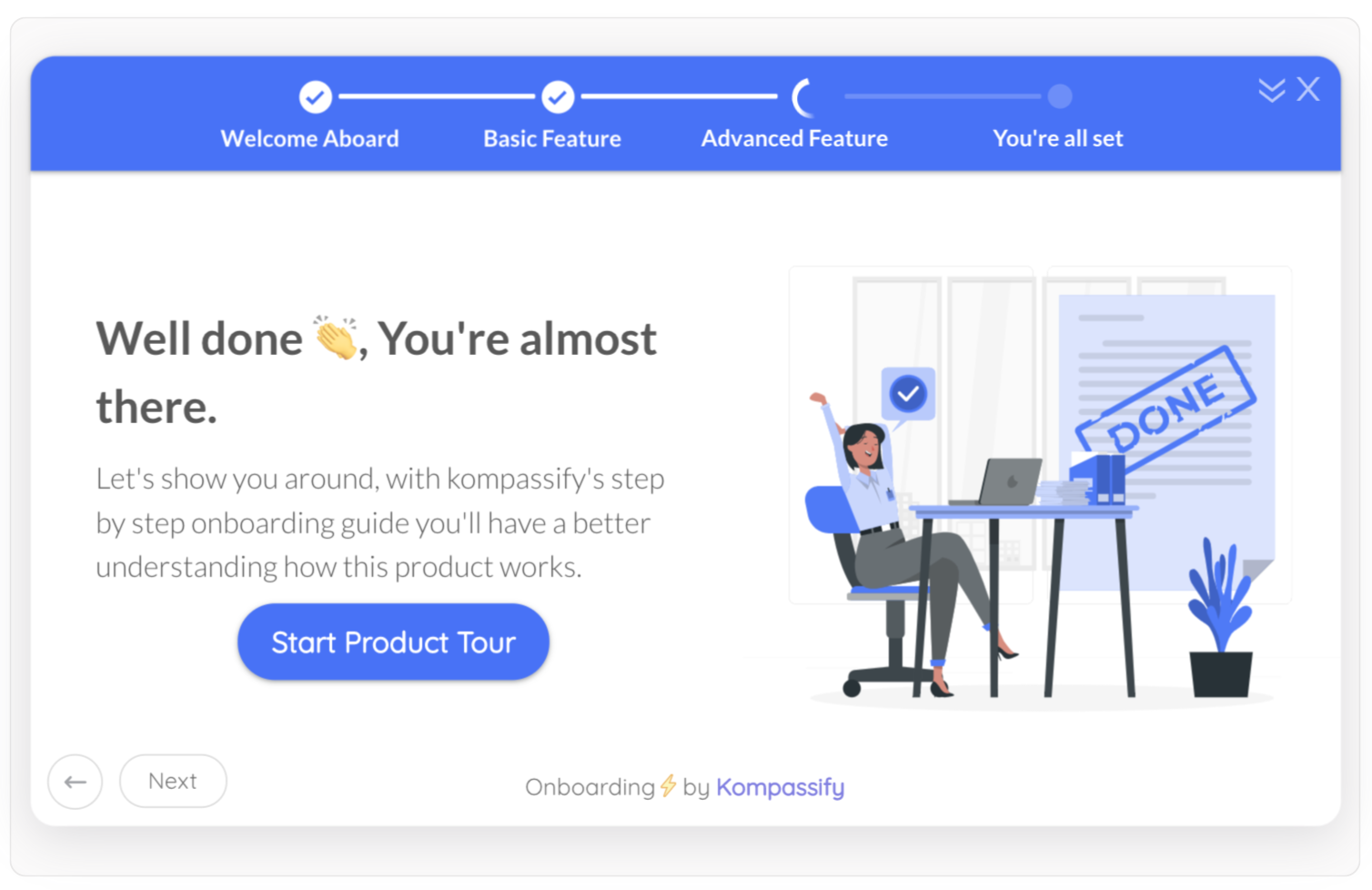
The floor beneath every trainer: a colleague who joined months after the session still gets walked through the first steps.
For large accounts, the two-layer structure in our guide to enterprise onboarding is the right frame: the trainer serves the account layer, and the product serves the seat layer. Where the programme is growing faster than the team running it, the staged approach in scaling user onboarding describes what to build at each size.
Measuring a Trainer-Led Account
1. Coverage: trained share of current users
Not how many people were trained, but what fraction of the people using the account today have been. The first number only grows; the second erodes, and the gap between them is the entire argument for the floor.
2. Trainer bench depth
How many certified, currently employed trainers each account has. Any account sitting at one is a notification away from having none, and this is the cheapest risk in your portfolio to fix.
3. New-joiner activation
Activation for users who joined an account after its training session, compared with the original cohort. This is the sharpest available measure of whether the floor works, and it is rarely calculated because most reporting groups by account rather than by join date. The behavioural measures in our guide to user onboarding metrics work unchanged; only the grouping is different.
4. Drift signal
Support contacts describing behaviour your product no longer has, grouped by account. A cluster is a trainer teaching an old story, and the fix is a fifteen-minute update rather than a support response to each user individually.
Train-the-Trainer: Do vs. Don’t
✅ Do
- Ask users who they already go to when stuck, and start there
- Get the trainer’s manager to allocate time explicitly
- Certify two people per account, minimum
- Certify by watching them teach the three core tasks
- Hand over a kit the customer owns, not a link to your inbox
- Send a short, dated note whenever what they teach changes
- Design the in-product floor for the people nobody will train
- Measure the trained share of current users, not of attendees
❌ Don’t
- Default to the administrator because they own the account
- Hand over customer material and call it enablement
- Treat certification as attendance, or as permanent
- Leave an account single-threaded on one champion
- Let the trainer guess where their responsibility ends
- Assume new joiners inherit the original training
- Discover message drift through support tickets
- Report training delivered as if it were adoption
Building the Floor With Kompassify
The part of this that usually goes unbuilt is the layer underneath the trainer, because it needs to exist inside the customer’s account and nobody wants to spend engineering time on it.
With Kompassify you can build that floor without code. Put a short welcome flow on first entry so a colleague who joined three months after the training still gets oriented. Give each account a checklist of the tasks that matter to them, with progress that persists between sessions. Add contextual help to the screens where questions are actually asked, so the trainer is a route to the answer rather than the only copy of it. Show a brief announcement when something changes, targeted at that account’s users, so message drift is corrected where the work happens instead of in an email nobody opens. And because everything is segment-targeted, a trainer can be given a rehearsal flow that ordinary users never see.
The reporting side matters as much: per-step completion tells you whether the people who were never trained are getting through, which is the number that tells you whether the model is holding up in an account you have not visited in a year.
Make the product carry the training that expired
Build welcome flows, account-level checklists and contextual help without code, so every user who joins after the session still gets guided. Free up to 100 monthly active users, plans from $129/month, GDPR-compliant and EU-hosted.
Start for free →The One-Paragraph Version
Train-the-trainer is how you reach accounts you could never meet in person, and it decays in three predictable ways: the trainer forgets the parts they do not use, trainers leave, and the story they teach drifts away from the product you actually ship. Choose the trainer by asking users who they already go to when stuck rather than defaulting to the administrator, and get their manager to allocate time, because credibility without calendar produces nothing. Hand over a kit built around the three tasks that matter rather than eleven features, with the common questions answered, a practice environment, an explicit escalation boundary and a dated note whenever the story changes. Certify by watching someone teach, never by a quiz, and never leave an account single-threaded on one champion. Above all, design the floor: whatever guidance lives in the product is what every untrained joiner gets forever, and within a year that is most of the account. Then measure the trained share of current users, trainer bench depth, activation for people who joined after the session, and support contacts describing behaviour your product no longer has.
Frequently Asked Questions
What is the train-the-trainer model?
Train-the-trainer is an enablement model in which a vendor trains a small number of people inside a customer organisation, and those people then train their own colleagues. It exists because direct training does not scale: a customer success team cannot run sessions for every user of every account, so it concentrates its effort on a few champions who carry the knowledge onwards. The model works well for reach and poorly for durability, which is why it is usually paired with guidance inside the product rather than used alone.
When should you use train-the-trainer instead of training users directly?
Use it when an account has more users than you could ever meet, when the work is specific to how that customer operates, or when the customer has its own onboarding process that new joiners already pass through. Train directly when the group is small enough, when the configuration is unusual enough that a mistake would be expensive, or when the account is new and nobody internally is yet credible enough to teach it. In practice most enterprise accounts need both: direct training for the first cohort, train-the-trainer for everyone who follows.
Who makes a good internal champion or trainer?
Someone who does the work daily, is asked questions by colleagues already, and has time explicitly allocated for it. The administrator is the obvious choice and frequently the wrong one, because administrators know configuration rather than daily work, and their colleagues do not naturally go to them with practical questions. The strongest signal is who people already ask when they are stuck, which is a role that exists in every team regardless of the org chart.
How do you stop training from being forgotten?
Accept that it will be, and design for the moment of need rather than the moment of training. Knowledge from a session decays quickly for anything not used in the following days, so the durable part of any programme is what is available in the product when the question actually arises: contextual help on the screen, a checklist that survives between sessions, a short refresher on entry after a long absence. A trainer should be a route into that layer rather than the only place the answer lives.
How is train-the-trainer different from customer education?
Customer education is the whole programme through which a vendor teaches its customers, including documentation, webinars, courses and in-product guidance. Train-the-trainer is one delivery model inside it, aimed specifically at making someone else capable of teaching. The distinction matters because the material differs: a trainer needs to know not only how the product works but which questions come up, which mistakes are common, and where to send someone whose problem is beyond their remit.
How do you certify an internal trainer without it becoming theatre?
Ask them to teach, not to answer a quiz. A short session in which the candidate walks you through the three tasks their colleagues will do most often shows fluency, gaps and confidence in a way a multiple-choice test cannot. Keep the record lightweight and dated, note explicitly what the trainer is not expected to cover, and re-check after significant product changes rather than treating certification as permanent.
What happens when the trained champion leaves?
Everything they held individually leaves with them, which is why champion turnover is the most common way trainer-led accounts decay. The mitigations are to certify at least two people per account so knowledge is never single-threaded, to keep the enablement kit in a place the customer owns rather than in one person's inbox, and to make sure the product itself guides new users so an account without a trainer is degraded rather than stranded. Watch for the handover moment too: a new champion inheriting a configured account is a first-time user with a senior job title.