Virality has a reputation problem in B2B. It sounds like a consumer-app concept (share buttons, referral bribes, growth hacks) and most business software teams have watched someone add an "invite your friends" panel to a product nobody wants to tell their friends about.
The version that works in business software is quieter and much more structural. It is not a feature bolted onto the side; it is the observation that some products are genuinely better with a second person in them, and that if you make involving that second person easy enough, your users will do your acquisition for you as a side effect of doing their job.
This guide covers what a viral loop actually is, the k-factor arithmetic and the cycle-time half that teams ignore, the five loop types that work in B2B, why the loop almost always breaks at the receiving end rather than the sending end, how to measure it honestly, and when the whole pursuit is a distraction from something more important.
Key Takeaways
- Virality is a by-product of use, not a favour. If the user has to go out of their way, that is word of mouth: valuable, but not a loop you can engineer.
- k = invites sent × conversion rate. Below 1.0 is still worth having: a k of 0.5 roughly doubles the yield of every user you acquire another way.
- Cycle time is the neglected half. A k of 0.6 completing in three days beats a k of 0.9 that takes six weeks, and cycle time is usually easier to improve.
- B2B loops are collaboration loops. The trigger is a workflow that needs a second person (reviewing, approving, receiving) not a broadcast.
- The loop breaks at the receiving end. Teams optimise the invite and neglect the invited person's first ninety seconds, which is the weaker term in the formula.
- A loop multiplies whatever retention you have. Build it on a leaky product and you distribute the leak faster.
What Product Virality Actually Means
Product virality, in one paragraph
Product virality is growth that comes from the product being used rather than from marketing spend: an existing user's ordinary activity exposes a new person to the product, and that person becomes a user too. What separates it from word of mouth is that the exposure is built into the mechanics: sharing a document, inviting a reviewer, receiving something the product generated, so it happens as a by-product of getting value rather than as a favour the user does you. That is what makes it repeatable, measurable and improvable.
The practical consequence of "by-product rather than favour" is a useful filter for any proposed loop. Ask whether the user would take this action even if it brought you no new users at all. If yes (they are sharing a report because the report needs to be seen, inviting a colleague because the approval must happen) you have a real loop. If the action only exists to grow your user base, you have a referral programme, which is a different thing with different economics and much weaker compounding.
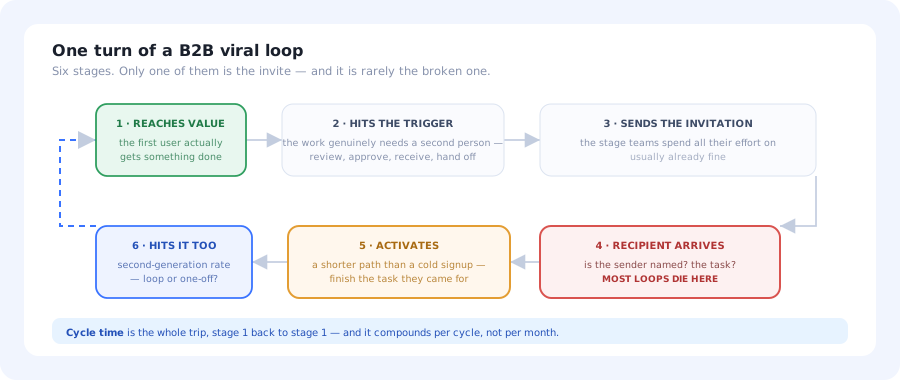
Six stages, and only two of them are the invite. Most teams spend all their effort on stage three and lose the loop at stages four and five.
The K-Factor, and the Half Everyone Ignores
The k-factor, or viral coefficient, is the number of new active users each existing user generates through the loop. The formula is deliberately simple:
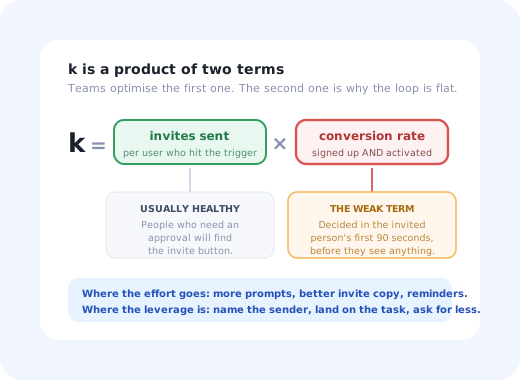
k = (invitations sent per user) × (conversion rate of those invitations)
A user who sends 4 invitations that convert at 25% has a k-factor of 1.0. Above 1.0, the user base compounds without any further acquisition. Below 1.0, the loop amplifies the acquisition you are already doing.
A k-factor above 1.0 is rare and mostly a consumer phenomenon; chasing it in B2B usually produces either despair or dishonest measurement. The more useful framing is amplification. A k-factor of 0.5 means every user you acquire brings, over the full chain of subsequent invitations, roughly one additional user, effectively halving your acquisition cost. That is a substantial business outcome and nobody needs to say the word "viral" out loud to justify it.
The half that gets ignored is viral cycle time: how long one full turn of the loop takes, from a user joining to that user causing someone else to join. It matters because compounding happens per cycle rather than per month.
| Loop | k-factor | Cycle time | Cycles per quarter | Effect |
|---|---|---|---|---|
| Slow, high coefficient | 0.9 | 6 weeks | ~2 | Modest amplification |
| Fast, lower coefficient | 0.6 | 3 days | ~30 | Substantially more growth |
Cycle time is also usually the easier variable to move, because it is made mostly of delays you control: how long before the user hits the moment where a second person is needed, how quickly the invitation is delivered, how long the recipient takes to act on it, and how long before that new user reaches the same moment themselves. Shortening time to value shortens the cycle directly, which is one of several reasons activation work tends to pay for itself twice.
The Five Loops That Work in B2B
Consumer virality is mostly broadcast: one person shows a thing to many. B2B virality is almost entirely collaborative: one person needs a specific other person inside the workflow. These are the five shapes that recur.
The core work genuinely requires a second person: review, approval, comment, hand-off. The strongest B2B loop because the invitation is the workflow, not an addition to it.
The product creates something that gets sent outside the company: a proposal, dashboard, report or form. Recipients see the product while doing something they had to do anyway.
Output is placed on the customer's own surfaces: a widget, embedded page or scheduling link, so the product is seen by that customer's audience continuously.
Value rises with the number of connected organisations: suppliers, agencies, clients. Each new participant has a direct reason to pull in their counterparts.
Not mechanical, but it can be instrumented: identify satisfied users from usage and survey data and make advocacy easy at that specific moment rather than at random.
Incentives can bump volume, but the action exists only for the reward, so it does not compound and the users it brings convert and retain worse.
The first two carry most B2B virality in practice. They share a property worth noticing: in both, the invitation is triggered by a real need rather than by a growth prompt, which means the recipient arrives with a reason to be there. That reason is the most valuable thing in the whole loop, and it is exactly what most implementations throw away, as the next section covers.
Loop five sits awkwardly on the list because it is not mechanical, but it is worth including for teams already measuring NPS: the survey response is a targeting signal, and the useful move is to make advocacy easy in the moment someone tells you they are happy. Our guide to customer advocacy covers that side properly.
The Loop Breaks at the Receiving End
Here is the pattern that repeats across nearly every underperforming loop. The team measures the k-factor, finds it low, and goes to work on the send side: more prompts, better copy, an invite step in setup, reminders. Sends go up. The k-factor barely moves.
The reason is arithmetic. k is a product of two terms, and the send rate is usually the healthier one: people who need a colleague's approval will find the invite button. Conversion is the weak term, and conversion is decided almost entirely in the invited person's first ninety seconds.
The context-destruction problem. An invitation creates intent about a specific thing: Dana needs me to approve the Q3 forecast. The typical implementation then drops that person on a generic signup page, followed by a generic welcome tour, followed by an empty dashboard. Everything that made them willing to click has been discarded, and they now have to work out both what your product is and where Dana's forecast went.
Fixing that is unglamorous and reliably effective. The invited user's first session should differ from a cold signup's in four ways.
1. Name the person and the thing
"Dana invited you to review the Q3 forecast", on the landing page, in the signup form, and in the first screen after signup. Two facts, carried all the way through, and they do more for conversion than any amount of value proposition.
2. Land them on the task, not the home page
The destination should be the document, the approval, the shared workspace. Everything else in your product is a distraction from the reason they came, and it can be discovered later. This is the same principle as a well-designed welcome screen, with a much sharper answer available about what the user is here to do.
3. Ask for less
Every field between the invitation and the task costs conversion, and an invited user has less patience than a self-motivated signup: they did not go looking for you. Company size, role and use case can be collected later through progressive profiling, once they have a reason to care.
4. Give them a different onboarding
An invited collaborator has a narrower first job than the person who bought the product, and showing them the full new-user tour buries it. Segment invited users and give them a shorter path: finish the task they came for, then introduce one adjacent capability. The general principles are in our guide to personalised onboarding, and this is one of the highest-value places to apply them.
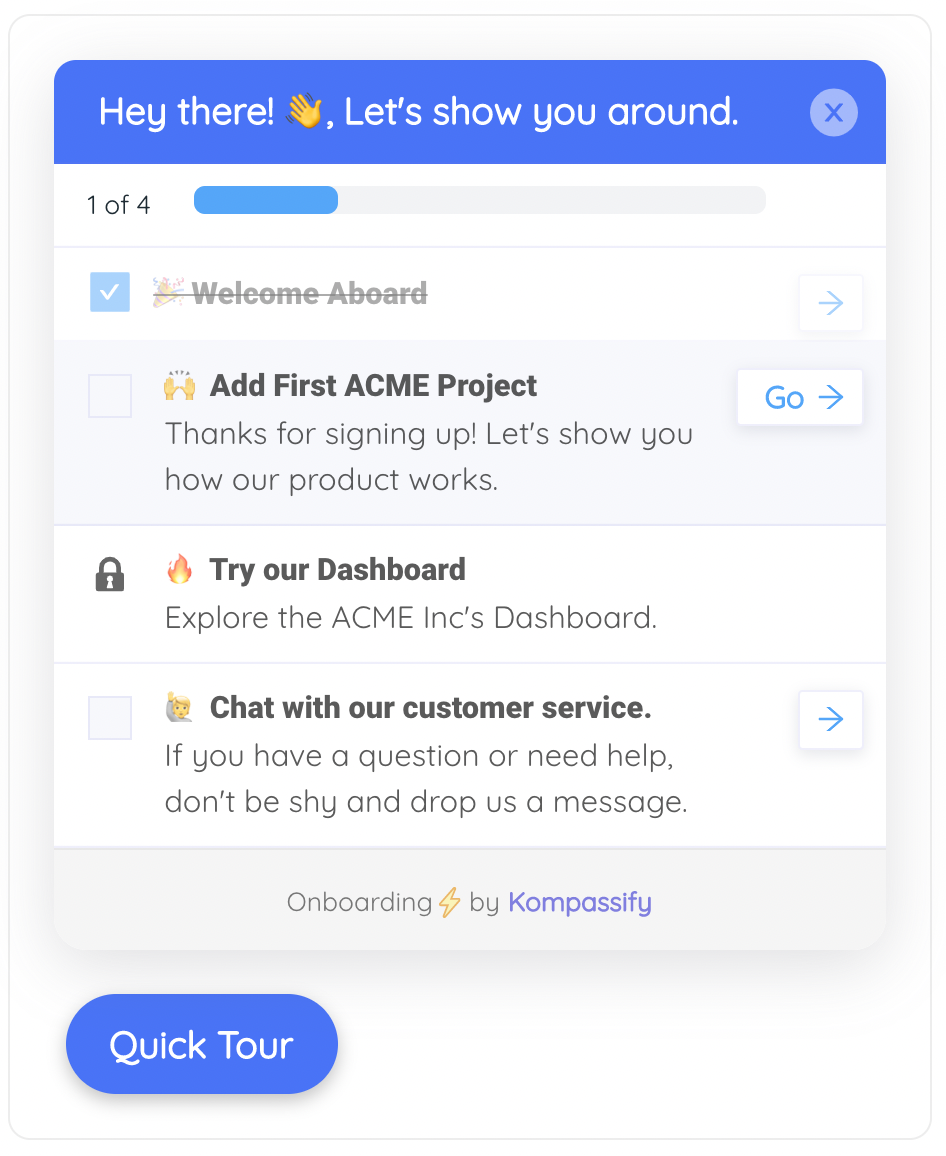
The invited user's version of this should be shorter than the buyer's: finish the task they were invited to, then introduce one adjacent thing.
There is a second, slower breakage worth naming: the invited user activates, uses the thing once, and never triggers the loop themselves. That closes the chain at one hop. Getting a second-generation user to the point where they need someone else is what turns a loop into a loop rather than a one-off referral, and it is squarely activation work.
Measuring a Loop Honestly
Loop metrics are unusually easy to flatter, mostly by counting the wrong population at each step. A small set of unambiguous definitions prevents most of it.
| Metric | Definition to hold to | The flattering version to avoid |
|---|---|---|
| Invitations per user | Per user who reached the trigger point | Per inviting user, hides that most users never invite |
| Invitation conversion | Recipients who signed up and activated | Recipients who clicked the link |
| k-factor | The two above, multiplied, per cohort | A blended all-time figure dominated by your best month |
| Cycle time | Median days from user joining to causing a join | Time from invite sent to invite accepted only |
| Second-generation rate | Share of invited users who later invite someone | Not measured at all, the most common omission |
| Loop-sourced retention | Retention of invited users vs. direct signups | Assuming they are equivalent, they usually are not |
The second-generation rate is the one to add if you only add one. It is the difference between a loop and a referral, and a low number tells you the chain is closing after a single hop, which redirects effort to activation rather than to the invite mechanics. Measure all of it by cohort, because blended figures hide whether the loop is getting better or worse.
Watch the retention row too. Invited users often retain better than direct signups, because they arrived with a task and a colleague already using the product. When they retain worse, it is usually a sign that the loop is being pushed harder than the product supports: invitations sent out of obligation rather than need.
When Virality Is the Wrong Thing to Work On
Retention is weak
A loop multiplies whatever activation and retention you have. Build one on a leaky product and you distribute the leak faster, at greater cost.
The product is genuinely single-player
Some tools are used alone and that is fine. Forcing a collaboration loop into them produces awkward prompts and irritated users.
The buyer is a committee
Where procurement and security review gate every seat, individual invitations do not compound: the constraint is a contract, not an invite.
Nobody involves anyone else
If retained users never pull colleagues in unprompted, that is information about the product. Do not paper over it with incentives.
There is also a line worth not crossing. Loops that harvest contact lists, send on the user's behalf without clear consent, or make the invitation hard to decline do produce short-term numbers, and they cost trust in ways that do not show up in the k-factor. Beyond the reputational cost, sending on someone's behalf raises real consent obligations under GDPR and similar regimes. Our guide to building user trust covers the design signals that decide whether people stay, and an aggressive loop is one of the fastest ways to spend that credit.
The honest sequence is: fix activation, confirm that retained users naturally involve other people, then make that natural behaviour easier and faster. Virality built in that order compounds. Built in any other order it is a growth feature that nobody uses, sitting in a product with a leak.
Fix the second user's first ninety seconds
The weak term in the k-factor is almost always what the invited person meets when they arrive. Kompassify lets you give invited users their own onboarding path (a short, targeted tour or checklist that lands on the task they were invited to, separate from your new-user flow) and shows you where that segment drops off, without engineering time. Free up to 100 monthly active users, plans from $129/month, GDPR-compliant and EU-hosted.
Start for free →The One-Sentence Version
Product virality in B2B is a workflow that genuinely needs a second person, made fast and made contextual, and since k is a product of sends and conversions, the highest-leverage work is almost never the invite, it is what the invited person sees when they arrive.
Frequently Asked Questions
What is product virality?
Product virality is growth that comes from the product being used, rather than from marketing spend: an existing user's normal activity exposes a new person to the product and that person becomes a user too. The distinction from word of mouth is that virality is built into the mechanics: sharing a document, inviting a teammate, receiving something the product generated, so it happens as a by-product of getting value, not as a favour the user does you. That is what makes it repeatable and measurable.
What is the k-factor and how do you calculate it?
The k-factor, or viral coefficient, is the number of new active users each existing user generates through the loop. It is calculated as invitations sent per user multiplied by the conversion rate of those invitations. A user who sends four invites that convert at 25% has a k-factor of 1.0. Above 1.0 the user base compounds on its own; below 1.0 the loop amplifies other acquisition rather than replacing it, which is still valuable: a k-factor of 0.5 effectively doubles the yield of every user you acquire by other means.
Why does viral cycle time matter as much as the k-factor?
Because the loop compounds per cycle, not per month, so the time it takes to complete one determines how many times it can compound in a given period. A loop with a k-factor of 0.6 that completes in three days will produce far more growth over a quarter than one with a k-factor of 0.9 that takes six weeks. Cycle time is also usually the easier of the two to improve, because it is dominated by delays you control: how quickly the invitation is sent, how fast it arrives, and how long the new user takes to reach the point where they invite someone in turn.
Can B2B SaaS products actually be viral?
Yes, but the loops look different from consumer ones. B2B virality is overwhelmingly collaboration-driven rather than broadcast-driven: the loop runs when the product is genuinely better with a second person in it, so a user invites a colleague to review, approve, comment or receive something. That produces a smaller and slower loop than consumer sharing, and it also produces much better users, because they arrive with a concrete task rather than curiosity. The mistake is copying consumer patterns, public share buttons and referral bribes, into a product where the natural loop is a workflow that needs two people.
Why do most viral loops fail?
Almost always at the receiving end rather than the sending end. Teams optimise the invite, more prompts, better copy, higher send rates, while the invited person lands on a generic signup page or an empty product with no reference to why they were invited or by whom. The invitation created intent about a specific task, and a generic first session throws that context away. Fixing the second user's first ninety seconds usually moves the k-factor more than any amount of work on the invite itself, because conversion is a multiplier in the formula and it is normally the weaker term.
When is chasing virality a distraction?
When the product is genuinely single-player, when retention is weak, or when the buying decision is made by a committee rather than by users. A loop multiplies whatever activation and retention you already have, so building one on a leaky product simply distributes the leak faster. The honest sequence is to fix activation first, confirm that retained users naturally involve other people in their work, and only then invest in making that natural behaviour easier, and if nobody involves anyone else, that is a signal about the product, not about the loop.