The second product launches on a Tuesday. Every existing account gets access, an announcement goes out, the switcher appears in the navigation, and for about a week the numbers look excellent. A large share of the base opens it. Leadership sees an attach rate that justifies the investment.
Then the line flattens, and at the next renewal a number of accounts remove the second product from their contract with a polite note saying they never really got into it. Nobody complained. Nobody asked for help. Nothing was broken.
What happened is that a company treated a new product as a new feature, and treated existing customers as people who need no onboarding. Both assumptions are comfortable and both are wrong. This guide covers what actually transfers between products in a suite, why entitlement is not interest, the four different audiences hiding inside your customer base, how to design the first crossing, what to reuse and what to rebuild, and the four numbers that tell you whether any of it worked.
Key Takeaways
- Existing customers arrive expecting competence. When they are confused they go quiet rather than ask, which makes the failure invisible.
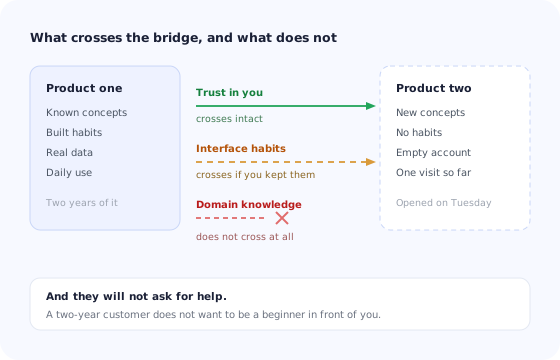
- Only trust transfers fully. Interface habits transfer if you preserved them; domain knowledge of product two does not transfer at all.
- Access is not adoption. Granting entitlement to the whole base produces a spike in openings and tells you almost nothing.
- Your base is four audiences, not one. Each needs a different first experience.
- The second product needs its own activation metric, measured from entitlement rather than from signup.
Why Existing Customers Are the Hardest Audience for Product Two
A new user has a useful advantage: they know they are new. That permission to be a beginner is worth more than any feature. They will read a tour, open documentation, click things to see what happens, and contact support without embarrassment.
A two-year customer opening your second product has none of that. They know your company well. They may have championed the purchase internally. Their self-image is of a competent user of your software, and that self-image makes asking basic questions unattractive. So when the new product does not make sense within a couple of minutes, they close the tab and tell themselves they will look properly later.
This is the confidence gap, and it inverts the usual assumption. Onboarding effort is normally aimed at the least experienced users, on the reasonable theory that they need the most help. In a multi-product company, some of the quietest failures are among your most experienced customers, because nobody designed for the person who is expert in one product and a complete beginner in the next one.
The tell. If your second product shows high first-open rates, near-zero support tickets and low sustained use, you are not looking at a product nobody needs. You are looking at a population too experienced to ask.
Three Familiarities, and Only One of Them Transfers
“They already know us” is doing a lot of work in most second-product plans. It bundles three quite different things, which behave differently.
The mistake is spending the first row's credit as though it covered the third.
Trust transfers fully, and it is genuinely valuable: an existing customer will open something you built without being persuaded. That is an attention advantage, not a comprehension one. Treat it as the reason you get a first visit, not as a reason to skip the explanation.
Interface habits transfer conditionally. If the second product uses the same navigation, the same vocabulary for shared concepts and the same interaction patterns, a returning customer starts several steps ahead. If it was built by a different team, acquired, or designed on a different system, that advantage disappears and nobody warned the user it would.
Domain knowledge does not transfer at all. Knowing your support product very well teaches nothing about your analytics product. This is the row that decides adoption, and the one that “they already know us” most often hides.
Entitlement Is Not Interest
The most common second-product launch grants access to the whole base at once. It is the easy thing to do and it produces the most flattering possible chart: a large spike in first opens, because a notification appeared and people are curious.
Curiosity is not intent. The users who arrive in that spike mostly do not have a job for the new product in mind; they came to look. If the first screen assumes a purpose they do not yet have, they leave, and the spike becomes a population of accounts that have already decided the second product is not for them — which is a much harder position to recover from than never having opened it.
Separate the commercial moment from the adoption moment. The commercial motion is about willingness to pay and belongs with the patterns in the in-app upsell guide. The adoption motion is about reaching a first real outcome and starts after access exists. Running them as one event is why so many second products are bought and not used.
A more effective sequence is to make the first crossing contextual: rather than announcing to everyone at once, surface the second product at the moment in the first product where its job becomes relevant, to the segment for whom that moment is real. This trades a large spike for a smaller number of arrivals who came with a purpose, and purpose is the entire difference in what happens next. The mechanics of announcing without wasting the moment are covered in how to announce a new feature.
The Four Audiences Inside Your Base
“Existing customers” is not a segment. There are at least four groups behind that phrase, and each needs a different first experience.
| Who they are | What they already have | What they need first |
|---|---|---|
| Same person, same job | Product two extends work they already do daily | A contextual entry from the exact workflow, and continuity of their data |
| Same person, new job | Fluent in you, beginner in this domain | The concepts, taught briefly and without condescension |
| New person, existing account | A colleague invited them; they know neither product | Ordinary first-time onboarding, unaffected by the account's history |
| Whole account new to the category | Bought as a bundle; nobody has a use case yet | A reason to start at all, and one narrow first outcome |
The third row is the one most often broken by a well-meaning shortcut. Products commonly suppress onboarding for accounts flagged as established, so a person who joined that account last week — and has never seen either product — is treated as a veteran and shown nothing. Guidance should key off the individual's experience, not the account's age. Getting the segments right is the whole subject of the user segmentation guide, and this is one of the highest-value places to apply it.
The Bridge: Designing the First Crossing
The crossing from product one to product two is a real design object, and in most suites nobody owns it. Four decisions make up most of its quality.
1. Enter from the workflow, not only from the switcher
A global product switcher serves people who already know what they want. Everyone else needs the second product to appear where its job is: at the point in product one where the user hits the problem it solves, with one sentence explaining what it will do about it.
2. Carry the context across
If a user crosses from a specific customer record, a specific campaign or a specific project, arrive in the second product already scoped to that thing. Dropping someone onto a generic home screen throws away the only piece of intent you had, and forces them to reconstruct it manually before anything can happen.
3. Do not restart from zero
Nothing signals “we did not think about you” like asking a five-year customer for their company name, industry and team size again. Anything the account already told you should be pre-filled, and the setup that remains should visibly be the remainder rather than the whole thing.
4. Give the second product a real first outcome
Not a tour of its features: one concrete result, reachable in a few minutes, ideally using data that already exists in the account. A second product that can show something true about the customer's own business in its first session has solved most of its adoption problem, which is why empty states matter even more here than in a first product — the account is full, so an empty screen reads as a fault.
What to Reuse and What to Rebuild
Reusing onboarding assets across a suite saves real time and quietly causes most of the failures. A working division:
Reuse: identity and account setup, billing, invitations and permissions, the visual language and interaction patterns, the shared vocabulary for concepts that genuinely are shared, and your support and knowledge base structure.
Rebuild: the activation definition, the first-run experience, the setup checklist, the empty states, the segments and targeting rules, and the measurement. These are all specific to what the second product does, and inheriting them from product one is how a checklist ends up telling a user to complete steps that do not exist in the product they are looking at.
The one asset never to reuse verbatim is the tour. A tour written for product one's new users will address an audience that does not exist here: someone who knows nothing about your company. For an existing customer that tone is faintly insulting, and it is the fastest way to have your guidance dismissed by exactly the people you needed to reach.
Measuring Multi-Product Adoption
Attach rate is the number that gets reported and the least useful one available, because it counts a commercial event. Four measurements describe what actually happened.
- Entitled. Accounts with access. A contract fact, not a customer one.
- Opened. Accounts where at least one person entered the second product. Sensitive to announcements and largely a measure of curiosity.
- Activated. Accounts that reached a genuine first outcome in the second product, defined on its own terms. This is the number that predicts renewal of the line item.
- Retained. Accounts still using it thirty days later. The gap between activated and retained tells you whether the second product earned a place in someone's week or only in their afternoon.
Two further cuts are worth keeping. Time to value measured from entitlement, not from original signup, because the customer's clock on the new product starts when they get access — the framing in the time to value guide applies unchanged. And products genuinely used per account, where “used” means activated rather than entitled, which is the honest version of the suite metric and the one that moves with net revenue retention.
Five Ways Second-Product Launches Fail
1. Treating a product as a feature
A feature extends a mental model the user already has. A product requires a new one. Announcing a product with the machinery of a feature release gets it opened once and understood never.
2. Skipping onboarding because the account is old
Suppression rules based on account age are how brand-new colleagues at long-standing customers end up with no guidance at all. Segment on the person, not the contract.
3. Launching to everyone at once
The whole-base announcement converts your most valuable audience into people who have already looked and left. Start with the segment for whom the second product's job is currently real, learn what they get stuck on, then widen — the same staged logic as progressive onboarding applied to a launch.
4. Leaving the crossing unowned
Product one's team owns product one, product two's team owns product two, and the bridge between them belongs to nobody. It is the highest-leverage surface in a suite and it is routinely orphaned, for the reasons set out in who owns user onboarding.
5. Measuring the suite instead of the product
A blended activation number across products stays healthy while the second product is inert, because product one carries it. Measure them separately or you will not find out until renewal.
Running Multi-Product Onboarding With Kompassify
Almost everything above is targeting and guidance rather than engineering. The second product exists; what is missing is a different first experience for four different audiences, at the moment each one crosses.
With Kompassify you can put a contextual entry point in the first product for the segment whose work the second product touches, show a short walkthrough on first entry that assumes competence in you and no knowledge of this domain, run a separate onboarding checklist for the second product with its own steps and its own progress, target new colleagues at established accounts with full first-time guidance while veterans get the short version, and read per-step completion for each product independently. Because it is no-code and segment-targeted, the team that owns the second product can run its own onboarding without waiting for the team that owns the first one.
Make the second product as easy to start as the first one was
Build contextual entry points, per-product checklists and segment-specific walkthroughs without code, and measure activation for each product separately. Free up to 100 monthly active users, plans from $129/month, GDPR-compliant and EU-hosted.
Start for free →The One-Paragraph Version
Existing customers are the hardest audience for a second product, because they arrive expecting to understand it and go quiet instead of asking when they do not. Only trust transfers between products; interface habits transfer if you kept them, and domain knowledge does not transfer at all. Stop treating entitlement as adoption: a whole-base launch produces a spike of curiosity and a population who have already decided. Segment the base into the four audiences it really contains, and remember that a brand-new colleague at a five-year account is a first-time user whatever the contract says. Design the crossing deliberately — contextual entry, carried context, no restarting from zero, one real outcome fast. Reuse identity and interface, rebuild activation, checklist, empty states and measurement. Then track entitled, opened, activated and retained separately per product, because a blended number will stay green while the second product quietly goes unused until renewal.
Frequently Asked Questions
What is multi-product onboarding?
Multi-product onboarding is the work of getting customers who already use one of your products to reach real value in a second one. It differs from ordinary onboarding because the audience is not new to you, only to this product, and it differs from a feature launch because a second product usually has its own concepts, its own setup and its own definition of success. The distinguishing risk is that everybody, including the customer, assumes no onboarding is required.
Do existing customers need onboarding for a new product?
Yes, and often a more carefully designed onboarding than new users get. An existing customer arrives with an expectation of competence: they already know your company, so they expect to find the new product obvious, and when they do not they tend to quietly stop rather than ask for help or open documentation. New users will read a tour because they expect to be new. Existing customers will skip it because being guided contradicts how they see their relationship with you, which is why guidance for them has to be shorter, more contextual and less like a beginner's tour.
How is cross-sell different from multi-product onboarding?
Cross-sell is the commercial motion that gets a customer to want and buy the second product. Multi-product onboarding is everything after that, and it is where the value is either realised or lost. The two are frequently confused because a single in-app prompt can serve both, but they have different owners and different failure modes: a cross-sell fails visibly when nobody buys, while onboarding fails invisibly when everybody buys, nobody uses it, and the line item is cancelled at renewal.
Where should a second product appear in the product's navigation?
Where the user is when they need it, not only in a global switcher. A top-level switcher is necessary for people who already know what they are looking for, but it does nothing for the majority, who do not know the second product solves a problem they have. The stronger pattern is a contextual entry point: the second product surfaces at the exact moment in the first product where its job becomes relevant, with an explanation of what it will do, and the switcher exists for everyone who has already crossed once.
How do I measure adoption of a second product?
Separate access from use with four numbers: how many accounts have entitlement, how many opened the second product at all, how many reached a genuine first outcome in it, and how many were still using it thirty days later. Attach rate alone, the first of those, is the number most often reported to leadership and the least informative, because it measures a commercial event rather than a customer one. The gap between opening and reaching an outcome is where multi-product onboarding either works or does not.
Should a second product have its own activation metric?
Yes. A shared activation metric across a suite hides the case that matters most, which is the customer deeply activated in product one and completely inactive in product two. Define the first meaningful outcome in the second product on its own terms, measure time to reach it from the moment of entitlement rather than from signup, and track it separately per product. Only then does a suite-level view of how many products each account genuinely uses mean anything.