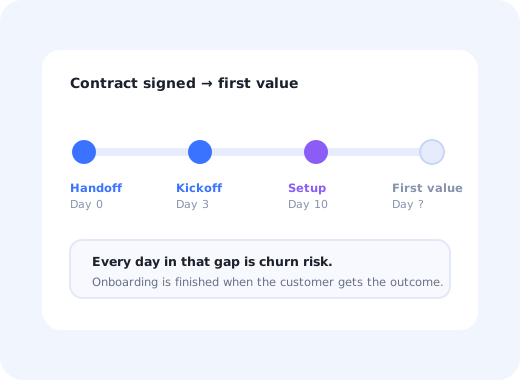
The contract is signed, the champagne emoji goes into the deal channel, and the account moves to a team that was not in any of the sales calls. What happens over the next thirty days decides whether that customer renews, and in most companies it is the least designed part of the entire lifecycle.
Customer onboarding is the programme that carries an account from signature to the outcome it bought. It overlaps with in-product user onboarding but is not the same job: one gets a person through a screen, the other gets an organisation through a change.
This guide covers what customer onboarding is, the six stages of the process, what belongs on the checklist, which metrics tell you it is working, and how to run it without adding a CSM for every account you sign.
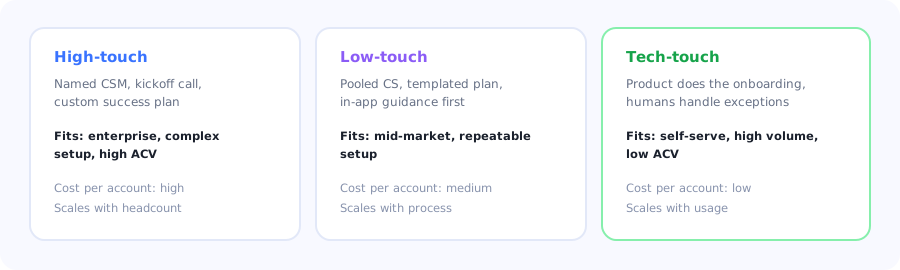
Three delivery models. Most companies need two of them running side by side.
Key Takeaways
- Customer onboarding ends at an outcome, not at a training session. If the customer has not done the thing they bought the product for, onboarding is still running.
- It is an account-level programme; user onboarding is a person-level experience. You need both, and they fail differently.
- The handoff is the highest-risk moment. Most onboarding problems are actually context lost between sales and customer success.
- Pick a delivery model deliberately (high-touch, low-touch or tech-touch) and match it to contract value, not to habit.
- Time to first value is the metric that predicts renewal; completion of your internal steps is not.
- Anything a CSM explains more than five times should be in the product instead.
What is customer onboarding?
Customer onboarding definition: the structured process that takes a newly signed account from contract to first realised outcome, covering the sales handoff, kickoff, configuration, data migration, enablement of the people who will use the product, and the checkpoint where the customer confirms they got what they bought. It is measured in time to value and early retention, not in tasks completed by your team.
The distinguishing feature is that customer onboarding is about an organisation adopting something. There are stakeholders who never log in, a legacy process being retired, an internal champion whose credibility is attached to the decision, and usually a deadline that was promised in the business case. None of that is visible from inside your product analytics.
Customer onboarding vs user onboarding
| Customer onboarding | User onboarding | |
|---|---|---|
| Unit | The account or organisation | The individual user |
| Starts at | Contract signature or handoff | Signup or first login |
| Ends at | The business outcome is realised | The user reaches their first value |
| Delivered by | Customer success, onboarding specialists, the product | The product itself |
| Fails as | A stalled implementation, a silent champion, a missed go-live | An abandoned first session |
| Measured by | Time to value, onboarding completion, early churn | Activation rate, time to first value |
They are two halves of the same problem. A perfect kickoff call cannot save an account whose twenty end users each abandon their first session; that half is covered in our complete guide to user onboarding. This guide covers the account-level programme wrapped around it.
The 6 stages of the customer onboarding process
Handoff from sales
Kickoff and success plan
Configuration and data
Enablement of the end users
First value checkpoint
Transition to ongoing success
1. Handoff from sales
The single most under-engineered step. What the customer said they wanted, who pushed for the decision internally, which competing option they rejected and why, what they were promised, and what the deadline actually is, all of it lives in one salesperson's memory unless a handoff document forces it out.
A useful test: can the person running the kickoff state the customer's business goal in one sentence, in the customer's own words, before the call starts? If not, the first meeting will be spent re-discovering things the customer has already explained, which is where trust starts leaking.
2. Kickoff and success plan
The kickoff exists to agree on three things: the outcome that defines success, the date it should happen by, and who is responsible for what on both sides. Everything else (the product demo, the feature tour, the org chart) is optional.
Write the success plan down and share it. A one-page document naming the goal, the milestones and the owners does more for renewal than any number of check-in calls, because it survives the champion changing jobs.
3. Configuration and data
This is where timelines die. Integrations wait on someone's IT ticket, the data export arrives in the wrong format, single sign-on needs a security review nobody scheduled. The fix is not to work faster, it is to start these tasks on day one in parallel, and to name the customer-side owner of each with a date.
The blocked-on-customer trap: when a project stalls because the customer has not delivered something, the natural response is to wait politely. Weeks pass, momentum dies, and the internal champion starts avoiding the thread. Treat customer-side blockers as your problem to escalate, with a named date, on the day they appear.
4. Enablement of the end users
The account has bought the product; the people who will use it have not. This is where account-level onboarding hands over to in-product guidance, and where most implementations quietly fail: the champion is trained, the twenty users who arrive later are not.
Live training sessions serve the launch cohort only. Anything an end user needs to know should also exist inside the product: a first-session product tour, a checklist of the setup steps that matter, tooltips on whatever the account's admins get asked about most.
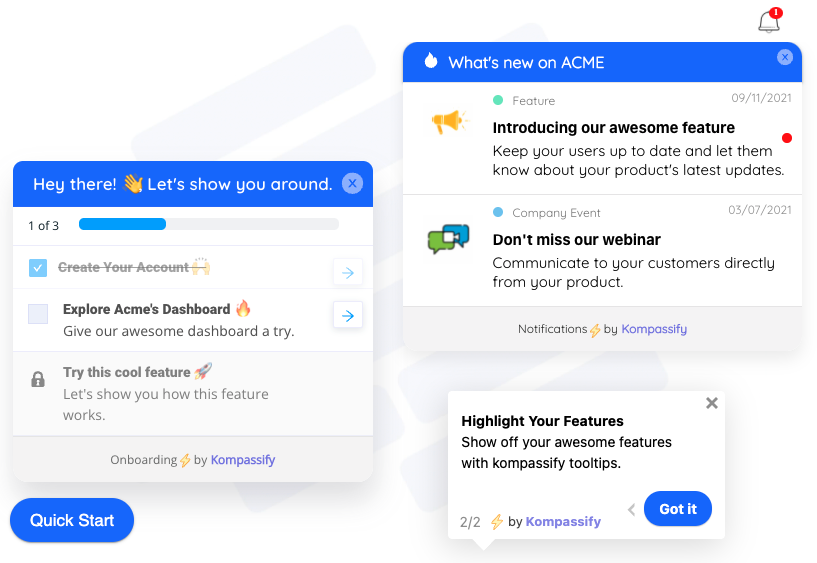
The account signs; the end users still have to be onboarded one at a time.
5. First value checkpoint
A scheduled moment where the customer confirms, in their own words, that they got the outcome from the success plan. Not a status update: a confirmation. If the answer is no, onboarding has not finished, regardless of what your project tracker says.
This checkpoint is also the right place to ask for the first structured feedback. A short in-app or emailed survey at this moment has context that a quarterly NPS sweep never will.
6. Transition to ongoing success
Onboarding ends with an explicit handover: what the customer has achieved, what is still open, who they talk to now, and what the next milestone is. An account that drifts out of onboarding without that conversation is an account with no owner, which is where the second-year churn comes from.
Choosing a delivery model
High-touch, low-touch and tech-touch are not maturity levels; they are choices that should follow contract value and setup complexity. Most companies need at least two running in parallel, and the common failure is running high-touch onboarding on accounts that cannot pay for it.
-
High-touch
Named owner, live kickoff, bespoke success plan, hands-on configuration. Reserve it for accounts where the setup is genuinely complex or the contract justifies the hours.
-
Low-touch
A pooled team working from templates, with the product carrying the routine steps and humans stepping in at defined checkpoints. This is where most mid-market SaaS should live.
-
Tech-touch
The product does the onboarding; humans handle exceptions surfaced by usage data. Requires real investment in in-app guidance, and pays for itself at volume.
The practical rule: anything a CSM explains more than five times belongs in the product. Every one of those explanations is a recurring cost with a fixed, one-time fix.
Customer onboarding metrics
| Metric | Definition | Why it matters |
|---|---|---|
| Time to first value | Days from signature to the first realised outcome | The strongest early predictor of renewal |
| Onboarding completion rate | Accounts reaching the first-value checkpoint ÷ accounts started | Shows where implementations stall |
| End-user activation | Seats completing the core task ÷ seats provisioned | Distinguishes a signed account from an adopted one |
| Time in each stage | Median days per stage of the process | Locates the bottleneck, usually configuration |
| Early churn | Accounts lost within the first renewal cycle | The outcome the whole programme exists to prevent |
Time to first value is the one to instrument first; our time to value guide covers how to define and shorten it, and the customer health score guide covers how onboarding signals feed the model that flags accounts at risk later.
Customer onboarding do's and don'ts
✅ Do
- Force a written handoff from sales
- Agree one outcome and one date at kickoff
- Start configuration tasks in parallel on day one
- Escalate customer-side blockers immediately
- Onboard end users in the product, not only in calls
- Confirm value with the customer, out loud
- Close onboarding with an explicit handover
❌ Don't
- Make the customer re-explain what they bought
- Measure your task list instead of their outcome
- Run high-touch onboarding on low-value accounts
- Assume the trained champion will train everyone else
- Let a stalled project go quiet for two weeks
- Treat go-live as the end of onboarding
- Answer the same question by email forever
Scaling customer onboarding with Kompassify
The part of onboarding that does not scale is the part where a human explains the product. Moving those explanations into the product is what lets one team onboard ten times the accounts without the quality dropping.
- Guide the first session with an interactive product tour that runs for every new seat, not just the ones who attended training.
- Turn the success plan into a visible list with an in-app onboarding checklist the account's admins can work through.
- Branch by role so an admin and an end user see different paths from the first screen.
- Watch where accounts stall with product analytics on the onboarding funnel.
- Confirm value with a short survey at the first-value checkpoint.
Kompassify is a no-code digital adoption platform for SaaS teams: tours, checklists, tooltips, announcements, surveys and analytics in one place. Free up to 100 monthly active users, paid plans from $129/month, GDPR-compliant with EU hosting.
Onboard more accounts without more headcount
Move the repeated explanations into the product, and keep the human time for the accounts that genuinely need it.
Start for Free →Frequently Asked Questions
What is customer onboarding?
Customer onboarding is the structured process that takes a newly signed account from contract to its first realised outcome. It covers the handoff from sales, the kickoff and success plan, configuration and data migration, enablement of the people who will actually use the product, a checkpoint where the customer confirms they got what they bought, and an explicit transition to ongoing success. It is measured in time to value and early retention rather than in internal tasks completed.
What is the difference between customer onboarding and user onboarding?
Customer onboarding operates at the level of the account or organisation and starts at contract signature; user onboarding operates at the level of the individual and starts at first login. Customer onboarding is delivered by customer success and the product together and ends when a business outcome is realised. User onboarding is delivered by the product alone and ends when a person reaches their first value. They fail differently: a stalled implementation versus an abandoned first session, and you need both to work.
What are the stages of the customer onboarding process?
Six. Handoff from sales, where the context behind the purchase is transferred in writing. Kickoff and success plan, where you agree the outcome, the date and the owners. Configuration and data, where integrations, imports and access are set up in parallel. Enablement of the end users, where in-product guidance takes over from calls. The first value checkpoint, where the customer confirms the outcome in their own words. And the transition to ongoing success, with an explicit handover.
How long should customer onboarding take?
It should take as long as it takes to reach the first outcome, which means the honest target is set by your product's complexity rather than by a calendar convention. What matters more than the absolute number is that you measure the median time per stage: the bottleneck is almost always configuration, waiting on integrations, data or a security review on the customer's side. Shortening onboarding usually means starting those tasks on day one in parallel rather than working through them in sequence.
What is a customer onboarding checklist?
A customer onboarding checklist is the shared list of steps both sides must complete to reach first value, each with a named owner and a date. The useful version is written from the customer's outcome backwards rather than from your internal process forwards, is visible to the customer rather than living in your CRM, and separates the steps you own from the steps they own so blockers are attributable. In-app checklists extend the same idea to the end users inside the product.
How do you measure customer onboarding success?
Time to first value is the primary metric because it is the strongest early predictor of renewal. Support it with onboarding completion rate, which shows how many accounts reach the first-value checkpoint; end-user activation, which distinguishes a signed account from an adopted one; median time in each stage, which locates the bottleneck; and early churn, which is the outcome the whole programme exists to prevent. Internal task completion is not a success metric.
What is tech-touch onboarding?
Tech-touch onboarding is a model where the product itself delivers the onboarding, and humans intervene only on exceptions that usage data surfaces. It suits self-serve, high-volume, lower-contract-value segments, and it requires real investment in in-app guidance: tours, checklists, tooltips and triggered messages that cover what a CSM would otherwise explain. The practical rule for deciding what to move into it is that anything explained more than five times should be in the product.
Who owns customer onboarding?
Ownership varies by company size, but the failure mode is the same everywhere: it sits between sales, customer success and product, and each assumes another is handling it. The pattern that works is a single named owner for the account through onboarding, a written handoff that transfers context out of the salesperson's head, and product ownership of the in-app guidance that carries the end users. The handover at the end must also be explicit, or the account exits onboarding with no owner at all.