Ask a SaaS leadership team for their customer acquisition cost and you will get a number in four seconds. Ask what it costs to onboard one customer and you will get a pause, then a guess, then a caveat about it depending on the customer.
The pause is the interesting part. Onboarding is often the largest post-sale cost in the business, it varies by an order of magnitude between segments, and, unlike acquisition cost, most of what drives it is under your direct control. It is simply nobody's line item, because it is spread across customer success, support, engineering and professional services, none of whom are asked to report it.
This guide covers how to calculate customer onboarding cost honestly, what actually drives it, how it interacts with acquisition economics, the levers that reduce it without damaging activation, and the savings that are not savings.
Key Takeaways
- Divide by customers onboarded, not signed. Failed onboardings should raise the cost of the successful ones. That is the point.
- Four of the five cost drivers are properties of your product, not of your customers. That is good news.
- Never report a blended number. Self-serve and enterprise onboarding costs differ by orders of magnitude.
- Move effort from people to product, and reserve human time for judgment: data mapping, stakeholders, edge cases.
- Guard every cut with activation and 90-day retention. A saving that reduces activation moved the cost to churn.
- A segment whose per-customer cost does not fall with volume is not scaling.
What Is Customer Onboarding Cost?
Customer onboarding cost: definition
Customer onboarding cost is the fully loaded cost of taking one new customer from signed contract or signup to successfully using your product. It covers the people time spent on that customer, a share of the tooling and content that supports onboarding, the support they consume during the onboarding window, and any services or credits absorbed to get them live.
Calculate separately per segment. A blended figure describes no customer you actually have.
Two details in that formula do most of the work:
Use onboarded, not signed, in the denominator
Every customer who consumed onboarding effort and never got live is a cost with no corresponding success. Dividing by successful onboardings loads that waste onto the successful ones, which is economically correct and produces a number that gets worse when your onboarding fails more, exactly the behaviour you want from the metric.
Use fully loaded salary costs
Base salary understates a person's cost by a substantial margin once employment taxes, benefits, equipment and overhead are included. Your finance team already has a loaded rate; use theirs rather than inventing one, so the number survives its first contact with a CFO.
What does not belong: pre-sale solution engineering (that is acquisition cost), ongoing customer success after the customer is live (that is cost to serve), and general product development. If you cannot decide, apply the test: would this cost exist if the customer were already fully onboarded? If yes, it is not onboarding cost.
The Five Cost Drivers
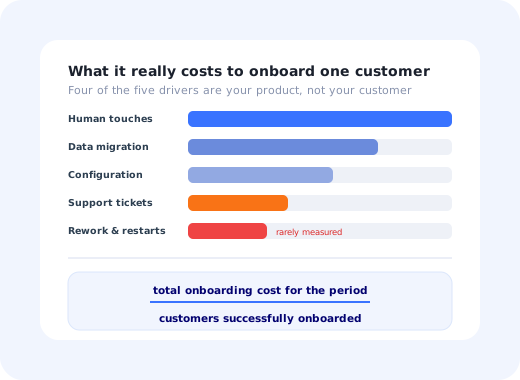
A typical assisted onboarding, decomposed. The proportions vary, but the ordering is remarkably stable across companies:
1. Human touches
Calls, emails, sessions, chases. The dominant cost in almost every assisted model, and the one most sensitive to product design, because a large share of those touches exist to deliver explanations the product could deliver itself. Count them for ten customers and sort by topic; the top three topics are usually the same three, and they are usually answerable in-product.
2. Data migration and cleaning
The only driver genuinely determined by the customer rather than by you. It is also the one worth spending human time on, because bad migrated data poisons everything downstream, a lesson the CRM onboarding guide covers in painful detail. Automate the mechanics; keep the judgment human.
3. Configuration effort
Everything that must be set up before the product does anything. Highly compressible through templating: most customers in a segment configure the same eighty per cent, and the difference between "here is a blank system" and "here is a preset for your industry, adjust it" is often several hours per customer.
4. Support during onboarding
New customers generate support volume at several times the rate of established ones. This cost usually sits in the support budget and is therefore invisible to whoever owns onboarding, which is precisely why it never gets optimised. Tag tickets by customer age and the picture appears immediately.
5. Rework and restarts
The stalled onboarding that has to be picked up three weeks later by someone new, the configuration done twice because a decision changed, the migration re-run. Almost never measured, frequently large, and the driver that most directly rewards making onboarding resumable.
Four of those five are properties of your product and process rather than of your customers. That is the encouraging finding of nearly every onboarding cost exercise: the number feels like fate and is mostly design.
Onboarding Cost, CAC and Payback
Customer acquisition cost conventionally stops at the purchase. Onboarding cost starts there. Reporting them separately is correct, but managing them separately is not, because a cheap acquisition feeding an expensive, failure-prone onboarding is not a cheap customer.
| Metric | Covers | Owned by | Use it for |
|---|---|---|---|
| CAC | Sales and marketing up to purchase | Marketing / sales | Channel efficiency |
| Onboarding cost | Purchase to successfully live | Customer success / product | Segment viability, scalability |
| Cost to serve | Everything after the customer is live | Support / customer success | Long-run margin |
| Payback period | Months of gross margin to recover CAC + onboarding | Finance | Whether the segment is worth serving at all |
The question worth asking once a year: for each segment, what is CAC plus onboarding cost, as a share of first-year gross margin? Companies that run this calculation frequently discover a segment they have been enthusiastically selling into that has never been profitable, and the discovery is almost always in the onboarding half, because that is the half nobody was measuring.
The Cost Curve by Segment
Near-fixed cost
Almost all of it is product and content built once. Marginal cost per customer approaches zero, which means every improvement compounds across all future customers. The whole game is keeping human touches at zero without letting activation fall.
Mixed, and dangerous
Part product, part human, and the segment where costs quietly escalate, because the human layer gets added case by case with no single decision to add it. Templating and in-product guidance pay back fastest here.
Genuinely per-customer
Multi-stakeholder, migration-heavy, weeks or months long. High cost is legitimate; the goal is not to eliminate it but to stop paying it repeatedly for the same explanations. See enterprise onboarding.
Report all three separately, always. A blended average across these three shapes is not a simplification of the truth, it is a different number that corresponds to nothing, and it will make your self-serve segment look expensive and your enterprise segment look cheap, which is the exact opposite of reality and leads to exactly the wrong decisions.
Seven Levers That Actually Reduce It
In rough order of return per unit of effort:
1. Answer the top three repeated questions inside the product
Count the topics that come up in ten consecutive onboarding calls. Three will dominate. Each one delivered as a tooltip or a short walkthrough converts a recurring per-customer cost into a fixed one, and it works for every future customer at no extra cost.
2. Make setup resumable
Onboarding spans weeks in most segments and days in the rest. Every step that must be redone because progress was not held is pure rework. A persistent, resumable onboarding checklist is the cheapest fix on this list and the one with the most reliable effect on the hidden rework driver.
3. Template the configuration
Look at the last twenty onboarded customers and find the configuration they share. Ship it as a preset per segment or industry. This routinely removes hours per customer and, as a bonus, improves quality, because the preset embodies decisions made carefully once rather than hurriedly twenty times.
4. Replace the standard walkthrough call with a guided in-app flow
The generic "let me show you around" portion of the kickoff call is identical every time. Move it in-product and keep the call for the customer-specific half. Most teams find the call can be halved, not eliminated, and halving a recurring hour across every customer is a larger saving than most projects deliver.
5. Move the human touch later, not away
The instinct when cutting cost is to remove the first call. That is backwards: the first interaction sets expectations and catches misfits early. Cut the middle sessions, the ones that exist to check whether someone did something, and replace them with progress visibility so you can intervene only when they have not.
6. Tag support tickets by customer age
Instant visibility into a cost that is otherwise buried in another team's budget, and it turns the top onboarding ticket topics into a prioritised list of things to fix in the product. Nearly free to implement.
7. Kill the onboardings that will not succeed, earlier
A customer who was never going to get live consumes as much effort as one who does, sometimes more. Define the checkpoints where an onboarding is visibly stalling, and have an explicit decision at each one. This feels uncomfortable and is the single largest available saving in most assisted models.
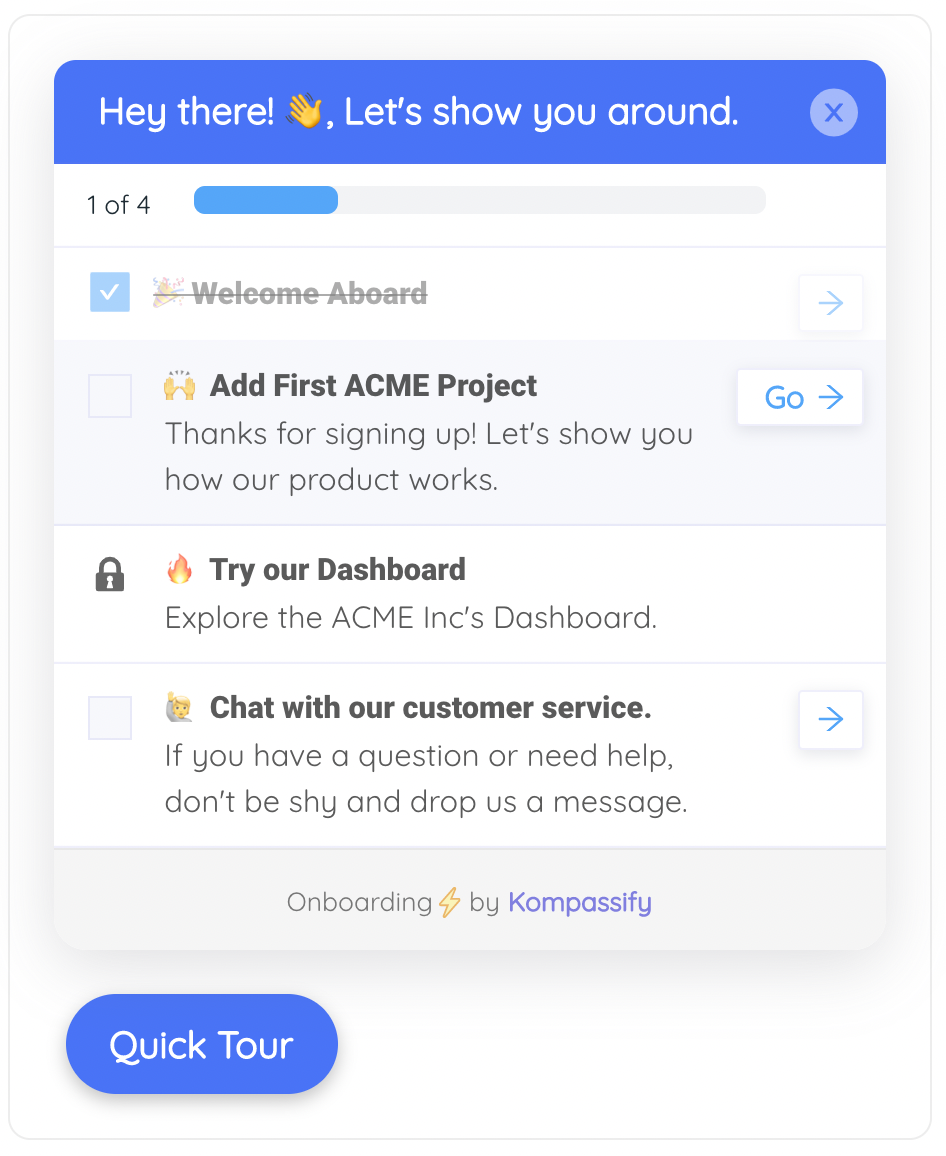
Every explanation that moves from a call into the product converts a per-customer cost into a fixed one.
The Four False Economies
- Removing onboarding support entirely The cost disappears from a budget line and reappears in churn, where it is larger and takes two quarters to become visible. If you cut human support, replace it with something, not with nothing.
- Replacing guidance with documentation A help centre is necessary and is not a substitute for in-context guidance. Documentation moves cost to the support queue, because the customer who could not find the answer still needs it. Both, in their proper places. See the knowledge base guide.
- Skipping the data quality work The fastest way to shorten an onboarding and the fastest way to produce a customer who does not trust the system. This one is not a trade-off, it is a mistake.
- Cheapening the human layer before simplifying the product A less experienced team on the same complex product needs more touches per customer, not fewer. Simplify first, then the staffing question becomes real rather than a way of moving the problem.
Metrics Worth Reporting
| Metric | Definition | What it tells you |
|---|---|---|
| Cost per onboarded customer | Total onboarding cost ÷ successful onboardings, per segment | The headline, and only meaningful per segment |
| Human hours per onboarding | Median assisted hours per customer | The most controllable component |
| Onboarding completion rate | Share of started onboardings that reach live | Failed onboardings are pure cost |
| Support tickets in first 30 days | Per new customer, tagged by age | The hidden cost, made visible |
| Cost trend vs. volume | Per-customer cost as volume grows | Whether the segment scales or just repeats |
| Activation & 90-day retention | Held constant while costs fall | The guardrail on every saving |
That last row is not optional. Every cost reduction in this guide should be reported next to activation and ninety-day retention, because it is trivially easy to reduce onboarding cost by doing less onboarding, and the resulting saving is borrowed from a future quarter at a poor interest rate. The onboarding metrics guide covers defining those numbers so they hold still while you change things around them.
Onboarding Cost: Do vs. Don't
✅ Do
- Divide by customers onboarded, not customers signed
- Use fully loaded salary costs from finance
- Report separately per segment
- Tag support tickets by customer age
- Count the topics in ten consecutive onboarding calls
- Template the configuration that repeats
- Make every step resumable
- Report activation and retention beside every saving
❌ Don't
- Report one blended number across segments
- Exclude support because it sits in another budget
- Ignore the cost of onboardings that failed
- Cut the first call to save money
- Replace guidance with a documentation link
- Shorten onboarding by skipping data quality
- Juniorise the team before simplifying the product
- Celebrate a cost reduction without checking retention
Converting Per-Customer Costs Into Fixed Ones
Every lever in this guide comes down to the same move: take something a person currently does for one customer and make the product do it for all of them. With Kompassify a customer-success or onboarding owner can build that layer without engineering time:
- The standard walkthrough, delivered in-product The generic half of every kickoff call, as a guided flow that runs for every customer at no marginal cost.
- A resumable setup checklist A persistent checklist that holds progress across weeks, the direct fix for the rework driver nobody measures.
- Answers to the three questions everyone asks Contextual tooltips at the exact fields that generate them, removing the recurring touch rather than scheduling it.
- Different flows per segment Segmented guidance so self-serve customers get the full guided path and enterprise customers get only what their assisted onboarding does not already cover.
- Progress visibility instead of check-in calls Analytics showing exactly where each account has got to, so a human intervenes when someone is stuck rather than on a schedule.
Kompassify is no-code, GDPR compliant and EU-hosted, free for under 100 monthly active users, with paid plans from $129/month.
Stop Paying for the Same Explanation Every Time
Move the repeatable half of onboarding into the product, and keep your team's hours for the judgment calls that actually need a person.
Start FreeFrequently Asked Questions
What is customer onboarding cost?
Customer onboarding cost is the fully loaded cost of taking one new customer from signed contract or signup to successfully using your product. It includes the people time spent on that customer, a share of the tools and content that support onboarding, the support tickets they raise during the period, and any credits or professional services you absorbed. Divide the total onboarding cost for a period by the number of customers onboarded in that period, and calculate it separately per segment: a single blended number across self-serve and enterprise describes no real customer.
How do you calculate the cost to onboard a customer?
Take the fully loaded salary cost of everyone who spends time on onboarding, multiplied by the share of their time it consumes; add onboarding-specific tooling and content production costs; add the cost of support tickets raised by customers still inside the onboarding window; add absorbed professional-services or migration costs. Divide by the number of customers successfully onboarded in the same period. Two refinements matter: use customers onboarded rather than customers signed, so failed onboardings correctly increase the cost of the successful ones, and use fully loaded salary costs rather than base pay.
Is onboarding cost part of CAC?
Conventionally no: customer acquisition cost covers sales and marketing spend up to the point of purchase, and onboarding happens after it. But the two are economically inseparable, because a cheap acquisition that produces an expensive, failure-prone onboarding is not a cheap customer. The practical answer is to report them separately and then look at their sum against gross margin and payback period, which is the number that actually determines whether a segment is worth serving.
What drives onboarding cost up?
Five things, in rough order of impact: how much data has to be migrated and cleaned; how many people on the customer side must be involved and coordinated; how much configuration is required before the product does anything useful; how many questions the product raises that it does not answer itself; and how often onboardings stall and have to be restarted. Notice that only the first is genuinely about the customer: the other four are properties of your product and process, which is why onboarding cost is more controllable than it usually feels.
How can you reduce onboarding costs without hurting activation?
Move effort from people to product, in that order: answer repeated questions inside the product rather than in a call, replace the standard walkthrough with a guided in-app flow, make setup resumable so nothing has to be redone, template the configurations that repeat, and reserve human time for the parts that genuinely need judgment: data mapping, stakeholder alignment, edge cases. The test for every reduction is whether activation and ninety-day retention hold. A cost cut that reduces activation has not saved money; it has moved the cost to churn, where it is larger and harder to see.
What is a good onboarding cost?
There is no universal benchmark, because the right number depends entirely on contract value and gross margin. The useful test is relative: onboarding cost should be a small enough share of first-year revenue that the customer becomes profitable well inside the expected lifetime, and it should fall per customer as volume grows in any segment you intend to scale. A segment whose onboarding cost stays flat as you add customers is a segment you are not scaling: you are just doing more of it.
What are the false economies in onboarding?
Four recur. Cutting onboarding support entirely, which reduces a visible cost and increases an invisible one in churn. Replacing guided onboarding with documentation nobody reads, which moves cost to the support queue. Shortening onboarding by skipping data quality work, which produces a customer who never trusts the system. And offshoring or juniorising the human layer without simplifying the product first, which increases the number of touches needed per customer. Each of these looks like a saving on a quarterly report and shows up two quarters later as retention.
How does in-app guidance reduce onboarding cost?
It removes the repeated human touches. Most onboarding calls consist of the same handful of explanations delivered again, and every one of those can be a walkthrough, a checklist or a tooltip that runs for every customer at no marginal cost. With a no-code platform such as Kompassify a customer-success owner can build that layer on the existing product, target it by segment, and update it whenever the process changes, which converts a per-customer cost into a fixed one. Kompassify is GDPR compliant and EU-hosted, free for under 100 monthly active users, with paid plans from $129/month.