
Sign-ups are easy to celebrate. Engagement is where the real story of your product plays out. A user who signs up, logs in once, and never comes back looks identical to a loyal power user on your acquisition dashboard, right up until renewal, when one churns and the other expands.
User engagement is the difference between those two users. It is the ongoing pattern of meaningful interaction that turns a fresh sign-up into a habitual, paying, loyal customer. And it is the single best early signal you have of whether a user is going to stay or quietly disappear.
The trouble is that "engagement" gets used loosely. Some teams count logins. Some count clicks. Some point at a vanity chart that goes up and to the right and call it a day. Real engagement is more specific than that, and this guide walks through exactly what it means, how to measure it, and how to improve it, with the same tactics the best product-led companies use to keep users coming back.
Key Takeaways
- Engagement is meaningful, repeated interaction. It is not logins or clicks. It is how often and how deeply users take the actions that deliver real value from your product.
- Engagement sits between activation and retention. Activation is the first value moment. Engagement is the ongoing habit. Retention is the long-term result. You cannot retain users you never engaged.
- No single number captures it. Measure a small set of metrics together: DAU/MAU stickiness, core-action frequency, feature adoption, and an engagement rate tied to your value action.
- Engagement is the leading indicator of revenue. Engaged users renew, expand, and refer. Disengaged users churn, often silently, before you ever hear from them.
- Onboarding is the engagement lever. Product tours, checklists, and contextual guidance are how you drive users to value, in-app and in context, not through email or documentation.
- Engagement is continuous, not a launch task. Every new feature you ship creates a fresh engagement challenge, users have to discover it, try it, and fold it into their routine.
What Is User Engagement?
User engagement is the depth, frequency, and quality of the interactions a user has with your product over time. An engaged user does not just open the app, they take meaningful actions, return regularly, and consistently get real value out of what they do.
User engagement, defined: the ongoing pattern of meaningful interaction between a user and your product, measured by how often users return and how deeply they use the features that deliver value. Engagement is not a single action or a one-time event, it is a habit that compounds over time.
The word "meaningful" is doing a lot of work in that definition. Opening your app and immediately closing it is an interaction, but it is not engagement. Logging in to dismiss a notification is not engagement. Engagement is the user reaching the part of the product that solves their problem, and coming back to do it again.
The exact behaviors that count differ by product. For a design tool, engagement might be creating and sharing files every week. For a CRM, it might be logging deals and moving them through the pipeline. For an analytics platform, it might be building dashboards and checking them each morning. What they share is that the action represents genuine value, not busywork.
Where engagement fits in the user lifecycle
It helps to place engagement next to the two concepts it is most often confused with. In the journey from stranger to loyal customer, there is a clear sequence: Acquisition (the sign-up) → Activation (the first value moment) → Engagement (the ongoing habit of getting value) → Retention (staying over the long term).
Activation is a single milestone, the first time the product clicks. Engagement is everything that happens after: the repeated, deepening use that builds a habit. And retention is simply the downstream result of sustained engagement. You cannot retain a user you never engaged, and you cannot engage a user you never activated.
Where engagement fits: activation is a single milestone, engagement is the repeating habit that follows, and retention is its downstream result.
Why User Engagement Matters
Engagement is the metric that quietly determines almost everything else. It is the leading indicator that shows up weeks before churn, expansion, or advocacy do. When engagement drops, revenue follows, you just find out later.
Here is why it deserves a place at the center of your product strategy.
- It predicts retention. Users who build a habit around your product stay. Research by Bain & Company found that increasing customer retention by just 5% can boost profits by 25% to 95%, and sustained engagement is what makes users stick around long enough to be retained.
- It makes acquisition pay off. Acquiring a new customer costs five to 25 times more than keeping an existing one (Harvard Business Review). If the users you paid to acquire never engage, that spend is simply lost.
- It drives expansion and advocacy. Gallup's research on customer engagement found that fully engaged customers deliver a 23% premium in share of wallet, profitability, and revenue over the average customer. Engaged users upgrade, buy more, and refer others.
- It validates product-market fit. High sign-ups with low engagement is one of the clearest signals that something is off, either the product, the audience, or the onboarding. Strong, repeated engagement is proof you are solving a real problem for the right people.
- It lowers support costs. Engaged users understand the product. They raise fewer tickets, need less hand-holding, and are more forgiving when something breaks, because they already trust the value they get.
Low engagement is an invisible problem. A churned user rarely writes to tell you why. They simply stop showing up. By the time low engagement appears in your churn numbers, the user made the decision to leave weeks earlier, during the quiet period when they stopped finding value and no one noticed. This is exactly why engagement, a leading indicator, matters more than churn, a lagging one: it gives you time to act while the user is still reachable.
User Engagement vs. Adoption vs. Retention
These three terms get used interchangeably, and that causes teams to measure the wrong things. They are related but distinct, and knowing the difference sharpens every decision you make about your product.
| User Engagement | User Adoption | User Retention | |
|---|---|---|---|
| Question it answers | How often and how deeply are users interacting right now? | Have users incorporated the product (or a feature) into their workflow? | Are users still here weeks and months later? |
| Time frame | Ongoing, day to day and week to week | Over the first weeks of use | Long term, month over month |
| Key metrics | DAU/MAU, session frequency, core actions per user | Feature adoption rate, breadth of use | Retention rate, churn rate, retention curve |
| Role | The leading indicator | A component of engagement | The lagging result |
The simplest way to hold them together: adoption is whether users picked up the product, engagement is how actively they use it over time, and retention is whether that use lasts. Engagement is the one you can influence most directly week to week, which is why it is the metric to build your habits and experiments around.
What about "customer engagement"? The terms overlap, but "user engagement" usually refers to interaction inside the product itself, while "customer engagement" is broader, spanning support, marketing, community, and every touchpoint with your brand. For a product team, in-product user engagement is the sharper, more actionable lens.
How to Measure User Engagement
There is no single "engagement number." The mistake most teams make is picking one metric, usually logins, and treating it as the whole picture. Real measurement uses a small, complementary set of metrics that together tell you whether users are getting value and building a habit.
Step 1: Define your core value action
Before you can measure engagement, decide what a genuinely engaged user actually does. Look at your best long-term customers and find the action they repeat, the one that maps to real value. That is your core value action. For a messaging tool it might be "sends a message"; for a BI tool, "views a dashboard." Everything else you measure hangs off this definition.
Step 2: Track these engagement metrics
| Metric | What It Measures | Why It Matters |
|---|---|---|
| DAU/MAU Ratio (Stickiness) | Daily active users divided by monthly active users | The classic stickiness metric. It tells you what share of your monthly users show up on a given day. Above 20% is widely considered healthy for daily-use products |
| Engagement Rate | Percentage of users who perform your core value action in a period | Your headline engagement number, tied directly to value rather than to raw logins |
| Session Frequency & Length | How often users return and how long they stay per visit | Frequency signals habit; length signals depth. Read them together, a short, frequent session can be healthier than a long, rare one |
| Feature Adoption Rate | Percentage of active users using a specific feature | Shows whether users are discovering the features that deliver the most value, or ignoring them |
| Core Actions per User | The count of value actions each active user takes | Distinguishes power users from passers-by and reveals where depth of use is building or stalling |
| Engagement Cohorts | Engagement tracked by sign-up cohort over time | Reveals whether recent product and onboarding changes are actually improving how new users engage |
Formula: Engagement Rate = (Users who performed the core value action / Total active users) × 100. For example, if 1,000 users were active this month and 420 performed your core value action, your engagement rate is 42%. Track it as a trend, not a one-off snapshot.
Step 3: Watch the trend, not the vanity number
A single engagement figure means little in isolation. What matters is the direction of travel: is your DAU/MAU ratio climbing? Are new cohorts engaging faster than old ones? Is feature adoption spreading? Segment your engagement data by cohort, plan, and role so you can see who is engaging and who is slipping, then act on the specific group that needs help.
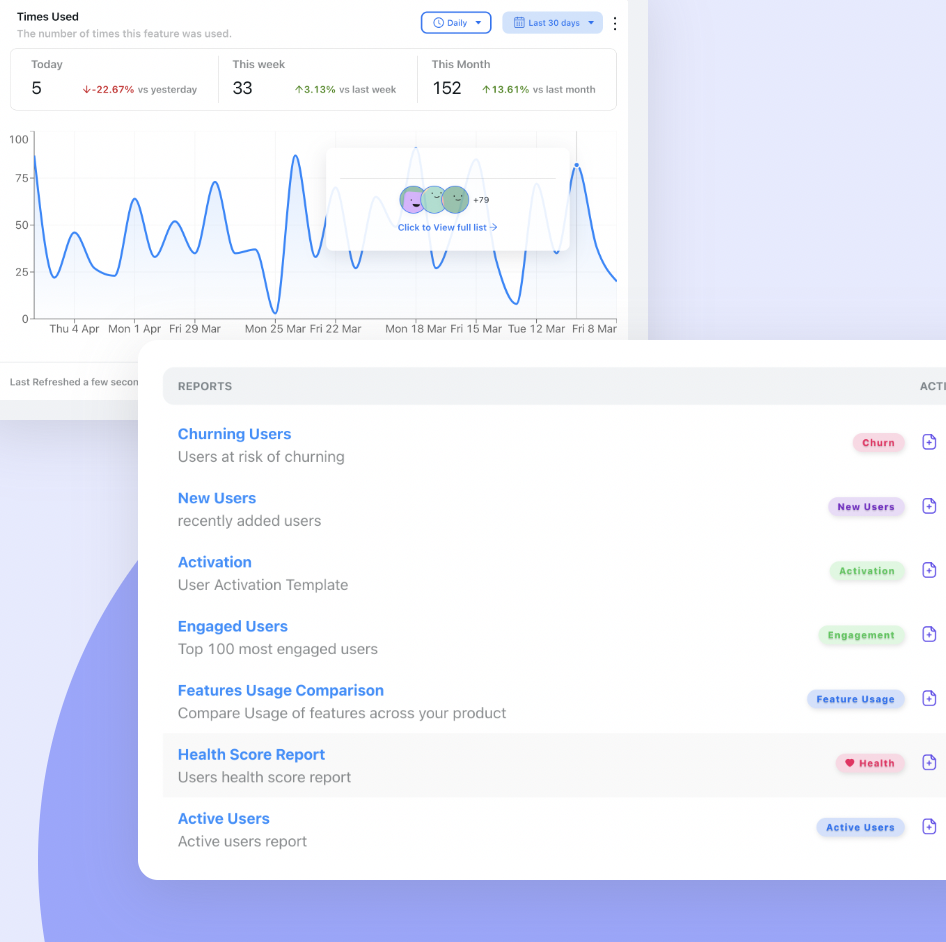
Kompassify's built-in product analytics let you track engagement, feature adoption, and funnel drop-off without writing code or sending data to a third-party tool.
User Engagement Benchmarks (2026)
Benchmarks are a sanity check, never a target. The right level of engagement depends entirely on how often your product is meant to be used, a daily habit tool and a quarterly reporting tool cannot be judged on the same scale. With that caveat, here are the rules of thumb teams commonly reference.
| Signal | Rule of Thumb | Notes |
|---|---|---|
| DAU/MAU (daily-use products) | 20%+ is healthy, 50%+ is exceptional | Widely cited stickiness benchmark for consumer and daily-use SaaS. Below 20% is normal for weekly or monthly tools |
| Usage frequency | Match it to intended cadence | A weekly tool used weekly is fully engaged. Judge against how often the product should be used, not an absolute number |
| Feature adoption | Concentrate on core features | A small fraction of features typically drives the majority of usage. Aim for high adoption of the few that matter, not all of them |
| Engagement trend | Flat-to-rising by cohort | The most important benchmark is your own trend. Newer cohorts should engage at least as well as older ones |
The takeaway: do not anchor on someone else's number. Define your core value action, establish your own baseline, and measure whether the trend is moving in the right direction month over month.
How to Improve User Engagement
Improving engagement comes down to two jobs: get users to value faster, and give them reasons to come back. The strategies below are the highest-leverage ways to do both, and most of them live inside the product, not in a marketing email.
1. Nail activation first
Engagement is impossible without activation. If users never reach their first value moment, there is nothing to build a habit on. Shorten the path from sign-up to that moment ruthlessly, remove non-essential setup, defer optional fields, and get users to a real outcome in the fewest clicks. Everything in our guide to increasing user activation applies here as the foundation.
2. Structure the first sessions with an onboarding checklist
New users do not know what "engaged" looks like for your product, so show them. An onboarding checklist lays out a short, finite set of steps that lead to the core value action, and the visible sense of progress pulls users forward. Keep it to three to five tasks, each tied to a real value moment, not busywork.
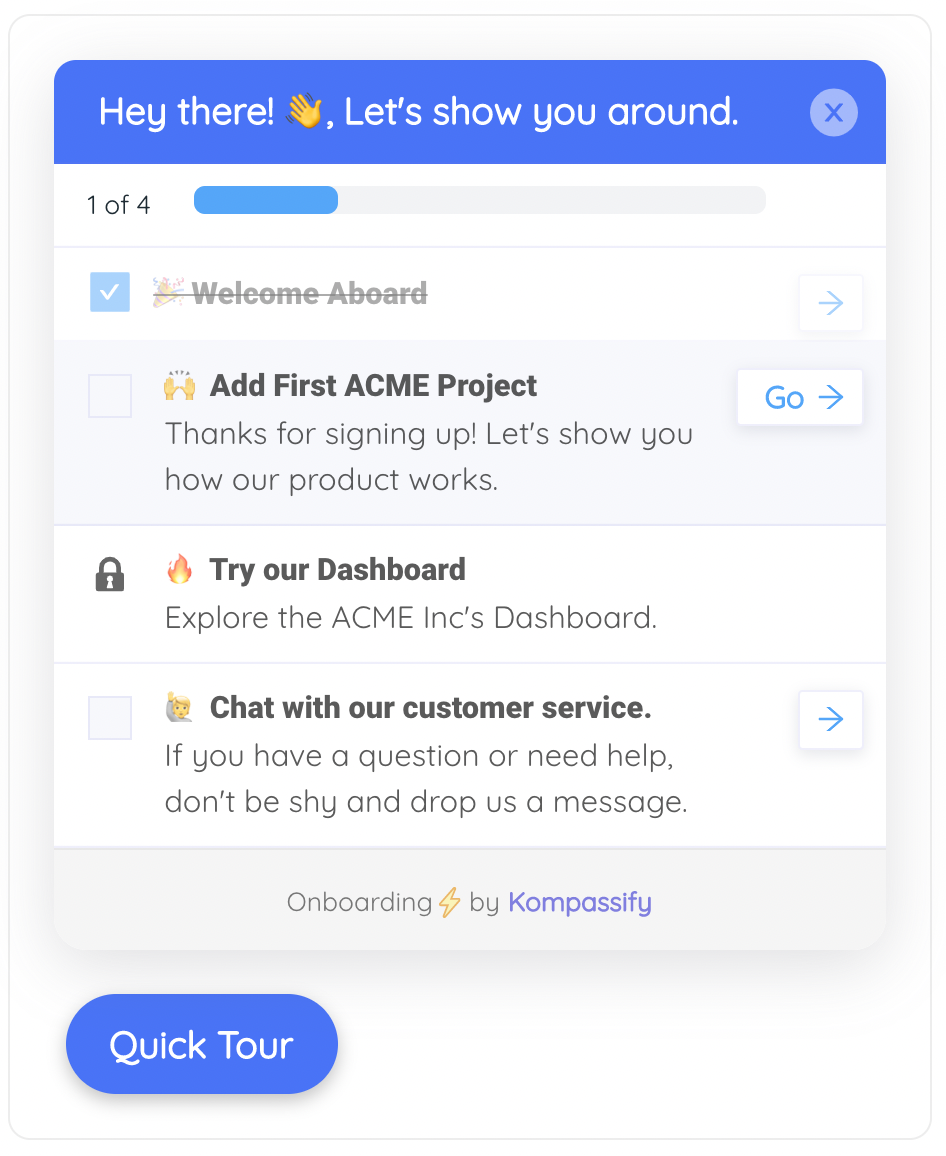
A short, progress-tracked onboarding checklist gives new users a clear path to the actions that build engagement.
3. Guide users with contextual product tours
A product tour walks users through a workflow at the exact moment they need it, inside the product, not in a video they have to hunt for. The best tours are short, skippable, and focused on a single high-value workflow. They lower the friction of the first few uses, which is precisely when engagement habits form or fail.
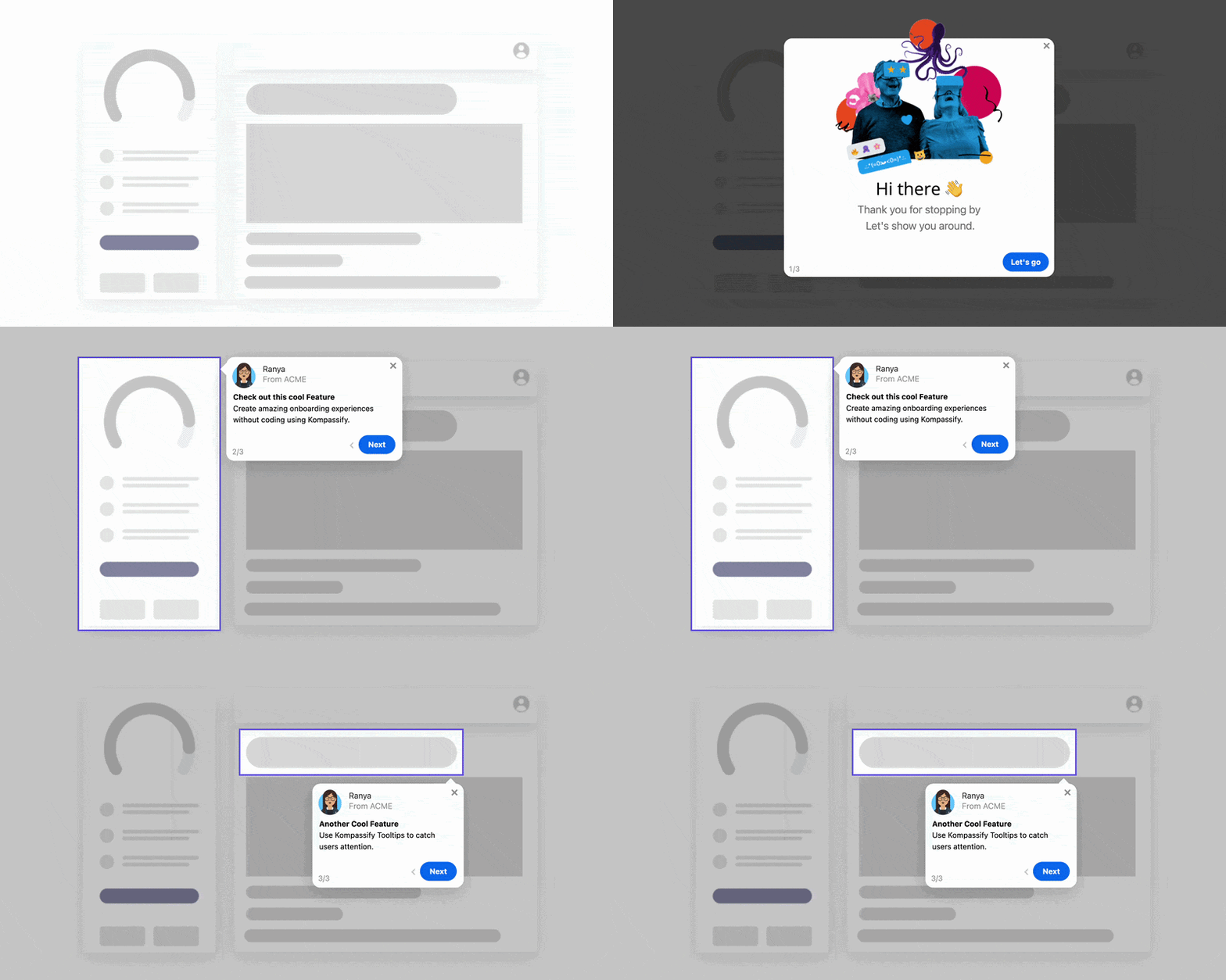
Contextual product tours trigger at the right moment to guide users into the workflows that deliver value.
4. Personalize the experience by role and goal
A marketer and a developer engage with the same product in completely different ways. Ask one or two quick questions at sign-up, role, goal, team size, and use the answers to tailor which features you highlight and which examples you show. A simple welcome segmentation step cuts the noise and puts each user on the shortest path to the value that is relevant to them.
5. Re-engage users the moment they go quiet
Some users drift. Do not wait for the churn report to notice. Use in-app announcements and notifications to bring returning users back to where they left off, and specific, contextual nudges rather than generic "we miss you" messages. "You built a dashboard but haven't shared it with your team yet, here's how" beats a hollow reminder every time.
6. Drive engagement with every new feature
Shipping a feature is not the same as getting people to use it. Every release is a new engagement challenge, users have to discover it, try it, and fold it into their routine. Use feature announcements and targeted tours to turn new features into new engagement instead of ghost features no one touches.
7. Build habit loops and reasons to return
The stickiest products give users a reason to come back on a natural cadence, a weekly summary, a streak, a notification that something relevant happened, a report that is ready each morning. Identify the natural rhythm of your product and reinforce it with timely, relevant triggers that pull users back to their core value action.
The habit loop behind sticky products: a timely trigger pulls the user back to the core value action, and the value delivered becomes the reason to return.
8. Measure, find the drop-off, iterate
Treat engagement as a weekly practice, not a quarterly review. Watch your engagement funnel, find the biggest drop-off, run one experiment to fix it, and measure again. Kompassify's no-code product analytics let you track engagement at each step and segment by cohort, plan, or role, so you always know which group to focus on next, without standing up a separate analytics stack.
User Engagement: Do vs. Don't
A quick reference for what builds engagement and what quietly erodes it.
✅ Do
- Define engagement as a real value action, not logins
- Measure a set of metrics together, not one in isolation
- Guide the first sessions with checklists and product tours
- Personalize the experience by role, goal, or plan
- Surface new features to the users they help
- Re-engage quiet users with specific, contextual nudges
- Track engagement by cohort and watch the trend
- Reinforce the product's natural usage rhythm
❌ Don't
- Treat a login or a page view as engagement
- Rely on one vanity metric that only goes up
- Drop new users into an empty screen with no direction
- Show every feature to every user on day one
- Send generic "we miss you" emails with no context
- Ship features and assume adoption will follow
- Chase another company's benchmark instead of your trend
- Wait for the churn report to notice disengagement
Best Practices for User Engagement in 2026
These principles hold whether you are a small startup or a scaling SaaS company. They are simple to state and easy to get wrong.
Anchor engagement to value, not activity
Activity metrics like logins and time-in-app are easy to inflate and easy to misread. Anchor your definition of engagement to the action that delivers value. A user who logs in daily but never reaches that action is not engaged, they are stuck, and that is a problem to solve, not a number to celebrate.
Meet users in the product, not the inbox
In-app, in-context guidance consistently beats email and documentation for driving engagement. A tooltip at the moment of need, a checklist inside the dashboard, an announcement where the user already is, these reach people while they are engaged, not hours later when the moment has passed.
Segment relentlessly
Averages hide the truth. A healthy overall engagement number can mask a power-user cohort propping up a disengaged majority. Segment by role, plan, and sign-up cohort so you can see, and fix, the specific groups that are slipping.
Make progress and value visible
Progress bars, completed checklists, and "you're almost there" cues tap into the completion effect and keep users moving. Surfacing the value a user has already gotten, time saved, tasks completed, insights found, reminds them why they came back and makes them likely to do it again.
Treat engagement as a continuous practice
Engagement is never "done." Review it weekly, treat a dip the way you would treat a spike in churn, as something to investigate immediately, and keep running small experiments. The teams that win are the ones that make engagement an ongoing habit rather than a one-time project.
User Engagement Examples
The best way to understand engagement is to see how strong products design for it. A few well-known patterns:
-
Streaks and habit loops
Duolingo's daily streak is a textbook engagement mechanic: it gives users a reason to return every single day and makes the cost of breaking the habit feel real. The streak is not the value, but it reliably pulls users back to the value.
-
Timely, relevant notifications
Slack keeps teams engaged by surfacing exactly the messages and mentions that matter, at the moment they happen. The trigger is relevant, not noisy, which is why it pulls users in rather than pushing them away.
-
Onboarding checklists that build momentum
Products from Notion to countless SaaS tools use a getting-started checklist to walk new users through the first high-value actions, converting curiosity into a repeated habit before the trial ends.
-
Recurring value delivery
Weekly summary emails, "your year in review" recaps, and ready-each-morning dashboards give users a reason to come back on a natural cadence, reinforcing engagement without demanding constant attention.
The common thread is that none of these are gimmicks bolted on after launch. Each one is a deliberate design choice that pulls users back to the core value action. For more patterns you can adapt, see our roundup of great user onboarding examples.
Your User Engagement Checklist
Use this as a practical checklist for any engagement improvement project.
Define & Measure
- Identify your core value action from your best long-term users' behavior
- Set up tracking for DAU/MAU, engagement rate, feature adoption, and frequency
- Build engagement cohorts in your product analytics
- Establish your current baseline and set a target trend
Drive the Habit
- Shorten the path to the first value moment (activation)
- Add an onboarding checklist with 3–5 value-linked tasks
- Create a product tour for each core workflow
- Personalize the experience by role or goal
- Reinforce your product's natural usage rhythm with timely triggers
Sustain & Re-engage
- Review the engagement funnel weekly and fix the biggest drop-off
- Announce new features to the users they help with in-app announcements
- Set up contextual re-engagement nudges for users who go quiet
- Run one engagement experiment per sprint and document learnings
What Helps vs. What Hurts User Engagement
Not everything that looks like engagement work actually builds it. Here is a direct comparison.
| ✅ Helps Engagement | ❌ Hurts Engagement |
|---|---|
| Defining engagement around a real value action | Counting logins, page views, or time-in-app as engagement |
| A short onboarding checklist that leads to value | Dropping new users into an empty dashboard with no direction |
| Contextual product tours triggered at the moment of need | A single long tour that explains everything at once |
| Personalized paths based on role and goal | One-size-fits-all flows that show every feature to everyone |
| Specific re-engagement nudges referencing where the user stopped | Generic "we miss you" emails with no context |
| Announcing new features to the users they actually help | Shipping features and assuming users will find them |
| Reinforcing the product's natural usage rhythm | Spamming notifications until users mute or churn |
| Tracking engagement by cohort and acting on the trend | Watching one vanity number and waiting for churn to appear |
Ready to Boost Your User Engagement?
Kompassify gives you product tours, onboarding checklists, in-app announcements, surveys, and built-in analytics: everything you need to guide users to value and keep them coming back, without writing a single line of code. Free for up to 100 monthly active users, GDPR-compliant, and EU-hosted.
Start for Free →Frequently Asked Questions
What is user engagement?
User engagement is the depth, frequency, and quality of the interactions a user has with your product over time. An engaged user does not just log in, they take meaningful actions, return regularly, and get real value from the product. Engagement sits between activation (the first value moment) and retention (staying over the long term): it is the ongoing pattern of usage that turns a new sign-up into a habitual, loyal user.
How do you measure user engagement?
Measure it with a small set of behavioral metrics rather than one number: the DAU/MAU stickiness ratio, session frequency and length, feature adoption rate, core actions per user, and an engagement rate tied to your core value action. The right mix depends on your product, a daily-use tool leans on DAU/MAU, while a weekly tool focuses on core-action frequency and feature adoption instead.
What is a good user engagement rate?
There is no universal benchmark, because engagement depends on how often your product is meant to be used. For the DAU/MAU stickiness ratio, above 20% is widely considered healthy for daily-use products and 50%+ is exceptional, but many valuable weekly or monthly B2B tools score lower by design. Define your core value action, measure the share of users performing it and how often, and focus on improving that trend.
What is the difference between user engagement and user retention?
Engagement measures how deeply and how often users interact with your product right now. Retention measures whether those users are still around over weeks and months. Engagement is the leading indicator; retention is the lagging result. Users who engage frequently and get real value are far more likely to be retained, which is why improving engagement is one of the most reliable ways to improve retention downstream.
Why is user engagement important?
Because it is the strongest predictor of retention, expansion, and revenue in SaaS. Engaged users renew more often, upgrade more, refer others, and cost less to support. Since acquiring a new customer costs far more than keeping one, driving engagement among your existing users is one of the highest-leverage things a product team can do. Low engagement, even with high sign-ups, is an early warning sign of future churn.
How can you improve user engagement?
Guide users to value faster and give them reasons to return. The most effective tactics are contextual onboarding (product tours and checklists that lead to the core value action), in-app announcements that surface relevant features, personalization by role or goal, re-engagement nudges for users who go quiet, and continuous measurement of your engagement funnel so you fix the biggest drop-off first.
What tools help improve user engagement?
Kompassify provides everything in a single no-code platform: product tours and onboarding checklists to drive users to their core value action, announcement widgets to re-engage users, in-app surveys to hear from them, and built-in analytics to measure engagement, without writing code or sending data to a third-party tool. It is free for up to 100 monthly active users and GDPR-compliant with EU-based data hosting.