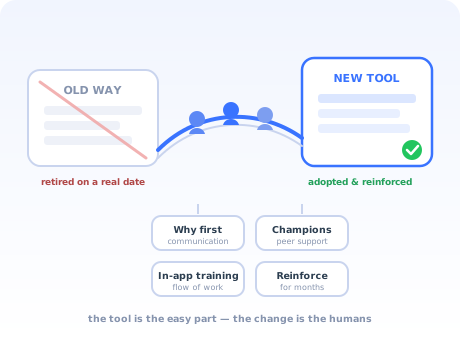
Every organisation has the story. A new system was chosen carefully, bought at real expense, and launched with an all-hands announcement, and a year later, half the team still runs the old spreadsheet in parallel "just in case", the licences renew mostly unused, and the person who championed the purchase has stopped mentioning it in meetings.
Nothing was wrong with the software. What failed was the change: the humans were expected to abandon a way of working that made them competent, in exchange for one that made them beginners again, on the strength of a kickoff email and a training PDF.
Change management is the discipline that prevents that story. This guide keeps it practical and specific to software and digital adoption: why people genuinely resist new tools, what the classic models actually say once the jargon is removed, a seven-step process you can run, and how to measure whether the change stuck.
Key Takeaways
- The tool is the easy part. Software rollouts fail on communication, training and reinforcement, almost never on features.
- Resistance is rational. A new tool resets people's competence to zero and costs them time now for value later. Treat resistance as information, not obstruction.
- Communicate the why before the what. People who understand the reason forgive the friction; people who don't, won't.
- ADKAR is the most useful lens for software: each user needs Awareness, Desire, Knowledge, Ability and Reinforcement, and each can fail independently.
- Train in the flow of work. A one-off training session is forgotten in days; guidance inside the tool arrives exactly when it is needed.
- The launch is the middle, not the end. Reinforcement (measuring, nudging, celebrating, retiring the old tool) is the phase that decides everything.
What is change management? (Definition & meaning)
Definition: Change management is the structured practice of moving people from an old way of working to a new one: preparing them before the change, supporting them through it, and reinforcing it afterwards until the new way becomes simply the way. In a software context it covers everything around the tool: the case for change, the communication, the training, the support, and the follow-through.
The definition earns its keep in what it excludes. Change management is not the project plan for installing the software; that is project management, and it usually goes fine. It is not the announcement, which is one artefact among many. It is the deliberate work on the people side: the recognition that an organisation does not adopt a tool, individuals do, one at a time, each with their own reasons to embrace or quietly ignore it.
That makes change management the umbrella discipline over several things this blog covers in depth: the software rollout plan is its launch machinery, and digital adoption is its finish line, the state where people use the new tools well enough to get the value that justified them.
Why people resist new software (and why they are not wrong)
The least useful model of resistance is "people hate change". People change constantly (jobs, phones, habits) when the trade is worth it. What they resist is a specific, usually rational calculation:
-
The competence reset
An experienced person is fast, confident and respected in the old tool. The new one makes them a beginner in front of their colleagues. That is a real loss, felt immediately, and no feature list compensates for it; only a fast, dignified path back to competence does.
-
The time asymmetry
The costs of switching land this week: learning, migrating, slower work. The benefits land next quarter, mostly on someone else's dashboard. Asking for adoption without acknowledging this asymmetry reads as either naive or dishonest.
-
The missing why
When people are told what is changing but not why, they fill the gap with the worst available theory: cost-cutting, surveillance, some executive's pet project. The vacuum does more damage than any honest reason could.
-
The training gap
Training that happens weeks before go-live is forgotten by go-live. Training that never happens converts the most willing adopters into frustrated ones. Either way, the person concludes the organisation wants the change more than it is willing to support it.
-
The memory of last time
Most organisations have a history of initiatives that launched loudly and faded quietly. Veterans have learned that waiting out a change is often a winning strategy. Every abandoned rollout raises the price of the next one.
Read resistance as data. The person pushing back hardest is often the heaviest user of the old system, which makes them the person with the most to lose, the most knowledge of the edge cases your new tool must handle, and the most credibility with their peers once converted. Recruit them early; do not route around them.
The classic change management models, in plain language
Three models dominate the field. Stripped of consultancy language, each contributes one genuinely useful idea to a software rollout.
| Model | Core idea | What it contributes to a software rollout |
|---|---|---|
| Lewin (3 phases) | Unfreeze the old habit → change → refreeze the new one | The reminder that habits must be actively unfrozen (make the old way visibly ending) and refrozen (retire the old tool, or people drift back) |
| Kotter (8 steps) | Build organisational momentum: urgency, coalition, vision, wins, anchoring | The organisational playbook, especially visible sponsorship and engineered short-term wins that make progress undeniable |
| ADKAR (5 outcomes) | Each individual needs Awareness, Desire, Knowledge, Ability, Reinforcement | The diagnostic: when someone is not adopting, locate which of the five is missing and fix that one, instead of repeating the all-hands announcement |
For software adoption specifically, ADKAR maps most directly onto practice, because its five outcomes correspond to distinct, observable failure modes:
The 7-step change management process for a new tool
- Define the outcome and the honest case for change
- Map who is affected, and how much
- Recruit sponsors and champions
- Communicate the why before the what, repeatedly
- Train in the flow of work
- Launch with support in place and quick wins first
- Reinforce until the new way is the only way
1. Define the outcome and the honest case for change
Not "migrate to the new CRM": that is an activity. The outcome is the working behaviour you need: every deal logged the same day, so forecasts stop being fiction. Then write the case for change in the affected people's terms, including the honest costs. A case that admits "the first two weeks will be slower" buys more trust than one that promises seamlessness nobody believes.
2. Map who is affected, and how much
List every group that touches the change and score the disruption for each: whose daily workflow is rebuilt, whose weekly report moves, who merely gets a new login. This map drives everything after it: the heavily-disrupted groups get champions, hands-on training and early involvement; the lightly-touched ones get a clear announcement and a help link. Uniform treatment wastes effort on one end and under-supports the other.
3. Recruit sponsors and champions
Two different roles, both non-optional. The sponsor is the visible leader who keeps saying the change matters after the kickoff, and who conspicuously uses the new tool themselves, because people believe calendars and behaviour, not memos. Champions are respected peers inside each affected team who get early access, extra training, and a direct line to raise problems. A colleague two desks away answering "how do I…" converts more sceptics than any training programme.
4. Communicate the why before the what, repeatedly
The communication plan is not one announcement; it is a sequence, and it front-loads the reason. Why the change, why now, what happens to the old tool, what is in it for each group, where help lives. Then it repeats, because nobody absorbs a change on first contact. The channel mix matters less than the consistency, and the single most damaging thing a leader can do here is announce the change and then go silent for six weeks while the project team works.
5. Train in the flow of work
The traditional model (a training session weeks before go-live, a slide deck, a PDF) fails on a simple mechanic: people forget instructions they cannot immediately use. The alternative is training in the flow of work: short guidance that appears inside the new tool, at the moment of need. An interactive walkthrough for each core task, an onboarding checklist for the first week, tooltips on the controls people hesitate over. Keep the live sessions for questions and context; move the how-to into the tool itself. Our guide on training employees on new software covers this layer in detail.
6. Launch with support in place and quick wins first
Sequence the launch so the first thing each group does in the new tool is something that visibly works, a task that is easier, faster, or newly possible. Engineered early wins are Kotter's most practical idea: they convert the undecided middle faster than any argument. And staff the launch window properly: floor-walkers, a fast answer channel, champions briefed to be findable. The mechanics of phasing, pilots and go-live belong to the software rollout plan.
7. Reinforce until the new way is the only way
The phase that decides everything, and the one most often skipped. Reinforcement means: measure actual adoption weekly and act on the laggard pockets; keep guidance available for late adopters and new joiners; celebrate teams whose numbers move; and (Lewin's refreeze) retire the old tool on a announced date. As long as the old system remains available, it remains the fallback, and the organisation runs two systems at double the cost. The change is done when the new way survives without anyone pushing it.
How to measure whether the change stuck
Change programmes love ceremony metrics: sessions held, emails sent, completion certificates. Users can sit through all of it and still run the old spreadsheet. Measure behaviour instead:
| Metric | What it tells you | Watch out for |
|---|---|---|
| Adoption rate | Share of intended users actively using the tool | Logins are not usage; count meaningful actions |
| Depth of use | Whether the workflows that justified the purchase are used | A team can "adopt" a suite and use one screen of it |
| Time to proficiency | How fast a new user reaches normal working speed | Rising values as rollout widens = training isn't scaling |
| Support tickets | Where people struggle, in their own words | Silence can mean mastery, or abandonment |
| Old-tool retirement | Whether the fallback is actually gone | The truest single indicator of a finished change |
Pair the numbers with one question. A short in-app survey, "what is still easier the old way?", asked a few weeks after launch, surfaces the residual friction that usage data can only hint at, and tells you exactly what the next round of guidance should fix.
Change management: Do vs. Don't
✅ Do
- Explain why before what, and repeat it
- Acknowledge the real costs of switching honestly
- Recruit the old tool's power users as champions
- Put guidance inside the tool, at the moment of need
- Engineer visible quick wins into the first week
- Measure behaviour weekly and act on laggard pockets
- Retire the old tool on an announced date
- Keep onboarding alive for new joiners and late adopters
❌ Don't
- Treat the kickoff announcement as the communication plan
- Dismiss resistance as stubbornness
- Train everyone weeks before they can touch the tool
- Declare victory at go-live
- Leave the old system running indefinitely "just in case"
- Measure training attendance instead of tool usage
- Let the sponsor vanish after the launch email
- Run the same programme for heavily and lightly affected teams
Where digital adoption tools fit in
Steps 5 and 7 (training in the flow of work, and reinforcement that lasts months) are exactly the steps traditional change programmes struggle to sustain, because they require a human presence that does not scale and does not persist. This is the layer a digital adoption platform automates.
With Kompassify, the change team builds interactive walkthroughs, onboarding checklists, tooltips and announcements on top of the new tool with no code, targets them by team or role, and keeps them running for every late adopter and new joiner indefinitely. The built-in analytics show which teams progressed through the guidance and where people stall, turning the reinforcement phase from anecdote into data. It is free up to 100 monthly active users, GDPR-compliant and hosted in the EU, which matters when the tools you are rolling out carry company data.
Make the New Way the Easy Way
Kompassify layers no-code walkthroughs, checklists and in-app guidance over any web tool you are rolling out, so training happens in the flow of work and reinforcement runs itself. Free up to 100 monthly active users, GDPR-compliant, EU-hosted.
Start for Free →Frequently Asked Questions
What is change management?
Change management is the structured practice of moving people from an old way of working to a new one: preparing them for the change, supporting them through it, and reinforcing it until the new way becomes the normal way. In a software context, it is everything around the tool itself: the communication, training, support and follow-through that determine whether a new system gets used or quietly ignored. The tool is the easy part; the change is the humans.
What are the main change management models?
Three come up constantly. Lewin's model describes change in three phases: unfreeze the old habit, make the change, refreeze the new one. Kotter's 8 steps focus on organisational momentum: create urgency, build a coalition, communicate the vision, generate short-term wins, and anchor the change in culture. ADKAR tracks the individual: Awareness of why, Desire to participate, Knowledge of how, Ability to do it, and Reinforcement to make it stick. For software adoption, ADKAR maps most directly onto what each user needs.
Why do employees resist new software?
Rarely because they are stubborn. The honest reasons: the old tool works and the new one resets their competence to zero; the change costs them time this week for a payoff that lands next quarter; nobody explained why the switch is happening; the training arrived weeks before the tool did, or never; and previous rollouts fizzled, so waiting it out has historically been a winning strategy. Address those five and most resistance evaporates.
What are the steps in a change management process?
A practical seven-step process for software change: define the outcome and the case for change in the audience's terms; map who is affected and how much; recruit visible sponsors and local champions; communicate the why before the what, repeatedly; train in the flow of work rather than in one big session; launch with support in place and quick wins first; and reinforce for months, measuring adoption and celebrating progress until the new way is simply the way.
How does change management relate to digital adoption?
Digital adoption is the goal: people actually using new digital tools well enough to get their value. Change management is the discipline for reaching that goal: the structured work on communication, motivation, training and reinforcement. In practice they meet in the software rollout: change management supplies the plan and the psychology, and digital adoption tools supply in-app guidance that trains and reinforces inside the tool itself, where the habits are formed.
How do you measure change management success?
Measure the behaviour, not the ceremony. Track adoption rate (share of intended users actively using the new tool), depth of use (are they using the workflows that justified the purchase, or just logging in), time to proficiency, support ticket volume and themes, and whether the old tool or workaround is actually retired. Sentiment surveys add colour but usage data decides: a change is managed when the new way of working survives without pushing.
How long does change management take?
Longer than the rollout. The launch is a milestone in the middle of the process, not the end: preparation and communication typically start weeks before go-live, and reinforcement, the phase that decides whether the change sticks, runs for months after it. The common failure pattern is ending the effort at go-live, which produces a spike of forced usage followed by a slow slide back to the old ways. Plan the reinforcement phase with the same seriousness as the launch.