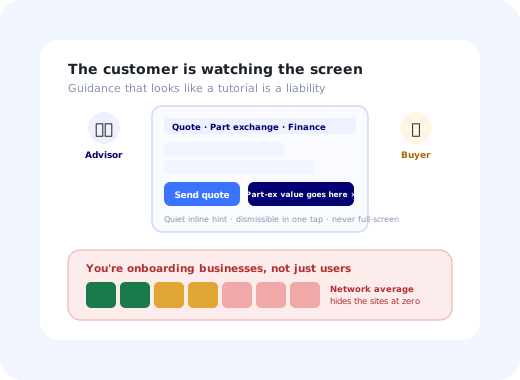
Automotive software onboarding has two properties that do not occur together anywhere else. The first is that your users mostly work for somebody else: a franchised dealer network is a collection of independent businesses that an OEM can incentivise and contractually oblige, but cannot manage. The second is that a large share of the software is used with a customer sitting there: on the showroom floor, at the service desk, mid-handover.
That second point is the one most rollout plans underestimate. A sales advisor who is unsure how to do something in front of a buyer will not explore the interface and will not open help. They will switch to the thing they know works (a paper form, a spreadsheet, the old system, or "I'll email that to you later") because looking incompetent in front of a customer is a worse outcome than any internal process failure. Uncertainty in front of a customer converts into permanent non-adoption faster than almost any other force in enterprise software.
This guide covers automotive software onboarding across dealer management systems, service and workshop software, CRM and OEM platforms: the audiences, why network rollouts stall, a dealer-by-dealer method, and how to measure adoption across businesses you do not control.
Key Takeaways
- You are onboarding businesses, not just users. A franchised network is hundreds of independent operations with their own processes and priorities.
- Customer-facing screens need zero-hesitation design. Any uncertainty in front of a buyer converts straight into non-adoption.
- Sales turnover is structural. In showroom roles, onboarding that runs once covers a workforce that will substantially have changed within the year.
- The dealer principal is the gatekeeper. If they see it as an OEM reporting exercise rather than a way to sell more, the site will comply and not adopt.
- Service and sales are different rollouts. The workshop is deskless and time-pressured; the showroom is customer-facing and relationship-driven.
- Measure per dealer, never per network. A network average hides the fact that a third of sites never started.
What Automotive Software Onboarding Covers
| System | Primary users | The onboarding problem |
|---|---|---|
| DMS, dealer management | Sales, service, parts, accounts | Runs the whole business; replacing it touches every role at once. |
| Sales CRM & configurators | Sales advisors, business managers | Used in front of the customer. Hesitation is fatal. |
| Service & workshop systems | Service advisors, technicians | Deskless, on tablets, hands dirty, measured on throughput. |
| Parts & inventory | Parts advisors | High-frequency lookups where speed beats every other consideration. |
| OEM portals & programmes | Dealer principals, managers, aftersales | Perceived as reporting for the manufacturer, not a tool for the dealer. |
| Connected-vehicle & telematics | Aftersales, fleet customers | Value is real but indirect: classic feature adoption problem. |
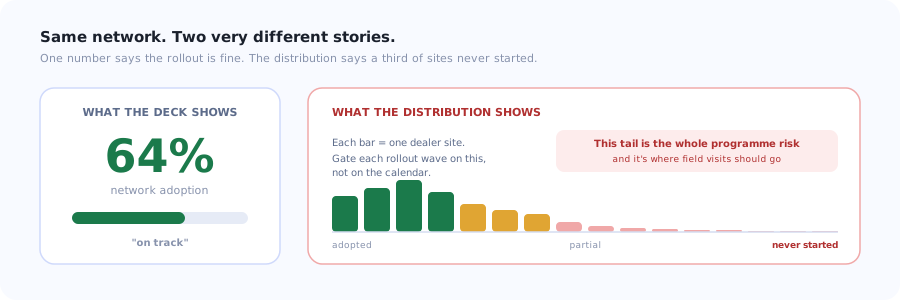
The network average is the most misleading number in an automotive rollout; it averages sites that adopted with sites that never started.
Why Network Rollouts Stall
The dealer is an independent business with its own priorities
A dealer group has margin targets, its own processes, often its own preferred systems, and a manufacturer relationship that is commercial rather than hierarchical. "Head office says so" produces compliance (a login, a token amount of data) and compliance looks like adoption on a dashboard while changing nothing about how the business runs.
Hesitation in front of a customer is unacceptable
This is the constraint that distinguishes automotive from most B2B software. A sales advisor mid-negotiation, or a service advisor with a queue at the desk, cannot afford ten seconds of visible uncertainty. If a screen is at all ambiguous, they will not learn it there; they will revert to what they know and complete the task afterwards, or not at all.
Showroom turnover outruns the training programme
Sales roles turn over quickly enough that a launch-event training programme covers a population that will have substantially changed within a year. Whoever arrives after the launch gets whatever is built into the software, which in most rollouts is nothing, so adoption decays steadily and looks like a motivation problem rather than a design one.
The workshop and the showroom were treated as one audience
A technician on a tablet with dirty hands, between jobs, measured on hours sold, has almost nothing in common with a sales advisor at a desk with a customer. One onboarding path for both fits neither, and the workshop is usually the half that gets neglected, despite aftersales being where much of the margin lives.
It looks like it is for the manufacturer
If the first thing a new system asks a dealer to do is enter data that primarily benefits OEM reporting, the framing is set and hard to reverse. Dealers adopt tools that help them sell cars, book workshop hours or retain customers. Lead with the dealer's own benefit or expect permanent minimum-effort compliance.
The Four Audiences
1. Sales advisors
Customer-facing, target-driven, high turnover, and using the software while someone watches. Their onboarding must produce genuine fluency in a small number of screens (quote, configure, part exchange, finance, handover) rather than broad familiarity with many. Guidance has to be available in the moment and discreet enough to use with a customer present, which in practice means short in-screen prompts rather than anything that visibly announces "the advisor is reading instructions".
2. Service advisors and technicians
The deskless half of the dealership. Service advisors work a queue at a counter; technicians work on tablets in a workshop, often sharing devices, frequently with gloves on. Their onboarding belongs on the device, at the moment of the job: check-in, job card, upsell recommendation, sign-off. Aftersales is where a large share of dealer profitability sits, and it is routinely the part of a rollout with the least attention.
3. Dealer principals and department managers
The gatekeepers. They decide whether the system becomes "how we work here" or "the thing we do for the manufacturer". They need to see their own site's numbers early, and to understand the commercial case in their own terms: leads converted, hours sold, retention. A principal who has found something useful in their own data will drive adoption harder than any network mandate.
4. OEM field teams and network managers
The people who own the rollout across sites they do not control. What they need is per-dealer adoption data rather than a network average, so they can spend their limited visit time on the sites that have not started rather than the ones already succeeding. This is genuinely the highest-leverage reporting decision in an automotive programme.
A Seven-Step Method for a Dealer Network
1. Start with a small group of representative dealers
Not the best-performing sites, and not only the largest groups. Pick a mix (a large group, an independent single-site franchise, an urban and a rural site) because the objections differ and you want them all early. Five to eight sites for six to eight weeks gives you real variation without a network-wide blast radius.
2. Lead with something that helps the dealer sell or service
The first capability a dealer meets sets the framing permanently. Faster quoting, a workshop upsell that is easy to present, a retention prompt that brings a customer back. Anything that primarily serves manufacturer reporting should arrive later, once the tool has established itself as useful locally.
3. Design customer-facing screens for zero hesitation
For every screen used in front of a customer, the target is that a new advisor can complete the task without pausing. That means the frequent path is obvious, the vocabulary matches what advisors actually say, and any guidance is brief and unobtrusive. This is interaction friction with an audience: the cost of a moment's confusion is much higher than usual, so the bar is higher too.
4. Split sales and aftersales into separate paths
Different first tasks, different vocabulary, different devices, different guidance. It is the same role-based approach that any multi-persona product needs, and skipping it is why workshop adoption so often lags a year behind the showroom.
5. Put the training inside the software
Given turnover and the impossibility of scheduling network-wide training, in-app guidance is the only delivery mechanism that reaches everyone. Short walkthroughs on first use of each key screen, tooltips on the fields that get filled in wrongly, and a help launcher for "how do I". This is what a new advisor starting in month nine receives, and it is what keeps the network from decaying.
6. Brief dealer principals with their own site's numbers
Not network benchmarks in the abstract: their site, their conversion, their workshop hours, compared with the pilot sites. A principal who can see something actionable becomes an advocate; one shown a network average learns nothing and stays neutral.
7. Roll out in waves, with per-dealer adoption gating each wave
Add sites in groups, and before each wave check that the previous one actually adopted, per dealer, not on average. A network rollout that advances on schedule regardless of adoption ends with hundreds of sites nominally live and a quarter of them never having started, which is much harder to fix retrospectively than to prevent.
Designing for Use in Front of a Customer
This deserves its own section because it inverts several normal onboarding instincts. Ordinarily you want guidance to be prominent and to encourage exploration. On a customer-facing screen, prominence is a liability.
✅ Works in front of a customer
- Short, quiet inline hints that do not read as a tutorial.
- A single obvious primary action per screen.
- Vocabulary matching what advisors say out loud to buyers.
- Guidance the advisor can dismiss instantly and without ceremony.
- Practice on real-but-safe data before the first live use.
- An always-available help launcher for use between customers.
❌ Does not
- Full-screen modal tours that obviously announce a training moment.
- Multi-step wizards launched automatically at an unpredictable time.
- Anything requiring reading a paragraph mid-conversation.
- Celebratory animations and confetti on a shared showroom screen.
- Guidance that cannot be dismissed in one tap.
- Video with sound, ever.
The showroom test. Before shipping a customer-facing flow, have someone who has never used it complete the task while a colleague plays the customer and watches the screen. If they pause visibly, or apologise, or say "bear with me", the flow is not ready, and no amount of training will fix it, because the failure happens in a situation where nobody consults training.
Measuring Adoption Across a Network
| Metric | What it tells you | Warning sign |
|---|---|---|
| Adoption by dealer | Distribution across sites, not an average. | A long tail of sites at or near zero. |
| Sales vs aftersales split | Whether the workshop was actually included. | Service far behind sales: usually a neglected path, not reluctance. |
| Live-use rate on customer-facing screens | Whether the task is done with the customer or afterwards. | Entries clustered after hours: advisors are avoiding it in the moment. |
| Time to productive for new advisors | Whether onboarding survived the launch period. | Rising over successive cohorts. |
| Depth beyond the mandated minimum | Compliance versus genuine adoption. | Usage that stops precisely at the required fields. |
| Workaround persistence | Spreadsheets and old systems still in use per site. | Any meaningful volume after the site's cutover. |
The two most revealing entries are the last two. Usage that stops exactly at the mandated minimum is the signature of a dealer doing what the contract requires and nothing more, worth knowing early, because it is a framing problem that gets harder to reverse with time. And a cluster of entries made after the showroom closed tells you advisors are avoiding the software in front of customers, which is a design finding disguised as an adoption statistic. General approaches are covered in measuring digital adoption.
The In-Product Guidance Layer
Discreet first-use guidance on customer-facing screens
Three or four quiet inline steps, dismissible in one tap, that never look like a tutorial to somebody sitting opposite. The aim is fluency on the frequent path, not coverage.
Workshop guidance on the tablet
Large targets, high contrast, short steps at the moment of the job card. Triggered by task and context rather than user identity, since workshop tablets are usually shared.
A first-week checklist per role
What "using this properly" means for a new sales advisor or service advisor, visible and progressive. In a high-turnover environment this is the artefact that most reliably shortens time to productive; the pattern is covered in building an onboarding checklist.
A help launcher for between customers
Short answers for the current screen, usable in the two minutes between appointments. It replaces "ask the manager", and it works at sites the field team visits twice a year. See in-app support.
Reach every site without visiting every site
Kompassify adds walkthroughs, tooltips, checklists and announcements to your DMS, dealer CRM, workshop system or OEM portal without changing its code, so a new advisor at any site gets the same guided first experience, months after the launch programme ended. Paths can differ by role and by dealer group, and adoption is reported per site rather than as a network average. GDPR compliant, EU-hosted, free up to 100 monthly active users and from $129/mo after that.
Start for Free →A Realistic Network Rollout
- Weeks 1–3: spend time at three or four sites. Watch a sale and a service check-in end to end; list every point where an advisor hesitates in front of a customer.
- Weeks 4–6: fix the customer-facing screens and build separate sales and aftersales guidance paths.
- Week 7: brief the pilot dealer principals with their own site's numbers and the commercial case in their terms.
- Weeks 8–13: pilot five to eight representative sites. Include an independent single-site franchise, not only large groups.
- Week 14: instrument and fix. Tooltips onto the worst fields; check the sales/aftersales split and the after-hours entry pattern.
- Weeks 15+: roll out in waves, gating each wave on per-dealer adoption rather than on the schedule.
- Per site, on an agreed date: retire the workaround, once the system is genuinely faster for the frequent tasks.
The mistake that defines failed network rollouts: advancing waves on the calendar rather than on adoption. It ends with the whole network nominally live, a healthy-looking average, and a quarter of sites that never genuinely started, and retrofitting adoption at a dealer that has already decided the system is an OEM reporting chore is far harder than earning it the first time.
Frequently Asked Questions
What is automotive software onboarding?
It is the process of getting the people across a dealer network (sales advisors, service advisors, technicians, parts staff and managers) to actually work in systems such as a dealer management system, sales CRM, workshop software or an OEM portal, rather than around them. It differs from ordinary enterprise onboarding in two ways: franchised dealers are independent businesses that a manufacturer can incentivise but not manage, and much of the software is used in front of a customer, which changes what kind of guidance is usable at all.
Why do dealer network software rollouts fail?
Most often because dealers comply rather than adopt. A franchised dealer is an independent business with its own margin targets and processes, so a mandate produces a login and a minimum amount of data while nothing about how the business runs actually changes. The other recurring causes are hesitation in front of customers driving advisors back to familiar workarounds, showroom turnover outpacing a one-time training programme, treating the workshop and the showroom as a single audience, and leading with data entry that visibly serves manufacturer reporting rather than the dealer.
How do you design software onboarding for screens used in front of a customer?
Invert the usual instincts. Prominent guidance that encourages exploration is a liability when a buyer is watching, because it visibly announces that the advisor is reading instructions. Use short, quiet inline hints that can be dismissed in one tap, a single obvious primary action per screen, and vocabulary matching what advisors actually say out loud. Avoid full-screen modal tours, auto-launching wizards, celebratory animations on a shared showroom screen, and video with sound. Save anything longer for the help launcher used between customers.
Why should you measure adoption per dealer rather than across the network?
Because a network average is generated by combining sites that adopted enthusiastically with sites that never started, and it reports a comfortable middle that describes neither. The distribution is what matters: a long tail of sites at or near zero is the actual state of the programme, and it is also the guide for where field teams should spend their limited visit time. Reporting per dealer is probably the highest-leverage single decision in an automotive rollout, because it turns a vague average into a specific list of sites to help.
How do you onboard workshop technicians and service advisors?
Treat aftersales as a separate rollout from sales, because almost nothing transfers. Technicians work on shared tablets, often with gloves, between jobs, and are measured on hours sold; service advisors work a queue at a counter. Guidance belongs on the device at the moment of the job (check-in, job card, upsell recommendation, sign-off) with large touch targets, high contrast and short steps, triggered by task and context rather than user identity since the tablets are shared. Aftersales carries a large share of dealer profitability and is routinely the neglected half of a rollout.
How do you get dealer principals to support a new system?
Show them their own site's numbers, in their own commercial terms (leads converted, workshop hours sold, customer retention) rather than network benchmarks in the abstract. The dealer principal decides informally whether the system becomes how the site works or a chore done for the manufacturer, and that framing is set early and is hard to reverse. A principal who finds something genuinely actionable in their own data will drive adoption at that site harder than any network mandate can.
How do you handle high staff turnover in dealership onboarding?
Build the onboarding into the software rather than delivering it as an event. Showroom roles turn over quickly enough that a launch training programme covers a workforce that will have substantially changed within a year, and everyone arriving afterwards gets whatever is in the product, usually nothing. In-app walkthroughs on first use of each key screen, tooltips on the fields people fill in wrongly, a role-specific first-week checklist and a persistent help launcher mean an advisor starting in month nine receives the same guided experience as the pilot group.
Should an OEM roll out to the whole network at once?
No, roll out in waves, and gate each wave on per-dealer adoption of the previous one rather than on the calendar. Start with five to eight deliberately varied pilot sites: a large group, an independent single-site franchise, an urban and a rural location, because the objections differ and you want all of them early. A rollout that advances on schedule regardless of adoption ends with the network nominally live and a quarter of sites that never started, which is much harder to fix retrospectively than to prevent.