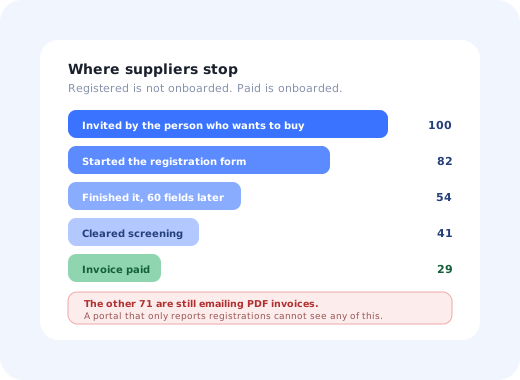
Somebody in operations found a supplier they want to buy from. Nine weeks later the purchase still has not happened, the supplier has emailed twice asking what is going on, and the buyer has quietly put the order on a company card because waiting was not an option.
That is the ordinary failure mode of supplier onboarding, and it is not usually caused by the controls. It is caused by a process designed department by department, delivered through a form nobody owns, to a person who has no obligation to persevere and often no idea where in the queue they are.
This guide is about the supplier's side of that process: the five stages, where they actually break, how to stage a long form without removing a single check, and which metrics distinguish a portal that works from one that merely has registrations in it.
Key Takeaways
- Registered is not onboarded. The completion event is a first invoice paid straight through, not a form submitted.
- Sixty fields is an ownership problem, not a compliance one. Four departments each added theirs; nobody owns the whole.
- Stage the requests instead of cutting them: identity, then qualification, then payment details, each unlocking something visible.
- Keep friction in exactly one place: bank details, and any later change to them, verified out of band.
- Status transparency removes most of the support load. Suppliers email because the portal will not tell them anything.
- Measure spend through the portal, not registrations; purchasing by email is invisible to every other metric.
What Supplier Onboarding Is
Supplier onboarding: definition
Supplier onboarding is the process of taking a new vendor from the moment someone inside your organisation wants to buy from them to the point where they can be ordered from, invoiced by and paid reliably through your own systems. It covers company and tax data collection, identity and bank verification, risk, compliance and insurance checks, creation in the finance system, and enablement on the ordering and invoicing channel.
The word "onboarding" is doing two jobs there, and separating them helps. There is a compliance process, checks the organisation must complete before money can move, and a product problem: a portal that an outsider has to use successfully with no training and no support. Most organisations invest heavily in the first and treat the second as a form. The delays, the workarounds and the support volume all come from the second.
Not to be confused with marketplace seller onboarding. The incentives are reversed: a marketplace seller is joining to reach demand they do not yet have, so the platform holds the leverage and the hard problem is liquidity. A supplier already has the customer: someone has decided to buy from them, so the leverage sits with the supplier and the buying organisation absorbs the cost of every abandonment. If you are building the two-sided kind, see marketplace onboarding instead; almost none of the persuasion advice there applies here.
The Five Stages of the Supplier Onboarding Process
| Stage | What happens | Who owns it internally | Where it breaks |
|---|---|---|---|
| 1. Request & sponsorship | An internal buyer identifies the supplier; someone becomes accountable for getting them live. | The requesting business unit. | No named sponsor, so the supplier has nobody to chase and nobody chases them. |
| 2. Registration | Company details, contacts, tax identifiers, category and basic commercial information. | Procurement. | Everything asked at once, before the supplier knows what completion gets them. |
| 3. Verification & qualification | Identity and bank verification, sanctions and risk screening, insurance, policy attestations. | Risk, legal, compliance. | Silent waiting. Suppliers cannot see the queue, so they email, or give up. |
| 4. Enablement | Creation in the finance system, portal account, catalogue or e-invoicing channel set up. | Accounts payable and IT. | Technically complete, practically unused: the supplier never learns the invoice format. |
| 5. First transaction | A purchase order is raised, an invoice submitted correctly, a payment made. | Nobody, usually. | The first invoice is rejected on a format error and the supplier reverts to email permanently. |
The fifth row is the one that matters and the one nobody owns. An onboarding that ends at stage four produces a supplier record, a portal login and no change in how business is actually done, the procurement equivalent of an onboarding funnel that celebrates signups and ignores activation.
Why Suppliers Abandon the Portal
The form has four authors and no editor
Procurement needs category and commercial data. Finance needs tax and banking. Legal needs the code of conduct accepted. Risk needs insurance certificates, security questionnaires and increasingly sustainability reporting. Each set is individually justified. Nobody is responsible for the total, and the total is what the supplier experiences.
The person filling it in is not a procurement professional
For a large vendor, a dedicated bid team completes your form on a Tuesday. For the small specialist supplier your engineers actually wanted, it is one person who also does the invoicing and the deliveries, working through it at nine in the evening without the insurance certificate to hand. Save-and-resume is not a nicety for that person; without it the form cannot be completed at all.
Yours is not the only portal they are onboarding onto
A supplier serving thirty corporate customers is completing thirty variations of the same information, on thirty different portals, each with its own login and its own idea of what a company registration number looks like. Nothing about that makes them enthusiastic, and it puts a hard ceiling on how much attention any single buyer can expect.
Nothing tells them where they are
Between submission and approval there is often silence for weeks. Silence generates email, email generates support load, and support load is the cost the portal was bought to remove. A visible status (what stage, who is waiting on what, what happens next) removes a large share of it for very little work.
The requests arrive out of order
Asking for bank details and an insurance certificate before anyone has checked whether the supplier passes screening wastes the supplier's effort and creates data you now have to protect. Sequence matters as much as volume, the same objection that progressive profiling answers in a signup flow.
How to Stage a Sixty-Field Form Without Removing a Control
The instinct when a form abandons is to delete fields, and in a regulated procurement process most of them cannot be deleted. The alternative is to change when each one is asked and what the supplier gets for answering it.
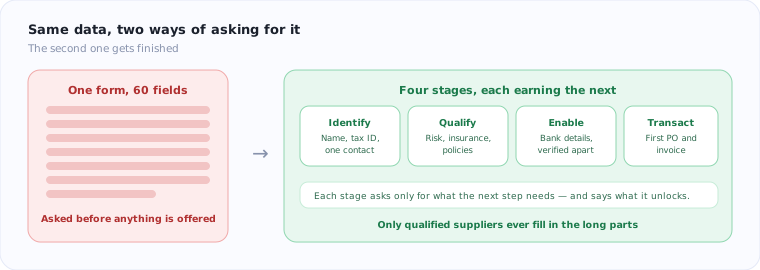
Same data, same controls, asked in four stages, each of which unlocks something the supplier can see.
1. Identify: the shortest possible first step
Legal name, registration or tax number, country, one contact. Enough to check the supplier is who they say they are and is not already in your system under a slightly different name, which is a surprisingly large share of the duplicate records in most vendor masters.
2. Qualify: only for suppliers who passed step one
Risk questionnaires, insurance, certifications, policy attestations. This is the long section, and staging it means only suppliers who will actually be used ever complete it. It also means a rejection costs the supplier ten minutes rather than two hours, which is worth something for the ones you will want to approach again.
3. Enable: payment details, deliberately last and deliberately careful
Bank details are the one place where friction is correct. Invoice-redirection fraud typically arrives as a plausible request to update payment details, so verification out of band (a call to a number you already hold, not one supplied in the request) belongs here permanently, for the initial entry and every subsequent change. Do not let a programme to streamline onboarding quietly streamline this.
4. Transact: treat the first invoice as part of onboarding
The first invoice is where the format errors happen and where the supplier decides whether the portal is worth it. Guide it: show the required fields on the submission screen, validate before submission rather than rejecting three days later, and confirm what happens next. A rejected first invoice with an unclear reason is the single most reliable way to lose a supplier back to email permanently.
Staging is not the same as hiding. Tell the supplier upfront that there are four stages, roughly what each involves and how long approval usually takes. A short first step that turns out to be the first of many undisclosed ones is worse than the long form; it feels like being drawn in, and it is the fastest way to lose the goodwill you gained.
Portal Patterns That Cut Supplier Support Load
-
Show status without being asked
Which stage, who is waiting, typical duration. Most supplier emails are status requests, and a status page answers them all at once.
-
Let different people complete different sections
Insurance sits with one person, banking with another, the security questionnaire with a third. A single-login form forces one person to collect everything by email first.
-
Save and resume, always
Nobody finishes a supplier registration in one sitting. A form that loses progress is a form that produces phone calls.
-
Speak the supplier's language and format
Tax identifiers, address formats and date conventions differ by country. See multi-language onboarding; for an international supplier base this is a completion-rate issue, not a courtesy.
-
Answer the question on the field that raised it
"Which registration number do you mean?" is a tooltip, not a support ticket. An in-app support layer on the portal deflects most of the recurring ones.
-
Complete your own form as an outsider
With no internal knowledge, no shortcuts and a browser you have never logged into. Every hesitation is a supplier delay; the happy path your team walks is not the one suppliers get.
Guide suppliers through the portal you already have
Kompassify adds contextual guidance, checklists and in-app help on top of an existing supplier portal, explaining the field that causes half your tickets, walking a first invoice submission, and showing per-step completion so you can see exactly where suppliers stop. No engineering, and no release cycle when the process changes. GDPR compliant, EU-hosted, free up to 100 monthly active users and from $129/mo after that.
Start for Free →The Metrics That Show It Is Working
Split by supplier size. A sole trader and a global vendor have nothing in common and averaging them hides both.
Every supplier who needs a human costs real money. This number, not registrations, is what a portal is bought to move.
The only metric that catches purchasing quietly continuing by email around a perfectly healthy-looking system.
Two more are worth reporting: completion rate per section, which turns "suppliers abandon" into "suppliers abandon at the insurance upload", and first-time invoice match rate, which tells you whether enablement produced a working channel or just an account. Reading section-level drop-off is the same discipline as reading user friction in any signup flow, and the fixes are usually the same size: a clearer label, an example, a format hint, a save button.
Supplier Onboarding: Do vs. Don't
✅ Do
- Name one owner for the supplier's end-to-end experience.
- Stage requests so unqualified suppliers never fill the long sections.
- Say upfront how many stages there are and how long approval takes.
- Pre-fill from public company registries wherever you can.
- Verify bank details and every later change out of band.
- Treat the first invoice submission as part of onboarding.
❌ Don't
- Let each department bolt its fields onto one form.
- Ask for banking and insurance before screening has passed.
- Leave suppliers with no visible status for weeks.
- Require one login to complete sections owned by four people.
- Report registrations as if they were adoption.
- Streamline the bank-detail check because it slows things down.
The One-Sentence Version
Supplier onboarding is not a compliance form, it is a product an outsider has to use successfully with no training, and it is complete when the first invoice is paid straight through, which is a different and much later event than the one most vendor portals are reporting on.
Frequently Asked Questions
What is supplier onboarding?
Supplier onboarding is the process of taking a new vendor from the moment someone inside your organisation wants to buy from them to the point where they can be ordered from, invoiced by and paid, reliably and through your own systems. It normally covers collecting company and tax details, verifying identity and bank information, running risk, compliance and insurance checks, setting the supplier up in the finance system, and enabling them on whatever portal or e-invoicing channel you use. It is finished when the first invoice is paid without anyone intervening manually, not when the registration form is submitted.
What are the stages of the supplier onboarding process?
Five, in practice. Request and sponsorship, where an internal buyer identifies the supplier and someone becomes accountable for getting them live. Registration, where the supplier provides company, contact and tax information. Verification and qualification, covering identity, bank details, sanctions and risk screening, insurance and any policy attestations. Enablement, where the supplier is created in the finance system and connected to the ordering and invoicing channel. And first transaction: a purchase order raised, an invoice submitted correctly, and a payment made. Most portals measure the second stage and assume the rest.
Why do suppliers abandon vendor registration portals?
Usually because the form asks for everything at once, before the supplier has been told what they get for finishing it. A registration form is typically assembled by four departments: procurement, finance, legal and risk, each adding their fields, and nobody owns the resulting experience. Add that the person filling it in is often a one-person business who does not have the insurance certificate to hand, that the same supplier may be onboarding onto a dozen different buyer portals, and that the form usually cannot be saved and resumed, and abandonment is the rational response rather than a motivation problem.
How is supplier onboarding different from marketplace seller onboarding?
The incentive structure is inverted. A marketplace seller is joining to reach demand they do not have, so the marketplace holds the leverage and the problem is liquidity: getting enough supply and demand live at once. A supplier is being asked to complete a compliance process by a customer who has already decided to buy from them, so the supplier has the revenue motivation but no reason to enjoy the portal, and the buyer bears the cost of every abandonment in delayed purchasing and manual workarounds. The design implication is that supplier onboarding must be short and clearly justified rather than persuasive.
How do you speed up supplier onboarding without weakening controls?
Stage the requests instead of removing them. Ask only for what the next decision needs: identity first, then qualification, then payment details, so a supplier who will not pass screening never fills in the long sections, and a supplier who will passes quickly. Pre-fill anything available from public company registries, allow save and resume, let different people at the supplier complete different sections, and show progress and status so nobody has to email to ask. The one place to keep friction deliberately is bank-detail entry and any later change to it, which should always be verified out of band.
What metrics should you track for supplier onboarding?
Cycle time from invitation to first paid invoice, split by supplier size, since a large enterprise vendor and a sole trader behave nothing alike. Then completion rate per form section rather than overall, which locates the abandonment; the proportion of suppliers who complete without contacting your team, which is the real cost driver; first-time invoice match rate, which shows whether enablement actually worked; and the share of spend flowing through the portal rather than around it. Registration counts alone will look healthy while purchasing carries on by email.
Who should own supplier onboarding?
One named owner for the supplier's end-to-end experience, whatever their department. The common failure is that procurement owns the policy, accounts payable owns the payment, legal owns the terms, risk owns the screening and IT owns the portal, so every team owns a section of the form and nobody owns whether a supplier can get through it. Splitting the process by internal department is exactly how you end up with sixty fields, three separate emails and no visible status.
How do you get suppliers to actually use the portal instead of emailing invoices?
Make the portal route faster for the supplier and eventually make it the only route, in that order. Suppliers care about being paid on time, so the arguments that work are visible invoice status and predictable payment dates rather than your efficiency. Guide the first invoice submission inside the portal itself, because the first one is where the format errors happen and where suppliers decide it is easier to go back to email. Then close the email channel for onboarded suppliers deliberately, once the portal genuinely works for them.