Two people with the same job title, at two companies of similar size, can have almost nothing in common. One spends the week in scheduled calls with fifteen large accounts. The other owns nine hundred accounts they will never speak to and works entirely through in-product programmes. Both are customer success managers. Both are doing the job correctly.
What holds the title together is not the activity but the accountability: a CSM exists to make sure customers who already bought the product actually get the outcome they bought it for, and, because of that, renew. Everything else in the role is a means to that end, and which means make sense depends almost entirely on segment.
This guide covers what the role is really accountable for, how it differs from the three jobs it gets confused with, the five recurring jobs that fill a real week, how the work changes across segments and in product-led companies, the skills that matter, what to measure, and how to hire and ramp one.
Key Takeaways
- The accountability is the outcome, not the relationship. Meetings are a tactic, and often the wrong one.
- Proactive is the defining word. A CSM who only answers incoming requests is doing support under a different title.
- Segment decides the job. Enterprise CSM work and tech-touch CSM work share a goal and almost no daily practice.
- The highest-value conversation is the uncomfortable one, told early, while there is still time to change how the customer works.
- Measure outcomes, watch activity. Meetings held and emails sent rise with busyness, not with results.
- Leverage comes from the product. Anything a CSM explains repeatedly should stop being a conversation and start being in-app guidance.
What Is a Customer Success Manager?
Customer success manager (CSM): definition
A customer success manager is the person accountable for existing customers reaching the outcome they bought the software for, and for retaining and growing those customers as a consequence. The role is proactive by definition: a CSM is expected to notice that an account is drifting and intervene before the customer complains, rather than to respond well once they do.
That word, proactive, is the whole distinction, and it is also the first thing to go when a team is under-resourced. A CSM covering three times the accounts they can serve will spend every hour on whoever emailed most recently, which is a reactive queue with a proactive job description attached to it. If that describes your team, the fix is not better prioritisation; it is either fewer accounts per person or a different service model for the tail, which is the subject of digital customer success.
CSM vs Account Manager vs Support vs Onboarding Specialist
Four roles touch the customer after the sale, and companies combine them in different ways. Confusion here is expensive: it produces accounts that everyone assumed someone else was watching.
| Role | Accountable for | Triggered by | Judged on |
|---|---|---|---|
| Customer success manager | The customer reaching their outcome, across the whole relationship | Signals: adoption, health, milestones, risk | Retention, expansion, adoption across the book |
| Account manager | The commercial relationship: renewal and expansion | The contract calendar | Bookings, renewal rate, quota |
| Support | Resolving problems the customer reports | An incoming request | Resolution time, quality, CSAT |
| Onboarding specialist | Getting a new customer live and productive | A closed deal | Time to onboard, activation, handover quality |
The two boundaries worth being deliberate about are the commercial one and the onboarding one. Giving a CSM a quota is defensible when they can genuinely influence the product experience; it becomes counter-productive when it does not, because the incentive points at the renewal conversation while the churn is happening quietly in the interface. And the onboarding split is usually worth making as soon as volume allows, since onboarding rewards repeatable process while ongoing success rewards judgement; the role itself is covered in onboarding specialist.
What the Job Actually Involves
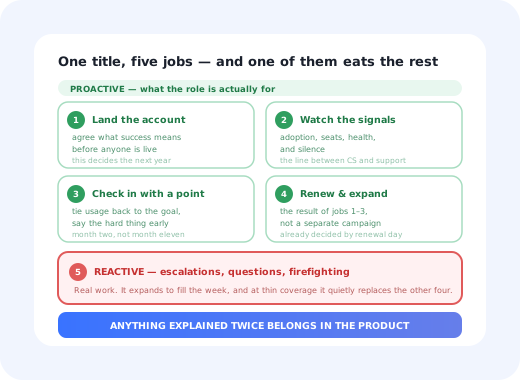
Strip away the variation and five recurring jobs fill a CSM's week. The ratio between them is what changes by segment; the list does not.
The five jobs of a CSM week, and the one that eats the others when coverage is thin.
How the Role Changes by Segment
This is the variation that makes job descriptions across companies incomparable. The same title covers three quite different professions.
Few accounts, many stakeholders each. The work is political as much as practical: mapping who cares about what, keeping a sponsor, surviving the reorganisation that removes them. Depth over process.
Dozens of accounts. The balancing act between judgement and repeatability. Playbooks matter here more than anywhere: without them the CSM defaults to whoever emailed last.
Hundreds or thousands of accounts served mainly through the product. The CSM designs programmes rather than holding meetings, and their unit of work is a segment, not an account.
No named owner; a team responds to signals and requests across the whole base. Efficient, and dependent on the signal quality: a pooled model with bad health data is just a queue.
Coverage ratios only make sense inside one of these models, which is why "how many accounts should a CSM have" has no portable answer. The better question is how many hours of real attention each account needs, and whether the ratio leaves any room for the proactive four jobs. When it does not, the honest options are to reduce the book, narrow the promise, or move part of the service into the product.
How the Role Changes in a Product-Led Company
When users adopt the product before anyone talks to them, the CSM's entry point moves. Instead of picking up a signed account and starting from zero, they arrive at an account that already has usage, habits and, often, an internal champion nobody has spoken to.
Three parts of the job change. Targeting becomes a data problem: the CSM works from usage signals that say an account is ready for a conversation, rather than from a contract list, which is essentially the product qualified lead model applied to existing customers. The conversation changes shape, because the customer already knows the product and wants help with their use case rather than a demo. And the leverage moves into the product: the fastest way for a tech-touch CSM to improve adoption across a segment is not a webinar but a well-placed in-app programme that reaches every account at once. The broader model is in product-led growth.
The Skills That Separate Strong CSMs
Job listings ask for communication and empathy, which are table stakes and impossible to assess from a CV. Four capabilities actually distinguish performance.
-
Product fluency deep enough to redesign a workflow
Not "can answer questions about features" but "can look at how this customer works and propose a different way to do it using the product". This is the capability that turns a check-in into something the customer would pay for.
-
Business literacy in the customer's terms
Understanding what the customer's organisation is trying to achieve, who is judged on it, and how your product connects to that. Without it, every conversation stays at the level of feature requests.
-
Prioritisation under permanent scarcity
Every CSM has more accounts than hours. Results are decided by the ranking, and a good CSM can explain why they are not working on an account this week, which requires trusting the signals. See customer health score.
-
Saying the uncomfortable thing early
"The way your team is using this will not get you the result you described." That sentence, delivered in month two, is the highest-value conversation in the job. Delivered at renewal, it is an autopsy.
A useful interview question: "Tell me about a customer you told they were doing it wrong." Strong candidates have several examples and remember the specifics of how they framed it. Candidates who have never had that conversation have usually been doing reactive support, whatever the title said.
What a CSM Should Be Measured On
The outcome measures are the obvious ones: net revenue retention, gross retention and expansion within the book. They are correct to report and useless to manage with week to week, because they move long after the behaviour that caused them. Pair them with two or three leading indicators the CSM can actually influence this month: activation and time to value for new accounts, adoption breadth across the book, active seat ratio, and the share of accounts with an agreed, documented success plan.
Activity counts belong on the dashboard as a sanity check and nowhere near the performance review. A CSM optimising for meetings held will hold meetings, including the ones nobody needed. The full four-layer picture (which numbers describe the result, which predict it, and which merely describe the team) is in customer success metrics, and the structure the success plan itself should take is in customer success plans.
Hiring and Ramping a CSM: 5 Steps
- Write the job description for the segment, not the title
- Test product fluency before anything else
- Interview for the uncomfortable conversation
- Ramp on real accounts with a named safety net
- Decide what they own by day 90, and what they do not
1. Write the job description for the segment, not the title
"Customer success manager" tells a candidate nothing. Name the segment, the approximate book size, the service model and whether a quota is attached. The single biggest source of early attrition in this role is a candidate hired for a relationship job who arrives to find a ticket queue.
2. Test product fluency before anything else
Give candidates access, a realistic scenario and thirty minutes, then ask them to walk through how they would set it up and what they would tell the customer to do differently. This one exercise predicts performance better than any behavioural interview, and it is impossible to fake.
3. Interview for the uncomfortable conversation
Ask for the story of a customer they disagreed with, a renewal they lost and why, a time they told somebody internally that a promise should not have been made. You are testing whether they will raise a problem while it is still small.
4. Ramp on real accounts with a named safety net
Shadowing has a short useful life. Give a new CSM a small set of real accounts in week two, with a named person who reviews their plans rather than rescuing them. Ramp is faster when the accounts are genuinely theirs and mistakes are survivable.
5. Decide what they own by day 90, and what they do not
Write it down: which accounts, which decisions they can make alone, what they escalate, whether they carry commercial responsibility. Most of the friction between CS, sales and support in the first quarter comes from this document not existing.
Customer Success Manager: Do vs. Don't
Do
- Define the role by segment and service model
- Give CSMs signals they trust, then let them prioritise
- Agree what success means with each account, in writing
- Raise the uncomfortable observation in month two
- Move anything explained twice into the product
- Measure outcomes; watch activity without rewarding it
Don't
- Staff a proactive job description at reactive ratios
- Attach a quota where the CSM cannot influence the experience
- Treat the renewal conversation as where retention is won
- Judge a CSM on meetings held or emails sent
- Leave the long tail with a named owner who never contacts it
- Copy another company's coverage ratio without its service model
The Leverage a CSM Cannot Get From Meetings
Every CSM has a short list of things they explain over and over: the setting everyone misses, the second feature nobody discovers, the reason a step behaves the way it does. Each explanation is twenty minutes and reaches one account. There are only so many twenty-minute blocks in a week, which puts a hard ceiling on how many customers one person can genuinely serve.
The way past the ceiling is to move the repeated explanation into the product. Kompassify lets a customer success team do that without engineering: onboarding checklists and product tours that walk a new account through the setup a CSM would otherwise talk them through, tooltips and hotspots that explain the confusing control where it lives, in-app announcements that tell a specific segment what changed, and NPS or CSAT surveys asked at the moment they refer to. Everything is targeted by segment and reports its own completion, so the tech-touch half of the book gets a real programme instead of a newsletter, and the CSM's remaining hours go to the accounts where a human genuinely changes the outcome.
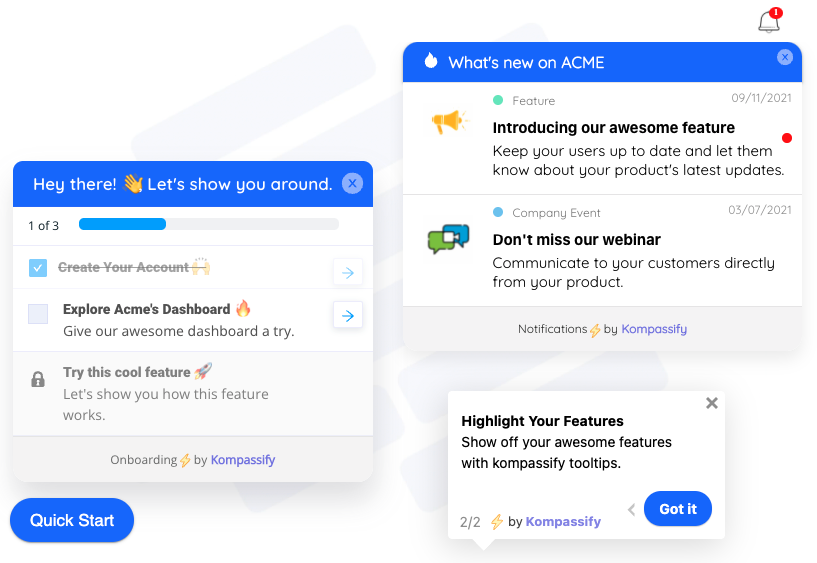
Anything a CSM explains twice is a candidate for in-app guidance.
Give your CS team reach beyond the accounts they can meet
Kompassify lets customer success and onboarding teams deliver guided onboarding, contextual help, in-app announcements and surveys to every segment, no engineering ticket, with adoption data on each one. Free up to 100 monthly active users, plans from $129/month, GDPR-compliant and EU-hosted.
Start for free →The One-Sentence Version
A customer success manager is accountable for customers reaching the outcome they bought, which makes the job proactive by definition, makes the segment the thing that decides what the work looks like, and makes anything explained twice a candidate for moving into the product.
Frequently Asked Questions
What does a customer success manager do?
A customer success manager is accountable for making sure existing customers reach the outcome they bought the software for, and for keeping them as customers as a result. In practice the week is made of five recurring jobs: landing new accounts after the sale, monitoring adoption and acting on the accounts that are drifting, running structured check-ins that connect usage back to the customer's goal, handling renewals and expansion conversations, and carrying what they learn back into product and support. The role is proactive by definition: a CSM who only responds to incoming requests is doing support with a different job title.
What is the difference between a customer success manager and an account manager?
An account manager is primarily accountable for the commercial relationship: renewal, expansion and the negotiation around them. A customer success manager is primarily accountable for the customer reaching their outcome, on the theory that revenue follows. In many companies the same person does both, which is workable as long as everyone is clear which hat is on. Where it goes wrong is when a CSM carries a quota but no ability to influence the product experience: the incentive points at the conversation while the churn is happening in the interface.
What is the difference between a customer success manager and an onboarding specialist?
An onboarding specialist owns a defined window, from signed contract to the customer being live and productive, and is measured on getting through it quickly and completely. A customer success manager owns the whole relationship after that, including renewal and expansion. Smaller companies combine the two roles; as volume grows, splitting them usually improves both, because onboarding rewards repeatable process while ongoing success rewards judgement about individual accounts.
What skills does a customer success manager need?
Four matter more than the rest. Product fluency deep enough to redesign how a customer works, not just to answer questions about features. Business literacy: understanding what the customer's organisation is trying to achieve and being able to talk about it in their terms. Prioritisation, because every CSM has more accounts than hours and the ranking decides the results. And the ability to say uncomfortable things early: telling a customer they are not using the product in a way that will get them the outcome is the single highest-value conversation in the job, and the one most often postponed until renewal.
How many accounts should a customer success manager have?
It depends entirely on the segment, and comparing the raw number across companies is meaningless. An enterprise CSM with complex, high-value accounts may carry a small handful and still be fully occupied; a mid-market CSM typically carries dozens; a tech-touch CSM may nominally own hundreds or thousands and serve most of them through in-product programmes rather than meetings. The useful question is not how many accounts, but how many hours of genuine attention each account needs and whether the ratio leaves room for proactive work at all.
What KPIs is a customer success manager measured on?
The outcome measures are usually net revenue retention, gross retention and expansion within the book of business. Those are correct to report but slow to move, so strong teams pair them with leading indicators the CSM can influence this month: activation and time to value for new accounts, adoption breadth across the book, active seat ratio, and the share of accounts with a documented, agreed success plan. Activity counts, meetings held, emails sent, tickets closed, should be visible but never used as the measure of the job, since they rise with busyness rather than with customer outcomes.