Gamified onboarding has an image problem, and it earned it. A decade of badges awarded for uploading an avatar, points that buy nothing, and leaderboards ranking colleagues against each other has left a lot of product teams convinced that gamification is a consumer gimmick with no place in serious software.
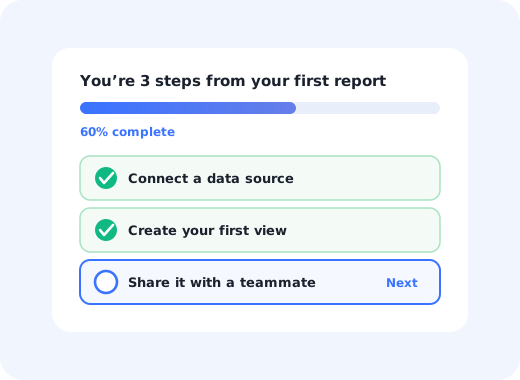
The mechanics that work are quieter than that, and they are already in most good onboarding: a progress bar, a checklist that fills up, a moment of acknowledgement when the first real task is done. Gamification in B2B is less about play than about making invisible progress visible.
This guide separates the mechanics that reliably improve completion from the ones that reliably annoy people, and explains the psychology that decides which is which.
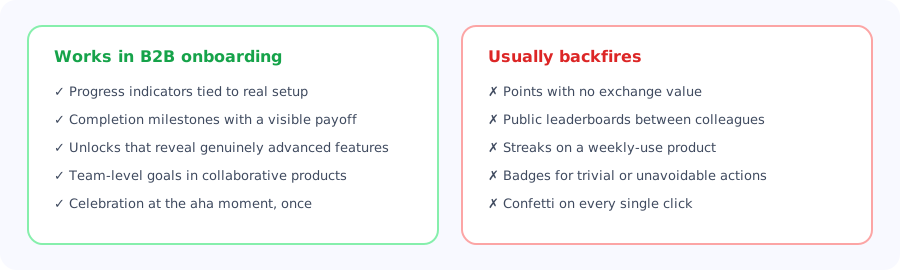
The dividing line: does the mechanic mark real progress, or manufacture a reason to keep clicking?
Key Takeaways
- Gamify progress, not activity. Rewarding steps that produce real value works; rewarding clicks does not.
- The strongest mechanic is the least game-like. A visible, honest progress indicator beats points, badges and streaks combined.
- Extrinsic rewards can crowd out intrinsic motivation. Paying attention to a badge can make the underlying task feel like a chore.
- Leaderboards belong between teams, not colleagues. Ranking coworkers publicly creates resentment far faster than motivation.
- Never gamify a weekly-rhythm product with streaks. You are punishing users for using the product exactly as intended.
- If the mechanic disappeared, would behaviour change for the better? If yes, remove it.
What onboarding gamification actually is
Onboarding gamification definition: the use of game-derived mechanics (progress indicators, milestones, unlocks, rewards and challenges) inside a user onboarding flow to make progress visible, create a sense of momentum, and increase the share of users who reach first value.
The important word is mechanics, not games. Nobody is trying to make expense reporting fun. The goal is to borrow the specific things games are unusually good at: showing you where you are, making the next step obvious, and acknowledging when something is finished.
Why it works when it works
Three psychological effects do nearly all the useful work:
- The goal-gradient effect. Motivation rises as a goal gets closer. This is why a progress bar showing 80% pulls harder than one showing 20%, and why pre-filling the first item of a checklist measurably increases completion.
- Completion bias. Unfinished sequences create a mild, persistent pull toward finishing them. A 3-of-5 checklist is genuinely harder to abandon than three unrelated suggestions.
- Immediate feedback. Setup work in SaaS is often invisible: you configure things and nothing observable happens. Acknowledgement closes that loop and tells the user their effort registered.
Notice that none of these require points, badges or competition. They require structure and feedback, which is why the most effective "gamified" onboarding often does not look gamified at all.
The mechanics that work in B2B onboarding
1. An honest progress indicator
The highest-return mechanic available, and the least decorative. It answers "how much is left?", which is the question every user in a multi-step flow is silently asking.
Two rules decide whether it helps. It must be accurate; a bar that jumps backwards when a step is added destroys trust instantly. And it should show some progress before the user does anything: a checklist that opens at 1 of 5, with account creation already ticked, converts better than one starting at zero. See the onboarding progress bar guide for the detail.
2. A checklist with a real payoff at the end
An onboarding checklist is gamification in its most useful form: a visible sequence, a completion state, and a clear next action. What separates a checklist that gets finished from one that gets dismissed is whether the items are tasks that produce something or chores that satisfy the product.
"Upload your avatar" is a chore. "Import your first 10 records" is a task with an outcome. The first one teaches users to ignore the checklist; the second one teaches them the product.
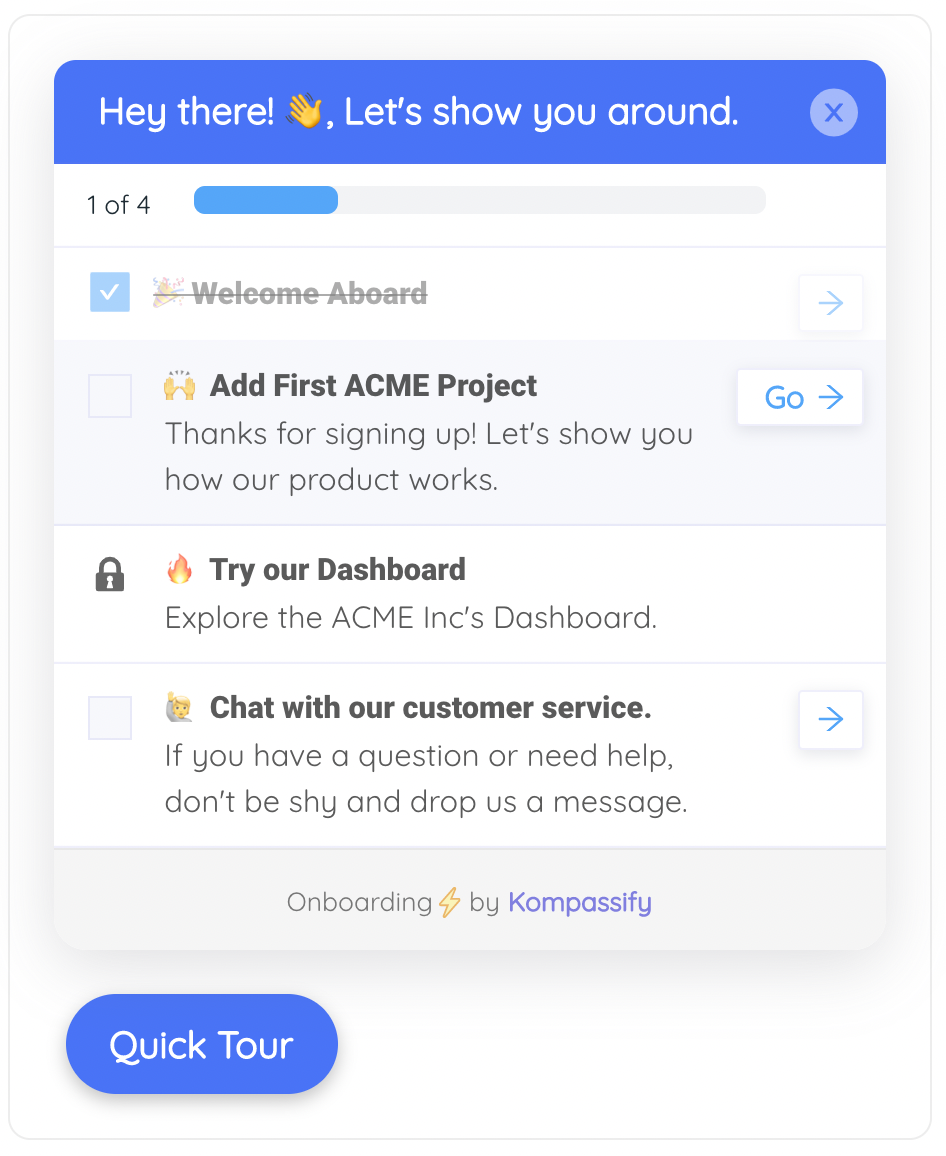
Progress bar, completed state, locked item, one clear next action: every mechanic here marks real progress.
3. Milestones with a visible unlock
Marking a genuine threshold (first report generated, first teammate invited, first automation live) works when the acknowledgement comes with something real: a new capability becoming available, a template unlocked, a limit raised. A milestone that produces only a congratulatory message is a notification wearing a costume.
4. Progressive unlocks, used honestly
Revealing advanced functionality as users master the basics reduces early overwhelm, which is a real problem in feature-dense products. The line to respect: unlock things that were genuinely not useful yet. Artificially withholding a feature the user already needs, to manufacture a sense of progression, is a dark pattern that shows up immediately in support tickets.
5. Team goals in collaborative products
"3 of 5 teammates have set up their workspace" works where individual leaderboards fail. It creates collective momentum rather than interpersonal comparison, and in multi-seat products it targets the thing that most predicts retention: how many seats are actually active. This is one of the few competitive mechanics that is safe in a workplace context.
6. One good celebration, at the aha moment
A single, well-placed moment of acknowledgement when the user first experiences real value (their first report, their first automation running) is memorable and reinforces the connection between effort and payoff. The word doing the work here is single. Celebrate the aha moment, not every click on the way to it.
The mechanics that usually backfire
The overjustification effect: when you attach an external reward to something a person was doing for its own reasons, the reward can replace the original motivation rather than adding to it. Award points for configuring a workflow and some users stop experiencing configuration as useful work and start experiencing it as unpaid labour, which is precisely what happens when the points turn out to buy nothing.
Points that cannot be exchanged for anything
A number that goes up and never converts into anything is noticed once and ignored thereafter. If you cannot say what points are for (a discount, a limit increase, a support tier, real status) do not implement points.
Public leaderboards between colleagues
Ranking employees against each other by product usage creates two reliable outcomes: the people at the bottom disengage, and the people at the top optimise for the metric rather than the work. In a workplace tool, where usage is often not voluntary, this is worse than doing nothing.
Streaks on a product used weekly
Streaks reward daily frequency. If your product is genuinely needed twice a week, a streak punishes correct usage and generates guilt for behaviour that was never a problem. Before adding a streak, check your actual usage rhythm: a product with a healthy DAU/MAU ratio of 15% is not a candidate.
Badges for trivial or unavoidable actions
A badge for verifying your email is not a reward, it is a receipt. Awarding recognition for things every user must do anyway devalues the entire system, including the badges that were meant to mean something.
Celebration inflation
Confetti on the first meaningful win is delightful. Confetti on the eleventh is noise, and it makes the twelfth feel condescending. Every celebration you add reduces the value of all the others.
How to add gamification without making it worse
Define the behaviour you want before choosing a mechanic
Check that the behaviour is actually valuable
Pick the least game-like mechanic that fits
Make it skippable and dismissible
Measure completion and what happens afterwards
1. Define the behaviour before choosing a mechanic
"Add gamification" is not a goal. "Increase the share of new accounts that connect a data source in week one from 34% to 50%" is. The mechanic follows from the behaviour; teams that pick the mechanic first end up with badges looking for something to reward.
2. Check that the behaviour is actually valuable
Before incentivising a step, confirm it correlates with retention. Compare users who did it with users who did not, matched on tenure and plan. Gamifying a step that does not predict anything is how products end up with high checklist completion and flat activation, a specific and common failure that looks like success on the dashboard.
3. Pick the least game-like mechanic that fits
Start with progress visibility. Then a checklist. Then milestones. Only reach for points, badges or competition if you can explain what they are for in one sentence that does not include the word "engagement".
4. Make it skippable and dismissible
Experienced users, returning users and users who migrated from another tool do not need the guided path. A checklist that cannot be collapsed is an obstacle, and one that reappears after dismissal is an adversary. Respect the dismissal permanently.
5. Measure completion and what happens afterwards
Track checklist completion, milestone reach and step-level drop-off, but weight the downstream numbers more heavily. The questions that matter: do users who complete the gamified flow have better week-4 retention? Do they use more features? Is the effect real, or are you simply measuring users who were always going to succeed?
Gamification do's and don'ts
✅ Do
- Show accurate, honest progress
- Pre-fill the first checklist item
- Reward outcomes, not clicks
- Attach real unlocks to milestones
- Use team goals in collaborative products
- Celebrate the aha moment once
- Let users dismiss it for good
- Validate that the rewarded step predicts retention
❌ Don't
- Award points that buy nothing
- Rank colleagues publicly
- Add streaks to a weekly-use product
- Badge unavoidable actions
- Withhold features users already need
- Celebrate every interaction
- Make the checklist impossible to close
- Report completion as if it were activation
The test worth applying to every mechanic: if you removed it tomorrow, would users be worse off, or just less nudged? A progress bar removed leaves users genuinely disoriented. A badge removed leaves nothing missing. Ship the first kind.
Building it with Kompassify
The mechanics that work in B2B onboarding (progress, checklists, milestones, well-timed acknowledgement) are exactly the ones you can build and change without engineering work.
- Checklists with real progress via onboarding checklists that persist across sessions and track genuine completion.
- A visible progress bar so users always know how far they are from a working setup.
- Milestone moments triggered on real events with a tour of the capability they just unlocked.
- Segment-aware flows so power users and migrating teams are not forced down the beginner path.
- Honest measurement with product analytics: completion rates next to week-4 retention, not instead of it.
Kompassify is a no-code digital adoption platform for SaaS teams. Free up to 100 monthly active users, paid plans from $129/month, GDPR-compliant with EU hosting.
Make onboarding progress visible
Build a checklist, a progress indicator and a milestone moment that mark real value, and measure whether they change retention.
Start for Free →Frequently Asked Questions
What is onboarding gamification?
Onboarding gamification is the use of game-derived mechanics such as progress indicators, milestones, unlocks and rewards inside a user onboarding flow, in order to make progress visible, create momentum, and increase the share of users who reach first value. The word that matters is mechanics rather than games: the goal is not to make software fun but to borrow the things games do well, namely showing where you are and acknowledging what is finished.
Does gamification actually work in B2B software?
The structural mechanics do, and the competitive ones usually do not. Progress indicators, checklists with real outcomes, and milestone unlocks reliably improve onboarding completion because they exploit the goal-gradient effect and completion bias. Points, badges and public leaderboards tend to fail in workplace tools because usage is often not voluntary and colleagues resent being ranked against each other.
Which gamification mechanics work best for onboarding?
In rough order of return: an honest progress indicator, an onboarding checklist whose items produce real outcomes rather than chores, milestones that unlock something genuinely useful, progressive disclosure of advanced features, team-level goals in collaborative products, and a single celebration at the aha moment. Notice that none of these require points or competition.
Why do badges and points often fail?
Because of the overjustification effect: attaching an external reward to something a person was doing for its own reasons can replace the original motivation instead of adding to it. Points that cannot be exchanged for anything are noticed once and ignored thereafter, and badges awarded for unavoidable actions such as verifying an email devalue the whole system, including the recognition that was meant to mean something.
Should I add streaks to my product?
Only if your product is genuinely used daily. Streaks reward daily frequency, so on a product that is correctly used twice a week they punish appropriate behaviour and generate guilt for something that was never a problem. Check your actual usage rhythm first: a product with a healthy DAU/MAU ratio around 15% is a weekly-rhythm product and is not a candidate for streaks.
How do I measure whether onboarding gamification is working?
Track completion and drop-off for the gamified flow, but weight the downstream metrics more heavily. The questions that matter are whether users who complete the flow have better week-four retention and use more features, and whether the effect is real or you are simply measuring users who were always going to succeed. High checklist completion with flat activation is a common failure that looks like success on a dashboard.
How do I avoid annoying experienced users?
Make every gamified element skippable and dismissible, and respect the dismissal permanently. Segment your flows so power users, returning users and teams migrating from another tool are not forced down the beginner path. A checklist that cannot be collapsed is an obstacle, and one that reappears after being dismissed reads as adversarial.
What is the simplest test for whether a mechanic is worth keeping?
Ask whether removing it tomorrow would leave users worse off or merely less nudged. Removing a progress indicator leaves people genuinely disoriented in a multi-step flow, so it earns its place. Removing a badge that rewards a trivial action leaves nothing missing. Ship the first kind and delete the second.