Ask someone about their worst first day and you will get a specific story: nobody knew they were starting, the laptop had not arrived, they sat in a meeting room reading a handbook until lunch. Ask about their best one and the story is just as specific: someone was waiting for them, the accounts worked, and by the afternoon they had done something small that mattered.
The difference between those two days is almost never budget. It is whether anybody wrote down who does what, and by when.
Employee onboarding is that written-down process: taking a person from accepted offer to genuinely productive team member. This guide covers the four dimensions a programme has to cover, the preboarding period that decides how day one feels, a 30-60-90 structure, what remote hiring changes, a checklist with owners attached, the internal-tools gap that nobody in the org chart owns, and the handful of metrics worth reporting.
Key Takeaways
- Onboarding is four jobs, not one: compliance, clarification, culture and connection. Most programmes do the first well and the rest by accident.
- Preboarding is where the tedious work belongs, so day one can be about people rather than forms.
- Run ninety days in three phases, each ending in something the new hire actually delivered.
- HR owns the process; the manager owns whether it works. Give managers their own short, measured list.
- Remote onboarding must schedule what used to happen incidentally. Nothing is absorbed by osmosis over a video call.
- The internal-tools gap is unowned. New hires arrive long after the rollout training and are expected to just know.
What Is Employee Onboarding?
Employee onboarding: definition
Employee onboarding is the structured process of taking someone from accepted offer to fully productive, contributing member of a team. It covers the legal and administrative setup, the clarification of what the job actually is, the transmission of how things really work here, and the relationships the person needs in order to get anything done.
Three things share this word. This guide is about bringing a new hire into an organisation. Getting an entire workforce onto a new HR system is HR software onboarding; teaching existing staff to use a newly deployed tool is covered in training employees on new software and the software rollout guide. They intersect in one place, the section on internal tools below, and confusing them is how organisations end up with three unconnected onboarding programmes.
The Four Dimensions of Employee Onboarding
A useful way to audit any programme is to sort what it contains into four buckets. Almost every organisation is strong on the first and improvises the rest, which is exactly backwards, because the first is the one that fails loudly and gets fixed, while the others fail silently for months.
Compliance
Contract, policies, mandatory training, equipment, accounts, access. Necessary, unglamorous, and the only part with a legal deadline. Belongs almost entirely in preboarding.
Clarification
What the job is, what good looks like, what is expected by when, and who decides. The most frequently skipped dimension and the one most strongly linked to a new hire leaving early.
Culture
How decisions are really made, what gets escalated, what "urgent" means here, how people disagree. Written values are not this. Explaining the unwritten rules is.
Connection
The specific people this person needs in order to do their job, and one person they can ask a stupid question without cost. Introductions to forty people achieve none of this.
A fast audit: take your current onboarding plan and label each item with one of the four. If more than half the items are compliance, you have an induction process, not an onboarding programme, and the gap will show up as confused, under-supported hires somewhere around week three.
Preboarding: Everything Before Day One
The gap between accepting an offer and starting is typically several weeks and is usually silent. The new hire is still working somewhere else, still in daily contact with colleagues who like them, and still, whatever they said in the acceptance email, capable of changing their mind. Silence from the new employer during this period reads as indifference.
Preboarding has two jobs, and they are both worth doing properly:
1. Move the administration out of day one
Contract, bank details, emergency contacts, equipment choices, policy acknowledgements. All of it can be done in advance, and every form completed before the start date is thirty minutes of day one returned to something that actually matters. If your HR system supports self-service before the start date, use it; if the paperwork is still landing on day one, that is a process decision rather than a constraint.
2. Reduce the anxiety of not knowing what happens
Send the first-week agenda. Say what time to arrive or which link to click, who will meet them, what to bring, whether lunch is a thing. Name their buddy and let that person send a short message. This costs almost nothing and it is the single most reliable way to make day one feel organised, because the new hire arrives already knowing the shape of it.
The equipment deadline deserves a specific mention: order it the week the offer is accepted, not the week before the start date. A laptop arriving on day three is the most common preventable failure in employee onboarding, and it is entirely a procurement-lead-time problem.
The 30-60-90 Structure
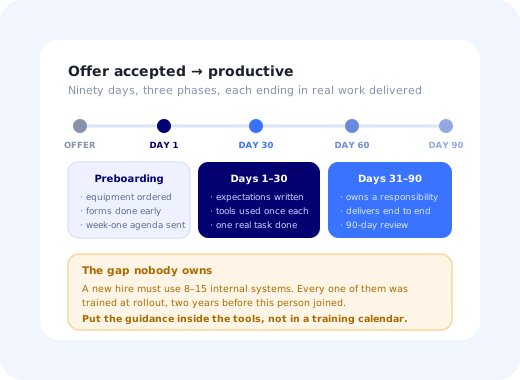
Ninety days, three phases, each ending in something the new hire actually delivered. The point of the structure is not the calendar; it is that each phase has an explicit goal, so both the hire and the manager can tell whether it is going well.
Learn and deliver something small
- Role expectations written down and agreed
- Core tools set up and used once each
- Introductions to the ten people who matter
- One small real task, completed and reviewed
- Weekly manager check-in, no exceptions
Work with less supervision
- Owns a recurring responsibility
- Contributes in meetings without prompting
- Knows who to ask, without asking the manager first
- First feedback conversation, both directions
- Remaining knowledge gaps named explicitly
Deliver end to end
- Owns something visible outside the team
- Onboards the next person into one thing
- Ninety-day review against the written expectations
- Agreed goals for the next quarter
- Structured feedback on the onboarding itself
The most valuable single item in that grid is "role expectations written down and agreed" in the first thirty days. It is the cheapest item and the one most often skipped, and its absence is what produces the classic month-three conversation in which a manager and a new hire discover they have had different jobs in mind the whole time.
A checklist with a named owner per line is the difference between a programme and a set of good intentions.
The Employee Onboarding Checklist
Organise it by phase, not by department, and give every line an owner. Unowned lines are the ones that fail, and they fail invisibly because everyone assumes someone else did them.
| Phase | Item | Owner |
|---|---|---|
| Preboarding | Contract signed and filed | HR |
| Equipment ordered (week of acceptance) | IT | |
| Accounts and access provisioned | IT | |
| First-week agenda sent to the hire | Manager | |
| Buddy assigned and briefed | Manager | |
| Day one | Someone waiting, in person or on the call | Manager |
| Access verified: every tool opened once | Hire + IT | |
| Team introductions (people, not org chart) | Buddy | |
| One small real task, completed | Manager | |
| Week one | Role expectations written and agreed | Manager |
| Core internal tools used once each | Hire | |
| Mandatory compliance training scheduled | HR | |
| Introductions beyond the immediate team | Buddy | |
| 30 / 60 / 90 | Written check-in at each milestone | Manager |
| "What is still unclear?" asked explicitly | Manager | |
| Feedback collected on onboarding itself | HR |
Notice how many lines sit with the manager. That is the real finding of most onboarding audits: HR owns the process, but the items that determine how week two feels belong to a busy person who has never been given a list. Giving managers a short, specific, time-boxed checklist, and measuring its completion, changes more than any amount of programme redesign.
Remote and Hybrid Onboarding
Remote onboarding is not harder because of the technology. It is harder because everything that used to happen incidentally now has to be deliberately scheduled, and nobody has time budgeted for scheduling it.
- Equipment arrives before day one, verified Not "shipped": arrived, and confirmed by the hire. A remote first day with no laptop is unrecoverable in a way an office first day is not.
- Schedule the informal The coffee conversations that would have happened by accident must appear in a calendar. Short, one-to-one, no agenda, six of them in the first fortnight.
- Write down what was absorbed by osmosis Which channel is for what, how decisions get made, what response time is normal, when it is fine to be offline. Remote hires cannot infer any of this.
- Make asking structurally easy A named buddy, an explicit "no question is too basic for the first month", and a manager checking in more often than feels necessary for three weeks.
- Record the repeatable parts once The systems walkthrough, the product overview, the how-we-work session. Live for the parts that need a conversation; recorded for the parts that do not.
The Internal-Tools Gap Nobody Owns
Here is a problem almost every organisation has and almost none has assigned to anyone. A new hire arrives and is expected to use eight to fifteen internal systems: HR, expenses, ticketing, CRM, project tracking, the internal wiki, whatever industry-specific tool the job needs. Every one of those systems had a training programme, at rollout, two years before this person joined.
So what actually happens is: a colleague shows them, badly, from memory. Or they figure it out from the interface and quietly form a wrong mental model that surfaces six months later as a data problem. This is the joint between employee onboarding and digital adoption, and it is where HR assumes IT has it covered and IT assumes HR does.
The fix is structural, not procedural: put the guidance inside the tools rather than in a training calendar. A short walkthrough that triggers on a person's first visit to each system, a setup checklist for the once-only tasks, and permanent tooltips on the fields people get wrong. Built once, it serves every hire who joins afterwards, including the ones who join in three years, when everyone who ran the original training has left.
This also fixes the measurement gap. "Completed onboarding" usually means someone ticked a box in an HR system; tool-level guidance produces an actual signal: this person opened the expenses system, followed the walkthrough and submitted a claim successfully, which is a far better answer to the question of whether a new hire is set up to work.
Employee Onboarding Metrics
| Metric | How to define it | What it tells you |
|---|---|---|
| Time to productivity | Days to a named first deliverable, defined per role | The headline number, but only if the deliverable is concrete |
| 90-day and 12-month retention | New hires still present at each mark | Early departures are almost always an onboarding or expectation failure |
| Day-30 new-hire sentiment | A short survey at thirty days, not on day one | Day-one answers are politeness; day-thirty answers are information |
| Checklist completion by owner | Completion rate split by HR, IT, manager and buddy | Exactly where the process quietly fails |
| Tool-adoption coverage | Core systems each new hire has actually used once | Whether the hire can do the job, not just attend it |
Ask the day-thirty question well. "How was your onboarding?" produces nothing; "what is still unclear to you about your role?" and "what did you have to figure out on your own that should have been explained?" produce an edit list. A two-question in-app survey delivered inside a system the hire already uses gets far better response rates than an email from HR.
Employee Onboarding: Do vs. Don't
✅ Do
- Order equipment the week the offer is accepted
- Move every form you can into preboarding
- Send the first-week agenda before the first week
- Write role expectations down within thirty days
- Give managers their own short, measured checklist
- Assign a buddy who is briefed on what that means
- Schedule the informal conversations for remote hires
- Put tool guidance inside the tools, permanently
❌ Don't
- Treat day-one induction as the whole programme
- Fill day one with paperwork
- Introduce forty people and call it connection
- Leave expectations verbal and assumed
- Assume the manager knows what to do
- Survey new hires on day one and believe the answers
- Expect new joiners to absorb tool knowledge from colleagues
- Measure onboarding by checkbox completion alone
Closing the Internal-Tools Gap Without Engineering Time
The people parts of onboarding need people. The systems parts do not, and they are the parts that currently depend on a colleague being free to show someone. With Kompassify an HR operations or enablement owner can build guidance directly into the internal tools:
- A first-visit walkthrough in each system Triggered the first time a new joiner opens the expenses tool, the ticketing system or the intranet, whenever they join, not when the rollout happened.
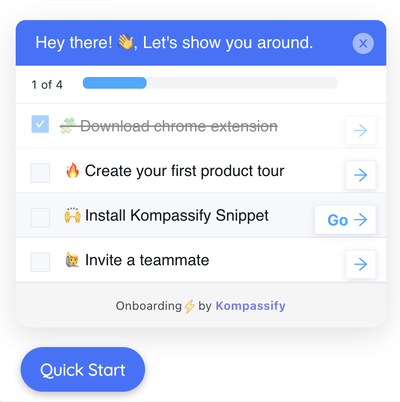
- A new-starter checklist inside the tools The once-only setup tasks in a persistent checklist that survives across the first fortnight and shows what is left.
- Permanent tooltips on the confusing fields Cost centre, project code, absence type, approval routing: the four fields that generate most internal support requests in most organisations.
- Process-change announcements where people work When the expenses policy changes, an in-app announcement reaches the person at the moment they are filing one.
- Real tool-readiness data Analytics showing which systems a new hire has actually used, a far better onboarding signal than a completed checkbox.
Kompassify is no-code, GDPR compliant and EU-hosted, free for under 100 monthly active users, with paid plans from $129/month.
Make Every New Hire's First Week Work
Put walkthroughs, checklists and field-level help inside your internal tools, so a new joiner in March gets the same guidance as one who arrived at launch.
Start FreeFrequently Asked Questions
What is employee onboarding?
Employee onboarding is the structured process of taking someone from accepted offer to fully productive, contributing member of a team. It covers four dimensions at once: compliance (contracts, policies, equipment, access), clarification (what the job actually is and what good looks like), culture (how decisions are really made here) and connection (the people this person needs to know). It is not a first-day induction session. A well-run programme runs from the moment the offer is signed until somewhere around the ninety-day mark.
How long should employee onboarding last?
Plan for ninety days, structured as three distinct phases rather than one long induction. The first thirty days are about orientation and a first small delivery; days thirty to sixty about working with reduced supervision; days sixty to ninety about owning something end to end. Roles with heavy regulatory or technical depth may run longer, and the honest test is not the calendar but whether the new hire has completed a piece of real work that mattered without someone standing behind them.
What is preboarding and why does it matter?
Preboarding is everything between offer acceptance and the first day: paperwork, equipment ordering, accounts and access, a welcome message, and telling the person what will actually happen on day one. It matters because it is the period in which a new hire is most likely to reconsider: they have accepted a job, they are still in touch with their old colleagues, and silence from the new employer reads as indifference. It is also where the tedious administration belongs, so that day one can be about people rather than forms.
What should be on an employee onboarding checklist?
Group it by phase, not by department. Before day one: contract signed, equipment shipped, accounts created, first-week agenda sent, buddy assigned. Day one: welcome, workspace and access verified, team introductions, one small real task. Week one: role expectations documented, core tools set up and actually used once each, mandatory compliance training scheduled. Days thirty, sixty and ninety: a written check-in each, with an explicit question about what is still unclear. Assign every line to a named owner: unowned items are the ones that silently fail.
How is remote employee onboarding different?
Everything that happened incidentally now has to be scheduled. A remote hire does not overhear how the team talks, cannot see who looks approachable, and will not casually ask the question they would have asked leaning over a desk. So: send equipment early enough to arrive before day one, schedule the informal introductions explicitly, write down what is normally absorbed by osmosis, and make asking questions structurally easy: a named buddy, an open channel, and a manager who checks in more often than feels necessary for the first three weeks.
Who owns employee onboarding?
HR owns the process and the compliance layer; the hiring manager owns whether it works. That split is the source of most disappointing onboarding programmes, because the parts that determine how a new hire feels in week two, clear expectations, a real first task, introductions to the right people, sit with a manager who is busy and has no checklist. The practical fix is to give managers a short, specific, time-boxed list of their own, and to measure completion of it.
What metrics should you track for employee onboarding?
Five are enough: time to productivity, defined per role as a concrete first deliverable rather than a feeling; ninety-day and twelve-month retention of new hires; new-hire satisfaction measured at day thirty rather than day one, when the answer is still politeness; onboarding checklist completion by owner, which exposes where the process quietly fails; and manager confidence at ninety days. Add tool-adoption coverage if a meaningful part of the role depends on internal software, because a new hire who cannot use the systems is not productive whatever the calendar says.
How do you onboard new hires onto internal software?
Not with a launch-week training session, because most new hires arrive long after any rollout training happened. The approach that scales is guidance inside each tool: a short walkthrough that appears on a person's first visit to the system, checklists for the setup tasks that must be done once, and tooltips on the fields people get wrong. With a no-code platform like Kompassify, an enablement or HR operations owner can build that layer on top of the internal tools without engineering work and keep it current as processes change. Kompassify is GDPR compliant and EU-hosted, free for under 100 monthly active users, with paid plans from $129/month.