Every digital transformation programme has a moment that decides it, and it is almost never the moment anyone plans for. It is not the vendor selection, or the migration weekend, or the launch email. It is an ordinary Tuesday three weeks after go-live, when someone who has a job to finish decides whether to do it in the new system or in the spreadsheet that still works.
Enough people make that decision the same way and the programme quietly becomes a very expensive licence renewal. The technology was delivered. The transformation was not.
This guide covers what digital transformation actually means and how it differs from the two terms it gets confused with, the four pillars, the five stages of a programme, the specific place value leaks, an eight-step plan, and how to measure progress early enough to act on it.
Key Takeaways
- Transformation means the work changes. Putting the old process on a screen is digitalisation, not transformation.
- Four pillars: technology, process, data, people. Programmes over-resource the first and under-resource the fourth, then wonder why nothing changed.
- The stall point is predictable. Between deployment and habit, where a licence exists and a behaviour does not.
- Training events do not create habits. Guidance available at the moment of the task does.
- Adoption is the leading indicator. It moves months before the business case does. Measure it or find out late.
- Sequence beats scope. One department transformed and proven beats a five-year plan that lands nowhere.
What Is Digital Transformation?
Digital transformation: definition
Digital transformation is the process of changing how an organisation operates and delivers value by rebuilding its processes around digital technology, rather than adding software to the way things are already done. The distinguishing feature is that the work itself changes. Installing a system so a team can carry on doing exactly what they did before, only on a screen, is automation. Redesigning the process because the technology makes a different approach possible is transformation. That is why it is an organisational programme rather than an IT project, and why an IT-owned transformation is a common early warning sign.
The test is simple and uncomfortable: after the programme, does anyone's job look different? If the same steps happen in the same order with the same handoffs, and the only change is where the data is stored, the organisation has bought efficiency, which is valuable, but is not what the business case was written for.
Digitisation vs Digitalisation vs Digital Transformation
These three words are used interchangeably and it causes real damage, because each one implies a completely different budget, timeline and set of risks.
Most "transformation" programmes are digitalisation with a transformation budget. That mismatch is usually visible in the plan before it is visible in the results.
The Four Pillars
Frameworks differ in wording but converge on four areas. The useful exercise is not to admire the model but to ask honestly how the programme's effort and budget are distributed across them.
Platforms, integrations, infrastructure, security. The pillar everyone plans well because it has vendors, deadlines and people whose job it obviously is.
How the work is actually redesigned. The pillar most often skipped: the new system is configured to reproduce the old process, and the opportunity is spent on faithful reimplementation.
Whether information is accessible, consistent and trusted enough to decide on. Untrusted data means people keep their private spreadsheet, and the private spreadsheet is where transformations go to die.
Skills, incentives, and daily habits. The pillar that determines whether the other three produce anything, and the one usually represented in the plan by a single training workshop.
The Five Stages of a Transformation Programme
Programmes move through a recognisable sequence. Knowing where you are matters because the risks are completely different at each stage, and because the transition between stage four and stage five is where value is won or lost.
1. Case and scope
The problem is named, the outcome is quantified, and the scope is drawn. The critical decision is narrowness: one process, one group, one measurable result. Programmes that begin with "transform the organisation" produce a governance structure rather than a change.
2. Process redesign
Before configuring anything, map how the work is done today, including the informal steps nobody documented, and design how it should be done given what the technology allows. Skipping this stage is what converts a transformation into digitalisation, permanently, because the configuration decisions get made by whoever is implementing and they default to "like it was before".
3. Build and migrate
Configuration, integration, data migration, testing. The best-run stage in most programmes, and the one that consumes the attention. The risk here is not failure but success: a stage that goes well creates confidence that the hard part is over.
4. Rollout
Go-live, communications, training, hypercare. This is where the plan usually ends. The structure and sequencing of this stage is a discipline in itself; our software rollout plan guide covers the wave design, and change management for software adoption covers the human side, including the models, such as ADKAR and Kotter's eight steps, that give it structure.
5. Adoption and embedding
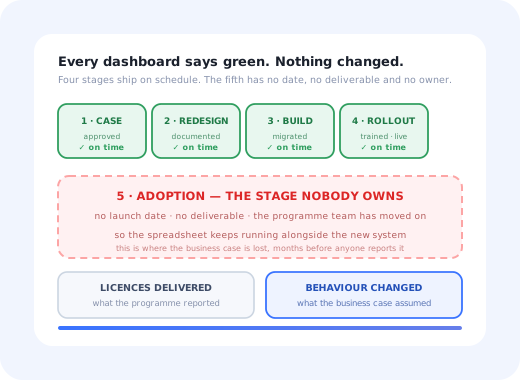
The stage where the new way becomes the normal way, or does not. It has no launch date, no obvious owner once the programme team disbands, and no deliverable, which is precisely why it is the stage that gets cut when the timeline compresses.
Where Programmes Actually Stall
The gap sits between stage four and stage five: everything has been deployed, and the behaviour has not changed. It is uniquely hard to see, because every dashboard the programme built says green. Licences: purchased. Migration: complete. Training: delivered. Go-live: on schedule.
The tell is the shadow process. Somewhere there is a spreadsheet, a chat thread or a personal workaround doing the real work while the new system holds the record afterwards. When you find one, do not ban it. Ask what it does that the new process does not: the answer is almost always a gap in stage two that surfaced too late to fix.
There are four reliable causes, and none of them are about the software:
An owner accountable for delivering a system, not for changing how a department works. The system arrives; nobody was accountable for the rest.
The value case quietly assumes everyone uses the new process from day one. Nobody budgeted for the work of making that true.
A workshop two weeks before go-live, on a system with test data, for a task people will next perform a month later under time pressure.
The programme reported on delivery milestones and then closed. Nobody checked, in month three, whether the new process was being followed.
The fourth cause is the most fixable and the most commonly missed. A programme that measures adoption weekly from go-live can intervene while it still has a team; one that measures outcomes annually finds out when the business case is already lost. This is the specific problem digital adoption exists to solve, and it deserves a named owner in the plan.
An Eight-Step Plan
- Pick one process, not the organisation
- Write the outcome as a number
- Map the work as it is really done
- Redesign before you configure
- Name an owner for behaviour, not just for delivery
- Put the training inside the tool
- Measure adoption from week one
- Close the loop and pick the next process
1. Pick one process, not the organisation
Choose a process that is painful, bounded and measurable, with a group of people who can be identified by name. The point is not modesty; it is that a complete change with a proven result creates far more organisational appetite than a comprehensive plan with a status report.
2. Write the outcome as a number
"Improve efficiency" cannot be verified, so it cannot fail, so nobody will act when it does. Cycle time from four days to one. Rework below a stated threshold. Hours released per week. Whatever it is, the number must be measurable before the programme starts so there is a baseline.
3. Map the work as it is really done
Sit with the people doing it. The documented process and the real one differ everywhere, and the difference is where the workarounds you are about to recreate live. Every undocumented step is either a problem to eliminate or a requirement nobody told you about.
4. Redesign before you configure
Decide what the process should be, on paper, before anyone opens the admin console. Once configuration starts, the path of least resistance is always to reproduce the old process, and that decision is very hard to reverse later.
5. Name an owner for behaviour, not just for delivery
Someone must be accountable for "the new process is how work gets done here", a role that outlives go-live and has authority to change the process when it collides with reality. Without it, stage five belongs to nobody. The people dimension of this is the same problem as employee onboarding: a system nobody owns produces a first week nobody planned.
6. Put the training inside the tool
This is the highest-return change available to most programmes. A workshop delivers information weeks before it is needed; guidance inside the software delivers it at the moment of the task. A short walkthrough the first time someone reaches a new screen, a checklist for the new process, a tooltip on the field that generates every support call: these outperform training events because they arrive when the person is actually trying to do the thing. Our guide to training employees on new software compares the methods directly.
7. Measure adoption from week one
Not at the quarterly steering committee: weekly, by team, from the day of go-live. Active users against licences, share of transactions completed in the new system, and the volume of activity still happening in the old one. Falling usage in one team in week three is a solvable problem; the same signal discovered in month nine is a failed programme.
8. Close the loop and pick the next process
Publish the result against the number from step two, including what did not work. Then choose the next process. Transformation that compounds through a sequence of proven changes is more likely to survive a change of sponsor than a single multi-year programme, which usually does not.
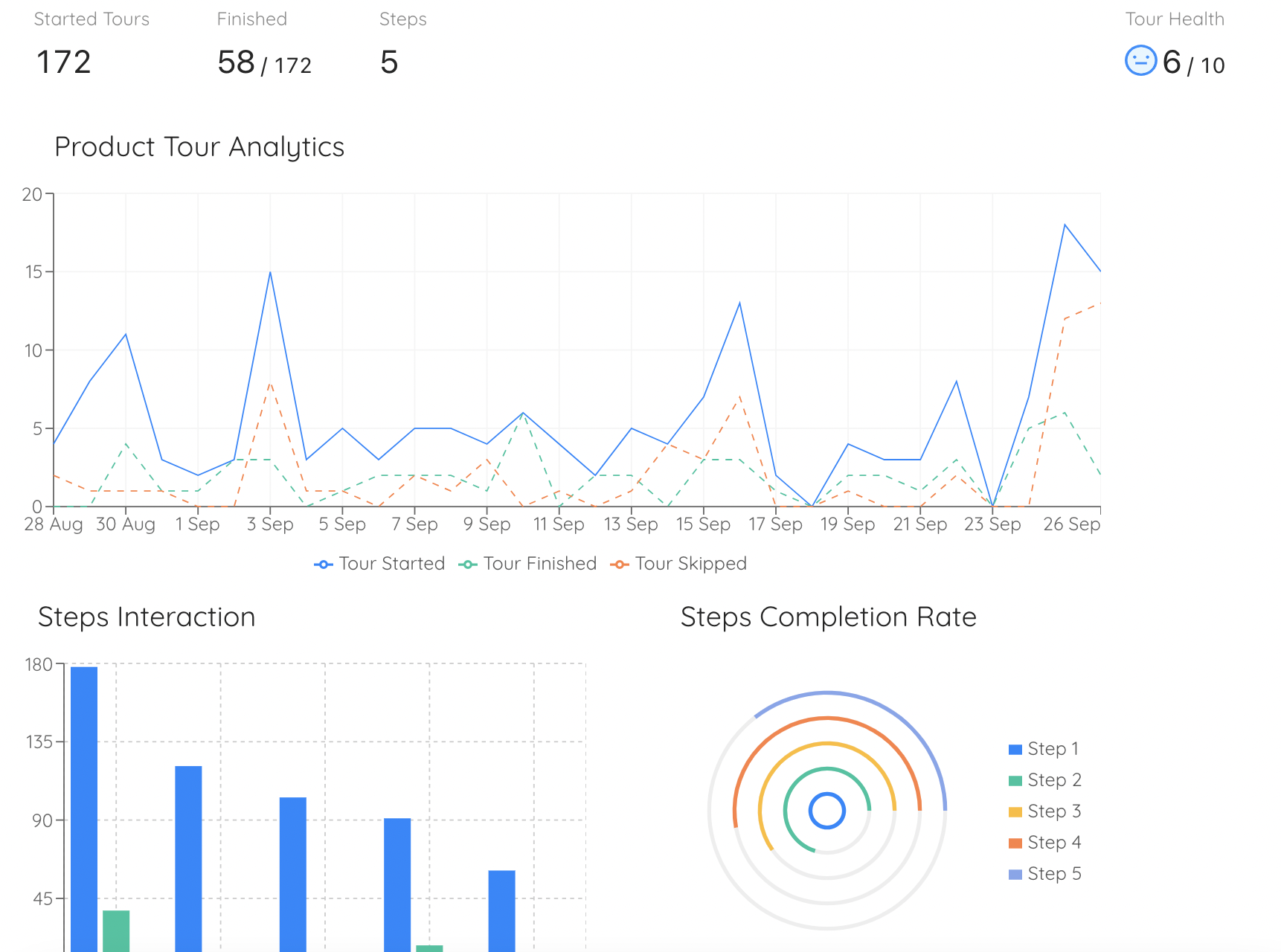
Step seven, made concrete. Per-step completion data shows exactly where the new process loses people, which is a fixable problem for as long as the programme team still exists.
Measuring a Digital Transformation
Three layers, in the order they move. Programmes that report only the third layer discover problems roughly a year after they could have been fixed.
| Layer | Measures | Answers |
|---|---|---|
| Adoption moves first |
Active users vs licences · share of the target group using the new process · residual activity in the old system | Are people using it at all? |
| Proficiency moves second |
Task completion time · error and rework rate · support tickets per hundred users · share of tasks completed without help | Are they using it well? |
| Outcome moves last |
Cycle time · cost per transaction · capacity released · the number from step two | Did the business case land? |
One caveat worth stating: logins are not adoption. A person who signs in daily and completes the process outside the system is counted as a success by a login metric and is in fact the exact failure mode described above. Measure completion of the new process, not presence.
Digital Transformation: Do vs. Don't
Do
- Scope one process with one measurable outcome
- Redesign the work before configuring the tool
- Give behaviour change a named owner past go-live
- Deliver guidance in the tool, at the moment of the task
- Track adoption weekly from day one
- Investigate shadow processes instead of banning them
Don't
- Run it as an IT project with an IT owner
- Reproduce the old process in the new system
- Treat a training workshop as an adoption plan
- Assume adoption inside the business case
- Count logins and call it usage
- Commit to a five-year plan with one review a year
Closing the Adoption Gap Without Engineering Time
The reason step six and step seven get skipped is rarely disagreement; it is that both normally require changes to software the organisation did not build and cannot modify. So guidance ends up as a PDF on an intranet, and adoption measurement ends up as a licence report.
Kompassify sits on top of the applications people already use. Programme and change teams build walkthroughs for the new process, checklists for the first week, contextual tooltips on the fields that generate support calls, and in-app announcements when something changes: visually, without a release, targeted at the specific teams in the current rollout wave. Every guide reports who started it, who finished it and where people dropped out, which turns stage five from a hope into something with a weekly number next to it.
Turn licences into a change in how people work
Kompassify lets change, IT and enablement teams deliver in-app training, contextual help and announcements inside the software people already use, and measure adoption per team and per step. Free up to 100 monthly active users, plans from $129/month, GDPR-compliant and EU-hosted.
Start for free →The One-Sentence Version
Digital transformation is not finished when the system is live; it is finished when the new way of working is the easy way, which is why the money goes on technology and the outcome is decided by whether anyone changed what they do on an ordinary Tuesday.
Frequently Asked Questions
What is digital transformation?
Digital transformation is the process of changing how an organisation operates and delivers value by rebuilding its processes around digital technology, not simply adding software to the way things already work. The distinguishing feature is that the work itself changes. Installing a system so a team can carry on doing exactly what they did before, only on a screen, is automation. Redesigning the process because the technology makes a fundamentally different approach possible is transformation. That is also why transformation programmes are organisational projects rather than IT projects.
What is the difference between digitisation, digitalisation and digital transformation?
Digitisation converts something analogue into a digital format: scanning paper records into files. Digitalisation uses digital technology to run an existing process better, such as replacing a paper approval chain with a workflow in a system while the approval steps stay the same. Digital transformation changes the process itself, and often the operating model around it, because the technology makes a different way of working possible. The three are frequently used interchangeably, which causes real damage in planning: a digitisation budget and timeline will not deliver a transformation outcome.
Why do digital transformation programmes fail?
They rarely fail at selection or implementation. They stall at the point where people are supposed to change how they work. The software is configured, the migration completes, the training session happens, and then daily behaviour reverts to the previous method or to a spreadsheet running alongside the new system. The underlying causes are consistent: the change was scoped as a technology project with an IT owner, the value case assumed adoption rather than planning for it, training was a one-off event weeks before go-live, and nobody measured whether the new process was actually being used once the programme team moved on.
What are the pillars of digital transformation?
Four pillars appear in almost every serious framework: technology, meaning the platforms and integrations; process, meaning how the work is actually redesigned rather than merely relocated; data, meaning whether information is accessible and trustworthy enough to make decisions on; and people, meaning skills, incentives and daily habits. Programmes are usually resourced heavily on the first pillar and thinly on the fourth, which is exactly why they stall: the technology arrives on time and the behaviour never changes.
How do you measure digital transformation?
Use three layers. Adoption measures show whether people are using the new way at all: active users against licences, share of the target group completing the new process in the system, and how much of the old method is still running alongside. Proficiency measures show whether they are using it well: task completion time, error and rework rates, support tickets per hundred users. Outcome measures show whether the business case is landing: cycle time, cost per transaction, capacity released. Adoption moves first and predicts the rest, so a programme that reports only outcomes finds out too late.
How long does a digital transformation take?
There is no single answer, and treating it as one long programme is itself a risk. The better structure is a sequence of scoped changes, each with a defined process, a defined group of people and a measurable outcome, delivered in months rather than years. Multi-year programmes accumulate two specific problems: the sponsors who approved them move on, and the technology assumptions made at the start expire before delivery. Shipping a complete change to one department and proving the outcome is worth more than a plan covering everything and landing nowhere.